Alexander Dugin

Noomakhia – Beyond the West: China, Japan, Africa, and Oceania

Alexander Dugin, Noomakhia – Beyond the West: China, Japan, Africa, and Oceania

(Moscow: Academic Project, 2014)


Table of Contents: 

Introduction: A Survey of Civilizational Circles

PART I: Chinese Civilization and the Chinese Logos

Chapter 1: Ancient China

Chapter 2: The Beginnings of Chinese Philosophy

Chapter 3: The Time of Kingdoms and Empires

Chapter 4: Chinese Buddhism: The Third Religion

Chapter 5: The Middle Ages and Modernity

PART II: The Japanese Logos

Chapter 6: Ancient Japan

Chapter 7: Emperors and Samurai, Buddhism and Shinto

Chapter 8: Modern Japan

PART III: The Logos of Africa

Chapter 9: Ancient Egypt

Chapter 10: The Civilizations of North Africa

Chapter 11: The Civilization of the Kush

Chapter 12: Central and South Africa

Chapter 13: The Ancient Peoples of Africa: The Pygmies and Khoisan

PART IV: The Logos of Oceania

Chapter 14: Malay Civilization

Chapter 15: Micronesia and Polynesia

Chapter 16: Melanesia and Papuasia

Chapter 17: Great Australia

NOOMAKHIA – Beyond the West: The Indo-European Civilizations of Iran and India

Alexander Dugin, Noomakhia – Beyond the West: The Indo-European Civilizations of Iran and India 

(Moscow: Academic Project, 2014)


Table of Contents:

Introduction: The Indo-European Geosophy of Asia

PART I: The Persian Logos

Chapter 1: Ancient Iran

Chapter 2: Islamic Iran

Chapter 3: Inner Islam

Chapter 4: Modern Iran: The Continuity of Tradition

PART II: The Logos and Logoi of India

Chapter 5: Vedic Civilization

Chapter 6: The Indian Historial

Chapter 7: India in the Middle Ages

Chapter 8: Buddhism: From Hinayana to Mahayana 

Chapter 9: The Post-Middle Ages: Towards Modernity


NOOMAKHIA – The Hamites: The Civilization of the African North

Alexander Dugin, Noomakhia – The Hamites: The Civilization of the African North 

(Moscow: Academic Project, 2018)


Table of Contents: 


Introduction: Continent Africa: Horizons and Civilizations

PART I: The Logos of Egypt: The Black Lands and the Sun of the Pharaohs

Chapter 1: The First Kingdoms: Matriarchy, Pharaohs, and the Constants of the Historial

Chapter 2: The New Kingdom and the Path to Decline

Chapter 3: The Gods of Egypt: Theology, Cosmology, and Gestalts

Chapter 4: Egypt and Death

Chapter 5: Alexandria: The Capital of Great Ideas

Chapter 6: The Spiritual Traditions of Late Hellenistic Egypt

Chapter 7: Islamization and Arabization

Chapter 8: Modern Egypt: Independence and the Search for Identity

PART II: The Berber Horizon: The Pull of the Far West

Chapter 9: The Libyan Horizon: Cultures, Peoples, and Territories

Chapter 10: The Religion and Noology of White Africa

Chapter 11: The Berbers in the Islamic Era

Chapter 12: The Post-Colonial History of the Maghreb: Typologies of Berber Nationalism

PART III: Civilization of the Kush and the Ethiopian Mission

Chapter 13: The Kushite Horizon

Chapter 14: The Ancient Kingdoms of Kush, Nubia, and Meroë

Chapter 15: The Islamization of Nubia and Sudan

Chapter 16: The Ethiopian Zion: The Pearl of the Spirit

Chapter 17: Somalia: Puntland and the Black Chaos of Islamism

Chapter 18: In Search of the Kushite Logos

PART IV: The Negroes of Afro-Asia: The Culture of the Chadian Peoples

Chapter 19: Hausaland and the Chadian Languages

Chapter 20: The Historial of Hausa

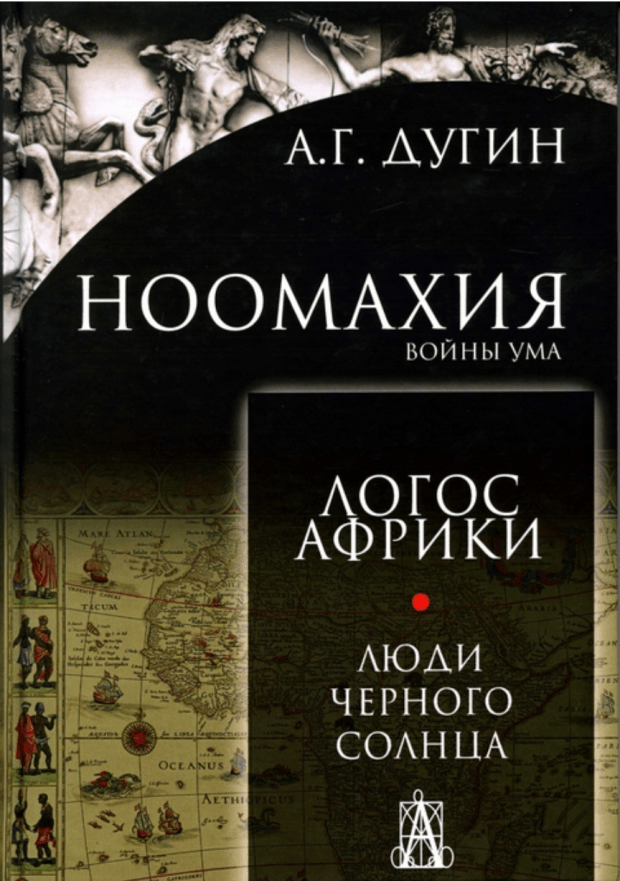
NOOMAKHIA – The Logos of Africa: The People of the Black Sun

Alexander Dugin, Noomakhia – The Logos of Africa: The People of the Black Sun

(Moscow: Academic Project, 2018)

Table of Contents:

Introduction: Black Africa

PART I: The Logos of the Nilotes: The Apotheosis of Androcracy

Chapter 1: The Nilo-Saharan Horizon

Chapter 2: The Nilotes and Androcracy

Chapter 3: The Nilo-Saharan States: The Gestalt of Adroa

PART II: West Africa: The Black Mother and Imperial Verticles

Chapter 4: The Niger-Congolese Languages and Peoples

Chapter 5: The First African Empires: The Mande Horizon

Chapter 6: The Paradigms of the Bambara and the Dogon

Chapter 7: The Atlantic Family of West Africa: The Maternal Presence

Chapter 8: The Spirit of Swamps and “Being a Negro”

Chapter 9: The Solar Pole of the Yoruba

Chapter 10: The West-African Frontier: The Kwa and the Gur

Chapter 11: The Adamawa-Ubangi Horizon: The Soul of Witchcraft

PART III: The Bantu Ecumene: The Metaphysics of Strength and the Ontology of Witchcraft

Chapter 12: The Bantu Languages and Peoples of Strength

Chapter 13: Great Zimbabwe and its Legacy

Chapter 14: The Secret of the Chwezi of Light

Chapter 15: The Civilization of the Congo: Peoples and Polities

Chapter 16: South Africa

Chapter 17: The Structure of Bantu Mythology and the Leopard-People

PART IV: The Pygmies and Khoisan: The Greatness of Little

Chapter 18: The Pygmies: The Little Dances of God

Chapter 19: The San Bushmen: The Geometrical Dreams of the Cave Hunt

Chapter 20: The Hottentots (Khoikhoi): On the Side of the Red Sky 

Conclusion: The Flaming-Face Peoples and their Logos

NOOMAKHIA – The Russian Logos II – The Russian Historial: The People and State in Search of the Subject

Alexander Dugin, Noomakhia – The Russian Logos II – The Russian Historial: The People and State in Search of the Subject

(Moscow: Academic Project, 2019)


Table of Contents: 

PART I: Russian Origins and the Creation of the Derzhava

Chapter 1: Prelude to the Russian Historial: The Ancient Slavs

Chapter 2: The East Slavic Tribes and the Establishment of the State

Chapter 3: The Varangians: The Founding of the State

Chapter 4: Kievan Rus: The Golden Age

PART II: Differentials and Fragmentations

Chapter 5: The Poles of Rus: The Russian North

Chapter 6: The Russian East: The Origins of the Great Russians

Chapter 7: The Russian West: The Path to Eminence

Chapter 8: The Sources of White Rus

Chapter 9: Russian Balance: The Third Pole that Never Became Reality

Chapter 10: Kiev and the Kiev Region in the Era of Fragmentation

Chapter 11: The Russian Federation

Chapter 12: The Types of Russian Christianity in the Pre-Mongol Era

PART III: The Mongol Invasion, the Rise of Moscow, and the Decline of the Russian West

Chapter 13: The Mongol Period: The End as a Continuation and New Beginning

Chapter 14: Vladimir Rus in the Mongol Era

Chapter 15: Western Rus, Great Russia, Little Russia, and Belorussia: The Differentials of Russian Unity

Chapter 16: Russian Hesychasm and the First Heresies

PART IV: The Muscovite Kingdom: The Third Rome, Katechon, and the Schism

Chapter 17: The New Mission of Great Russia 

Chapter 18: Ivan the Terrible: The Existential Eschatology of the First Russian Tsar

Chapter 19: The Time of Troubles and its Overcoming

Chapter 20: The Cossacks and the Birth of Ukraine

Chapter 21: The Schism: The Spiritual Tendencies of Rus in the Phase of Antagonism

Chapter 22: Moscow’s Final Accord

PART V: The Russian “Empire” and the Problem of the Antichrist: Peter and the Empresses

Chapter 23: The Discrepancy of the 18th Century

Chapter 24: The Structure of the 18th Century: The Curse of Archeomodernity

PART VI: The 19th Century: Towards Russian Identity

Chapter 25: The 19th Century Historial: The Beginning

Chapter 26: Alexander I: Political Eschatology and the Return of Katechon

Chapter 27: Russia in the “Golden Age” of Russian Culture: The Decembrists, Slavophiles, and Emancipation of the Peasantry

Chapter 28: Alexander II: Incomplete Emancipation

Chapter 29: Alexander III: Identity and Sovereignty

Chapter 30: The Late Slavophiles and Populists: The Dialectic of Archeomodernity

Chapter 31: The End of the Empire

Chapter 32: The Silver Age

PART VII: Soviet Rus

Chapter 33: The Catastrophe of the Russian Logos

Chapter 34: The Russian Church in the First Stage of Bolshevism

Chapter 35: Trotsky and Stalin: The Industrialization of Russia

Chapter 36: The Autumn of Sovietism

Chapter 37: The USSR: The Semantics of the End

PART VIII: After the End of Bolshevism

Chapter 38: The 1990s: The Catastrophe of Liberalism

Chapter 39: The 2000s: Towards an Unknown Goal (Correcting Liberalism)

Chapter 40: The Historial of the Russian Future

NOOMAKHIA – The Russian Logos – The Kingdom of Land: The Structure of Russian Identity

Alexander Dugin, Noomakhia – The Russian Logos I – The Kingdom of Land: The Structure of Russian Identity (Moscow: Academic Project, 2019)

Table of Contents: 

PART I: The Russian Horizon

Chapter 1: On the Threshold of the Russian Logos

Chapter 2: Deducing the Russian Horizon and the Contours of Unique Identity (Samobytnost’)

Chapter 3: Russian Christianity and its Historial

Chapter 4: Russia and Europe: The Noology of Modernization

Chapter 5: The Russian Structure and the Russian Historial: A Preliminary Theory

Chapter 6: Russian Eleusis: The Peasant Historial and the Mystery of Grain

PART II: The Russian Mother

Chapter 7: Foundations: The Russian Mother

Chapter 8: The Idiot and the Snake: The Russian Nocturne

Chapter 9: The Feminine Gestalts in Folk Christianity

PART III: The Russian Father

Chapter 10: The Indo-European Verticle in Old Russian Religion

Chapter 11: The Patriarchal Gestalts in Folk Christianity

PART IV: The Morphology of the Russian Structure

Chapter 12: The Russian Space: Territory or Land?

Chapter 13: State Time and Peasant Eternity

Chapter 14: The Russian Subject and the Archetypes of Russian Gender

PART V: World, Existence, Being

Chapter 15: The Superposition of the Two Russian Worlds

Chapter 16: The Russian Telos: Being-towards-Death and Being-towards-Marriage

Chapter 17: Russian Phenomenology and Russian Being

Conclusion: Russian Identity and the Dialectic of the Russian Historial

NOOMAKHIA – The Non-Slavic Horizons of Eastern Europe: The Song of the Vampire and the Voice of the Depths

Alexander Dugin, Noomakhia – Wars of the Mind – The Non-Slavic Horizons of Eastern Europe: The Song of the Vampire and the Voice of the Depths
(Moscow: Academic Project, 2018)

Table of Contents: 

Introduction: The Slavs and Non-Slavs in Eastern Europe

PART I: Great Baltica: The Lithuanian Logos and Unrealized Civilization

Chapter 1: The Proto-Balts

Chapter 2: On the Baltic Gods and Baltic People

Chapter 3: The Lithuanian Historial

Chapter 4: The Historial of Latvia

Chapter 5: Baltic Philosophy: Overcoming Subtle Chaos

PART II: Black Dacia: Mioritic Space and the Romanian Idea

Chapter 6: The Thracians and their Identity

Chapter 7: Images and Structures of Thracian Religion

Chapter 8: Thrace and Dacia: Polities and Conquests

Chapter 9: Dacia Unbowed

Chapter 10: The Gods of Dacia

Chapter 11: The Transylvanian Historial

Chapter 12: Walachia: The Orthodox Kingdom of Dracula

Chapter 13: Moldova and its Historial

Chapter 14: Romania in the 20th Century

Chapter 15: The Burning Bush of Romanian Thought

Chapter 16: The Romanian Absurd: The Dark Horizons of Decomposition

PART III: The Hungarians and the Scythian Idea

Chapter 17: The Magyars in Europe

Chapter 18: The Ancient Magyar Faith

Chapter 19: Medieval Hungary

Chapter 20: Hungary and Modernization

Chapter 21: The Hungarian Language and its Poetry

Chapter 22: In Anticipation of Hungarian Philosophy

Chapter 23: Black Hungary: In the Captivity of Melancholy

PART IV: From Illyria to Albania: Dragons and Warriors

Chapter 24: Albanian Antiquities

Chapter 25: Albanian Myths: Female and Male Dragons

Chapter 26: The Albanian Historial

Chapter 27: The Albanian Logos

Chapter 28: The Noology of the Albanian Eagle

PART V: The Jews of Eastern Europe: The Fiery Nihilism of Liberation

Chapter 29: Hypotheses on the Jewish Horizon of Eastern Europe

Chapter 30: The Spiritual Currents of Eastern European Jewry

Chapter 31: Eastern European Jews and Political Ideologies

Chapter 32: The Gestalts of Eastern European Jewry

Chapter 33: The Roma

Chapter 34: Gypsy Sacrality

Chapter 35: The Noology of Gypsy Identity

NOOMAKHIA – The Yellow Dragon: The Civilizations of the Far East

Alexander Dugin, NoomakhiaThe Yellow Dragon: The Civilizations of the Far East
(Moscow: Academic Project, 2018)

Table of Contents:

PART I: The Chinese Logos

Chapter 1: Principles for Comprehending Chinese Civilization

Chapter 2: The Chinese People and its Structures

Chapter 3: The Foundations of Chinese Metaphysics

Chapter 4: The Noology of the Ancient Chinese Tradition

Chapter 5: The Metaphysics of First Principles: The Sources of the Historial

Chapter 6: The Beginnings of Chinese Philosophy: Confucius

Chapter 7: Taoism

Chapter 8: Other Doctrines: Zou Yan, Mozi, and the Legalists

Chapter 9: The Qin Empire of the Spirit of Water

Chapter 10: The Han

Chapter 11: The Three Kingdoms

Chapter 12: The Han-Turanian Symbiosis

Chapter 13: Chinese Buddhism: The Third Religion

Chapter 14: The Song Empire: The Restoration of Unity

Chapter 15: The Yuan Dynasty: China in Greater Eurasia

Chapter 16: The Ming Dynasty: Han Restoration

Chapter 17: The Qing Dynasty: The Manchurian Mandate

Chapter 18: The White Lotus and Thalassocracy

Chapter 19: Post-Imperial China

PART II: The Korean Logos: The Peninsula of Heaven and Earth

Chapter 20: Ancient Korea

Chapter 21: Medieval Korea

Chapter 22: Korea vs. Korea

Chapter 23: Buddhism in Korea

PART III: The Japanese Logos: The Irreversibility of the Arrow

Chapter 24: The Japanese Structure

Chapter 25: Shinto: The Qualitative Transformation of the Chinese Logos

Chapter 26: The Phases of the Japanese Historial

Chapter 27: Buddhism in Japan: The First Stage

Chapter 28: The Shogun Era

Chapter 29: The Second Stage of Japanese Buddhism: The Triumph of the Zen School

Chapter 30: From Edo to Meiji: Japan and Modernization

Chapter 31: Japan in the 20th Century

Chapter 32: In Search of Japanese Identity

Chapter 33: Japanese (Post-)Modernity

PART IV: Indochina: The Space of the Nagi and the Indo-Buddhist Mandala-States

Chapter 34: The Structure and Mission of the Indochinese Horizon

Chapter 35: Vietnam

Chapter 36: Cambodia

Chapter 37: Thailand (Siam)

Chapter 38: Laos

Chapter 39: Myanmar

Chapter 40: Hmongs and Muongs (Miao and Yao)

Chapter 41: The Geosophy of Indochina

Chapter 42: The Logos and Geosophy of the Yellow Dragon

NOOMAKHIA – Oceania: The Challenge of Water

Alexander Dugin, Noomakhia – Oceania: The Challenge of Water
(Moscow: Academic Project, 2018)

Table of Contents: 

PART I: The Logos of the Great Water: The Malay Ecumene

Chapter 1: The Cultural Circles and Peoples of Oceania

Chapter 2: The Structures of the Malay Horizon

Chapter 3: The Ethnic Layers of the Malay Horizon

Chapter 4: The Sources of the Malay Historial: The Indian Factor

Chapter 5: The Polities of the Malacca Peninsula

Chapter 6: The Sacred Island of Java

Chapter 7: Sumatra

Chapter 8: The Malay Polities of the Islands and Colonies

Chapter 9: The Malay-Indian Logos

Chapter 10: The Malay Polities in the Era of Islamization

Chapter 11: Malay Islam: The Light of Man and His Enemies

Chapter 12: European Colonization and the Struggle for Independence

Chapter 13: The Modern Malay States

Chapter 14: The Malay Logos in the 21st Century

PART II: The Horizons of Oceania: The Thoughts of Water and the Rays of Androcracy

Chapter 15: The Logos of Micronesia: The Feminine Civilization of Octopuses

Chapter 16: Great Polynesia

Chapter 17: Papua: The Black Mothers and the Flying Foxes

Chapter 18: Melanesian Selenomachy: The Battle for the Moon on Malakula

PART III: Continent Australia: Dreams of Heartland

Chapter 19: Great Australia

Chapter 20: Snakes, Water Spirits, and Matriarchy

Chapter 21: The Spiritual Wealth of Oceania and Conceptual Continents


“In this volume of the epic of Noomakhia: Wars of the Mind, Alexander Dugin studies the oceanic expanses of the islands of Oceania and the Malay ecumene, a zone which might be called the ‘space of the Great Water’, that of ‘Noological’ or ‘Geosophical Oceania.’ Close to this understanding, according to the author, is the concept of ‘Austronesia’, denoting the linguistic unity of the peoples speaking the language family of the same name and inhabiting the islands and archipelagos stretching from Madagascar to Polynesia. As distinct entities belong to this cultural horizon, this book also examines the two insular poles of the Papuans and the Australian Aborigines. All the territories of Austronesia are treated as bearing enormous importance from the standpoint of preserving the inviolability of these unique, ancient cultures, which have preserved keys to the primordial root layers of humanity.”

NOOMAKHIA – The Semites: Monotheism of the Moon and the Gestalt of Ba’al

Alexander Dugin, Noomakhia – The Semites: Monotheism of the Moon and the Gestalt of Ba’al
(Moscow: Academic Project, 2017)


Table of Contents: 

Foreword: The Poles of the Semitic World

PART I: The East Semites: The Mesopotamian Logos

Chapter 1: Great Sumer and its Legacy

Chapter 2: The Gods of Mesopotamia 

Chapter 3: The Structure of the Mesopotamian Logos: Noological Proportions

PART II: The West Semites: Ba’al, the Bloody God of Thunder

Chapter 4: West-Semitic Antiquity

Chapter 5: The Religion of the West Semites: The Paradigm of Ba’al

Chapter 6: The Metaphysics of the Phoenicians 

Chapter 7: Aramaic Culture

PART III: The Jews and Civilization

Chapter 8: The Ancient Jews: The Historial of Monotheism

Chapter 9: From Adam to Babylon

Chapter 10: The Patriarchs

Chapter 11: The Return to Canaan: The Paradoxes of Land

Chapter 12: The Canaanite Logos and the Paradoxes of Negative Identity

Chapter 13: Israel as a Kingdom

Chapter 14: The Time of the Prophets and the Iranian Pivot of the Jewish Historial

Chapter 15: Late Judaism in the Empire of Light

Chapter 16: Christianity and Judaism

Chapter 17: The Civilization of Exile 

Chapter 18: Awakening Ba’al: Pseudo-Messiahs and Holy Apostasy

Chapter 19: Judaism and Modernity

Chapter 20: A Noological Analysis of Jewish Identity

PART IV: The Arab Logos: The Secret of the Moon

Chapter 21: Arabian Identity

Chapter 22: Arab Polytheism

Chapter 23: On the Eve of Islam

Chapter 24: The Beginning of Islam

Chapter 25: The Historico-Theological Phases of Islamic Civilization

Chapter 26: Abbasid Islam: The Universalization of Discourse

Chapter 27: Arab Alchemy

Chapter 28: Sufism and its Logos: The Solar Monotheism of Ibn Arabi 

Chapter 29: Post-Arab Islam

Chapter 30: Ibn Khaldun: The Sociology of Islam

Chapter 31: Modern Islam: Identity and the Postcolonial Complex

Chapter 32: The Noology of Islam

Conclusion: The Versions and Types of the Semitic Logos