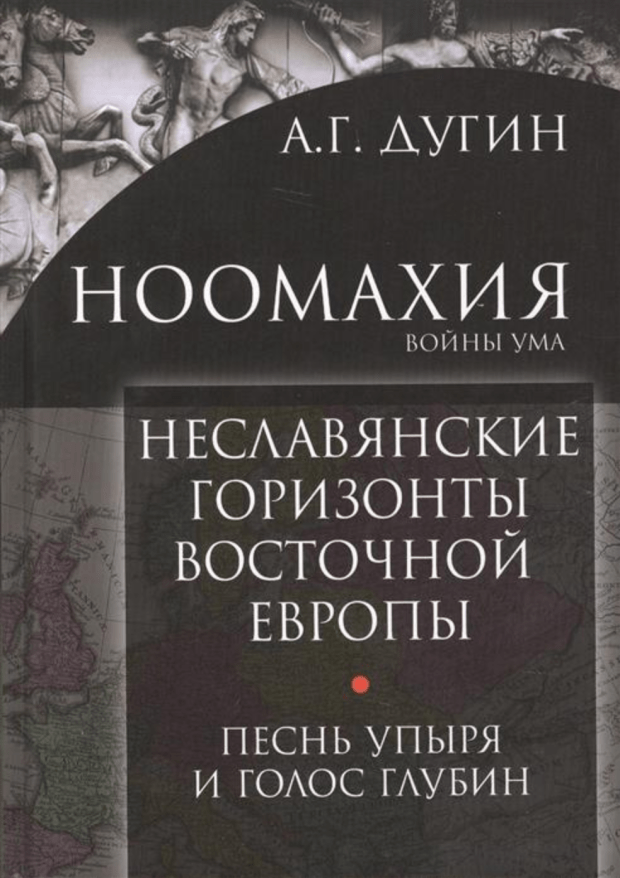
Alexander Dugin, Noomakhia – Wars of the Mind – The Non-Slavic Horizons of Eastern Europe: The Song of the Vampire and the Voice of the Depths
(Moscow: Academic Project, 2018)
Table of Contents:
Introduction: The Slavs and Non-Slavs in Eastern Europe
PART I: Great Baltica: The Lithuanian Logos and Unrealized Civilization
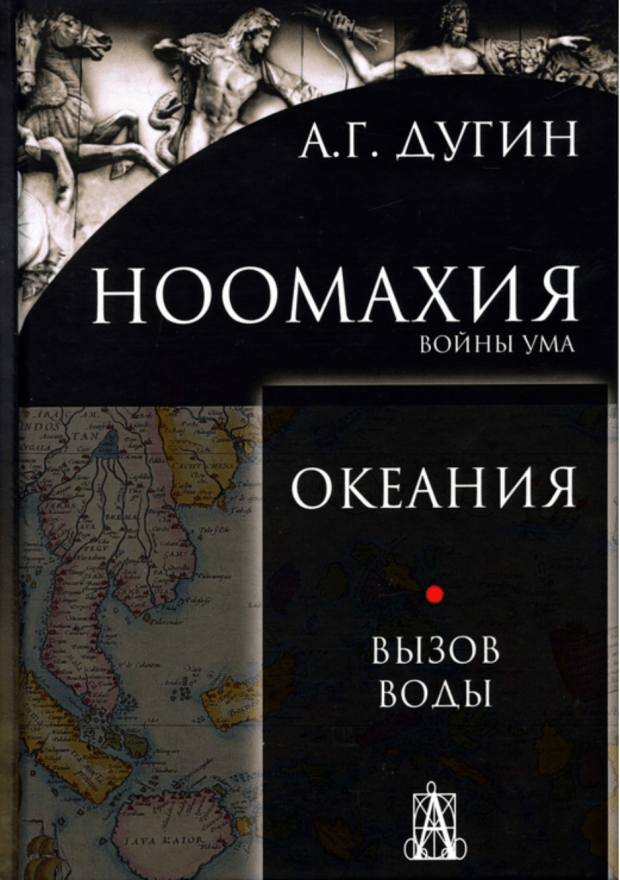
Alexander Dugin, Noomakhia – Oceania: The Challenge of Water (Moscow: Academic Project, 2018)
Table of Contents:
PART I: The Logos of the Great Water: The Malay Ecumene
Chapter 1: The Cultural Circles and Peoples of Oceania
Chapter 2: The Structures of the Malay Horizon
Chapter 3: The Ethnic Layers of the Malay Horizon
Chapter 4: The Sources of the Malay Historial: The Indian Factor
Chapter 5: The Polities of the Malacca Peninsula
Chapter 6: The Sacred Island of Java
Chapter 7: Sumatra
Chapter 8: The Malay Polities of the Islands and Colonies
Chapter 9: The Malay-Indian Logos
Chapter 10: The Malay Polities in the Era of Islamization
Chapter 11: Malay Islam: The Light of Man and His Enemies
Chapter 12: European Colonization and the Struggle for Independence
Chapter 13: The Modern Malay States
Chapter 14: The Malay Logos in the 21st Century
PART II: The Horizons of Oceania: The Thoughts of Water and the Rays of Androcracy
Chapter 15: The Logos of Micronesia: The Feminine Civilization of Octopuses
Chapter 16: Great Polynesia
Chapter 17: Papua: The Black Mothers and the Flying Foxes
Chapter 18: Melanesian Selenomachy: The Battle for the Moon on Malakula
PART III: Continent Australia: Dreams of Heartland
Chapter 19: Great Australia
Chapter 20: Snakes, Water Spirits, and Matriarchy
Chapter 21: The Spiritual Wealth of Oceania and Conceptual Continents
“In this volume of the epic of Noomakhia: Wars of the Mind, Alexander Dugin studies the oceanic expanses of the islands of Oceania and the Malay ecumene, a zone which might be called the ‘space of the Great Water’, that of ‘Noological’ or ‘Geosophical Oceania.’ Close to this understanding, according to the author, is the concept of ‘Austronesia’, denoting the linguistic unity of the peoples speaking the language family of the same name and inhabiting the islands and archipelagos stretching from Madagascar to Polynesia. As distinct entities belong to this cultural horizon, this book also examines the two insular poles of the Papuans and the Australian Aborigines. All the territories of Austronesia are treated as bearing enormous importance from the standpoint of preserving the inviolability of these unique, ancient cultures, which have preserved keys to the primordial root layers of humanity.”
Alexander Dugin, Noomakhia: The French Logos – Orpheus and Melusine (Moscow: Academic Project, 2015)
Table of Contents:
Foreword: The French Pair of Gestalts
Chapter 1: The Celtic Logos in the Ancient World
Chapter 2: The Civilization of Orpheus
Chapter 3: The State of France in the Middle Ages
Chapter 4: The French Logos in the Middle Ages: Scholastics, Sects, and Hermetism
Chapter 5: France towards Modernity
Chapter 6: Victorious Modernity
Chapter 7: The Literature of Social Materialism
Chapter 8: Seasons in Hell
Chapter 9: 20th Century France: In the Direction of Darkness
Chapter 10: French Philosophy in the 20th Century: Impulse and Loneliness
Chapter 11: Sociology as a Revolution
Chapter 12: The Culture of Night
Chapter 13: Traditionalism: The French Alternative to Modernity
Chapter 14: Structuralism: the Autonomy of the Sign
Chapter 15: Post-Modernity
Chapter 16: The New Right
“Noomakhia: The French Logos – Orpheus and Melusine presents a description of French identity and studies various aspects of the French and, more broadly, Celtic Dasein as manifest in mythology, history, philosophy, cultural, and mysticism.
Since the Middle Ages, France and Germany have acted as the two main poles of the dialectical formation of European civilization, thereby determining the historical, political, and cultural semantics of the most important processes in the history of Western Europe over the past half millennium. In studying the structures of the French Logos, the author arrives at the conclusion that this Logos’ main components are the two fundamental figures (Gestalts) of the Singer of the Sanctified, Orpheus, and the semi-female dragon, Melusine. According to the author, the paradigm of Modernity, in its mythological and cultural roots, can be traced back to the Gestalt of Melusine.”
In his article, “The Unipolar Moment”, which was based on a series of lectures delivered in Washington, D.C. in September 1990, Charles Krauthammer wrote that a new world order was emerging in which the United States would be the only superpower.[1] In the second paragraph of the article, Krauthammer introduced three main theses being discussed in the US political science community at the time: (1) the rise of multipolarity (interestingly enough, he suggests a “diminished Soviet Union/Russia” as one future pole, thus anticipating the collapse of the Soviet Union), (2) weakened consensus on foreign policy within the US, and (3) a diminishing of the threat of war in the post-Soviet era. Krauthammer promptly dismissed these arguments as erroneous, and instead spoke of the coming triumph of a unipolar world under the undisputed dominance of the US and its Western allies. Krauthammer did, however, immediately make one reservation: “No doubt, multipolarity will come in time. In perhaps another generation or so there will be great powers coequal with the United States and the world will, in structure, resemble the pre-World War I era.”
It seems that this moment has come. But for now let us refrain from making hasty statements, and first analyze on what grounds Krauthammer based his conclusions, where he was right, and on what he was mistaken. Such an excursion into the history of geopolitical thought will refresh our memory as to the methods by which Washington operates.
Krauthammer presents the Persian Gulf crisis and Washington’s reaction as an example of unwavering US might: “In the gulf, without the United States leading and prodding, bribing and blackmailing, no one would have stirred. Nothing would have been done: no embargo, no ‘Desert Shield,’ no threat of force.” In other words, this was not a multilateral action as it might have seemed, but the exclusive concoction of the US. As Krauthammer writes further on: “It is largely for domestic reasons, therefore, that American political leaders make sure to dress unilateral action in multilateral clothing.” This is done, evidently, because American citizens need legitimacy for the sake of their faith in democracy.
Yet here Krauthammer immediately follows up with a question: How long can America maintain its unipolar preeminence? To this end, light must be shed on theories of decline and imperial overstrain. Here Krauthammer introduces some figures – the United States was then spending 5.4% of GDP on defense, whereas earlier it spent nearly twice as much, and was now planning a reduction to 4% by 1995. However, Krauthammer adds that “American collapse to second-rank status will be not for foreign but for domestic reasons.” Let us take note of this.
Considering the balance between US domestic and foreign policy, Krauthammer suggests that it is “a mistake to view America’s exertions abroad as nothing but a drain on its economy…America’s involvement abroad is in many ways an essential pillar of the American economy. The United States is, like Britain before it, a commercial, maritime, trading nation that needs an open, stable world environment in which to thrive.” Later on, he adds that America is interested in maintaining its unipolar status, but questions whether Americans support such.
Here we can see mention of a dichotomy between the interests of the political elite and ordinary American taxpayers. Krauthammer himself notes that American isolationism “seems the logical, God-given foreign policy for the United States” by virtue of geography and the history of America’s founding, which is said to be have been motivated by the desire to distance itself from the intrigues and conflicts of the Old World.
Krauthammer also mentions another option, which he calls a far more “sophisticated” and “serious” school of international relations which insists on national interests – realism. In this context, he argues: “International stability is never a given. It is never the norm. When achieved, it is the product of self-conscious action by the great powers, and most particularly of the greatest power, which now and for the foreseeable future is the United States. If America wants stability, it will have to create it. Communism…is quite dead. But there will constantly be new threats disturbing our peace.” First and foremost among these threats is posited to be the proliferation of weapons of mass destruction. Also notable are such concepts as “rogue states” and “failed states,” although Krauthammer speaks of only one type – “The Weapon State,” under which he mentions Iraq, North Korea, and Libya. In his opinion, in order to become a Weapon State, a country only needs to develop its own industry, and then additional interests will arise which might conflict with the interests of other countries. This point is not discussed directly, but it is clear based on the context. Krauthammer writes:
With the rise of the Weapon State, there is no alternative to confronting, deterring and, if necessary, disarming states that brandish and use weapons of mass destruction. And there is no one to do that but the United States, backed by as many allies as will join the endeavor. The alternative to such robust and difficult interventionism – the alternative to unipolarity – is not a stable, static multipolar world. It is not an eighteenth-century world in which mature powers like Europe, Russia, China, America, and Japan jockey for position in the game of nations. the alternative to unipolarity is chaos.
Thus, Krauthammer recognizes that multipolarity is not only possible, but has historical precedent and, moreover, can help establish static stability (although the role of Japan in the 18th century, and indeed that of America, is up for debate).
Krauthammer’s next article on the same topic appeared twelve years later under the title “The Unipolar Moment Revisited.”[2] He begins with the same thesis as earlier, asking whether the US will face decline. Krauthammer argues that the third episode of American unipolarity has arrived with the threat of war posed by rogue states acquiring weapons of mass destruction. It is worth noting that this article happened to be released a year after the terrorist attack in New York and just before the invasion of Iraq (which was launched without UN sanction or the support of the US’ European partners). Krauthammer writes: “American dominance has not gone unnoticed. During the 1990s, it was mainly China and Russia that denounced unipolarity in their occasional joint communiqués. As the new century dawned it was on everyone’s lips. A French foreign minister dubbed the United States not a superpower but a hyperpower.” In other words, many countries did not take a liking to American dominance, and this was manifested against the backdrop of the bombing of Serbia and the occupation of Afghanistan, which were something like demonstrative wars at a distance that showed the whole world the new forms of US power.
If before the 9/11 terrorist attack many were pondering the possibility of an anti-hegemonic alliance, then afterwards many began offering the US their support, which “accentuated” the “historical anomaly of American unipolarity.” This happened by virtue of the “American anti-terrorism ultimatum”, which was essentially a mandate for the widespread use of military force by the US. Preventative operations violated traditional doctrines of just war, which led to a crisis of unipolarity. According to Krauthammer, this unipolarity found definitive formulation in the words of Pentagon chief Donald Rumsfeld on Afghanistan and the “War on Terror”: “the mission determines the coalition.” The mission is determined by the US.
Important here is Krauthammer’s admission that so-called multilateralism was merely a means of “liberal internationalism” to keep the US from falling into embarrassing situations in which other countries in disagreement with Washington’s position could “isolate” the US and make decisions themselves. If we soberly analyze both the “multilateral” approach of Madeleine Albright during the Bill Clinton administration, as well as the same rhetoric employed by Barack Obama and Hillary Clinton with her “reset”, then it is obvious that the “openness” and “interestedness” of the US has been but a cover for imposing its agenda. All of this was pursued, in Krauthammer’s words “in service to a larger vision: remaking the international system in the image of domestic civil society”, i.e., the American model.
From this standpoint, the nation-state is seen as an anarchic legacy of the past. Thus, Krauthammer explains, it is important for liberals to accelerate the erosion of sovereignty by means of new technologies and the unhindered movement of capital across borders. But America, as the great sovereign, must be “domesticated” by and for liberals who feel “discomfort” with US dominance. This in turn becomes a challenge to unipolarity, as the dominant pole inevitably comes to be diluted through international agreements, interdependences, and new norms.
At this point, Krauthammer briefly summarizes the contention between two schools of international relations – liberalism and realism – with regards to “paper or power”, i.e., agreements or threats and the use of force. In passing, Krauthammer reminds the reader of the question of multipolarity and actually contradicts himself. If in his previous article he spoke rather positively of multipolarity as once incarnated and possibly on the rise again, then this time his tone has changed dramatically. He writes: “Multipolarity is inherently fluid and unpredictable. Europe practiced multipolarity for centuries and found it so unstable and bloody, culminating in 1914 in the catastrophic collapse of delicately balanced alliance systems, that Europe sought its permanent abolition in political and economic union. Having abjured multipolarity for the region, it is odd in the extreme to then prefer multipolarity for the world.”
Prototypes of multipolarity actually existed in more places than just Europe by the 20th century. Before the arrival of European colonizers in Asia, Africa, and both Americas, similar systems existed which used special mechanisms of checks and balances that differed from European norms. Moreover, European countries developed within the paradigm of rationalism and the Enlightenment, which leaves Krauthammer’s argument unconvincing. Krauthammer can be understood, however, if we recognize the author’s Western-centric mindset and American political scientists’ propensity to justify double standards. Moreover, the nature of this shift can be explained as in the interests of many countries to develop multipolarity during this period (including not only China and Russia, but also the “left pivot” in Latin America, and the founding of the African Union in July 2002).
Further on, Krauthammer unveils his message: “[the] principal aim is to maintain the stability and relative tranquility of the current international system by enforcing, maintaining and extending the current peace. The form of realism that I am arguing for—call it the new unilateralism—is clear in its determination to self-consciously and confidently deploy American power in pursuit of those global ends.” Thus, in contrast to isolationist realism, this approach proposes that the US pursue none other than global objectives in Europe, Asia, Africa, South America, and the world ocean.
But let us recall what actually happened in 2002-2003. NATO officially invited Bulgaria, Latvia, Lithuania, Romania, Slovakia, and Slovenia to join its alliance; the state of Yugoslavia ceased to exist with its partition into Serbia and Montenegro; American troops occupied Afghanistan and Iraq; Israel carried out punitive operations against Palestinians; numerous terrorist attacks took place on Russian and Turkish soil; and a series of color revolutions began in the post-Soviet space following the effective testing of this new type of coup d’etat in Yugoslavia. For Krauthammer, this must all be “stability and relative tranquility.” Ironically, this actually might be such for the US, since all of these events took place with direct or disguised encouragement from Washington and outside of the borders of the United States (except for the terrorist attack of September 11th, 2001, which to this day remains the subject of serious debates). The maintenance of this unipolarity also means the preservation of the post-colonial legacy with its artificial division of the globe into first, second, and third worlds, entailing the merciless exploitation of the natural resources of countries incapable of effectively defending their sovereignty from transnational corporations, predatory policies of the IMF and World Bank and, of course, the US’ right to military intervention in other countries under false pretexts. As is well known, the concept of “Responsibility to Protect” was tested in Haiti in 1994 and in Yugoslavia in the early 1990’s and in 1999 to detach Kosovo and Metohija.
According to Krauthammer, the US should be “advancing democracy and preserving the peace by acting as balancer of last resort”, and “countries will cooperate with us, first, out of their own self-interest and, second, out of the need and desire to cultivate good relations with the world’s superpower.” In other words, other countries are presented with no real choice.
Although Washington uses both unilateral and multilateral approaches in similar fashion to advance its interests, there is one principal difference between the two which Krauthammer discerns in the form of a question: “What do you do if, at the end of the day, the Security Council refuses to back you?” As we very well know, even after the UN Security Council blocked its resolution on Iraq, the US acted as it saw fit. Even before this entered into force (let us recall that Krauthammer’s second article was released several months before the invasion of Iraq in 2003), Krauthammer believed that the unipolar moment had already become the unipolar era.
Thus, the article concludes with the following:
The new unilateralism argues explicitly and unashamedly for maintaining unipolarity, for sustaining America’s unrivaled dominance for the foreseeable future. The future of the unipolar era hinges on whether America is governed by those who wish to retain, augment and use unipolarity to advance not just American but global ends, or whether America is governed by those who wish to give it up—either by allowing unipolarity to decay as they retreat to Fortress America, or by passing on the burden by gradually transferring power to multilateral institutions as heirs to American hegemony.
Krauthammer therefore reiterates that unipolarity will be challenged not from without, but from within.
Now let us turn to summation. Krauthammer is partially correct that the unipolar regime depended on the US political elite. The lack of clear consensus therein and the ever-increasing gap between the aspirations of the American people and the corporate interests of the establishment which incessantly leans towards globalism, all yielded the phenomenon of populism and helped Donald Trump win elections with partially isolationist slogans.
Krauthammer was incorrect in his panicking over the proliferation of weapons of mass destruction. In the nearly 20 years since, the real balance in this sphere has remained virtually unchanged. Only the DPRK has increased its military-technological capabilities to a level causing panic reactions among US military and political circles. Without a doubt, another important landmark to be distinguished on this note is the decision by Russia’s leadership to deploy troops to Syria to help in the fight against terrorism.
The unipolar era never arrived. The unipolar moment lasted unfortunately long – for nearly two decades. But it was not an era. Krauthammer was right in his first article when he argued that multipolarity would arrive after one generation. Indeed, if we follow the criteria set for challenges facing the US, then according to such documents as the US National Security Strategy [3] and National Defense Strategy [4], the US now faces competitors in the face of certain powers familiar to us in the multipolar declarations of Russia and China. Iran and the DPRK have also openly challenged unipolarity and been assigned by Washington to the club of “rogue states.” Over the past few years, additional studies have increasingly suggested that America is losing its status as the global center of power in the face of emerging multipolarity.[5]
Therefore, we can say that Krauthammer was mistaken in saying that unipolarity would be threatened from within the United States. Threats have always come from the outside and, in different conditions, whether embryonic or frozen, have anticipated appropriate opportunities to change national strategies. As a matter of course, a number of countries have seized the first opportunity to escape Washington’s control. These cases can be called different things –whether “opportunism”, “transitioning to an active anti-colonial stage”, “searching for new solutions”, or “reactions to the US’ actions” – depending on the ideological framework and school of international relations employed.
What is important to understand is that unipolarity is disappearing forever. Even if globalists from the Democratic Party come to replace Trump, they will strategize how to erode sovereignty as such, including American sovereignty, and they will have to deal, first and foremost, with their taxpayers, who clearly showed their preferences by electing Trump. Moreover, given the heightened capabilities of other countries, the globalists will have to concede serious concessions and are unlikely to be able to achieve the same results that they did during the rise of the unipolar moment under Clinton or in the Obama administration’s later attempts to instate multilateralism. In one way or another, by this time faith in the US will have already been completely undermined – especially as newly declassified documents once again demonstrate to the whole world the dirty methods of the State Department and form a powerful argument in favor of severing relations with Washington – and, as former allies come to prefer new alliances, the balance of forces will change significantly in all regions across the board.
We now find ourselves in the multipolar moment. Our task is to transform this multipolar moment into a multipolar era.
Footnotes:
[1] Charles Krauthammer// Foreign Affairs, Vol. 70, No. 1, America and the World 1990/91 (1990/1991), pp. 23-33. http://www.jstor.org/stable/20044692
[2] Charles Krauthammer. The Unipolar Moment Revisited// The National Interest—Winter 2002/03. рр. 5-17
[5] See: C. Richard Neu, Zhimin Mao, Ian P. Cook. Fiscal Performance and U.S. International Influence, RAND Corporation, 2013; Global Trends 2030: Alternative Worlds, a publication of the National Intelligence Council, december 2012 http://worldview.unc.edu/files/2013/10/Global-Trends-2030-Executive-Summary.pdf; Global Trends to 2035 Geo-politics and international power. European Parliament, September,2017 http://www.europarl.europa.eu/RegData/etudes/STUD/2017/603263/EPRS_STU(2017)603263_EN.pdf; https://www.dni.gov/index.php/global-trends-home.
Everyone “thinks” that they can think and that what they are usually doing is called “thinking.” This is a misconception.
Those who have a certain culture of thought and are capable of self-reflection enter (I hope, consciously and responsibly) into what are virtually mechanical process of circulating certain schools, trajectories, and systems. They dwell there, following the main semantic rules and canons. In the best case, they can change, add to, correct, or amend something in this system, but certainly nothing fundamental. This is how dissertations teach “to think” – that is, of course, when they are honestly, thoroughly, and independently conceived and written. But this does not yet mean “thinking.” This is a preparatory stage, sometimes an important one, but it is far from the ultimate goal. Moreover, this does not necessarily lead to thought. In a number of cases, such might even become a block on the birth of thought. Moreover, one can think without such.
The first case is associated exclusively with those who have in one way or another consciously devoted their lives to science and culture and to everything connected to such. These are the “programmers” of thinking, and sometimes the hackers.
The second case includes everyone else. They have no conscious moment of entering into an organized and structured intellectual environment. They remain in ignorance with respect to where they are from and what it is that revolves inside their head and how such is organized. These are the ordinary users of thinking, who use ready-made programs without wondering about their algorithms. Here “thought” is understood to be the fragments of random inferences and instances of scattered and unsystematized knowledge and formulas whose origins remain unknown (to this “thinker”), the free recycling of rational calculations, all of which is continuously attacked by the sheaf of invasions of the unconscious, which lend to thinking a sinister, corporeally-saturated character. The latter aspect has been the subject of pyschoanalysis, for which the very process of thinking is a projection of the game of irrational corporeal forces barely covered with pseudo-rational nonsense. Subjectivity here is a random combination of complexes which were firmly established in early infancy and remain fundamentally unchanged. That is, everything that a person “thinks” about over the course of their life is simply a detailed, lifelong history of pain and anamnesis.
The second case – that of banal consciousness – is not thought at all, but the waste of the bodily machinery. The first is an act of belonging to a higher, but also completely alienated system, in which there is no subjectivity in sight. We can see a hint of this in the recognition of humanists that their discourses and all the discourses they hear are instances of quoting. Postmodernism takes this reflection to the point of absurdity and turns it into a new mental illness that converges with the idiocy of banal consciousness.
One could, of course, propose mixed variables as well, such as those of the “semi-intellectual” or “semi-layman” (the consumer), but such yields nothing new: only an advanced idiot or a mentally retarded intellectual. The alienation is not changed. We are outside of thought. We do not think, but rather participate in an alienated, mechanical process – some clearer, others dimmer.
Where is thought? On a different plane. Thought is born and comes into being in a completely different dimension. Compared to what we are doing when (it seems to us that) we are “thinking”, it is something radically other. The experience of thought means the collapse of everything we usually take such to mean. Thought can begin only when what we make thought out to be is finished. Both everyday delirium and intellectual “scholarly citations” are barriers to the birth of thought. They should be abolished. Thought is born out of the moment of madness or nonsense, when the rotation of the gears of both everyday and scientific consciousness is suddenly stopped. In the face of death, this feels good. But not for everyone. Pseudo-thinking reliably protects us from death by barricading against the very possibility of experiencing it with countless instances, fears, calculations, plans, and hopes (for doctors, miracles, police, common sense, science, and the “light at the end of the tunnel”). Everything is subject to death, but death is the lot of the chosen. Death is intimately connected to thought. Thought is born only in the face of death. That which is born freely and horribly in the face of death, when everything else that we have held “thought” to be has been destroyed – that is real thought. Only at this moment does subjectivity make itself known, having been in all other cases dissolved amidst the alienated fields of unfocused consciousness.
Thought requires colossal, superhuman effort to overcome the fundamental threshold.
Thought is incredibly difficult. It is a feat. At the same time, it is transformative illumination. It is not merely some particular, sublime thought, but just thought, thought as such – one could even say “any” thought, taking into consideration the root for “love” (in Russian: liubov’) in the word “any” (Russian liubaia). Thought is not the creation of systems or doctrines, which are consequences, and not necessary ones at that. The main aspect of thought is not its results and manifestations, but thought itself, its being. Thought irreversibly changes anyone who as at least once approached it. Thought gives us the first view of who it is that is thinking, i.e., the subject. But it is not us. It is the radical other in us. Someone hidden inside. To think means to present the possibility of emerging out of the inner darkness into the inner light.
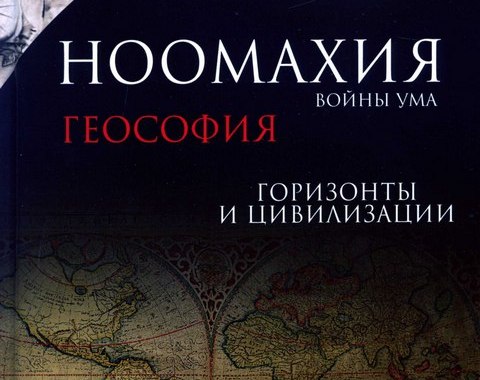
Virtually all of the books of the Noomakhia series are dedicated to what might be called “Geosophy” or “plural anthropology.”
In the first volume ofNoomakhia, The Three Logoi [1], we offered a most general representation of the Three Logoi as three basic paradigms within the framework of which one can interpret the semantic structures of any culture and civilization. In the very least, we have proceeded from precisely such a possibility as our initial position, allowing for the possibility of this tripartite reading in each and every society with numerous overlaps and combinations. As we proceed to examine different civilizations, we are faced with either accepting the conviction that such an approach, upon which all of Noomakhia is based, is indeed competent or, upon encountering insurmountable obstacles, recognizing the limited applicability of this noological methodology. The triplicity of the fundamental Logoi constitutes the essence of Noomakhia, and we will pursue this in the most diverse historical, religious, and social contexts. The main substancewhich we understand by the “Three Logoi” described in the first volume will be further refined as we examine the most diverse civilizations and cultures, first and foremost the Hellenic and Byzantine, where the corresponding figures of Apollo, Dionysus, and Cybele attained their clearest and most generalized expression. We have taken the latter to be a universal structural template, a paradigm. Thus, the two volumes of Noomakhia dedicated to the Greeks are of great importance to any correct and complete understanding of the foundational paradigms on which our study is based.
In the present work, we will examine yet another aspect of the plurality of Logoi. In the first book, we described – in the most general contours and primarily based on the example of the Hellenic cultural circle which determined the destiny of Western Europe for the last two and a half millennia – the structure of the three fundamental paradigms of thinking corresponding to three types of philosophy, religion, mythology, ritual, symbolism, gnoseology, ontology, and anthropology. The three paradigms which we distinguished – those of Apollo, Dionysus, and Cybele – can be considered the main constituent moments of the vertical topography. In our point of view, these three paradigms comprehensively exhaust all the possible variations of the concretization of the Mind (Νοῦς) in the Logos and logological structures. Although we limited ourselves to the Hellenic zone, it is theoretically possible to arrive at an analogous model on the basis of other cultural templates, be they developed and detailed like Indian and Chinese philosophy, or altogether archaic, such as in the case of shamanic complexes or the most elementary mythological systems.
This vertical topography of the Three Logoi can be envisioned as a perpendicular angle constructed upon and penetrating each geographical (or, more precisely, geocultural and geosophical) zone of the world. Every cultural space (cultural-historical type, civilization) by definition can possess Apollonian, Dionysian, or Cybelean dimensions as three dimensions ofits (cultural) space, i.e., height (the Light Logos), breadth (the Dark Logos) and depth (the Black Logos). We say “can”, for this does not mean that each of these Logoi will necessarily be present, much less predominate. The diversity of cultures and societies on earth lies in that every culture and every society presents its own kind of projection of the three vertical Logoi in different proportions and different relations. One of the Logoi might dominate in one place while the others remain in a virtual state; elsewhere, the picture can be more complex. The Three Empires of the Logoi are projected onto each culture not only in terms of this geometrical schema, but always also from different angles, just as one and the same projected image can, taking into consideration different folds, curvatures, breaks, dips, etc., yield different shapes on different surfaces. When reflected upon the sea, the sun’s rays are transformed from straight lines into curved lines, and their constancy gives way to a rhythmically repetitive sinusoid. Light disappears on a dark surface; it is reflected in a mirror, and so on. If we add to this understanding the fact that cultural fields are not strictly horizontal with relation to noetic topography, but are reflected at certain angles which differ from culture to culture, then we can appreciate and estimate just how diverse and multidimensional cultural geography can be, just how multifaceted the field of geosophy is, and, as follows, we can appreciate the richness of anthropological pluralism. The very identification of the presence of three Logoi and the discernment of the dramatic war between their Empires fundamentally enriches our understanding of the structures of the Mind, imparting vital and intense volume. Taking into account the diversity of the projections onto the horizontal plane of human cultures which these Logoi and Noomakhia can yield, turns the whole picture into a grand panorama of qualitative intellectual plurality, a fertile and substantive pluriversum.
In the first book of Noomakhia, we primarily busied ourselves with the vertical symmetries and oppositions of noology, as well as the philosophies and mythologies which express such. Now we shall transition to horizontal symmetries and approach the study of the diversity of the Logoi among civilizations and cultures. In the following books of Noomakhia, we intend to present a number of developed illustrations of how the Logoi independently and distinctly manifest themselves in the most different civilizations, both those close to Europe and those distant. This qualitatively complicates the overall picture of noology. We will see how, in addition to or beyond the war between the Three Empires, the oppositions and conflicts between these Empires are projected onto the horizontal plane, as well as the internal polycentrism and historical dynamics inherent to these projections. This will explain many aspects of inter-civilizational relations and inter-cultural ties, but still the resultant field of geosophy will present itself as an extremely complex model, even in its mere static structure, without taking into account temporal (whether cyclical or unilinear) dynamics. Taking into consideration the dynamic changes in cultural systems which are organized along primordially different lines and represent a field of intense battle between the Three Noetic Empires, promises to transform history, philosophy, religious studies, anthropology and cultural studies into such a complex picture, simultaneously containing such a multiplicity of layers and levels, that it should come as no surprise why no one has undertaken such before. After all, the hands of the most courageous and resolute scholar can waiver in the face of such an abundance of materials and the sheer quantity of relevant factors. Thus, all previous undertakings which, no matter what, pursued something similar, will be made all the more valuable to us.
Yet the horizontality discussed in this volume of Noomakhia is such only in correlation with the verticality of the model of the Three Logoi. Horizontality in itself is multidimensional and polycentric. It harbors not only the static layers of culture that are discernible independently of time and which constitute the structure of permanent identity, but also historical dynamics, over the course of which the very proportions of relations between these layers dialectically change. Thus, in each and every civilization (culture), we must inscribe history into the unchanging synchronic model of identity, as well as situate space in the structure of civilizational time. On this matter, Martin Heidegger posed the followed fundamental question in his Ponderings (The Black Notebooks):
Не является ли пространство временем народа?
Ist das auch der Raum als die Zeit für ein «Volk»?
Is that also space as time for a “people”?
Пространство и время не нечто рядоположенное, что было бы «дано», но прорыв и начало бытия, которое должно быть отвоёвано.
Raum und Zeit nicht das Nebeneinander, das es so «gibt», sondern Ausbruch und Anbruch des Seins, das ersrtitten warden muss.
Space and time not the juxtaposed, which is simply “given,” but instead the opening and upsurge of being, which must be striven for. [2]
Heidegger’s use of the two words Ausbruch and Anbruch is important as a formula for expressing being in both space and time. Both are formed by the common root brechen, that is “to smash”, “to sever”, “to break through”, “to split.” Space corresponds to the Ausbruch of being (Sein or Seyn), and time is the Anbruch of being (Sein or Seyn). Ausbruch can be interpreted as an “invasion”, “breakthrough”, “acute unfolding”, or “upsurge.” Being unfolds as space (living space, the space of the people) and thereby “surges” into existence, making it present. Time begins the being of Anbruch, that is “opening”, “revelation”, “discovery.” Space and time therefore form a common, but differentiated horizon of ontology based on a fundamental trauma – that of the “breaking”, “splitting”, the “glaringness of the abyss”, of the “primordial differential.” The Romanian philosopher Lucian Blaga called this the “divine differential” that lies at the heart of the cosmogonic act [3]. It is on these grounds that Blaga based his analysis of cultural and epistemological forms which he interpreted through the analysis of spatial and temporal horizons.[4]
Time and space, that is to say the dynamism and stasis and of every culture, together compose the intertwined edges of a common semantic horizon which we conceptualize as a horizon only by force of the fact that we are examining it in light of the noological vertical of the Three Logoi. In and of itself, a “horizon” is not flat, but simultaneously contains several dimensions – both spatial and temporal.
Therefore, we can envision the structure of this horizontal topography which is of priority interest to us in this work as a spatial-temporal whole. If we evaluate it from the synchronic perspective, then it can be seen as qualitative space or “living space” (Lebensraum a la Friedrich Ratzel [5]), i.e., a field which harbors events and meanings (Raumsinn or “spatial meaning” [6]) The discipline of Geopolitics as it developed over the 19th and 20th centuries was founded on this principle, yet this view can also be detected – indeed, like virtually everything else – in ancient Hellenistic culture, especially in the Neoplatonists and above all in Proclus.
If we approach this horizon from a diachronic point of view, then we will have to deal with the phenomenon of “history” in the form of a chronological sequence strung out along a semantic axis. History here opens up as a semantic sequence. Heidegger called this understanding of history “onto-history”, Seynsgeschichte.[7] Proceeding from this Hedeiggerian methodology, a closely related concept was proposed by the French philosopher and historian of religions Henry Corbin, who coined the notion of l’historial, or “existential-semantic time”.[8] Insofar as here we are dealing with a semantic chain, the diachronic order of unfolding cannot be free from the structure predetermining it, which in a religious context is usually referred to as “Providence” or “Predestination.” In the historial, everything is determined by the structure, which dictates not so much events themselves as the uniqueness of their interpretation (and, further, their tripartite significance, if we evoke the Three Logoi). The present volume of Noomakhia is devoted to substantiating this methodology. In this study, the phenomenon of culture or civilization is put at the center of attention as the most precise expression of a horizon. The highest form of this refinement is what we call a “Logos of Civilization”, or “Horizontal Logos” (insofar as such represents a shaped and reflected expression of the horizon itself).
The plurality of Daseins
The boundaries and characteristic signposts of different cultural spaces or civilizations can be defined in terms of the most diverse criteria which ultimately yield different results. We should clarify that we do not draw a terminological distinction between “culture” and “civilization”, unless otherwise specifically stipulated, in the spirit of that proposed by Oswald Spengler (1880-1936) [9]. Insofar as there exist many definitions of culture and civilization and many authors who study such, we cannot rely on any established unambiguity in definitions, interpretations, and theoretical generalizations. Therefore, we shall explain right away just which rules we intend to be guided by in the composition of our geosophical map.
First of all, we naturally do not claim to present any complete and detailed description of the Logoi of all different cultures, which is even theoretically impossible. The examples which we have taken for examination are rather arbitrary and are evoked only to illustrate the general approach to the plurality of Logoi which we have developed over the course of Noomakhia. For this reason in some cultures and societies we have chosen only that which interests us as a priority and that which most explicitly resonates with the three Logoi that we have distinguished. We consider the very notion of a “cultural Logos” or “Logos of a given culture”, i.e., the Logos of a people, religion, society, or civilization, to be a projection of the three universal (vertical) Logoi onto a given horizon (whose complex nature we have hitherto emphasized). Thus, the Horizontal Logos (the Logos of Civilization) is unpacked into three vertical, noological vectors. In other words, every concrete culture is a most complex code consisting of three fundamental elements.
Secondly, between all the different criteria for “culture” and intellectual expression, we primarily aspire to emphasize and take into consideration the existential dimension. Such a conceptualization is founded on the theory of the plurality of Daseins which we have outlined in our other works, first and foremost those dealing with Martin Heidegger [10]. This means that we believe that the basic, phenomenological level of the “thinking presence” of man in the world differs in its deepest roots, and this difference is the foundation upon which the structures of culture, society, philosophy, politics, knowledge, science, and art are built. We consider the Dasein of each civilization, in its approach to death, to be unique, and it is this existential plurality that determines differences in secondary significations and configurations.
Dasein is the root structure of man’s presence in the world, the fundamental backdrop of his existence. Although Heidegger himself, as befits a true European, was ethnocentric and believed the fate of Western European civilization to be the fate of all of humanity and the European Logos to be the universal Logos, we can nevertheless attempt to isolate Heidegger’s deep insight into the essence of the existential roots of man, taken as “thinking presence” (Dasein), from such claims to universality. In such a case, we acquire the concept of the plurality of Daseins as several existential poles corresponding to the nomenclature of civilizations. Consequently, we have the following picture:
I. At the heart of every civilization lies a special “thinking presence”, Dasein.
II. This “thinking presence”, Dasein, determines the structure of a given civilization’s Logos, that is to say it lies at the basis of the metaphysics which can subsequently be built upon the root structure of the Dasein.
III. The “thinking presence” of Dasein is responsible for both the basic structure of the Logos that is a result of its unfolding as well as this Logos’ transformation over the course of the whole cycle of a civilization’s historical being. We can see this in Heidegger’s analysis of the onto-history, Seynsgeschichte, of Western civilization, as well as in Henry Corbin’s concept of the historial [11].
IV. The plurality of “thinking presences” can be postulated both outside of a concrete civilization (as an other Dasein), as well as, with certain nuances, within it. Accordingly, in Mediterranean civilization, Hellenic, Roman, as well as Egyptian, Semitic, Chaldean, and Anatolian poles were all present, as are Germanic, Celtic, Latin, and other poles present within European civilization. Each of these poles can be analyzed on the basis of its existentials.
V. From the point of view of Noomakhia, the Logos of a given civilization (even in the form of its own inter-civilizational versions) can be subjected to spectral analysis with the aim of identifying the proportions between the three fundamental types of noology – the Logos of Apollo, the Logos of Dionysus, and the Logos of Cybele – the proportions of which can, theoretically, differ in any possible manner within any given civilization.
VI. Hypothesis: The differences in the concrete spectral structure of the Logoi of civilizations must be rooted in the differences of their root foundations, the “thinking presence” of their Daseins.
VII. Thus, on the basis of an Heideggerianism that has been expanded in all directions, and on the basis of Hedeiggerianism’s experience of the “destruction” of Western European metaphysics and the Western European historial, we can develop a methodological foundation for building a plural anthropology and a geosophical map of civilizations, where the Logos of each civilization corresponds to a special Dasein.
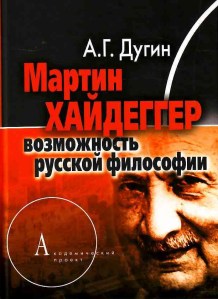
On these grounds, we can correlate the model of Heidegger’s existential analysis of the history of the Western Logos with those of other philosophies and civilizations – not to accept such as universal, but with the aim of seeking those possible homologies or, on the contrary, differences which, by virtue of the developed state of studies on European civilization and the relatively underdeveloped state of other civilizational studies, might turn out to be extremely useful and substantive. We have already accomplished something of this sort in the book The Possibility of Russian Philosophy [12] where, in trying to apply the Dasein’s existentials to the Russian “thinking presence”, we developed an extremely substantive and impressive framework qualitatively differing from the one which Heidegger cited as the quality of the existentials of Dasein in Sein und Zeit [13].
Thus, it has been revealed in practice that, when speaking of Dasein, Heidegger was in fact dealing with the European, Indo-European, Hellenic, Apollonian, and Germanic Dasein. The Russian Dasein looks significantly different, and it is completely obvious that the Russian Logos, when we try to reconstruct its main features, should also look completely different, for such explains to us the differences between civilizations and, indeed, justifies those intuitions as to the uniqueness and originality of Russian civilization advanced by the Slavophiles, Danilevsky, the Eurasianists, Spengler, and many other authors. It is only obvious that such differences should also be found in the existential structure of the “thinking presences” of other civilizations as well. Accordingly, the Heideggerian methodology for studying Dasein, ingeniously applied by Heidegger himself to his own civilization, can, given appropriate corrections and generalizations, be successfully applied to others (as the first approximation of the Russian Dasein has shown [14]).
The observant reader who has attentively read the first book of Noomakhia, The Three Logoi, could remark at this point: If we have correlated the philosophical phenomenology upon which Heidegger based his views of Dasein with the Logos of Dionysus, then would it really be justified for us to take precisely this Logos – as one of the vectors of the common noological map, as the intellectual jurisdiction of only one of the three Empires of the Mind) – to be the main quality of a cultural unit? This objection is well founded, but we would like respond to it thusly: The Logos of Dionysus to which phenomenology indeed corresponds, is in a certain sense intermediary between the two other poles of Noomakhia; therefore, we can correlate this Logos with the “middle world”, that is the horizontal section located strictly between the Logos of Apollo and the Logos of Cybele, between Heaven and Hell. Thus, we very well can begin precisely with this Logos as the phenomenological fixation of civilization (cultural space). This does not mean that, upon defining (however roughly) the zone of a concrete Dasein, we must stop there. On the contrary, we are faced with discerning the very structure of the correlation between the Three Logoi projected upon a given area, their balances and proportions. In other words, proceeding from an existential analysis, we will try to reconstruct both the Uranic (the Apollonian, the celestial) and the Chthonic (the maternal, the subterranean) dimensions of the cultures under examination. Of course, in some cases we will have to deviate from this application, such as if the Apollonian element or Cybelean Logos clearly predominate and clearly define the morphology of the Dasein. One example of this is the strictly Apollonian Iranian logos [15] or, conversely, the titanic Logos of the Semites [16], in which the intermediary, Dionysian dimension is weak, secondary, or derivative.
Thirdly, we do not wish to pass any final judgements regarding the scale which we have employed. We know some civilizations, such as the European and Russian, much better for a number of quite understandable reasons, hence logically follows our more detailed description of their particular points, such as our discernment in the field of European civilization multiple versions of this Dasein and their pronouncements in particular dimensions of the Dasein of the cultures of North and South America. We know much less about Asian and African cultures and the cultural circle of Oceania, so in examining them we have restricted ourselves to rather approximate generalizations, a point which concerns our own cultural limitations and does not reflect any simplicity or schematics of the cultural worlds under examination. In all of their regions, Asia, Africa, and Oceania present an astonishing ethnic, cultural, intellectual, and existential originality and a most wealthy plurality not only of shades, but also of colors, figures, thoughts, and theories.
The ensuing compilation of this map of geosophy can be continued in this direction to any and all points of the Earth’s space inhabited by people – among technologically developed cultures as well as among the archipelagoes of archaic societies, ethnoi, and tribes whose wealth, diversity, and originality were discerned by the new anthropology of the “cultural school” of Franz Boas, the “social school” of Bronisław Malinowski , and the “structural school” of Claude Lévi-Strauss.[17]
Ethnocentra and Ethnocentrism
The notion of a connection between thinking and geography can be found among different peoples in Antiquity. Various ethnoi explained the extraordinary qualities of (as a rule, their own) cultures in terms of special geographical conditions. This is the subject of what in the 20th century came to be defined as the field of “sacred geography” and, in its more pragmatic application, Geopolitics [18]. The Ancient Chinese, for instance, were convinced that their country lies in the center of the world, and it is precisely on these grounds that the Chinese called their state the Middle Empire or Middle Kingdom. In the view of the Ancient Jews, Israel, the “promised land” is also to be found at the center of the world, with its center in Jerusalem. It is telling that, according to Judaism, Jerusalem is home to the gates leading both down below the earth, to Sheol, to hell, as well as up to Heaven, are located. The Greeks also placed the region of their Mediterranean resettlement at the center of the Earth, and Proclus argued that the people of Attica were, unlike the populations of the hotter and colder countries, predisposed towards philosophy by virtue of the influence of this temperate climate. The Ancient Persians were convinced that the territory of Iran (Iranshahr) stood at the center of the Earth. The name of the city Babylon meant “Gate of God” and thereby implied a chosen point in space through which the gods enter and exit, i.e., the middle place between the sky and the underworld. In the Temple of Apollo in Delphi to this day rests the Omphalos, the sacred stone whose location was held to determine the center of the world. In the Christian era, the Byzantines believed the center of the ecumene to be Constantinople, the New Rome with its spiritual center in the Hagia Sophia. In the Scandinavian Eddas we find the term Midgard, or “Middle Earth.” We also find such views among the Ancient Slavs, the Irish (who saw Ireland as the island at the center of Earth), the Japanese, and so on. These perspectives are religious reflections of what we propose to represent as the projection of the vertical noetic topography onto the horizontal. Every culture (civilization) conceives itself as being the middle plane in the vertical model of the three worlds. But this vertical centrality is valid for all points on Earth and, as follows, for all ethnoi and cultural zones and, according to the logic of the ethnocentrum, is affirmed along the horizontal plane in contrast to other surrounding, differing cultures and peoples (hence the phenomenon of “ethnocentrism”). This is in line with the stable mythological practice of placing the dwelling place of a people in the center of the horizontal space of Earth, a theme which we invariably encounter in the views expressed by both great civilizations as well as small and archaic tribes.
If in the vertical sense this topography can be recognized as justified, with the nuance that different cultural spaces (in different periods), while existing on one “physical” plane, can find themselves under the preeminent influence of one or another Logos which renders their common vertical “centrality” more differentiated (some contemporary civilizations may be located closer to the subterranean zones of the Great Mother, while others closer to the celestial worlds of the Apollonian Logos), then in the horizontal sense this gives rise to the problem of situational relativity. The center is defined as a special space endowed with special and unique characteristics in comparison (contrast) with those of surrounding territories. Thus, the question of the plurality of horizontal centers raises the problem of “cultural relativity”, or the plurality of ethnocentra. Every culture proceeds from the fact that it itself is in the center of the intellectual universe. Consequently, every culture is built upon the presumption of its own uniqueness, universality, and “singularity.” Its Logos and the less obvious Dasein at its heart are taken as a point of reference and paradigm. This is how the ethnocentrum is formed. Man believes the Logos of the ethnocentrum to which he relates (which is almost always his own ethnocentrum or, in some cases, the ethnocentrum which he believes to be normative, e.g. the “Europe” of Russian “Westernizers” or the “Europe” of Asian “globalists”) to be “universal”, “obvious,” “self-evident”, and the “best.”
Here we arrive at the main methodological quality of geosophy. In order to correctly interpret the structures of a given civilization (culture), we must deliberately, consciously refrain from projecting our own ethnocentric views. Here we should turn to the phenomenology of philosophy, deconstruction, and apperception to bracket our own “ethnocentrism” which leads us to believe that the methods and criteria for evaluating our own civilization are a universal scale for interpreting all other cultures. In contrast to the semantic structure of the ethnocentrum which structures space, and departing from its exceptionalism and implicit superiority, we must consciously allow for the plurality and qualitative equality of ethnocentra, we must recognize every ethnocentrum to have the right to its own cultural topography, and we must share this topography to the extent that we wish to conceptualize the roots of its existential structure.
One advocate of the phenomenological method in the history of religions, Henry Corbin, who devoted many years to the study of Shiism and its philosophy, in some of his texts arrived at a complete identification with the society he studied, even using the phrase “We, Shiites.” While himself a Protestant Christian by confession and a phenomenologist in the field of the comparative study of religions, Corbin recognized that studying another religion is fully possible only if one abstracts himself over the course of study from his own established dogmatic and confessional positions – otherwise, we will be left with a variety of apologetics and insistences on the universality of our ethnocentrum. However, this need not entail an irreversible change of confession and cultural code. Corbin himself remained a Christian even though in his studies of Shiism he adopted the positions of another ethnocentrum for the sake of fuller understanding, and as a result of which his works were rendered more weighty, authoritative, and foundational. The point is not to leave the zone of one ethnocentrum only to enter another, but to accomplish the process of transparent philosophical apperception, to conceptualize one’s “natural”, “historical” position as ethnocentric and, without departing from one’s loyalty to such, to recognize that other studied cultures are just as ethnocentric and just as well claim “universality”, “exclusivism”, and “obviousness” as our own.
We cannot abolish the ethnocentrum, for in such a case we would be left without any philosophical territory, without any place for situating ourselves and our study; we would be left outside of the phenomenon we are examining. The only solution is to consciously accept the plurality of ethnocentra as founded on the plurality of Daseins, to accept that each and every one is built on the implicit recognition of its own (and not someone else’s or any outsider’s) centrality and exclusivity. In order to break through to cultural codes, we must recognize their existential rules. If not, we will remain within the confines of our own ethnocentrum and will not be able to travel beyond it. Even if we decide to act strictly impartially, still the Dasein embedded deep inside us will make itself known, albeit indirectly. And if we attempt to uproot it without accepting a new one, then we will simply disappear as a “thinking presence.” All that remains is to enter ethnocentra by accepting their structures, while also preserving consciousness of the fact that we are dealing not with anything “universal”, but with “relative universality” – not with a universum, but a pluriversum, in which any “exclusivity” and “self-evidence” are in essence no more than established protocol necessitated for the sake of free intellectual movement throughout a given cultural zone.
[2] Martin Heidegger, Überlegungen II-VI (Schwarze Hefte 1931-1938) (Frankfurt am Main: Vittorio Klostermann, 2014), p. 18.English translation from Martin Heidegger, Ponderings II-VI (Black Notebooks 1931-1938), translated by Richard Rojcewicz, (Bloomington: Indiana University Press, 2016), p. 14.
[3] Lucian Blaga, Les differentielles divines (Paris: Librairie du savoir, 1990).
[4] Lucian Blaga, Trilogie de la culture (Paris: Librairie du savoir, 1995); Ibidem, Trilogie de la connaissance (Paris: Libraire du savoir, 1992).
[5] Friedrich Ratzel, Anthropogeographie, Bd. 1-2 (Stuttgart: J. Engelhorn, 1882-1891).
[6] Friedrich Ratzel, Politische Geographie (Munich/Leipzig: R. Oldenbourg, 1897).
[7] Martin Heidegger, Geschichte des Seyns (Frankfurt am Main: Vittorio Klostermann, 2012).
[8] Corbin employed the archaic French term historial in 1938 in his French translation of the fifth chapter of Heidegger’s Sein und Zeit to convey the difference between the German words historische (in French historique) and geschichtliche (historial). The first – historische or das Historische – denotes the totality of historical facts and their correlations, while the second – geschichtliche or das Geschichtliche (l’historial being the French substantive) bears the meanings of existence, fate, and predestination.
[9] Oswald Spengler, Zakat Evropy. Obraz i deistvitel’nost’ (Moscow: Nauka, 1993).
[10] Alexander Dugin, Martin Heidegger. Vozmozhnost’ russkoi filosofii [“The Possibility of Russian Philosophy”] (Moscow: Academic Project, 2012).
[11] Alexander Dugin, Martin Heidegger: The Philosophy of Another Beginning (Moscow: Academic Project, 2010)/ (Arlington: Radix/Washington Summit Publishers, 2014).
[12] See footnote 10.
[13] Martin Heidegger, Sein und Zeit (Tubingen: Max Niemeyer, 1972).
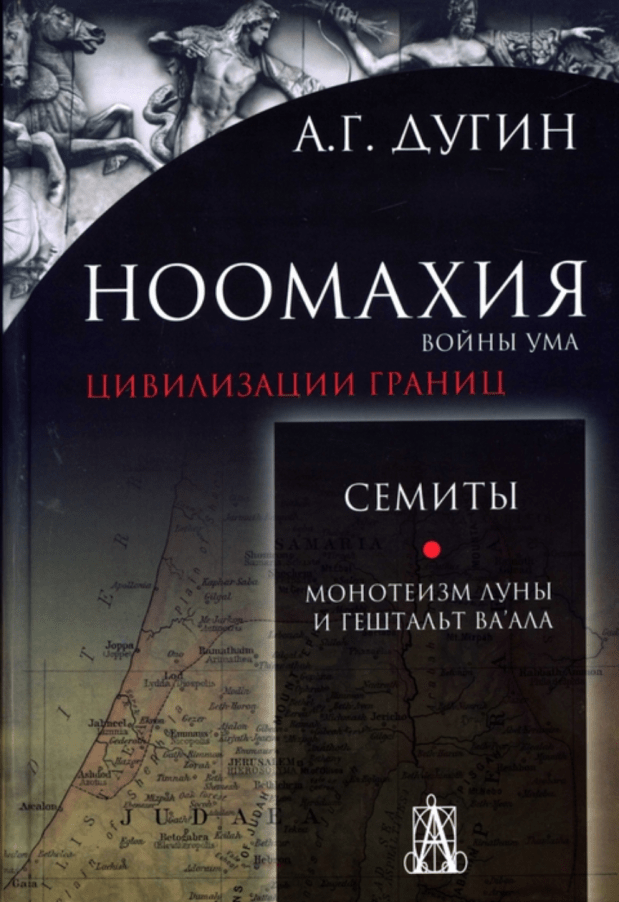
[16] Alexander Dugin, Noomakhia – The Semites: The Monotheism of the Moon and the Gestalt of Baal (Moscow: Academic Project, 2016).
[17] Alexander Dugin, Etnosotsiologiia [“Ethnosociology”] (Moscow: Academic Project, 2011). Partially in English: Ethnos and Society (translated by Michael Millerman, London: Arktos, 2018).
[18] Alexander Dugin, Geopolitika (Moscow: Academic Project, 2011).





 Eurasianist Internet Archive