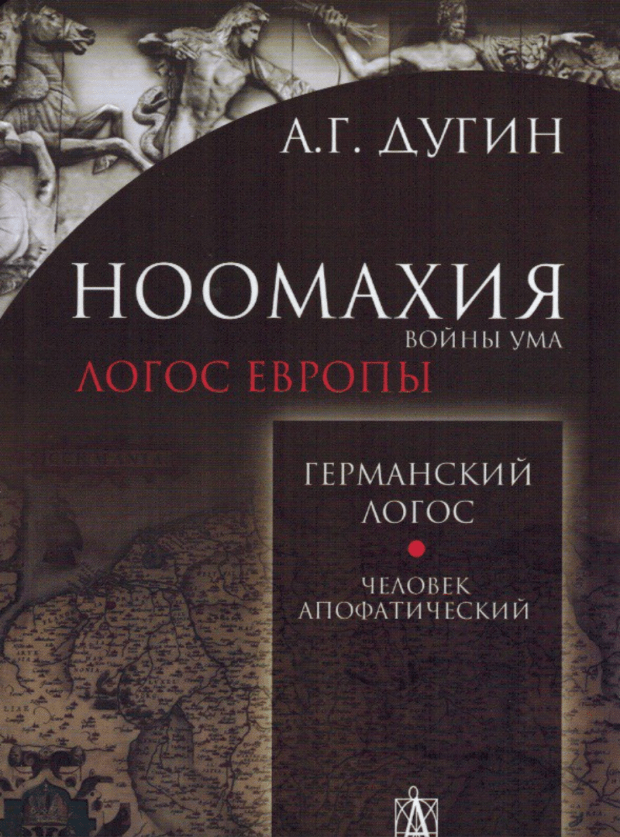
Noomakhia: The Germanic Logos – Apophatic Man

Alexander Dugin, Noomakhia: The Germanic Logos – Apophatic Man 
(Moscow: Academic Project, 2015)

Screen Shot 2019-04-22 at 5.03.33 PM

Table of Contents:

Preface

Part I: The Logos of Germania 

Chapter 1:  The Ancient Germanic Peoples and their Myths 

Chapter 2: A Brief History of the Germanic States

Chapter 3: German Literature in the Middle Ages

Chapter 4: Medieval German Thought: The Mystics of the Rhine

Chapter 5: The Germanic Renaissance 

Chapter 6: The Reformation in German History

Chapter 7: German Romanticism 

Chapter 8: Germany’s Classical Age: The Triumph of Philosophy

Chapter 9: The Philosophy of Twilight 

Chapter 10: The Conservative Revolution

Chapter 11: Germanic Expression: The Twilight of Man

Chapter 12: Martin Heidegger: Great Germany and the Fate of Europe

Chapter 13: The Three Logoi in the Europe of the ‘End Times’

Chapter 14: After the ‘End of History’

Part II: The Space of the Germanic World

Chapter 15: Austria: The Mission of the Habsburg Guardians

Chapter 16: Sweden, Norway, and Denmark: Scandinavia and its Spirits

Chapter 17: The Netherlands: The North, the Mother, and the Sea

Chapter 18: Switzerland: The European Equilibrium 

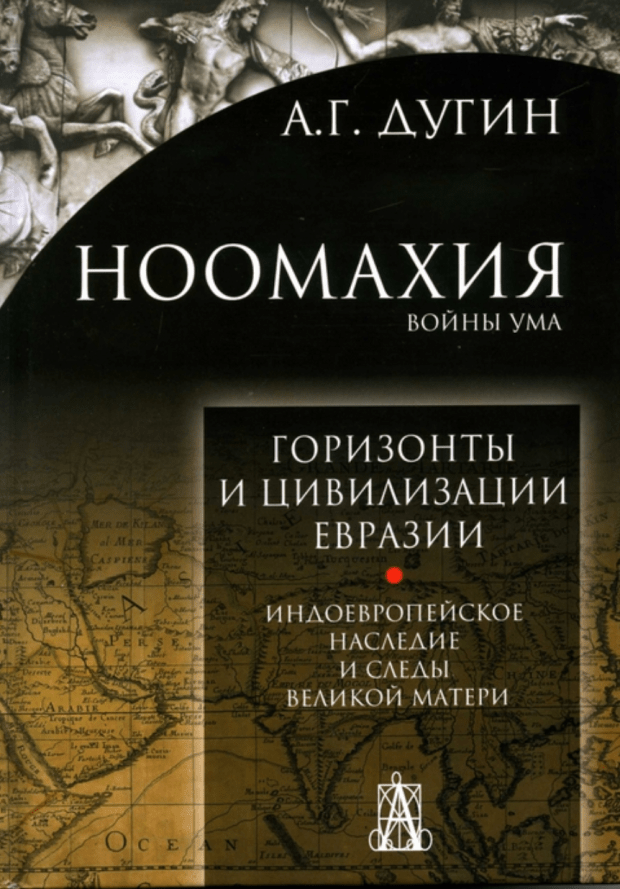
Noomakhia: The Horizons and Civilizations of Eurasia – The Indo-European Legacy and the Traces of the Great Mother

Alexander Dugin, Noomakhia: The Horizons and Civilizations of Eurasia – The Indo-European Legacy and the Traces of the Great Mother
(Moscow: Academic Project, 2017)

Screen Shot 2019-04-22 at 5.05.12 PM

Table of Contents: 

Part I: The Transmission of the Turanian Covenant: The Altaic Invasion 

Chapter 1:  The Altaic Pole

Chapter 2: The Huns: The Pivot of the Turanian Historial

Chapter 3: The Heirs to the Huns: The Bulgars, Sabirs, Avars, and Hungarians

Part II: The Turks in the Elements of Turan

Chapter 4: Sources

Chapter 5: The History of the Turkic Empire

Chapter 6: The End of the “Blue Turks” and the New Peoples

Chapter 7: The Second Empire

Chapter 8: The Religion of the Ancient Turks and Shamanism

Chapter 9: The Turks and Islam: The Sufi Logos

Chapter 10: Turkish Sufism: The Paths of Al-Hallaj

– Excerpt: Imadeddin Nasimi: Man as an Inscription

Chapter 11: The Ottoman Empire of the Source: The Ottoman Formula of Integration

Chapter 12: The Turano-Mediterranean Empire

Chapter 13: The Ottoman Empire and Europe (The Christian and post-Christian World) 

Chapter 14: Modern Turkey

Part III: The Mongols

Chapter 15: The Ancient Mongols

Chapter 16: Genghis Khan: The World Emperor and Son of the Sky

Chapter 17: Mongol Religion

Chapter 18: The Great Powers of the Mongol-Sphere

Chapter 19: The Mongols after Empire

Chapter 20: The Mongol Logos and Buddhism

Part IV: Tibet

Chapter 21: Ancient Tibet

Chapter 22: The Era of Theocracy

Chapter 23: Bon: Ahura-Mazda in Tibet

Part V: The Manchus

Chapter 24: From the Mohe to the Jurchens

Chapter 25: Manchuria and the Qing Dynasty

Chapter 26: The People and Spirits of the Evenki Universe

Chapter 27: Tungusic-Manchurian Shamanism and its Noological Classification

Part VI: The Paleo-Asiatics

Chapter 28: The Paleo-Asiatic Peoples of Eurasia

Chapter 29: Paleo-Asiatic Religion: The Structures of the Northern Spirits

Part VII: The Great Mother and Her Raven

Chapter 31: The Uralic Group

Chapter 32: The Urals in Sacred Geography

Part VIII: The Horizons of the Caucasus 

Chapter 33: The Cartography of the Caucasus 

Chapter 34: The Georgians: Sakartvelo, the Light Country

Chapter 35: The Adyghe

Chapter 36: The Vainakh

Chapter 37: The Historials of the Peoples of Dagestan

Chapter 38: The Religion and Myths of the Eastern Caucasus 

Chapter 39: The Noology of the Caucasus 

Conclusion. The Turning Point of Noomakhia

Introduction to NOOMAKHIA – Video Lecture Series by Alexander Dugin

Lecture series read by Alexander Dugin in Belgrade, Serbia (Spring 2018). 

Lecture 1: Introduction

Lecture 2: Geosophy

Lecture 3: The Logos of Indo-European Civilization

Lecture 4: The Logos of Cybele

Lecture 5: The Logos of Dionysus

Lecture 6: European Civilization

Lecture 7: The Christian Logos

Lecture 8: A Noological Analysis of Modernity

Lecture 9: The Serbian Logos

Lecture 10Noomakhia in the 21st Century

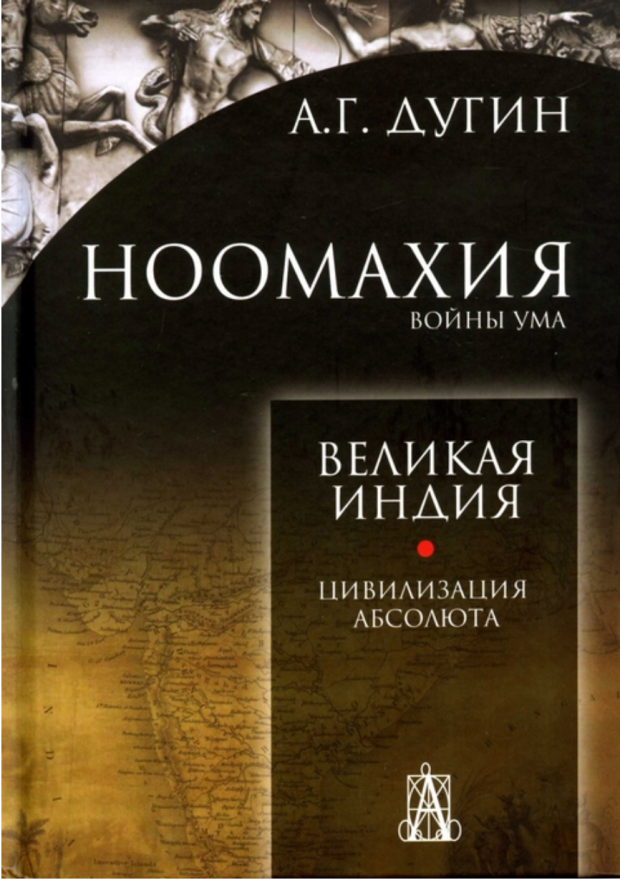
Noomakhia: Great India – Civilization of the Absolute

Alexander Dugin, Noomakhia – Wars of the Mind: Great India – Civilization of the Absolute
(Moscow: Academic Project, 2017)

Screen Shot 2019-04-22 at 5.04.51 PM

Table of Contents:

Introduction: The Indo-Europeans of the Eastern Limits

Part I: Vedic Civilization

Chapter 1: Approaches to Understanding India

Chapter 2: India’s Pre-History

Chapter 3: The Indo-European Ecumene

Chapter 4: Indian Titanomachy

Chapter 5: Varna: Castes of the Great Subject

Chapter 6: Vedic Religion

Chapter 7: The Structure of the Sruti

Chapter 8: The Logos of the Upanishads

Chapter 9: The Religion of Dasa

Chapter 10: The Indian Structure

PART II: The Indian Historial

Chapter 11: Vertical history

Chapter 12: The Conventional History of India

Chapter 13: The Logos of the Sramana: Jainism and Buddhism

Chapter 14: The Mahajamapadas, the Maurya Empire, and Nastika

Chapter 15: The Bhagavad Gita and the Metaphysics of Vishnuism

Chapter 16: Sankhya: The Philosophy of Parkriti and the Awakening of the Snake

Chapter 17: Adi Shakti: Woman vs. Mother

Chapter 18: Brahmasutra: Counter-Strike of the Vedanta

PART III: India in the Middle Ages

Chapter 19: The Structures of the Medieval Historial

Chapter 20: Tantra

Chapter 21: The Three Crowned Kings

Chapter 22: Gondwana: Central and South India in the Middle Ages

Chapter 23:  Advaita Vedanta

Chapter 24: Anti-Advaita

PART IV: Buddhism: Mahayana – The Indian Philosophy of the New Beginning

Chapter 25: The Transformation of Buddhist Metaphysics

Chapter 26: Madhyamaka: How to Philosophize by Emptiness

Chapter 27: Yogachara

Chapter 28: Tathagatagarbha: Non-Duality on the Counter-Attack

Chapter 29: Vajrayana: Sin Transformed

PART V: The Post-Middle-Ages: Islam and India

Chapter 30: After the Middle Ages

Chapter 31: From the Ghaznavids to the Delhi Sultanate

Chapter 32: The Great Moghuls and the Transcendental Unity of the Traditions of Akbar

Chapter 33: The States of North-West India

PART VI: Towards Modernity: From Colonization to Independence

Chapter 34: The European Colonization of India

Chapter 35: Reformed Hinduism

Chapter 36: Fundamentalists and the Politics of Swaraj

Chapter 37: Sanatana Dharma: True Hinduism

Chapter 38: Modern India: Post-Colonial Legitimacy and Deep De-Colonization

Conclusion

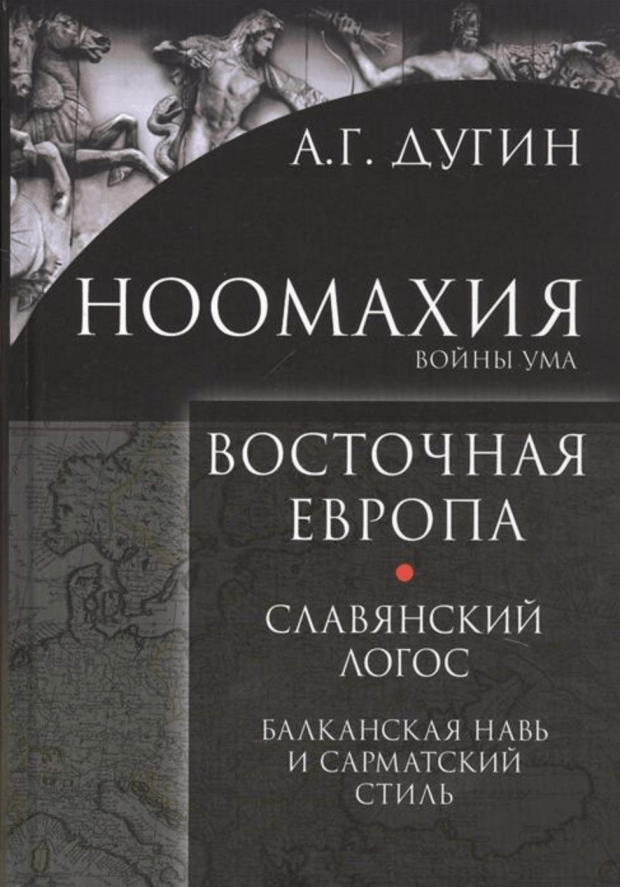
Noomakhia: Eastern Europe: The Slavic Logos

Alexander Dugin, Noomakhia – Eastern Europe: The Slavic Logos – Balkan Nav and Sarmatian Style
(Moscow: Academic Project, 2018)

Screen Shot 2019-04-22 at 4.59.28 PM

Table of Contents:

PART I: The Civilization of the Goddess and the Peasant Ecumene of Europe

Chapter 1: Eastern Europe as a Geosophical Concept

Chapter 2: The Matriarchal Pole of Eastern Europe

Chapter 3: The Turanian Invasion

PART II: The Eastern European Nav

Chapter 4: The Worlds of Nav and the Gestalt of the Vampire 

Chapter 5: The Witch, the Idiot, and the Languages of the Nocturne 

Chapter 6: The Indo-European Element: The Homeland of Dionysus

PART III: The Proto-Slavs

Chapter 7: The Structures of Slavic Identity: The Paleo-European Mother and the Indo-European Father

Chapter 8: At the Dawn of Slavic History

PART IV: The South Slavs: Bulgarian Katechon and the Mission of the Bogomils

Chapter 9: The Bulgarian Historial

Chapter 10: The Parallel Historial of Bulgarian Identity

Chapter 11: Macedonia: Gospel of the Vampire 

Chapter 12: The Structure of the Bulgarian Logos

PART V: Illyrian Civilization: Fiery Serbia and other South Slavs

Chapter 13: The Serbian Historial

Chapter 14: Bosnia: Bogomils and Islamization 

Chapter 15: The Serbian Wail 

Chapter 16: In Search of the Serbian Logos

Chapter 17: The Historial of the Croats 

Chapter 18: The Croatian Logos: Pan-Slavism and/or Nationalism

Chapter 19: Slovenia

Chapter 20: Slovenian Style: Euro-Integration and Nihilism

PART VI: The West Slavs: The Moravo-Bohemian Logos

Chapter 21: The West Slavs in the Slavic World

Chapter 22: Sources and Flight of the Czech State 

Chapter 23: The Czech Logos of the Hussites 

Chapter 24: The Czechs and Modernity

Chapter 25: The Philosophy of the Czech Renaissance

PART VII: The Polish Horizon: Sarmatian Spirit and European Mission

Chapter 26: The North-West Slavs in Antiquity 

Chapter 27: The Polish Historial

Chapter 28: Old Polish Religion

Chapter 29: Union, Partitions, Modernization, Freedom

Chapter 30: Polish Pride and the Polish Logos: The “Christ of Europe”

Chapter 31: Polish Terror

Chapter 32: The Polish Structure

Conclusion: On the Path Towards the Slavic Ereignis

“Noomakhia is the war in the sphere of the mind. The author of Noomakhia examines human history and the present as a ceaseless war between diverse civilizational projects founded on three noological paradigms (the Three Logoi of Apollo, Dionysus, and Cybele). The panorama of humanity presents in all its fullness and diversity the many dialogues, combinations, juxtapositions, appropriations, and annihilations of the Logoi which yield numerous types of rationality, mythologies, philosophies, religions, metaphysics, and constitute the plurality of civilizational constructs.

The space of Eastern Europe is a frontier between two civilizations – Western European and Russian. Precisely here ran the border between the nomadic, Indo-European, patriarchal civilizations of Turan and the matriarchal civilizations of Old Europe (which emerged in Anatolia and spread to the Balkans and Southern Europe), between the Catholic (Latin) Celto-Germanic West and the Russian-Orthodox East. The mosaic of this pivot region’s peoples and religions has never in history been geopolitically united, but this does not mean that the peoples of Eastern Europe cannot develop civilizational unity in the future and retrieve a cultural identity founded on the common Eastern European Dasein.

Since the fifth-sixth centuries A.D., the Slavic peoples have played a decisive role in the space of Eastern Europe. This volume of Noomakhia examines the Slavic horizon of Eastern Europe, which the author calls “Great Slaviania.” In question is not a concrete polity, but the inner unity of the Slavic Dasein, language, and ethno-sociological structure, constituted by the predominance of the settled agricultural population and the allogenic superstructure of a ruling warrior elite, the latter being an indirect trace of Sarmatian, Turanian, or Germanic influence. Alexander Dugin believes that, despite the powerful impact exerted on Slavic horizon of Eastern Europe by a number of non-Slavic peoples and powerful civilizational poles – such as Byzantium, Rome, Germany, France, England, Russia, and the Ottoman Empire – the mosaic of the West and South Slavic peoples, being the foci of mixed, self-sufficient cultures, can in the future form a multi-faceted and fully-fledged civilizational unity.

Noomakhia: The Three Logoi – Apollo, Dionysus, and Cybele

Alexander Dugin, Noomakhia – Wars of the Mind: The Three Logoi – Apollo, Dionysus, and Cybele (Moscow: Academic Project, 2014)

Table of Contents: 

Introduction: The Aims and Tasks of Noomakhia 

Chapter 1: Deconstructing the “Contemporal Moment”: New Horizons in the History of Philosophy

Chapter 2: The Three Logoi: An Introduction to the Triadic Methodology

Chapter 3: Plato: Death, Love, and the Soul

Chapter 4: Aristotle Uncomprehended: The Experience of Phenomenological Reading

Chapter 5: Plotinus: The Radical Challenge of Solar Philosophy

Chapter 6: Valentinus the Gnostic: Sophia and the Structures of the Feminine Logos

Chapter 7: Proclus: The Absolute Philosophy of the Sun

Chapter 8: Hermetism

Chapter 9: Cybele

Chapter 10: Noomakhia and its Vertical Topography

“Noomakhia is the struggle in the sphere of the ideal. The author presents humanity as an ensemble of civilizational paradigms which hold continuous dialogue (whether agreement, struggle, understanding, solidarity, or opposition) between one another over the course of all of world history. The panorama of modern humanity presents a diversity of philosophical Logoi, types of rationalities, and mythological matrices – from the European (bringing together Western European and Eastern European components), the Russian, American, Semitic, Iranian, and Indian to the Chinese, Japanese, African and Oceanic (Polynesian). In deconstructing his reflections on the studied material, the author insists that deconstruction should also be accomplished with respect to the observatory point itself.

The first book of the Noomakhia cycle, The Three Logoi: Apollo, Dionysus, and Cybele, is dedicated to studying the question of the multiplicity of the Logoi and philosophical and mytho-symbolic paradigms which define the structures of different civilizations. This book represents the philosophical and methodological introduction to the Noomakhia cycle; it describes the models of the three Logoi – of Apollo, Dionysus, and Cybele – which, in the author’s opinion, lie at the heart of diverse philosophical, religious, scientific, and political systems. From this angle, the author examines in detail the philosophy of Plato, the Neoplatonists (Plotinus and Proclus), Aristotle’s doctrine of categories, Christian Gnosticism, Hermetism, and various forms of materialist and nominalist worldviews.”

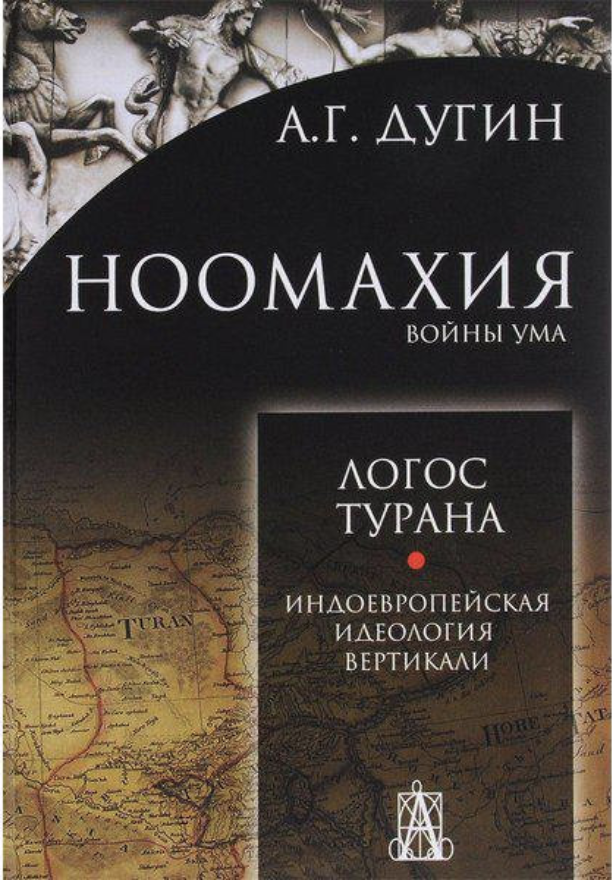
Noomakhia: The Logos of Turan – The Indo-European Ideology of the Verticle

Alexander Dugin, Noomakhia – Wars of the Mind: The Logos of Turan – The Indo-European Ideology of the Verticle (Moscow: Academic Project, 2017)


Screen Shot 2019-04-22 at 12.12.31 PM.png

Table of Contents:

Introduction: Turan as an Idea

PART I: The Indo-European Logos

Chapter 1: Cultures, Peoples, and Languages

Chapter 2: Indo-European Structures

Chapter 3: The Indo-European Proto-Religion: Exclusive Patriarchy

Chapter 4: Dumézil and the Tripartite Ideology

Chapter 5: The Indo-European Foundations of Philosophy

Chapter 6: Marija Gimbutas and the Indo-European Historial

Chapter 7: The Indo-Europeans of the Polar Myth

PART II: The Indo-Europeans Leave the Homeland: The War of Interpretations in Ancient Anatolia

Chapter 8: The Hittites

Chapter 9: The Phrygians and the Descendants of the Hittites

Chapter 10: The Semantic War of Anatolian Horizons: Mutterrecht and Vaterrecht

PART III: The Indo-Europeans Unbroken: The Tocharians, Armenians, and Kurds

Chapter 11: The Tocharians and the “Turanian Language” Hypothesis

Chapter 12: The Armenians: Faithfulness to the Sun

Chapter 13: The Kurds: The Rustling Wings of the Peacock Angel

PART IV: Great Scythia and its Rays

Chapter 14: The Metaphysics of the Great Steppe

Chapter 15: The Scythians: Nomadic Might

Chapter 16: The Peoples of Turan of the Scythian Type

Chapter 17: Afghanistan/Pakistan: The Third Empire

Chapter 18: The Sarmatians: Empire of the Nart

Chapter 19: The Thracians and the Turanian Heritage

Chapter 20: The Germanic Peoples and the Steppe

Chapter 21: The Slavs and Balts in the Horizon of Turan

Conclusion: Turan and the Logos of Apollo in the Indo-European Ecumene

Martin Heidegger, Russia, and Political Philosophy

Author: Leonid Savin

Translator: Jafe Arnold

The works of Martin Heidegger have recently been met with heightened interest in a number of countries. While interpretations of his texts vary widely, it is interesting that Heidegger’s legacy is constantly criticized by liberals across the board, regardless of where and what the object of criticism is – be it Heidegger’s work as a university professor, his interest in Ancient Greek philosophy and related interpretations of antiquity, or his relationship with the political regime in Germany before and after 1945. One gets the impression that liberals intentionally strive to demonize Heidegger and his works, yet the profundity and depth of this German philosopher’s thought gives them no break. Clearly, this is because Heidegger’s ideas harbor a message which is relevant to the creation of a counter-liberal project that can be realized in the most diverse forms. This is the idea of Dasein applied to a political perspective. We will discuss this in more detail below, but first it is necessary to embark on a brief excursion into the history of the study of Martin Heidegger’s ideas in Russia.

In the Soviet Union, Martin Heidegger’s ideas were not known to the general public, primarily because the peak of his activities coincided with Nazi rule in Germany. Heidegger himself, like many ideologists of the conservative revolution in Germany, criticized many aspects of National Socialism, but in the Soviet period any philosophy that did not follow the Marxist tradition was treated as bourgeois, false, and harmful. Perhaps the only exception is the work of Vladimir Bibikhin, although his translations of Heidegger’s Being and Time and Time and Being were published in Russia only after the collapse of the Soviet Union. Moreover, these translations have been repeatedly criticized for having too simplistic of an approach, incorrect terminological interpretations, linguistic mistakes, etc. Bibikhin’s lecture courses on early Heidegger at Moscow State University were delivered only in 1990-1992, i.e., during late Perestroika when the horizons of what was permissible in the USSR were expanding. That being said, it bears noting that a circle of followers of Martin Heidegger’s ideas had formed in the academic sphere in Moscow in the 1980’s. A similar situation took shape in St. Petersburg, which later found manifestation in translation and publishing activities.

Starting in the late 1990’s, other works by this German thinker began to be translated and published. The quality of translations improved considerably (and was done by different authors), and Heidegger’s legacy began to be taught at different Russian universities. Heidegger’s main philosophical concepts became obligatory for students at faculties of philosophy. However, the study of philosophical ideas does not mean that students will become philosophers or appeal to certain such concepts with regards to political processes. Plato and Aristotle are studied from the school-bench early on, but who is seriously engaged in using these philosophers of Ancient Greece’s ideas in discussing socio-political issues today?

Interest in the ideas of Martin Heidegger in the context of Russian politics was triggered in the early 2000’s by the various articles and presentations of the Russian philosopher and geopolitician Alexander Dugin.

Later, these materials were systematized and presented in voluminous texts. In 2010, the publishing house “Academic Project” released Alexander Dugin’s book, Martin Heidegger: The Philosophy of Another Beginning, which was logically succeeded in the following year by Martin Heidegger: The Possibility of a Russian Philosophy. In 2014, both works were released by the same publishing house in a single volume entitled Martin Heidegger: The Last God. Dugin’s interpretation of Heidegger’s ideas is tied to the history of Russian ideas, Orthodox Christianity, and a special path of state development including the theory of Eurasianism.

Needless to say, recounting Heidegger’s philosophical doctrine in a short journal publication would be senseless. Hundreds of volumes have been published in Germany alone which include whole works, lectures, and diaries. For our scope, let us focus merely on some provisions which, in our opinion, are applicable in a political context.

Firstly, it is worth pointing out that Heidegger employed many neologisms to describe the unfolding of time and being. One such key concept is Dasein, which is often translated as “being-here”. The French philosopher Henry Corbin translated this term as “human reality”, but for the sake of genuine, complete understanding, this and many other of Heidegger’s terms are best left untranslated. They should be provided in the original alongside something similar in one’s native language. Other possible variations should also be considered. For example, das Man expresses inauthentic Dasein that has fallen into banality, whereas in authentic existing, Dasein has the property of being-towards-death – Sein zum Tode – which represents existential terror. Terror is counterposed to fear, which imbues the world with external things and the internal world with empty worries. Interesting to note in this regard is the fact that modern Western policies and liberalism as such are built on fear. This tendency dates back centuries and is directly connected to the formation of Western (European) philosophy.

Let us add that another one of Dasein’s properties is spatiality, as space depends on Dasein, while on the other hand it is not a function of time. Dasein conditionally exists between the outer and inner, the past and present, the margin and the instant. Dasein has existential parameters – being-in-the-world (In-der-Welt-Sein), being-in (In-sein), being-with (Mit-sein), care (die Sorge), thrownness (Geworfenheit), Befindlichkeit (attunement, sofindingness, disposedness), fear (Furcht), understanding (Verstehen), discourse (Rede), and mood (Stimmung).

Another important element of Heidegger’s philosophy is the fourfold encompassing Sky, Divinities, Earth, and Mortals – which are depicted in the following manner: the Sky in the upper left, the Divinities (immortals) in the upper right, mortals (people) in the bottom left, and the Earth in the lower right. An axis runs between people and gods and another between Sky and Earth. The center of the fourfold is the most authentic modus of the existence of Dasein.

It should also be noted that Heidegger distinguishes between past and that which has passed, what is present and what is now, and the future and what is forthcoming. Dasein, according to Heidegger, must make a fundamental choice between the forthcoming and the future, i.e., the choice of authentic existing and directly confronting being (Seyn). Then the forthcoming will become the future. If Dasein chooses inauthentic existence, then the forthcoming will only be forthcoming, and therefore will not come into being.

Upon describing all of these elements of Heidegger’s philosophy in detail, Alexander Dugin poses a question: can one speak of a specific Russian Dasein? What are its existentials? In what does it differ from the European Dasein? Dugin arrives at the conclusion that a special Russian Dasein does exist, and not only a Russian one, for at the heart of each civilization lies a particular “thinking presence”, Dasein, which determines the structure of a given civilization’s Logos. As follows, every people (civilization) has its own special set of existentials.

And here we can find the political dimension of Dasein as Dugin sees it in his proposed concept of the Fourth Political Theory. Dugin focuses on three political theories claimed to be universal – Liberalism, Marxism and Fascism (National-Socialism). Each of them has their own subject of history.

Historical experience has proven that the Western liberal world has tried to forcibly impose its will upon all others. According to this idea, all public systems of the Earth are variants of the Western – liberal – system1 and their distinctive features should disappear before the approach of the conclusion of this world epoch.2.

Jean Baudrillard also states that this is not a clash of civilizations, but an almost innate resistance between one universal homogeneous culture and those who resist this globalization.3.

Apart from Liberalism, two more ideologies are known for having tried to achieve world supremacy, namely: Communism (i.e. Marxism in its various aspects) and Fascism/National Socialism. As Alexander Dugin rightly notes, Fascism arose after the first two ideologies and disappeared before them. After the disintegration of the USSR, the Marxism that was born in the 19th Century has been definitely discredited as well. Liberalism, based mainly on individualism and the atomistic society, human rights and the Leviathan-State described by Hobbes, emerged because of bellum omnium contra omnes4 and has long held on.

Here it is necessary to analyze the relation of the aforesaid ideologies in the contexts of their contemporary times and the loci from which they emerged.

We know that Marxism was a somewhat futuristic idea – Marxism prophesied the future victory of Communism at a time that nonetheless remained uncertain. In this regard it is a messianic doctrine, seeing the inevitability of its victory that would usher the culmination and end of the historical process. But Marx was a false prophet and this victory never eventuated.

National Socialism and Fascism, on the contrary, tried to recreate the abundance of a mythic Golden Age, but with a modernist form5. Fascism and National Socialism were attempts to usher in a new cycle of time, laying the basis for a new Civilization in the aftermath of what was seen as a cultural decline and death of the Western Civilization (hence the idea of the Thousand-Year Reich). This was abortive too.

Liberalism (like Marxism) proclaimed the end of history, most cogently described by Francis Fukuyama (as “the End of History and the Last Man)6. Such an end, nonetheless, never took place; and we have instead a nomadic-like “information society” composed of atomized, egoist individuals 7 that consume avidly the fruits of techno-culture. Moreover, tremendous economic collapses are taking place worldwide; violent conflicts occur (numerous local revolts, but also long-term wars on an international scale); and disappointment dominates our world rather than the universal utopia promised in the name of “progress.”8

From such an historical perspective, it is possible to understand the links between the emergence of an ideology within a particular historical epoch, or what has been called the zeitgeist or “spirit of the age.”

Fascism and National Socialism saw the foundations of history in the state (Fascism) or race (Hitlerian National socialism). For Marxism it was the working class and economic relations between classes. Liberalism on the other hand, sees history in terms of the atomized individual detached from the complex of cultural heritage and inter-social contact and communication. However, nobody has hitherto considered as the subject of history the People as Being, with all the richness of intercultural links, traditions, ethnic features and worldview.

If we consider various alternatives, even nominally ‘socialist’ countries have adopted liberal mechanisms and patterns that have exposed regions with a traditional way of life to accelerated transformation, deterioration and outright obliteration. The destruction of the peasantry, religion and family bonds by Marxism were manifestations of this disruption of traditional organic societies, whether in Maoist China or the USSR under Lenin and Trotsky.

This fundamental opposition to tradition embodied in both Liberalism and Marxism can be understood by the method of historical analysis considered above: Marxism and Liberalism both emerged from the same zeitgeist in the instance of these doctrines, from the spirit of money.9

Several attempts to create alternatives to neo-Liberalism are now visible – such as the political Shia in Iran, where the main state goal is the acceleration of the arrival of the Mahdi and the revision of socialism in Latin America (reforms in Bolivia are especially indicative). These anti-Liberal responses, nonetheless, are limited within the borders of their relevant, single statehood.

Ancient Greece is the source of all three theories of political philosophy. It is important to understand that at the beginning of philosophical thought, the Greeks considered the primary question of Being. However, they risked obfuscation by the nuances of the most complicated relation between being and thinking, between pure being (Seyn) and its expression in existence (Seiende), between human being (Dasein) and being in itself (Sein).10

It is noteworthy that three waves of globalization have been the corollaries of the aforementioned three political theories (Marxism, Fascism, and Liberalism). As a result, we need after them a new political theory which will generate a Fourth Wave: the re-establishment of (every) People with its eternal values. In other words, Dasein will be the subject of history. Every People has its very own Dasein. And, of course, after necessary philosophical considerations, political action must proceed.

Let us continue the preceding discussion about Heidegger’s ideas in Russia in the context of politics. It is significant that in Russia in 2016, Heidegger’s notebooks, Ponderings II-VI, known as his “Black Notebooks 1931-1938”, were published by the Gaidar Institute – a liberal organization which Russian conservative circles consider to be a network of agents of Western influence. Yegor Gaidar was the author of the liberal economic reforms in Russia under President Yeltsin and held the post of Minister of Finance in 1992. Gaidar was also acting Prime Minister of the Russian Federation and acting Minister of Economics in 1993-1994. Due to his reforms, the country was subject to inflation, privatization, and many sectors of the economy were ruined. The latter work of Heidegger’s is considered his most politicized, in which he speaks not only of philosophical categories, but of the role of the Germans in history, upbringing and education, as well as the political project of National Socialism. The Gaidar Institute most likely intended to discredit Heidegger’s teachings with such, but the opposite has happened, as the publication of Heidegger’s diaries has been met with widespread interest.

Paradoxically, in this work Heidegger criticizes Liberalism in the following manner: “The ‘liberal’ sees ‘connectedness’ in his own way. He sees only ‘dependencies’ – ‘influences’, but he never understands that there can be an influencing which is of service to the genuine basic stream of all flowing and provides a path and a direction.”11 Let us present a few more quotations from this work which, in our opinion, are of interest with regards to our approach.

The metaphysics of Dasein must become deeper in accord with the innermost structure of that metaphysics and must expand into the metapolitics ‘of’ the historical people.”12

The worthiness for power out of the greatness of Dasein – and Dasein out of the truth of its mission.”13

Education — the effective and binding realization of the power of the state, taking that power as the will of a people to itself.”14

At issue is a leap into specifically historical Da-sein. This leap can be carried out only as the liberation of what is given as endowment into what is given as task.”15

As Dugin has pointed out, if early Heidegger assumed that Dasein is something given, then later Heidegger concluded that Dasein is something that must be discovered, substantiated, and constituted. To this end, it is necessary first and foremost to accomplish a serious intellectual process (see Heidegger’s What is Called Thinking).

It is crucial to understand that although Heidegger’s ideas are considered to be a kind of culmination of European philosophy (which began with the Ancient Greeks, a point which is symbolic in itself since Heidegger built his hypotheses on an analysis of Ancient Greek philosophers), Heidegger is also often classified as a thinker who transcended Eurocentrism. For this reason, still during his lifetime, many of Heidegger’s concepts were welcomed in regions that had developed critiques of philosophy with regards to the European heritage as a whole. For example, enormous interest in Heidegger’s works could be found in 20th century Latin America. In Brazil, Heidegger’s works were addressed by Vicente Ferreira da Silva, in Argentina by Carlos Astrada, Vicente Fantone, Enrique Dussel, and Francisco Romero, in Venezuela by Juan David Garcia Bacca, and in Colombia by Ruben Sierra Mejia. Additional confirmation of this can be found in the words of the Iranian philosopher Ahmad Fardid to the effect that Heidegger can be seen as a figure of global significance, not merely as a representative of European thought. Given that Fardid, who is known for his concept of Gharbzadegi, or “Westoxification”, was a consistent critic of Western thought, which he believed contributed to the emergence of nihilism, such recognition of Heidegger is rather telling.

Indeed, Heidegger has had followers not only in Iran, but in many Asian countries as well. In Japan in the 1930’s, Heidegger’s student Kitaro Nishida founded the Kyoto School of Philosophy. Although in Japan Heidegger was largely considered a bearer of the European spirit (following the Meiji reforms, Japan was swept with excessive enthusiasm for everything European, especially German culture and philosophy), it is interesting to note that Heidegger’s notion of “existence” was redrafted in a Buddhist spirit as “true being” (genjitsu sonzai) and “Nothing” (“Oblivion”) was interpreted as “emptiness” (shunya). In other words, the Japanese interpreted Martin Heidegger’s basic concepts in accordance with their own concepts and often blended his terms with the concepts of such European existentialists as Jean-Paul Sartre, Albert Camus, and Gabriel Marcel. Another Japanese philosopher, Keiji Nishitani, has adapted Heidegger’s ideas to traditional Eastern models, as is so often done in the East. Parallels between traditional Eastern philosophy and Heideggerian analysis have also been drawn in Korea by Hwa Yol Jung.

In this regard, Russia and the study of Martin Heidegger’s legacy form a kind of bridge between Europe and the East, between the rigid rationalism that has subsumed European consciousness since the Middle Ages, and the abstract contemplative thinking characteristic of Asian peoples. Let us say even more directly that Eurasianism and Heideggerianism are in some sense interconnected and spiritually close tendencies among contemporary ideological currents in Russia.

Although these two schools can also be examined as independent philosophical doctrines, as is often done by secular scholars and opportunistic political scientists, any deep understanding of one can be had only upon grasping the other.

Footnotes:

1 For example, the insistence that all states and peoples should adopt the Westminster English parliamentary system as a universal model regardless of ancient traditions, social structures and hierarchies.

2 « Les droits de l´homme et le nouvel occidentalisme » in L’Homme et la socié (numéro spécial [1987], p.9

3 Jean Baudrillard, Power Inferno, Paris: Galilée, 2002. Also see for example Jean Baudrillard, “The Violence of the Global” (< http://www.ctheory.net/articles.aspx?id=385>).

4 In English: War of all against all.

5 Hence the criticism of National Socialism and Fascism by Right-Traditionalists such as Julius Evola. See K R Bolton, Thinkers of the Right (Luton, 2003), p. 173..

6 Francis Fukuyama The End of History and the Last Man , Penguin Books, 1992.

7 G Pascal Zachary, The Global Me, NSW, Australia: Allen and Unwin, 2000.

8 Clive Hamilton, Affluenza: When Too Much is Never Enough, NSW, Australia: Allen and Unwin, 2005.

9 This is the meaning of Spengler’s statement that, “Herein lies the secret of why all radical (i.e. poor) parties necessarily become the tools of the money-powers, the Equites, the Bourse. Theoretically their enemy is capital, but practically they attack, not the Bourse, but Tradition on behalf of the Bourse. This is as true today as it was for the Gracchuan age, and in all countries…” Oswald Spengler, The Decline of the West, (London : George Allen & Unwin , 1971), Vol. 2, p. 464.

10 See Martin Heidegger on these terms.

11 Martin Heidegger, Ponderings II-VI: Black Notebooks 1931-1938 (Bloomington, Indiana University Press, 2016), 28.

12 Ibid, 91.

13 Ibid, 83.

14 Ibid, 89.

15 Ibid, 173.

Civilization as a Discursive Tool of Western Politics

Author: Leonid Savin

Translator: Jafe Arnold 

The following is an excerpt from a forthcoming book on multipolarity…

The notion of civilization was introduced into broad scholarly circulation in the late 18th century by the Scottish philosopher Adam Ferguson, who meant by such a stage in the development of human society characterized by the existence of social classes, cities, writing, and other phenomena. The preceding stages, according to this thinker, were savagery and barbarism. In his Essay on the History of Civil Society, Ferguson remarked: “This progress in the case of man is continued to a greater extent than in that of any other animal. Not only the individual advances from infancy to manhood, but the species itself from rudeness to civilization.”[1] A similar approach was subsequently taken up by many scholars, especially in Soviet times, due to the fact that this view was maintained by Friedrich Engels. This imperative wields influence to this very day, hence such expressions as “civilizational approach”, and “civilized society”, etc. Around the same time, a similar idea was expressed by the English scholar, John Boswell.

The German sociologist Norbert Elias argued that the concept of civilization “expresses the self-consciousness of the West”, and: “By this term Western society seeks to describe what constitutes its special character and what it is proud of: the level of its technology, the nature of its manners, the development of its scientific knowledge or view of the world, and much more.”[2] Elias notes further:

But ‘civilization’ does not mean the same thing to different Western nations. Above all, there is a great difference between the English and French use of the word, on the one hand, and the German use of it, on the other. For the former, the concept sums up in a single term their pride in the significance of their own nations for the progress of the West and of humankind. But in German usage, Zivilisation means something which is indeed useful, but nevertheless only a value of the second rank.[3]

As is characteristic of the German school, Elias shares Spengler’s distinctions between culture and civilization, suggesting that civilization signifies a process or, in the very least, the result of a process. If civilization “plays down” national differences, insofar as the “concept of civilization has the function of giving expression to the continuously expansionist tendency of colonizing groups, the concept of Kultur mirrors the self-consciousness of a nation which had constantly to seek out and constitute its boundaries anew, in a political as well as a spiritual sense, and again and again had to ask itself: ‘What really is our identity?’”[4]

Examining the origins of the contrast between culture and civilization, Elias cites Kant’s 1784 Idea for a Universal History from a Cosmopolitan Point of View, which reads: “The ideal of morality belongs to culture; its use for some simulacrum of morality in the love of honor and outward decorum constitutes mere civilization.” In other words, according to Kant, civilization is a special kind of behavior, even if it is artificially created with the aim of legitimizing social status.

The sociogenesis of the notion of “civilization” is seen analogously in France. “The first literary evidence of the development of the verb civiliser into the concept civilisation is to be found, according to present-day findings, in the work of the elder Mirabeau in the 1760s.”[5]Maribeau wrote:

I marvel to see how our learned views, false on all points, are wrong on what we take to be civilization. If they were asked what civilization is, most people would answer: softening of manners, urbanity, politeness, and a dissemination of knowledge such that propriety is established in place of laws of detail: all that only presents me with the mask of virtue and not its face, and civilization does nothing for society if it does not give it both the form and the substance of virtue.

Elias thus summates:

Concepts such as politesse or civilité had, before the concept civilization was formed and established, practically the same function as the new concept: to express the self-image of the European upper class in relation to others whom its members considered simpler or more primitive, and at the same time to characterize the specific kind of behaviour through which this upper class felt itself different from all simpler and more primitive people.”[6]

This, let us note, means that people from the very same state or nation were seen as backward “barbarians” in the eyes of court-aristocratic and bourgeois circles. If earlier the upper class in all regions of Europe fundamentally opposed the lower strata, the “mobs”, then in the epoch of bourgeois revolutions, the idea appeared that all of society could be “finished up” and led to the state of “civilization.” It was often under this idea that the bourgeoning bourgeoisie fought against caste restrictions and everything that might interfere with their trade and interests. “The consciousness of their own superiority, the consciousness of this ‘civilization’, from now on serves at least those nations which have become colonial conquerors, and therefore a kind of upper class to large sections of the non-European world, as a justification of their rule, to the same degree that earlier the ancestors of the concept of civilization, politesse and civilité, had served the courtly-aristocratic upper class as a justification of theirs.[7] Thus, Elias argues that “civilization” was needed by the West in order to extend its power and influence to other regions of the world through a system of coercion and subordination in various forms. He emphasizes: “In this way civilizing structures are constantly expanding within Western society; both the upper and lower strata are tending to become a kind of upper stratum and the centre of a network of interdependencies spreading over wider and wider areas, both populated and unpopulated[8], of the rest of the world.”[9]

The “spread of civilization” is therefore the penetration of Western institutions and behavioral standards into other countries. Non-Western countries can voluntarily join this process insofar as they see the need for their own survival, the point of which is not only the borrowing of technical skills, but also forms of “civilized” behavior which allow them to enter the network of interdependencies. But the center of this network remains occupied by the people of the West.

 In fact, what Norbert Elias was describing is what is now called “globalization”, although the latter author arrived at these conclusions in the interwar period. In the present time, criticisms of Western civilization in its “exclusive form” have only intensified. For example, Raymond Aaron notes that “suspected, explicit racism could not endlessly resist the opening up of the greatness of other civilizations or the obvious fragility of European supremacy.”[10] Hamid Dabashi from Columbia University argues that the idea of Western civilization was for European nations a kind of umbrella structure asserting the universal identity of European national cultures and to “unify these cultures against their colonial consequences.” Dabashi thus surmises:

Islamic, Indian, or African civilizations were invented contrapuntally by Orientalism, as the intelligence arm of colonialism, in order to match, balance and thus authenticate ‘The Western Civilization.’ All non-western civilizations were therefore invented exactly as such, as negational formulations of the western, thus authenticating the western. Hegel subjected all his preceding human history into civilizational stages leading to the Western Civilization, thus in effect infantilizing, Orientalizing, exoticizing and abnormalizing the entire human history…[11]

Footnotes: 

[1] https://oll.libertyfund.org/titles/ferguson-an-essay-on-the-history-of-civil-society; Accessed in Russian in: Бенвенист Э. Цивилизация. К истории слова Civilization. Contribution a l’histoire du mot // Общая лингвистика. — М.: URSS, 2010.

[2] Norbert Elias, The Civilizing Process: Sociogenetic and Psychogenetic Investigations (Oxford: Blackwell, 2000), 5.

[3] Ibid, 6.

[4] Ibid, 7.

[5] Ibid, 33-34.

[6] Ibid, 34.

[7] Ibid, 43.

[8] The Russian translations reads “colonized and un-colonized”: Норберт Элиас. О процессе цивилизации. Изменения в обществе. Проект теории цивилизации. Т. 2. М.: Университетская книга, 2001. p. 256.

[9] Norbert Elias, The Civilizing Process: Sociogenetic and Psychogenetic Investigations (Oxford: Blackwell, 2000), 381.

[10] Реймон Арон. Избранное: Измерения исторического сознания. – М.: РОССПЭН, 2004. С. 97.

[11] Dabashi Hamid. For the last time: civilizations. Rethinking civilizational analysis// Intern. sociology – L., 2001. – Vol. 16, N3 (Special issue), P. 364.

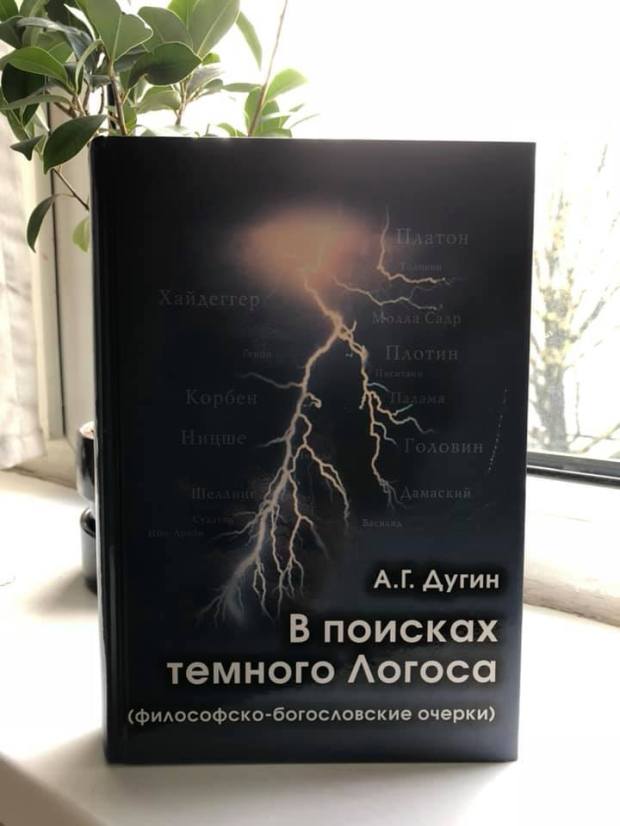
In Search of the Dark Logos

Alexander Dugin, In Search of the Dark Logos: Philosophico-Theological Outlines 

(Moscow: Academic Project/Department of the Sociology of International Relations, Faculty of Sociology, Moscow State University: 2013).

54727479_113018849866166_7704352583703330816_n

TABLE OF CONTENTS: 

Part I: The Moment of Russian Philosophy

Chapter 1: The Hermeneutics of the Russian Languages

Chapter 2: The Moment of Russian Philosophy

Part II: Man and his God

Chapter 3: Three Theologies

Chapter 4: Notes on Humanism

Chapter 5: The Metamorphoses of the Angel (Oppositions and Mediations)

Part III: Open Platonism

Chapter 6: The Pre-Platonists: Sacred Thinking in Pre-Socratic Philosophy

Chapter 7: The Vertical Topography of Plato’s Philosophy

Chapter 8: Non-Dualist Platonism: Noetic Structures in Neo-Platonist Systems

Chapter 9: The Challenge of Valentinus (Dualist Platonism, Pneumatics, and the Soteriology of the Gnostic Valentinus)

Chapter 10: Christianity and Platonism: A Clarification of Proportions

Chapter 11: Platonism in Islam

Chapter 12: Kabbalah and Neo-Platonism

Chapter 13: Traditionalism as a Theory: Sophia, Plato and the Event

Chapter 14: Platonopolis (Plato and the Platonists’ Philosophy of Politics)

Part IV: The Negative Spirit and the Secret of the Urgrund

Chapter 15: Deconstructing Hegel

Chapter 16: Schelling: The Dynamic God and Hierohistory

Part V: The Logos and its Double

Chapter 17: Thinking Chaos and the ‘Other Beginning’ of Philosophy 

Chapter 18: Hallucination and its Structures (Towards a Deconstruction of the End of the World)

Chapter 19: Overcoming Modernity with the Philosophy of Zen (On the Kyoto School of Kitarō Nishida)

Chapter 20: The Radical Subject and the Metaphysics of Pain

Chapter 21: Evgeniy Golovin’s Philosophy of Water

Chapter 22: The Last God (Martin Heidegger and the Eschatological Project of an Alternative Logos)

Chapter 23: The Logos of Dionysus


In the book, In Search of the Dark Logos: Philosophico-Theological Outlines, the contemporary Russian philosopher, sociologist, and political scientist Alexander Dugin explores models of thinking alternative to those that have been perceived as “universal” over the course of the Western European philosophical and theological tradition. The author demonstrates that other forms of the Logos are possible and, based on the methodologies pertaining to the ordering of Logological oppositions, are distinctly different from the typical forms of classical European thought. To explain the structure of this “Dark” or “Dionysian” Logos, the author draws on extensive materials from religious, theological, philosophical, mystical, political, and social doctrines – from Plato and Christianity to Heidegger and the “philosophy of chaos”. According to the author, the rebirth of Russian philosophy must begin with the search for the unclear and elusive reality of the new Logos that remains unreachable to straightforward, “frontal” analysis. This book is of interest to a broad circle of readers, particularly students of the Humanities, philosophers, sociologists, political scientists, culturologists, and theologians.”