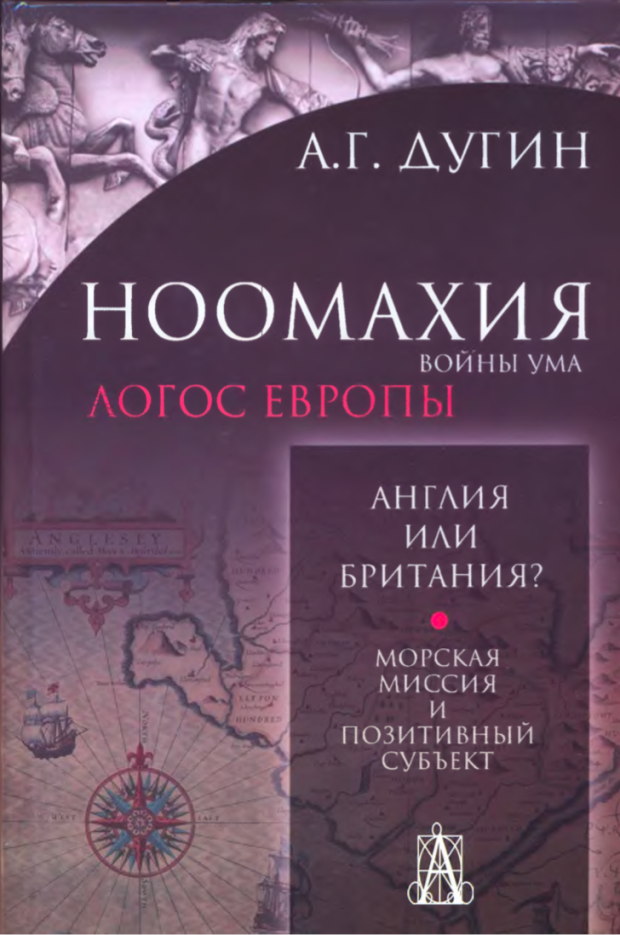
Noomakhia: England or Britain? The Maritime Mission and Positive Subject

Alexander Dugin, Noomakhia – Wars of the Mind: England or Britain? The Maritime Mission and the Positive Subject (Moscow: Academic Project, 2015).

Screen Shot 2019-03-28 at 12.43.43 PM

TABLE OF CONTENTS:

Introduction: England – The Homeland of the “Modern World”

Part I: England or Britain?

Chapter 1: From Britain to England: Ethnoi and States

Chapter 2: Anglo-Britain in the Middle Ages: Two Churches

Chapter 3: The Norman Invasion and the House of Plantagenet: The Franco-English Epoch

Chapter 4: English Theology

Chapter 5: Knights, Damsels, and Fairies in the Anglo-British Lai

Chapter 6: The Reformation

Chapter 7: English Thought at the Foundation of the Paradigm of Modernity: Locke’s Heartland

Chapter 8: Dreams on the Eve of Modernity

Chapter 9; The Yates Paradigm

Chapter 10: Pax Britannica: The Mercantile-Maritime Empire

Chapter 11: In Love with the Mind and in Trust of Feelings

Chapter 12: The Romantics: Gods and Titans in the Meadows of Green England

Chapter 13: Liberalism: The Positive Individual Subject

Chapter 14: Realism and Irony

Chapter 15: The Subtle Charm of Decadence: Pre-Raphaelites, the Dandy, and Satanists

Chapter 16: The 20th Century: Historial and Empire

Chapter 17: English Positivity

Chapter 18: Imperialism, Tradition, and Utopia in English Literature

Chapter 19: The British Invasion

Chapter 20: Conclusion

Part II: The Celtic Pole

Chapter 21: The Celtic Pole of Anglo-British Civilization

Chapter 22: Wales: The Titanomachy of Trees

Chapter 23: Scotland: The Drowsy Titans

Chapter 24: Ireland

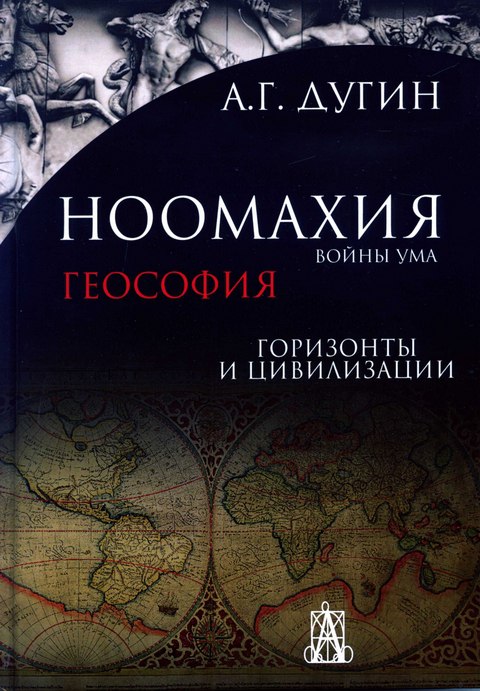
“NOOMAKHIA – Geosophy: Horizons, and Civilizations”

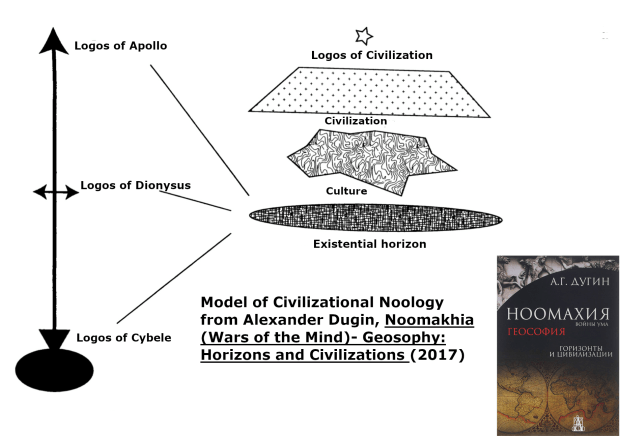
Alexander Dugin, Noomakhia: Wars of the Mind – Geosophy: Horizons and Civilizations (Moscow: Academic Project, 2017).

“A philosophical-methodological introduction and companion to the Greater Noomakhia cycle

geosofiya

TABLE OF CONTENTS: 

Part I: The Basic Concepts of Geosophy

Chapter 1: The Horizons of Cultures: The Geography of Logoi

Chapter 2: Deconstructing Eurocentrism

Chapter 3: Defining Civilizations

Chapter 4: The Topography of Geosophy

Part II: Theories of Civilizations: Criteria, Concepts, Correspondences

Chapter 5: Proclus

Chapter 6: Joachim de Flore

Chapter 7: Giambattista Vico

Chapter 8: Johann Gottfried Herder

Chapter 9: Friedrich von Schelling

Chapter 10: Georg Hegel

Chapter 11: Nikolai Yakovlevich Danilevsky

Chapter 12: Johann Bachofen

Chapter 13: Friedrich Ratzel

Chapter 14: Halford Mackinder

Chapter 15: Carl Schmitt

Chapter 16: Robert Graebner and Wilhelm Schmidt

Chapter 17: Moritz Lazarus, Wilhelm Wundt, and Alfred Vierkandt

Chapter 18: Franz Boas

Chapter 19: Oswald Spengler

Chapter 20: Richard Thurnwald

Chapter 21: Leo Frobenius

Chapter 22: Herman Wirth

Chapter 23: Marija Gimbutas

Chapter 24: Robert Graves

Chapter 25: Károly Kerényi

Chapter 26: Sigmund Freud

Chapter 27: Carl Gustav Jung

Chapter 28: Johan Huizinga

Chapter 29: René Guénon

Chapter 30: Julius Evola

Chapter 31: Mircea Eliade

Chapter 32: Ioan Culianu

Chapter 33: Georges Dumézil

Chapter 34: Pitirim Sorokin

Chapter 35: Gilbert Durand

Chapter 36: Nikolai Trubetzkoy

Chapter 37: Petr Savitsky

Chapter 38: Lev Gumilev

Chapter 39: Arnold Toynbee

Chapter 40: Fernand Braudel

Chapter 41: Samuel Huntington

Chapter 42: A Common Nomenclature of Basic Terminologies

Part III: Pluriversum: Geosophy and its Zones

Chapter 43: A Nomenclature of Horizons and the Plans of Greater Noomakhia

Chapter 44: The Logos of Europe: A History of Rise and Fall

Chapter 45: The Semitic Horizon

Chapter 46: The Horizons of the Two Americas

Chapter 47: The Eurasian Horizon

Chapter 48: The Iranian Logos

Chapter 49: The Indian Logos

Chapter 50: Chinese Civilization

Chapter 51: Japan and its Logos

Chapter 52: African Horizons

Chapter 53: The Horizons of the Pacific

Conclusion


64507530_2036340066661385_799996456982282240_o.png

Distributed Heartland: Towards a Multipolar Geopolitics

Author: Alexander Dugin

Transcript prepared/edited by Jafe Arnold

Dugin’s Expertise – Geopolitica.ru 

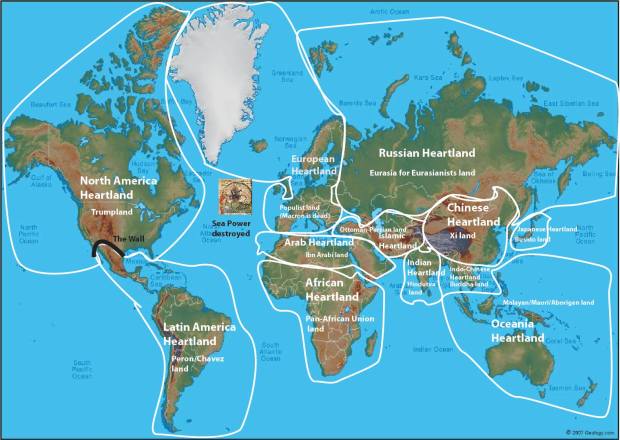
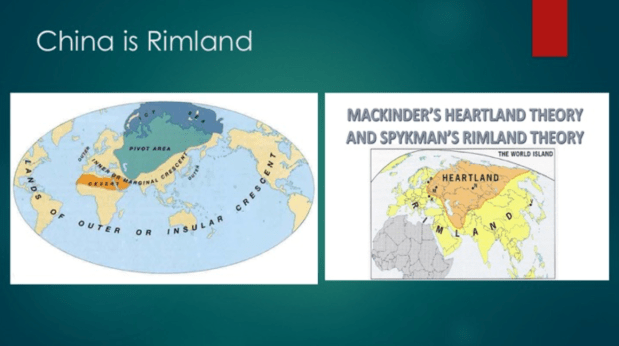
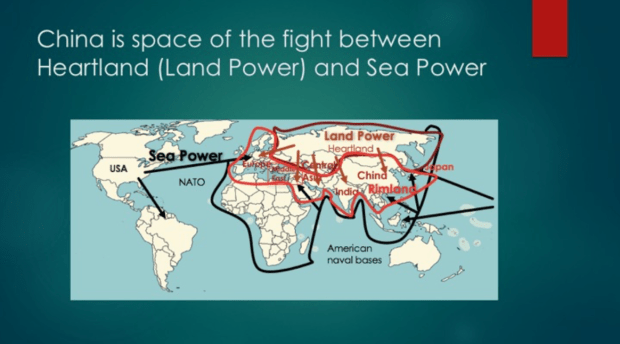
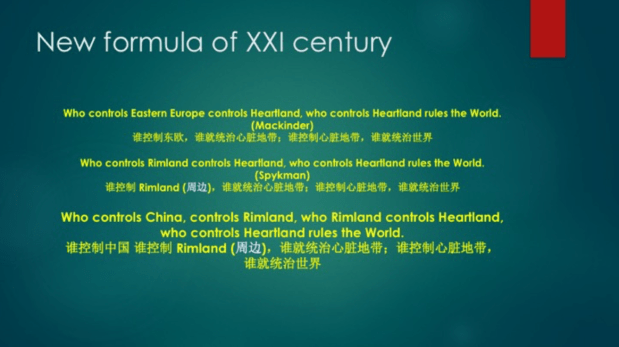
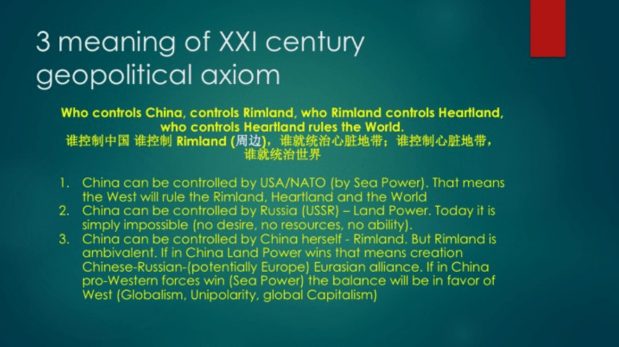
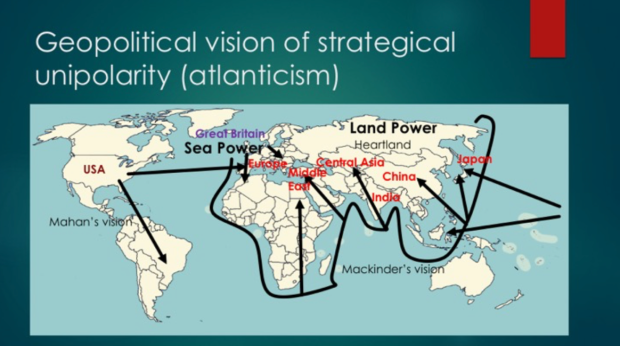
Today we must begin discussing a geopolitical problem which, in my view, is central to the construction of a multipolar world. Those who know geopolitics, know that one of the main laws or concepts of geopolitics is the notion of Heartland. All the classical schools of geopolitics – including the models of Mackinder, Spykman, Haushofer, Brzezinski, etc. – recognize a deep dualism between Heartland – the Continent, the Civilization of Land – and the Civilization of Sea, embodied today in the Anglo-Saxon world, first and foremost the US and its maritime policy. The Civilization of Sea, or Sea Power, attempts to surround Heartland – the Continent, Eurasia – from the sea and control its coastal territories. Sea Power strives to deter the development of Heartland, and thereby realize its domination on a global scale. As Mackinder said, “he who controls Eastern Europe, controls Heartland, and he who controls Heartland, controls the world.” This idea was subsequently developed by Spykman into: “He who controls Rimland (the coastal zone from Europe to China and South-East Asia), controls Heartland, and he who controls Heartland, controls the world.”

The fight to rule Heartland – by Sea Power from without, or in Heartland itself from within – is the main formula of geopolitical history, the very essence of geopolitics. Geopolitics is the battle for Heartland. All schools of geopolitics are founded upon and proceed from this model.

In the bipolar world of the Cold War, Heartland was represented by the Eastern camp, first and foremost the USSR, while Sea Power was the Western camp (Western Europe, the countries loyal to the West in the Middle East, etc.). Heartland, in the face of the USSR, lost this war in the early 1990’s, which marked the beginning of the unipolar moment. The defeat of Heartland in the Great War of Continents initiated the unipolar moment, a unipolar architecture in which the civilization of Sea and Sea Power achieved total domination. Fukuyama thus proclaimed the End of History. Sea Power ruled Heartland externally, such as by means of the Fifth Column at the head of Russian state, as was the case in the 1990’s. Heartland was blocked. Since Putin came to power, Russia has once again begun to step onto the path of sovereignty, and NATO has continued to blockade Russia. In the 1990’s, the battle against Heartland was won by Sea Power, and Heartland was “withdrawn from the system.” Thus began the unipolar moment: the global victory of Sea Power.

Today we often speak about a multipolar world and how Russia, despite its terrible losses, has preserved its identity, come to its senses, returned to itself, returned in history, and has ever so slightly squeezed itself out from under the total domination of the Fifth Column within Russia itself. At the same time, the unipolar domination of Sea Power has somewhat retreated, as Russia has won certain gains. It is obvious that Fukuyama declared the End of History and the global victory of liberalism prematurely. We were indeed close to this being the case, and we can say that we have lived in the unipolar world, but this unipolar world could not be made eternal, could not affirm itself, and thus became but a moment, an episode.

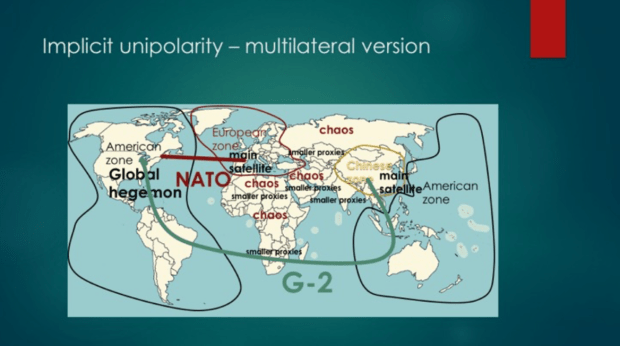
Just as the multipolar world arises, so does a contradiction. If we take into consideration only one Sea Power and one Heartland, then when it comes to speaking of a multipolar world, Russia cannot possibly be the only Heartland. Russia cannot achieve a multipolar world on its own. In the very least, multipolarity entails four or five of the most important poles in the world. Russia could be the center of this multipolar world or only one of its poles. But Russia cannot be the only Heartland.

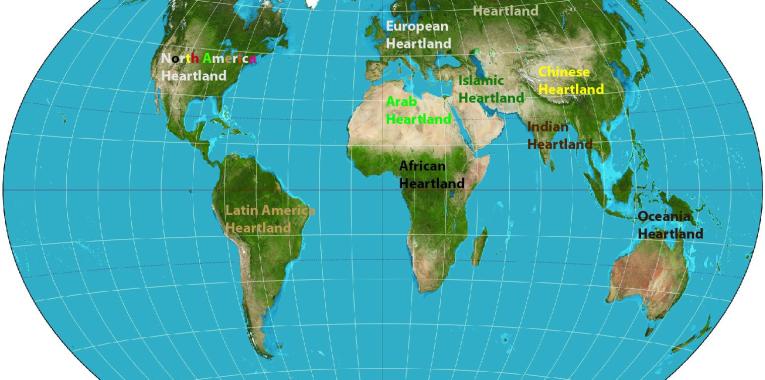
Over the course of numerous discussions, conferences, speeches, lectures, and articles, I have come to the conclusion that it is high time to introduce the notion of an apportioned, or “distributed Heartland.” To this end, I think it is important to attentively examine the German geopolitics of the 1920-’30’s, which proclaimed Germany to be the European Heartland. Of interest to us is not so much Germany itself as the very possibility of considering an additional Heartland.

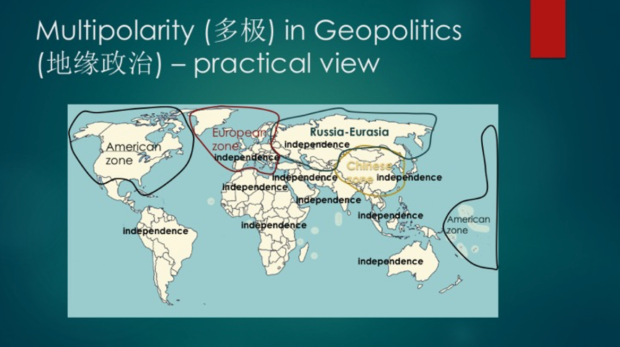
Naturally, there is the Russian, Eurasian Heartland, but it cannot assert itself as Land Power alone. As follows, it is necessary to look attentively into a European Heartland, a European pole: for example, a Franco-Germanic alliance, or the Paris-Berlin-Moscow axis. Continental Europe can be seen as one Heartland which could and should be friendly towards the Russian Heartland, while being an independent phenomenon.

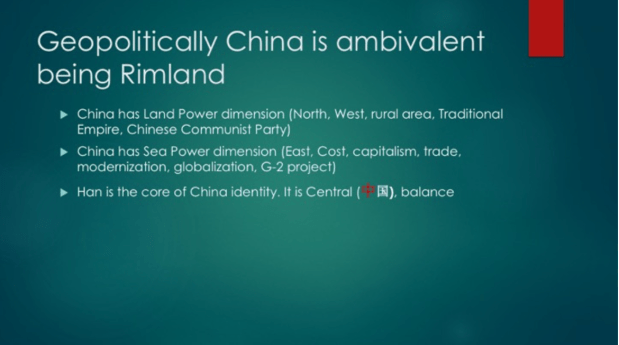
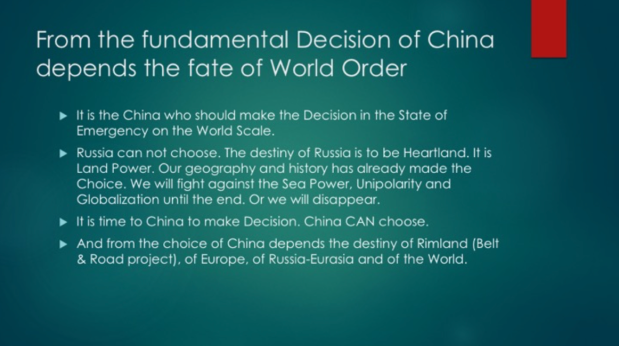
A Chinese Heartland is an altogether different question. China, after all, is Rimland, a coastal zone. If we recognize China as bearing the status of a Heartland, then we are recognizing China as an independent strategic space. If we qualify China as Heartland, then we are emphasizing the conservative aspect of China – China as Land Power. But if China declares itself to be a Heartland against Russia, just as Hitler’s Germany declared itself to be the heart of Eurasia against Soviet Russia, then conflict will immediately arise.

If Russia retains the status of an independent pole, then this “distributed Heartland” acquires a completely different meaning. Then it is possible to consider such Heartlands as a Russian Heartland, as in all traditional geopolitical maps as the “geographical pivot of history”, and a European Heartland. We also arrive at considering a Chinese Heartland, and this means that we consider China as a traditional, conservative, independent, and sovereign state as it is today – and it will only become more so in the future. In the very least, it is important to reconcile the Chinese Heartland with the Russian Heartland, and partially even the European Heartland. But even this is insufficient to constructing a multipolar world. We necessarily have to consider an Islamic Heartland (covering the historical spaces of at least 3-4 empires, stretching from Turkey to Pakistan). The concept of a distributed Heartland can further be expanded to India, and projected onto Latin America and Africa as well.

As follows, there should be an American Heartland in the multipolar system. We have become too accustomed to thinking in the terms of classical geopolitics that the US and Anglo-Saxon world can only be Sea Power. In a multipolar world, America will not be able to play this role, its global maritime range will naturally be reduced, thereby changing the very nature of America. As follows, an American Heartland should arise which, in a multipolar system, should not be seen exclusively as in opposition to other Heartlands. The vote for Trump represented the contours of this American Heartland.

If we begin to conceive of Heartland as a distributed type of culture associated with the reinforcement of conservative identity, then “Make America Great Again” is the thesis of an American Heartland. Stop being a Sea Power, and you will be Great Again. As a Sea Power, you will be miserable, the Deplorables, but you will be Great Again when you become an American Heartland.

Distributed Heartland is the imperative of the new geopolitical model, of multipolar geopolitics. I think that this concept deserves very serious cogitation, pondering, and description. There should be a number of conferences, or an even entire volume devoted to this inevitable question. The efficacy of this concept of distributed Heartland is, in my opinion, extremely important, insofar as the construction of a multipolar world now demands clearer and more precise roadmaps.

In my opinion, the notion of a distributed Heartland is the main, most key moment in the development and materialization of the Theory of the Multipolar World.

53729326_2400054030004623_2596949200977526784_o.jpg

The Gnostic

Author: Alexander Dugin

Source: Open Revolt 

Originally published in 1995 in Limonka, the official newspaper of the National Bolshevik Party.

The time has come to reveal the truth, to expose the spiritual essence of what boot-licking ordinary people call “political extremism.” We have confused them enough by changing the labels of our political sympathies, the color of our heroes, and by passing from fire to cold, from “rightism” to “leftism” and back again. All of this has been but an intellectual artillery barrage, a kind of ideological warm-up.

We have frightened and tempted the extreme right and extreme left, and now both, and others, have lost their way, strayed from the beaten tracks. This is amazing. As the great Evgeniy Golovin liked to repeat: “He who goes against the day, should not fear the night.” There is nothing more pleasant than when the ground is slipping out from under your feet. This is the first experience of flight. It kills vermin. It tempers angels.

Who are we, really? Whose menacing face is it all the more clearly peering out from the paradoxical, radical political movement with the terrifying name “National Bolshevism?”
Today we can respond without any ambiguity and vagueness. But this necessitates a brief excursion into the history of the spirit.

Mankind has always had two types of spirituality, two paths – the “Right Hand Path” and the “Left Hand Path.” The first is characterized by a positive attitude towards the surrounding world, in which harmony, balance, bliss, and peace are seen. All evil is but a particular instance, a local deviation from the norm, something insignificant, transient, having no deep, transcendental causes. The Right Hand Path is also called the “Milky Way.” It does not subject man to any particular suffering; it protects him from radical experiences, leads him away from immersion in suffering, and away from the nightmare of being. This is a false path. It leads to slumber. It leads to nowhere.

The second path, the “Left Hand Path”, sees everything in the reverse. There is no milky bliss, but black suffering; no silent calm, but the festering, fiery drama of split being. This is the “path of wine.” It is destructive, terrifying. Wrath and rage reign on it. In this path, all reality is perceived as hell, as ontological exile, as torture, as submersion into the heart of some kind of unthinkable catastrophe originating from the very heights of the cosmos.

If on the first path everything appears to be good, then on the second path everything appears evil. This path is monstrously difficult, but it is the only true one. On this path it is easy to stumble and even easier to disappear. It guarantees nothing. It entices no one. But only this path is correct. He who takes this path will gain fame and immortality. He who survives it will prevail and receive an award that is higher than being.

He who goes down the Left Hand Path knows that it will end. The dungeon of matter will collapse and be transformed into a heavenly city. A chain of initiates passionately prepares the desired moment, the moment of the End, the triumph of total liberation.

These two paths are not two different religious traditions. Both are possible in all religions, in all confessions, in all churches. There are no external differences between them whatsoever. They concern the most intimate parts of man, his secret essence. They cannot be chosen. They themselves choose a man to be their victim, their servant, their instrument, their weapon.

The Left Hand Path is called “gnosis”, “knowledge.” It is just as bitter as knowledge and it generates sorrow and cold tragedy. Once upon a time in antiquity, when mankind still attached decisive importance to spiritual things, the Gnostics created their own theories on the level of a philosophy, a doctrine, the cosmological mysteries, and on a cult level. Gradually people degenerated, stopped paying attention to the sphere of thought, and plunged into physiology in search of individual comfort in everyday life.

But the Gnostics did not disappear. They moved the dispute to a level of things understandable to modern citizens.

Some of them proclaimed slogans of “social justice”, developed theories of class struggle, and communism. The Mystery of Sophia became “class consciousness”, and the “struggle against the evil Demiurge, the creator of the cursed world” took the shape of social battles. The threads of ancient knowledge stretched to Marx, Nechaev, Lenin, Stalin, Mao, and Che Guevara. The wine of socialist revolution, the joy of rebellion against the forces of fate, and the sacred, berserker passion for total destruction of all that was black for the sake of obtaining a new, otherworldly Light.

Others opposed the ordinariness of everydayness with the secret energy of race, the noise of blood. Against mixing and deformity they raised laws of purity and a new sacrality, a return to the Golden Age, the Great Return. Nietzsche, Heidegger, Evola, Hitler, and Mussolini draped the Gnostic will in national, racial teachings.
It is quite right that the communists didn’t care much for workers, nor Hitler for Germans, but not out of cynicism. Both were obsessed with a deeper, more ancient, more absolute aspiration, the common Gnostic spirit, the secret and terrible light of the Left Hand Path. What workers, what “Aryans”… The point is totally different.

Other creative personalities summoned to the Left Hand Path, the path of gnosis, also floundered between “reds” and “blacks” and “whites” and “browns” in their spiritual quests. Entangling themselves in political doctrines, going to extremes, and yet unable to clearly express the metaphysical contours of their obsession, artists from Shakespeare to Artaud and from Michelangelo to Eemans, from the troubadours to Breton, have drunk the secret wine of suffering, greedily soaking up in society, passions, sects and occult brotherhoods the disparate fragments of a terrible teaching that leaves smiling impossible. The Templars, Dante, Lautréamont. They never smiled in their lives. This is a sign of a special chosenness, a trace of a monstrous experience of something that has been common for all Left Hand Pathers.

The Gnostic looks at our world with his severe gaze – the same gaze as that of his predecessors, the links in the ancient chain of the elect of Horror. A repulsive picture reflects in his eyes. A mad West in consumer psychosis. An East whose dullness and pathetic submissiveness disgusts. A sunken world, a planet lying on the bottom.

“In underwater woods, rush is useless and motion ceases…” (Golovin)

But the Gnostic does not abandon his cause. Not now, not tomorrow, not ever. Moreover, he has every reason to celebrate on the inside. Did we not tell the naive optimists of the “Right Hand Path” where their excessive ontological trust will lead? Did we not predict the degeneration of their creative instinct down to the grotesque parody that is today’s conservatives, who have reconciled with everything that horrified their more sympathetic (but no less hypocritical) predecessors just a few millennia ago? They didn’t listen to us. Now let them blame themselves and read New Age booklets or marketing handbooks.

We have forgiven no one. We have forgotten nothing.

We have not been deceived by the changes in social decorations and political (wanna-be) actors.

We have a very long memory. We have very long hands.

We have a very severe tradition.

The labyrinths of being, the spirals of thoughts, the whirlpools of anger…

Baron Ungern: God of War

Author: Alexander Dugin

Source: Open Revolt

Episode 6 of Alexander Dugin’s “Historico-Magical Meditative Radio Show” FINIS MUNDI

Petrograd, 1920. Feliks Edmundovich Dzerzhinsky is finishing up a report for comrade Lenin:

It seems that Ungern is more dangerous than Semenov. He is stubborn and fanatical. Clever and ruthless. He occupies key positions in Dauria. What are his intentions? To attack Urga in Mongolia or Irkutsk in Siberia? To swing around to Harbin in Manchuria, and then on to Vladivostok? To march on Beijing and restore the Manchurian dynasty to the Chinese throne? His monarchical plans are limitless. But one thing is clear: Ungern is preparing a coup. He is our most dangerous enemy to date. Destroying him is a matter of life and death.”

Dzerzhinsky attached to his report to the Supreme Soviet an excerpt from a letter that had fallen into the hands of Siberian partisans:

The Baron pronounces the words ‘commissar’ and ‘communist’ with hatred, often adding ‘will be hanged.’ He has no favorites, he is unusually firm, adamant in matters of discipline, very cruel, and very gullible…He lives surrounded by Lamas and shamans…Out of addiction to the scandalous and unusual, he calls himself a Buddhist. It is more likely that he belongs to some far-right Baltic sect. His enemies call him the ‘Mad Baron.’”

Baron Roman Fedorovich von Ungern-Sternberg was born on December 20th, 1885 in Graz (Austria) to a family of Baltic aristocrats living in Estonia. His family can be traced back to at least the 18th century. According to reliable data, two of his ancestors belonged to the Knights of the Teutonic Order and fell at the hands of the Poles. His family members served the Order, then Germany, and, finally, the Russian Tsar and Russian Empire. According to the baron himself, his grandfather converted to Buddhism while in India, after which his father and he himself also became Buddhists. The baron graduated gymnasium in Reval (Tallinn) and attended a cadets school in St. Petersburg, where in 1909 he was sent to a Cossack corps in Chita. During an officers quarrel in Chita, the baron challenged his opponent to a duel and wounded him. The baron himself sustained a serious injury, as a result of which he would experience severe headaches throughout the rest of his life, to the point that at times he lost the ability to see.

Because of this duel, the baron was expelled from the corps in July of 1910, from then onwards beginning a journey around Siberia accompanied by only one companion – his hunting dog Misha. Somehow he ended up in Mongolia, which was destined to be his fate. This strange, desert-stretched, wild, ancient and harsh country fascinated Ungern. In Mongolia, the baron managed to get into personal contact with the living Buddha, Kutuktu, the supreme figure of Mongolian Lamaism. At the time, Mongolia was experiencing a revival of imperial sentiments and was seeking independence from China. In Urga, the Mongolian capital, the baron’s determined character was soon noticed, and Kutuktu himself appointed Ungern commander of the Mongol cavalry. Taking advantage of the unrest and revolution in China, the Mongols succeeded in expelling the Chinese occupants from their country, and in 1911 the “living Buddha” established an independent monarchy in Mongolia. 

The baron’s military services for Kutuktu were duly noted, and he became a deeply revered figure in the Mongol world. Before his departure from Mongolia, Baron Ungern, accompanied by his friend Prince Djam Bolon. At the latter’s insistence, Ungern visited a clairvoyant of a most ancient and respected shamanic line. In this fateful moment, in a trance, the clairvoyant revealed to Baron Ungern the secret of his spiritual nature:

I see the God of War…

He rides a gray horse across our steppes and our mountains. You will

Rule over a vast territory, oh white God of War.

I see blood, lots of blood…

A horse…

Lots of blood.

Red blood…

I see no more. The White God of War has disappeared.”

In 1912, Ungern visited Europe – Austria, Germany, and France. According to the testimonies offered in Krauthof’s book on Ungern, Ich Befehle (“I order”), in Paris the baron met and fell in love with the woman of his heart, Danielle. This was just on the eve of the First World War. True to his duty and on the order of the Tsar, the baron was compelled to return to Russia to take his place in the ranks of the imperial army.

Ungern set off back to the Homeland with his sweetheart, Danielle. But in Germany he was threatened with arrest for being an officer of the enemy army. The baron took an extremely risky journey on a small boat across the Baltic Sea. The little vessel was wrecked in a storm, and the lady was killed. The baron’s survival was nothing more than a miracle. From that time on, the baron would never be the same. Thenceforth he paid no attention to women. He became extremely ascetic and extremely, inhumanely cruel. In his review of Krauthof’s book, Julius Evola wrote: “Great passion incinerated all the human elements inside of him, and from then on only the sacred force that stands above life and death remained in him.”

The maelstrom of war pulled him in. The baron fought with inimitable courage against the Austrians, sustaining multiple wounds and being awarded the Cross of St. George and the Sword of Honor for his bravery and selflessness. After the Bolshevik revolution, Ungern was one of the first to engage in merciless battle with the Reds under the command of Ataman Semenov. And in this war, he distinguished himself with unbridled courage, steadfastness, and superb knowledge of military strategy.

Ungern gradually organized his own division consisting of Russian officers, Cossacks, and indigenous Siberians (especially Buryats) who remained faithful to the Emperor. Its full name was the Asian Cavalry Division. Incredible, inhuman discipline reigned in Ungern’s units. The slightest offenses were punished in the most merciless manner up to the death penalty.

Major Antoni Aleksandrowicz, a White officer of Polish origins and former Mongolian artillery instructor, wrote:

Baron Ungern was an outstanding man, extremely complex both psychologically and politically. (1) He saw in Bolshevism the enemy of civilization. (2) He despised Russians for having betrayed their legitimate sovereign and failing to cast off the communist yoke. (3) Nevertheless, among Russians he singled out and liked ordinary peasants and soldiers while he fiercely hated the intelligentsia. (4) He was a Buddhist who was obsessed with the dream of creating a knightly order in the likes of the Teutonic Order and Japanese Bushido. (5) He strove to create a gigantic Asian coalition, with which he wanted to set off on a conquest of Europe to turn it towards the teaching of the Buddha. (6) He was in contact with the Dalai Lama and the Muslims of Asia. He wielded the title of Khan of Mongolia as well as the title of ‘bonze’, or an initiate of Lamaism. (7) He was ruthless to an extent that only an ascetic could be. The absolute absence of sensitivity that was typical of him can be encountered only among beings who know neither pain, joy, pity, nor sorrow. (8) He possessed an extraordinary mind and considerable knowledge. His ability as a medium allowed him to completely accurately understand the nature of whomever he spoke with from the first minute of conversation.”

This account of Baron Ungern, left by a man who served him, was published in 1938 by none other than René Guénon himself in the main Traditionalist organ, the journal Études Traditionnelles.

***

Mongolia once again lost its independence, and its capital, Urga, was occupied by Chinese troops who actively cooperated with Bolshevik agents and provocateurs among the local population. Kutuktu, the living Buddha, was arrested. The absolutely sovereign, spiritually-incarnated, theocratic ruler of Great Free Mongolia was made into a pathetic prisoner.

The White Cause gradually lost on all fronts. After Kolchak’s defeat, only Ataman Semenov and Baron Ungern posed serious, fierce resistance in the East. Pressed on all sides by the Reds, the Asian Cavalry Division entered Mongolia. Its ranks were composed of representatives of many peoples – both European and Asia. Having lost the Russian Empire, the heroes of the Asian Cavalry Division, faithful to the Principle, marched on to restore the Mongol Empire.

Ungern gradually devised a desperate geopolitical plan to create a unique zone in Asia, or more precisely in Mongolia, free from both Bolshevik influence and the troops of the profane West. It would be a unique world in which the ancient laws of the Sacred Tradition would be in force. Ungern was familiar with the books of Saint-Yves d’Alveydre, and knew of the existence of the secret, underground country of Agarttha, where the laws of time are not in effect and where the King of the World, the Chakravarti, resides. Like the Knights Templar, who not only guarded European pilgrims from the Saracens, but also protected the great mysteries of spiritual knowledge from degenerate Catholicism and the secularizing French monarchy, Ungern aimed to create a special zone between the shrines of Tibet, where according to legend lies the entrance to Agarttha, and the rest of the world.

The Name of Mongolia – Khalkha – means ‘Shield.’ It is the ancient homeland of Genghis Khan, the restorer of the Empire of Ram. The mission of Mongolia is to serve as an obstacle in the path of the rabid hordes of apocalyptic humanity – the Gogs and Magogs of Bolshevism, democracy, and the profane world, the freaks of the modern world…Here, and none other than here, Tradition must be restored and a fight be put up against the forces of the West, the citadel of perversion, the source of Evil. The whole destiny of my line is that of going to the East, to the Rising Sun. I have no heirs and I have reached the Eastern edge of Eurasia myself, on my own. There is nowhere further to go. From this magical point of sacred geography shall begin the Great Restoration…Khalkha – the sacred steppes, the Great Shield.”

Ungern entered Mongolia not as a leader of the last unit of an army battered by the Reds, but as a “mythological hero”, an incarnation of the God of War, as the fulfiller of the Swedish mystic Swedenborg’s testament that “only the sages of the Eurasian steppes of Tartary” – Mongolia – “can find the key to the mysteries of the sacred cycles and the original mystical manuscript long ago lost by humanity under the strange title “The War of Jehovah.”

Ungern’s troops neared Chinese-occupied Urga. On February 3rd, 1920 the baron ordered an attack on the Mongol city of Urga, defended by a Chinese garrison which greatly outnumbered the baron’s warriors. Thanks to a rapid and frantic operation in which Ungern himself took part, his men managed to free Kutuktu, the living Buddha, who was guarded by a large and well-armed Chinese unit. Afterwards, the Asian Cavalry Division, together with Mongol units that joined the baron, attacked Urga. It was a brilliant and extremely important Victory. Tradition and Order were restored in Mongolia. Kutuktu appointed the baron the absolute dictator of Mongolia. Baron Ungern became the first European to receive the title Khan of War, Khan-Chan-Chun.

The first part of this mad plan, parallels to which can only be found in the magnificent and brilliant Middle Ages, not in the “skeptical” and “cynical” 20th century, seemed to be coming true. Henceforth, the dictator of Mongolia, Khan-Chan-Chun, or simply Ungern-Khan, the cruel and noble ascetic, initiated his plan to restore the sacred meaning of Khalkha, the magical Shield of the earth.

No, this is not a fairy tale, not a hallucination. This really happened. Relatively recently.

In dark times, the purity of a hero draws such resistance from the degenerate surrounding environment that curbing and subordinating it necessitates extraordinary means. It is only a matter of course that the majority of officers and soldiers of the Asian Cavalry Division, the Russian Cossacks, and servants did not comprehend the sacred ideals of the mad baron. Kolchak and Wrangel’s failures, apathy, and fatigue all demoralized the army. Many could not resist drinking, stealing, looting, and deserting…The corrupting spirit of the decomposing emigration, the Harbin Russian saloons, and vacant spaces among Parisian taxi drivers – all with Russian tears, saliva, and sighs – all irresistibly tempted the broken fragments of Kolchak’s army.

The Khan of War had to resort to extreme measures. He organized a system of severe punishments. 18 officers, some of whom were decorated veterans personally loyal to Ungern, were thrown into the icy, stormy Mongolian river for drunkery. He spared no one and nothing. Some of those who could swim survived. Some didn’t. But the drinking stopped among them and the rest of those who saw the frozen-blue, frostbitten corpses of their comrades. Such was a kind of forced conversion of the Cossacks to shamanism – after all, swimming in the river in winter in one’s clothes by virtue of internal heat, tapas, and then drying one’s clothes on the shore with the warmth of one’s own body, is a typical shamanic practice. There could not have been more appropriate conditions for indulging in such a national custom.

Colonel Sipailov, Ungern’s shadow, nicknamed the “Thug” in the army, behaved even more grimly. Sipailov was a typical “dark twin” [to Ungern]. Such grotesque characters very often accompany the personal path of great men, embodying the dark aspects of the soul of the hero. If Ungern’s brutality was founded on high spiritual asceticism and was akin to a kind to holiness, then Colonel Sipailov was a genuinely mad sadist. For abusing a yard dog, Sipailov shot the best Cossack commander in all of Ungern’s army and put his corpse on public display. Some were beaten to death with whips for all types of faults, even the tiniest spoils. Sipailov was Ungern’s Dzerzhinsky. All the means by which Ungern imposed order in Mongolia and his army strikingly resembled the Bolshevik terror – no wonder the Bolsheviks respected Ungern more than other leaders of the White movement. Behind it all one could glimpse some kind of inner affinity, a unity of common type at that magical point where extreme right meets extreme left, where opposites coincide.

Sipailov’s atrocities were wild and senseless. Only for a short time did this “black double” of Ungern soften, when he met a girl who melted the stale heart of this sadist. For some time, the officers and soldiers sighed with relief as Sipailov, so it seemed, devoted all his time to pretty little Mashenka.

However, according to eyewitnesses, the following scene eventually took place in Ungern’s quarters. Mashenka had prepared a pie for the commanders. Ungern made an exception and allowed for some champagne to be drunk. Sipailov was extremely lively and unexpectedly kind. When the officers asked him to call Mashenka to thank her for such an amazing dish, Sipailov turned pale, went out, and came back with a strange bag in his hands. He pulled the bloody, severed head of his lover out of it and, with a yellow gleam in his eyes, dumped it on the table in front of the dumbfounded officers. He added laconically: “Bolshevik agent.”

***

Mongolia was still in good hands, but the situation became increasingly ominous. The Bolsheviks were winning on all fronts. Ungern gathered his officers at his quarters in Urga:

Gentlemen, bad news. Ataman Semenov has left Chita. The Soviet General Blücher, a Red Teutonic pig, has just occupied the city. His headquarters are in Verkhneudinsk near Lake Baikal. All of Siberia is now Bolshevik.”

And Crimea?”

Crimea is gone. The remnants of Wrangel’s army have fled on the ships of our Western pseudo-allies.”

The situation was as simple and deadly as the tip of a sword. The Baron summed up in one simple phrase:

Gentlemen, there is only one combat-ready White army left: the First Asian Cavalry Division.”

Well, we are the last ones then.”

This is a catastrophe.”

No, Boris Ivanovich, it is not a catastrophe. It is an honor.”

For Ungern, Honor meant Faithfulness. Or, as the profound contemporary poetess Savitri Devi Mukherji said on an altogether similar matter: “‘Faithful when all become unfaithful—while we never forget, never forgive.”

The storm clouds were gathering. Jean Mabire’s book on Baron Ungern describes Ungern’s last meeting with Kutuktu before the Khan of War left Urga forever to move North, to Siberia, where he would put up one last fight against the Bolsheviks.

Kutuktu, the Living Buddha, took his place. His face, in black glasses, was impenetrable as always, but his terrible fatigue was felt in all its force. Only with great difficulty did the old man restrain a nervous shiver. A huge throne with a high gilded back, littered with yellow silk pillows. Ungern bowed. He glanced around. The Baron was not one to deliver long speeches, he restricted himself to an announcement of his decision:

In a few days I am leaving Mongolia. I am going to Baikal to fight our common enemy, the Reds. Your country is henceforth free, and its sons, scattered around the world, should return to their Homeland. Soon the Empire of Genghis Khan will be reborn. You must preserve the freedom that we have won.’

But in his [Kutuktu’s] soul, a storm raged: without Ungern’s support he was nothing, just a blind old man, too feeble and impotent to drive young revolutionaries like Sukhbaatar and Choibolsan out of the country.  Kutuktu asked the Baron to follow him into his office to talk one-on-one.

The divine Kutuktu walked over to a safe oddly framed against the oriental decor of the room. He fumbled with the lock for a long while. Finally, a heavy door slowly opened…Kutuktu reached up the metal shelves for a casket carved out of ivory. Inside was a ruby ring with a solar sign, the Hackenkreuz, the symbol of ancient Aryan conquerors.

Genghis Khan never took this ring off of his right hand.’

Roman Fedorovich von Ungern-Sternberg stared at the jewel in a daze. As if in a dream, he extended his hand to Kutuktu. The old man was shaking and hardly managed to put the ring of the great conqueror onto the Baron’s finger. The Living Buddha blessed Ungern. Putting his hands on his head, he pronounced:

You will not die. You will be re-incarnated in a more perfect form of being. Remember this, living god of war, Khan to whom Mongolia is owed.’

Ungern felt as if the ring was burning his hand.

The Prince of Mongolia and loyal vicar of Kutuktu went out of the palace of Nogon-Orgo. The Lamas parted in front of him. In his resolutely ringing spurs, Ungern swiftly exited the corridor, never once turning back, and went beyond the palace, where he powerlessly collapse into the back seat of a car.

To headquarters’, he told Makeev.

The Baron felt the circle closing.”

Ungern’s forces once again marched onto Russian land. Now it was no longer a war they were waging, but guerrilla operations. Nevertheless, Ungern very seriously worried the Reds. He appeared where least expected, like lighting, suddenly, and would leave destruction and death in his wake. For him, the God of War, this was natural. The best units of the Red Army in Siberia were thrown at him, and General Blücher was made personally responsible for the whole operation.

But this was already agony. In the material world, everything reaches its fateful, fatal point. Ungern, however, was submerged in another reality, where he saw pictures of triumph and victory and the realization of a cherished dream. His being imperceptibly passed on to another, subtle plane which began to interfere with ordinary reality. His subordinates increasingly came to understand that their commander was insane.

Ungern rose, brought out maps, and unfurled them. Laying them out on the grass, with a bamboo cane he traced an imaginary route. He told his faithful assistant, General Rezukhin:

More fantasy, Boris Ivanovich! We go up to Selenga. It’s worse with Urga. We need to choose. Remnants of the White armies are hiding in western Mongolia. They will start to flock to us. Not all the Atamans and Cossacks have died. Together we will go further to the west. Now we are in Altai amidst mountains, caves, gorges, and shepherds who still believe in the incarnated god of war. We can easily cross the border of western Turkestan.’

In Xingjiang the Chinese will arrest you.’

We’ll deal with them quickly and head further south. We have to go through China. Does such a possibility scare you, Boris Ivanovich? The country is falling apart, revolution is in full swing. The only people we’ll come across are cowardly looters and deserters. All together it’s some thousand kilometers, and we are in an impregnable fortress. And we can start everything all over again. Absolutely everything.’

Tibet?’

Yes. The roof of the world. The Dalai Lama, the highest priest of Buddhism, is in Lhasa. Kutuktu occupies the third tier in the hierarchy compared to him. I made a mistake in the very beginning: the center of Asia is not in Mongolia. Mongolia is only the outer circle, the Shield. We should go to Tibet.’

The baron slapped the map with his bamboo stick right on the mountain chain of the Himalayas.

There, among the peaks, we will find people who have not forgotten their Aryan ancestors. On the dizzying border of India and China, my empire will be reborn. We will speak Sanskrit and live according to the principles of the Rig Veda. We will gain the law that Europe has lost. And once again the light of the North will shine. The eternal law, dissolved in the waters of the Ganges and Mediterranean, will prevail.’

The baron rose. His eyes shined. His voice broke into a rasp. A light stubble covered his sunken, fatigued cheeks. He threw back his hair, revealing an enormous forehead. He was the lone and fragile commander of a people absorbed by the shadow of centuries. He continued:

My Order will be on the mountain tops. Between Nepal and Tibet, I will open a school where I will teach strength, which is needed more than wisdom.’

With feverishly shining eyes, he shouted:

Everything is ready! They are waiting for me in Lhasa! I will reveal the secret of the runes that came from the North and hidden in the secret caches of temples. My Order of warrior-monks will be transformed into an army the likes of which have never been seen before. Asia, Europe, and America will tremble.’

‘No’, Rezukhin said.

For the first time, a little general had dared to stand up to Ungern. But this time, it was beyond his own power. He could no longer obey unconditionally. He forgot about discipline and friendship. His hands trembled, his eyes filled with tears. He repeated:

‘No, Roman Fedorovich, no.’

The Baron winced and looked at him. It was as if the word “no” had suddenly destroyed his dream, as if a runaway avalanche had swept away his Buddhist temple perched on a cliff and he flew into the abyss with his mills for prayers and bonzes in saffron robes.

I don’t understand your plans’, Rezushin, ‘I know only one army – the Tsarist. And one religion – Christianity. But that is not the point. The point is that we will never make it to Lhasa. Look at the map. We can’t cross Chinese Turkestan. And Manchuria is just a stone’s throw away. It’s enough to just head East.’

Never!’, the Baron cried out, ‘Only Tibet!’

Ungern was almost alone, if not for the lot of those who had not been killed and who remained loyal, who had Honor, like him, and Faithfulness too. Ungern rode across the Altai highlands on his favorite filly, Masha, and visions overcame him.

Here on the fortress monastery flies a banner with the golden horseshoe and solar sign of Genghis Khan. The waves of the Baltic Sea break against the mass of Tibet. The ascent, the eternal ascent to the roof of the world, where there is light and force. Ascent…”

The grey horse stumbled on a stone. The dream disappeared, absorbed by mirage that enveloped the sweltering earth.

The dreams of the God of War were a premonition of what is sure to happen – not now, but on another turn of the Eternal Return. He who is truly alive will never know death.

1921. The end. Betrayal. Ungern was captured by the Reds. General Blücher had ordered that Ungern be treated like a Soviet officer. The Red Guards took him to the company command post of the revolutionary military committee of the Yenisei.

Blücher personally met Ungern and proposed that he join the Bolsheviks. Both spoke in German. Blücher spoke of Eurasianists, National Bolshevism, and a special line in the Soviet leadership, a national one, which was merely superficially covered with “Marxist phraseology”, and which was striving to build a gigantic, continental, Traditionalist state not only in Mongolia, but throughout all of Eurasia. Blucher promised the Baron full amnesty and a high position. At the same time, in a secret department of the OGPU, headed by the Martinist Gleb Boki, plans were being developed for an expedition to Tibet, for the transformation of spiritual Bolshevism into a new kind of spiritual reality.

The Baron refused all the offers. Or at least that’s what official history maintains. On September 12th, 1921, Baron Ungern-Sternberg was shot. The God of War was dead.

But do Gods die? If you are asking this, you are absolutely right. They can go away, but they cannot die.

To this day, a legend circulates through Mongolian and Buryat religious circles: “From the North came a white warrior who raised the Mongols, called on them to break the chains of slavery fettering their free land. This white warrior was the embodiment of Genghis Khan, and he predicted the coming of an even greater one…”

The “even greater one” is the Tenth Avatar, the Avenger, the Triumphant, the Fearsome Judge. All Traditions call him by different names. But the essence does not change. The defeat of “ours” is only an eschatological illusion. To embrace it is immoral. Our duty is to stand to the end. It does not matter if we lose every last one and everything losable. Our Honor is in Faithfulness.

To challenge the doom of the dark ages – this gesture itself already harbors the highest reward.

And then a little later the avengers will catch up…the Last Battalion…the Wild Hunt of Odin. “Our” forces – with a golden banner flaunting the black rune UR, the sign of the Cosmic Midnight, the personal standard of the God of War, Baron Roman Fedorovich Ungern-Sternberg, harbinger of the Avatar.

Dugin in Shanghai: China in International Relations

“China in International Relations: Geopolitics, Globalization, and Hegemony” 

Author: Alexander Dugin

Transcript prepared by Jafe Arnold

Lecture #4 delivered at the China Institute of Fudan University, Shanghai, China, December 2018 [VIDEO]

Screen Shot 2019-02-04 at 9.39.20 PM.png

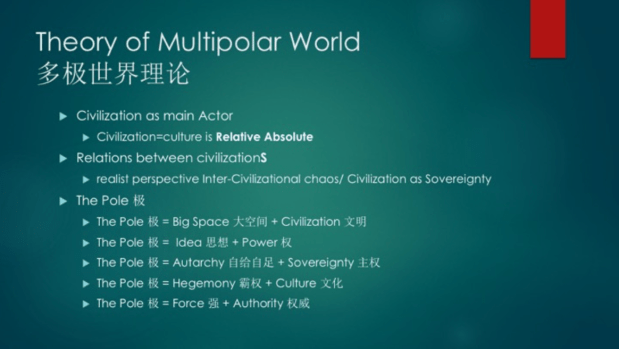
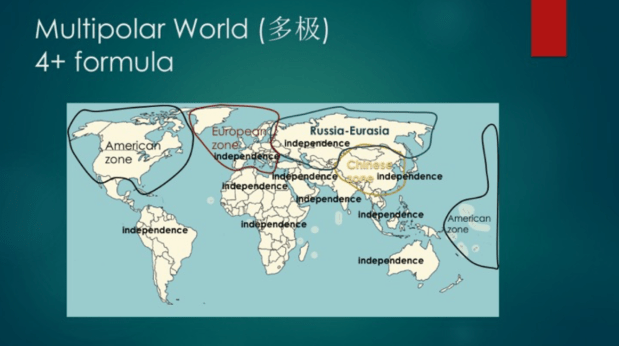
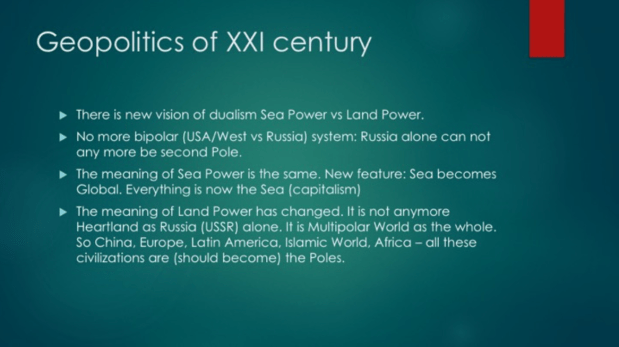
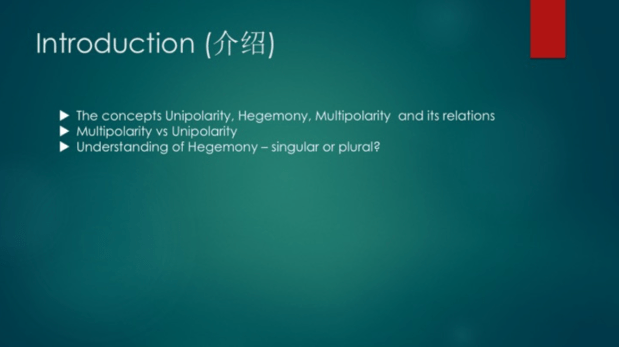
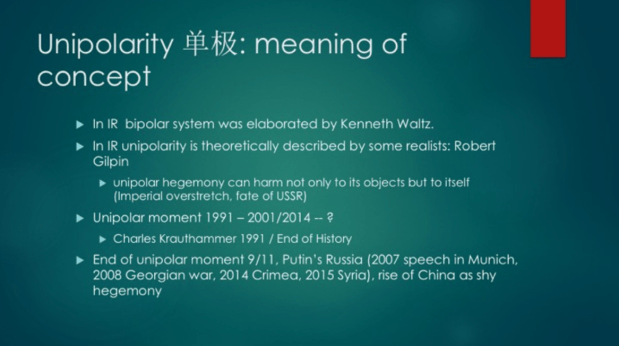
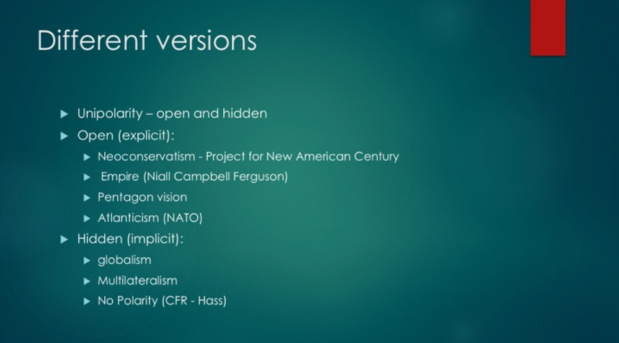
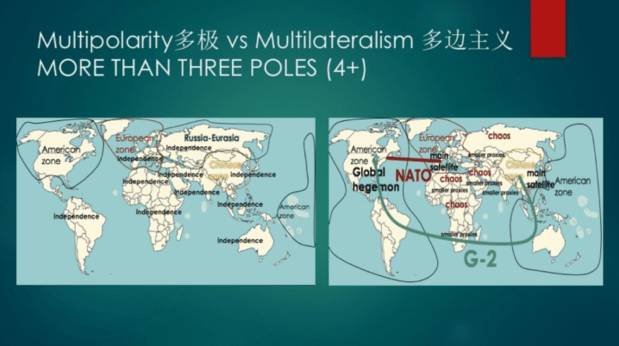
Today’s lecture will be dedicated to Chinese identity in different fields of science. In the first lecture I explained the main structure of the science of international relations, the main concepts, theories, schools, and debates. In the second lecture I explained what geopolitics is. We have explored the geopolitical vision of Sea Power vs. Land Power. In the third lecture I explained multipolarity and multipolar theory, which insists that there should be more than 4 poles, or at least 4 poles – the US, China, Russia, and Europe – and not only one, Western pole. Today, I will try to put China in all of these fields of research in order to better understand what modern China is in these three contexts.

Screen Shot 2019-02-04 at 9.39.25 PM

We are going to study the main, most important, or I would say central question: What is China? But we cannot start from the parts in order to come to the whole, because we cannot understand the meaning of the parts without knowledge of the whole. We cannot proceed in the opposite way either, because we do not know the whole. We need to use the philosophical method of hermeneutics in order to discover what China is through the process. We do not know what China is – nobody knows. China is a mystery. We are not going to reveal or explain this mystery, but we are going to enter this mystery, to try and think about Chinese identity, and put China’s identity into different philosophical, geopolitical, and intellectual contexts, to find China’s place in the world, but at the same time to define what China is here. The world is presumed to be whole, while China is only a part, but without knowing what China is or what the world is, we cannot find find the place. We are going to proceed together in this hermeneutic approach from Schleiermacher.

We should establish some hypothesis on what China is, after which we can make a kind of reality-check. This is not a dogmatic definition of China, but a kind of presumption or phenomenological approach. In order to understand this, we need to make some very important statements. Every statement here is of crucial importance.

Screen Shot 2019-02-04 at 9.39.30 PM

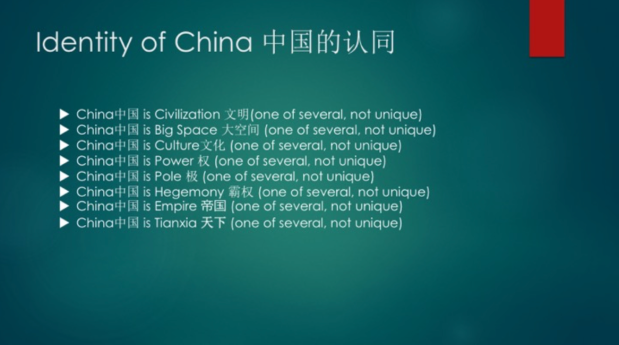
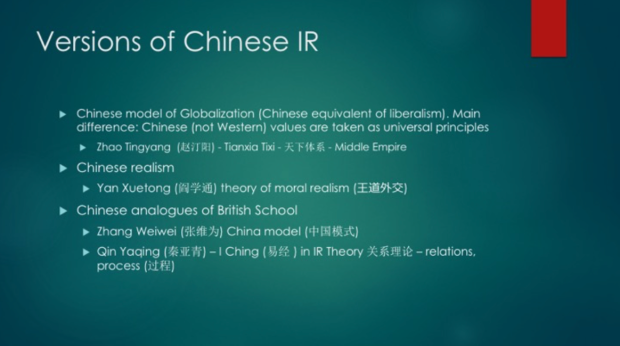
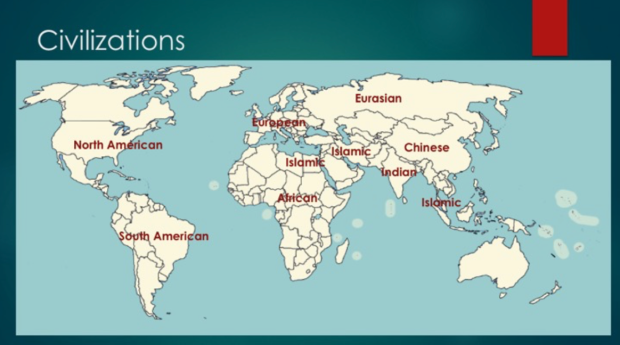
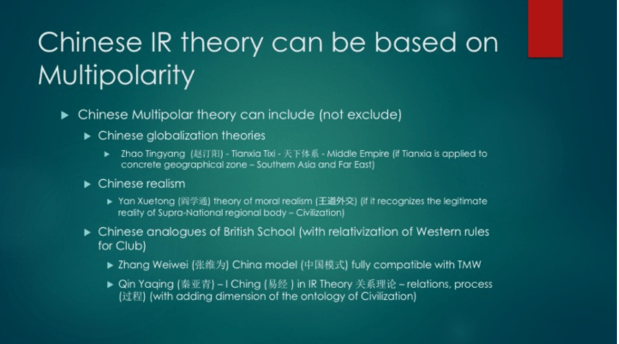
China is a civilization. That means not whole Civilization, obviously, as there are civilizations outside of China. China is one of the many civilizations. Being a civilization, China represents something complete and perfect, autonomous, and self-sufficient. To be a civilization means to have one’s own measure inside, not outside. A civilization can measure its control and define its own values, progress or failure, using its own tools. Civilization means many things. It is the highest point of more complex, integral concepts. It is something that Professor Zhao Tingyang, whom I met in Beijing and I have a great impression of, means by Tianxia (天下). Tianxia (天下) is not a country, it is a system or civilization.

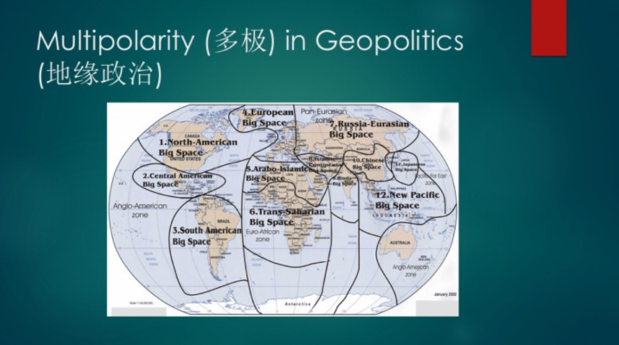
In geopolitics, China is a Big Space. For example Canada, which is a big country, is not a big space, because it could not represent this space as unified, centralized, historically united. North America is a big space, not Canada. Not every geographical big space is a geopolitical big space, but China is. China historically controls a big geographical zone that is united politically, socially, culturally, historically, religiously, by writing, by Han identity, and so on.

China is a culture. Chinese culture is more than the Chinese state, because the people of Taiwan and some non-Chinese, non-Han people share more or less the same culture, such as the Vietnamese, the Koreans, and partly the Japanese. Their identities and cultures were formed under the huge impact and influence of Chinese culture. Chinese culture is something supra-Chinese, something more than Chinese, because this culture can be given to others, and they can share this culture, such as the writing system for example.

China is a power, because it has political, economic, demographic, geopolitical, strategic, and military resources. It can oblige others to do something. If someone wanted to attack China, China could respond in any way. China is a power that can defend its sovereignty.

China is a pole in the multipolar system. I will explain later what concretely this means. When we are speaking about multipolarity, we immediately imagine the Western pole without any doubt as to it being a civilization, power, and big space. But next to the West today, China is also immediately a most important pole in the world.

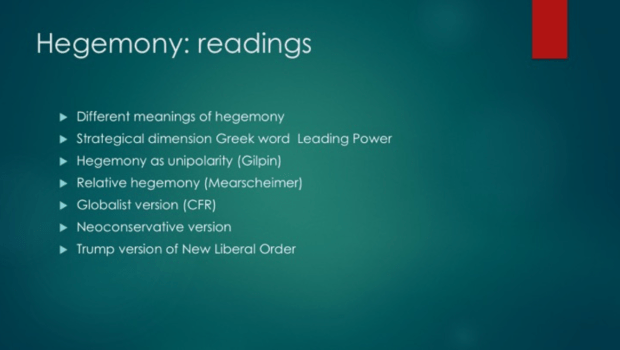
China is hegemony, but obviously China is not the only hegemony, or leading force. There are other hegemonies outside of China. China is a regional hegemony. It could lead and exercise leadership in some circle around China beyond its borders, but not too far. In some definite space, the same with culture, civilization, and power, China is a kind of center of hegemony that, compared to other countries that are close to China, is a real leading force.

China is an empire, not only in the traditional sense, but also in the idea of unifying national, political units. An empire is not one political state, but something more – a system. Tianxia  (天下)can be mentioned here. It is something that unites more than one political subject and can expand its influence over greater space.

Thus, finally, China is Tianxia (天下).

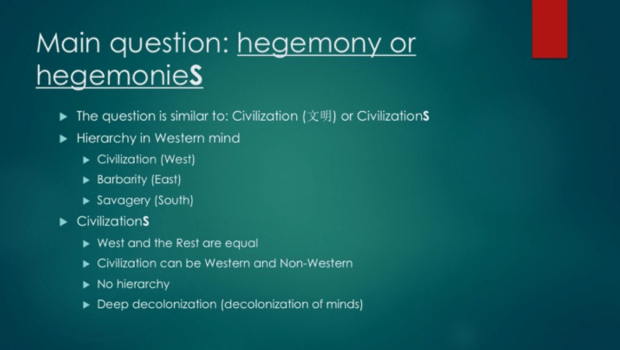
All of these definitions should not be considered in an absolute sense, as all these definitions can be applied to China only if we add “one of several, not unique.” It is one civilization, but there are others. It is one big space, but there are others. It is a culture, but there are other cultures. China is a power, but there are other powers. China is a pole, but there are certainly other poles. China is hegemony, but there are other hegemonies. China is an empire, but there are other empires. That is precisely what we argued with Zhao Tingyang concerning the meaning of Tianxia (天下). I will explain later, but the idea in my opinion, the point of divergence with Zhao Tingyang is that China is one possible Tianxia (天下), not the only one, as there are other global structures. For example, there is the American concept of a global world; there can be imagined the multipolar concept of a global world, and there is one Chinese investment in globalization in the form of a universal organization based on the Tianxia theory (天下 体系). We need to understand this project as one of several. Zhao Tingyang, who is the founder and author of Tianxia theory (天下 体系), has said that his concept has been hijacked by some American professor who has written a book on the American Tianxia. According to this professor, only the American Tianxia is the real Tianxia and China’s is only a provincial version. This means that you can propose your global system, but you cannot be sure that it will be accepted by everybody else, at least theoretically.  There is a fight for Tianxia (天下). This is already important because American scholars are beginning to borrow Chinese concepts – that is a very great and positive sign, a real sign of multipolarity.

Screen Shot 2019-02-04 at 9.39.36 PM

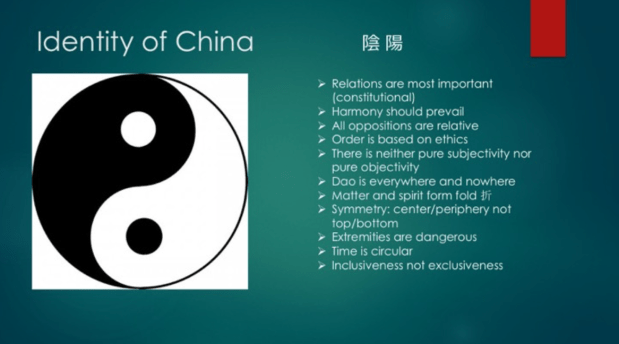
The identity of traditional China can be summed up with other definitions. We are speaking about cultural identity. The Yin-Yang system (陰陽) is based on some important sentences, axes, or laws. Relations are more important than ontological units. It is not of importance what is one thing and what is another, but how they relate to each other – relations and the relativity between two things, rather than these things themselves, because there is no eternal essence. It is not essentialism. Things are changing and relations between them are changing as well. But relations are more stable than things themselves. That is a completely non-Western vision. The Western vision is that things or essences are much more important than relations. Relations could change, but things not. China is quite the opposite. Nature can be flexible, but relations stay. That is the Yin-Yang (陰陽) concept of relations. That is the Yin-Yang (陰陽) vision. Relations are eternal. Harmony should prevail. Harmony is balance, not the victory of Yin over Yang or Yang over Yin. There is no radical opposition between them. There is a kind of play. All oppositions are relative.

Order is based on ethics more than power. Ethics is the highest of things; it is balance and the recognition of the rules of the “play.” Ethics are not a result of the balance of power, as in the Western attitude. There is neither pure subjectivity nor pure objectivity. This is an application of the concept that relations prevail. There is no Western Cartesian subject, nor Western object. There is something subjective in nature, in human culture. You cannot trace here such a radical dividing line as in Western culture. That is why you, Chinese, have such a great admiration for stones. Stones are made by nature. You see the subjective element in stones, for example in Confucius’ temple here in Shanghai which I’ve visited here with Dr. Wang Pei. These stones are considered to be works of art, because nature is the artist, and man is a little bit of nature.

The Dao () is everywhere and nowhere. You cannot say that there is a God, Beauty, or a most important value. When you show your ideal, you lose it. When you speak the word, you lose the word. This is a kind of appreciation of silence. As Dr. Pei Wang has reminded, if you listen to silence properly, you can hear the sound of thunder. If you say that the Dao () is everywhere or just nowhere, that is a lie. The Dao () is outside, as the highest value that encompasses and surrounds everything and is at the center of the thing. It is relational.

Matter and spirit form a kind of “fold.” You can go the way of matter and come into the spirit. There is no strict dividing line between soul and body, because matter and spirit are not in opposition, but are relative. They are something that you cannot define radically as in “here is the body, and there is the soul.” They are intermingled in some way. So there is not only care for the body, because in caring about your body, you are caring about your soul, and vice versa. That is the Tai Chi (太极拳) principle. This is the Chinese way of understanding things.

The prevailing symmetry in Chinese identity is the Center vs. Periphery, not Top vs. Bottom. At the center is the Yellow Emperor Huangdi (黃帝) and there is the periphery. But there is no radical opposition between Top vs. Bottom. Rather it is a matter of concentration and degrees of ontological concentration.

Extremities are dangerous. When you come to the extreme, you lose relations with the whole. Going to extremes, you can lose relations with Being, the Dao (), harmony, and the game of proportions.

Time is circular; it is not linear. The year starts again exactly at the same point where you begin, the New Year.

There is inclusiveness, not exclusiveness.

These are the main characteristics of Chinese identity. When we go to Western identity, we lose something important, these two points: the Yin and Yang.

Screen Shot 2019-02-04 at 9.39.42 PM

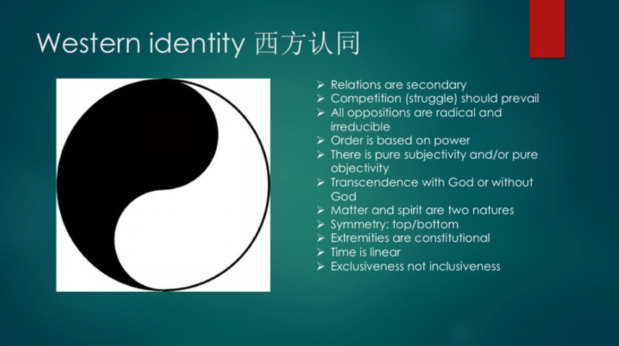
We are coming to a radical dualism that is completely different from Chinese identity. If we try to describe the Western, not Chinese, we will see almost immediately totally different sentences: relations are secondary, and essences are of more importance; competition and struggle, not harmony, should prevail; all oppositions are radical and irreducible. There cannot be an intermediary term between, for example, Good and Evil. There is a dividing line in all the structure of this non-Chinese identity. Order is based on power, not on ethics. Power comes first, while ethics is of secondary importance. There is pure subjectivity and/or pure objectivity – all systems of Western thought are based either on subjective idealism, which in its radical form denies the reality of the external world, or objective materialism, in which case the subject is regarded only as a reflection or mirror of matter. The subject and object are always outside of Chinese culture and philosophy.

Transcendence with God or without God. Transcendence is the absence of something common between the creator and creation. That is a basic aspect of monotheistic religion: God is transcendent, which means that he is incompatible with reality. Only God is; reality is not. In the materialist version, there is the same, only reality is; God does not exist. That is the modern version of the same transcendental attitude. In the modern sense, only material reality exists. As Nietzsche has said, God is dead – we have killed. him So transcendence at the same time prevails in the normal monotheistic theology of Western religions, or without them.

Matter and spirit are two natures. That is an absolute principle of Western identity.

In terms of symmetry, there is the top and the bottom, hierarchies, and taxonomies of different kinds, in which everything is included only based around the vertical line. The top is everything; the bottom is nothing. The top is Paradise or Heaven; the bottom is Hell.

Extremities are constitutional and very important in Western identity, because they create the space, because they go first.

Time is linear. Time is an arrow. Time is not seasons, but is an event that can never, or very rarely, be repeated. The difference between the event and the season is that an event does not repeat.

Exclusiveness, not inclusiveness, means that you organize reality by making strong differentiations between elements. The only way to understand something is to analyze it. What is analyzing in Greek? It is division, separation. To understand a thing, you should kill it and separate it apart, and afterwards try to re-combine and revive the dead system.

That is duality. Chinese culture is non-duality. This is important, because this means that Chinese identity is clearly not Western, but is also not sub-Western or would-be-Western. It is a completely different world organized on a different basis.

Screen Shot 2019-02-04 at 9.39.47 PM

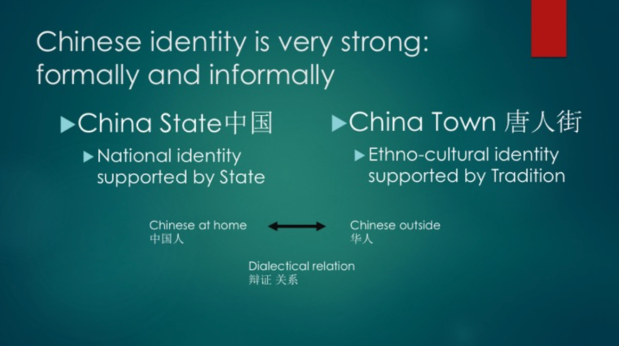
Now we see how deep Chinese identity is. When we speak about the China State, 中国(Zhōngguó), we can say that there is a national identity supported by the Chinese state. This means that the things I have mentioned exist only because of the state, the Confucianist state, the Imperial state, the Communist state – through all of Chinese history, there was a state that promoted these values, the values of Chinese culture, with an educational system, traditions, and way of life – everything was based on these continuations of Chinese identity. But when we go to China Town (唐人街) in the West, there is no China State. There is no necessity to follow this route by going abroad, and one can easily accept the values of other cultures. Sometimes there are no obstacles. But in Washington, in modern days – I was there in 2005 – near the White House, there is a huge Chinatown where everyone is Chinese – with Chinese restaurants, Chinese names, Chinese food, and Chinese speaking Chinese. They are not obliged; there is no state obliging them to be Chinese, but they prefer to stay Chinese. So here we have something more than an artificially constructed identity. We have something deeper than that. If we say that by changing the Chinese state, you will receive another culture, then Chinatown is a great example that this is not so simple. Sometimes Chinese live abroad 10, 20, sometimes 30 years, return to China and they are totally devoted to the Communist Party, to Chinese identity and Confucianism.

That is the great resistance of identity. Identity is not only about the state, nationality, and education; it is much deeper. Chinese identity can be preserved, developed, affirmed, and conserved in different situations and societies. Between the Chinese in China and the Chinese abroad, there is an important dialectical relationship. Chinese identity could exist outside of the state, and if you were to ask Chinese outside what kind of order they prefer, they will almost totally prefer the Chinese order and way of life. That is existential. “Chinese” is defined by Chinese culture, not by the outside, external structure of the state or society. The meaning of Chinese identity is such that it is already included in it. Outside, things can change, while inside there can be a balance – this is the relations-state. For example, you could modernize some part of your society, but other parts will be more conservative, in order to preserve the balance. That is flexible, not radical; this is an inclusive, relations-based, and very stable Chinese identity. It is eternal, like the seasons, or the Mandate of Heaven – you could lose such with one emperor or system, but you will certainly find it with another. You can return to the same point and start the next cycle, the next year.

Screen Shot 2019-02-04 at 9.39.54 PM

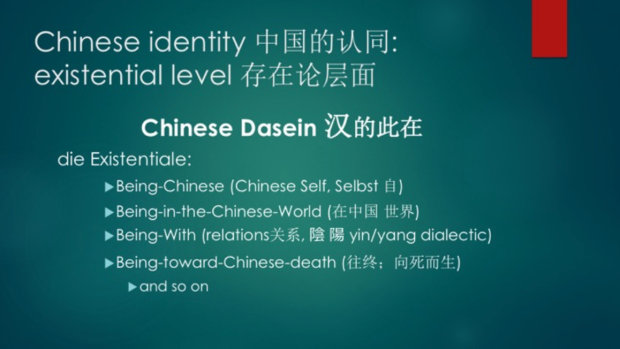
What we get from this analysis, this comparison of the China State and Chinatown, is that Chinese identity is deeper than both. The China state, and the Chinese living outside of China, have a main, common denominator. I call this the Chinese Dasein (汉的此在). Dasein (此在) is Heidegger’s term. I do not think we should use here the concept of Zhōngguó (中国) because it is too political, national, or related to the State. We should use here Han (), that is precisely the core of the Chinese Dasein (汉的此在). You can transform into Han nomads from the North or the population of the South of China, but Han is the core of Chinese identity. Han-Being is existential and ontological.

We can describe the Chinese Dasein (此在) using Heidegger’s methods in terms of Being-Chinese. You cannot be without being Chinese first. Being Chinese, you understand what Being means for Chinese, but without that you have no access to this existential understanding. Being-in-the-World, Im-der-Welt-Sein, is translated here as Being-in-the-Chinese-World. The Chinese world does not mean Zhōngguó (中国), the Chinese State, but is the world you interpret, see, and create over the course of this interpretation. You can live in a Chinese world while living inside or outside of China. Being-With, Mit-Sein in German, another concept of Heidegger’s, is the core of Chinese identity, as you cannot be alone, but always surrounded by other Chinese. You are with your family, ancestors, with the Other, the Chinese writing system, your thoughts. That is the Chinese dialogue. You are always with. With what? With something Chinese.

Being-Toward-Chinese-Death is the most radical definition of Being-Here, or Dasein (此在). I once told the last living disciple of Heidegger, Professor Friedrich von Hermann in Freiburg, that I believe in a multiplicity of Daseins – there is not only one universal Dasein for everybody, because there are different cultures and their own different descriptions of Being-Here. He said that Heidegger would not approve of that, because Heidegger believed in the universality of Dasein (此在), and the argument for such is the universality of Death. I responded: Not at all! In different cultures, there are different deaths. For atheists, death is the end of everything. For Christians, the way of death is based on the soul and post-mortem journey into Heaven and Paradise. These are completely different experiences. I think that there is or should be a Chinese understanding of Death inscribed in the Chinese culture of the return of the ancestors. The family, the house, the tradition are more important than Death. Entering into Death or coming to the world, there is this circular rotation. It is not a kind of interruption of continuity. There is continuity in Death. There could be a Chinese Death, a very special one. Being Russian, I could speak more about the Russian meaning and way of Death, but I leave it to you to explore this existential of Chinese Dasein (此在) more.

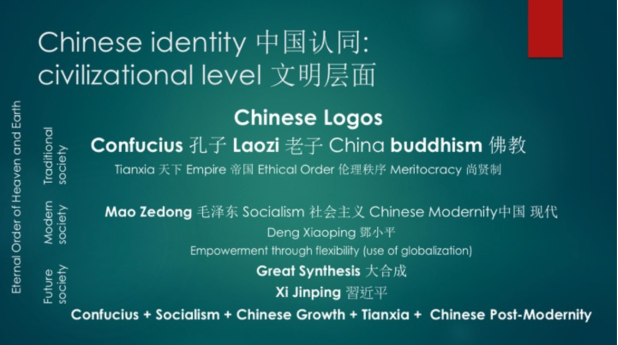
As for the Chinese Logos, this is is a more evident part of Chinese identity because it is explicit. If existential identity is implicit, or hidden on the existential, basic level of presence in the world, then the Logos is quite clear. In traditional society, we have the Chinese Logos with Confucius, Laozi, and Chinese Buddhism – these are the three great systems of Chinese culture and traditional society. Tianxia (天下) is precisely a traditional concept, not imagined byProfessor Zhao Tingyang. In the Zhuangzi text there is a chapter called “Tianxia.” It is the 33rd and the last in traditional division of the whole book (Miscellaneous Chapters —雜篇 Zapian).

Ethical order and meritocracy. Professor Daniel Bell has written a very interesting book on the Chinese model of meritocracy, which I recommend – “The China Model: Political Meritocracy and the Limits of Democracy”.[1] 

And so, there are very explicitly developed systems of how to understand the basic identity on the level of Logos. All the definitions we used in the beginning can be found here, very rich, with details, in books, systems, and schools. This is a huge cultural and intellectual heritage based on Chinese identity.

Screen Shot 2019-02-04 at 9.40.02 PMIn modern society you have another form of the Chinese Logos: Mao Zedong, socialism, and Chinese modernity are a kind of new form of the Chinese Logos adapted to new challenges in your history. In your present situation, this is just as important as the heritage of traditional Chinese identity. These are new names for things. Confucius said that we need to improve the names of things. Mao Zedong has improved some names to adapt them to reality without destroying relations between things, while continuing the same Chinese identity. In this situation, Deng Xiaoping added to this vision some new features, such as opening to the West – but not in order to give up your identity, but with the flexibility to empower your identity, to stay Chinese in the new global world.

It is not globalization that is using China. It is China that is trying to use globalization. This is very interesting, but very dangerous, because in coming into a world that is not Chinese and is organized on a completely different set of concepts and values, it is easy to lose identity. Maybe not for you, as we have discovered that your identity is so strong that you can accept this challenge. This is the difference between Chinese and Russian history. Russian identity is not so strong. Coming to meet the West, we have failed, we lost our country, and almost lost our soul. In the last moment, Putin appeared. Our situation was extremely critical in the 1990’s, and entering into globalization, we accepted it too deeply, we let it enter too deep into our system and it almost destroyed our society.

Now we are coming to future Chinese society, what I call the Great Synthesis of the traditional and modern society. That is precisely what Comrade Xi Jinping declares. He declares the Chinese Dream. China’s Dream is not only an imitation of the American dream, with consumption and comfort, but is a dream to re-affirm your eternal identity in new conditions, to join traditional society with its values and modern society. It is precisely Confucianism and Maoism – the traditions of ancient China and modern China. That is a kind of Chinese post-modernity or Chinese future. That is the Logos based on Chinese Dasein (此在).

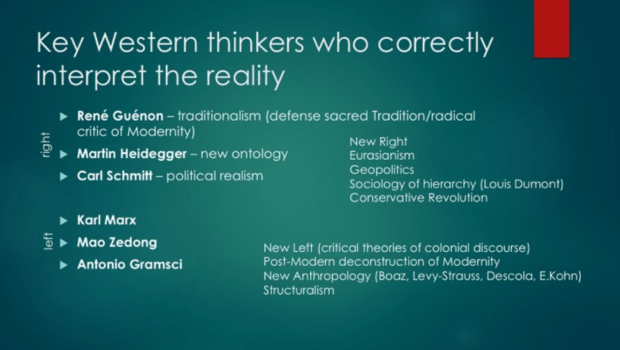
In order to reinforce and empower this Logos for future Chinese identity, you could use some European authors who are very critical of the European Logos and European Modernity, which are very useful to promoting your understanding of the West.

Screen Shot 2019-02-04 at 9.40.09 PM

René Guénon, the founder of Traditionalism, and his defense of sacred tradition and radical critique of modernity are important to defending your traditional values, such as Daoism, Buddhism, and all the traditions of your society. It is a defense of Traditional society.

You can use Martin Heidegger’s new or fundamental ontology, which is already being done in Chinese society as I have remarked with great pleasure, and I am happy that Heidegger is very well known here. That is something incredibly rich and important.

Carl Schmitt’s political realism helps with reading many different aspects of Western political thought.

I would also recommend the ideas of the New Right, Eurasianism, Geopolitics, the sociology of hierarchy (first of all the French sociologist Louis Dumont), and the concept of Conservative Revolution.

The Great Synthesis should include revolutionary and traditional elements. These are all considered more or less on the Right, but as for the Left, I think that anti-capitalism and the anti-capitalist ethics of Karl Marx are extremely important, maybe not the technical aspects of his thought which is a little outdated. Anti-imperialism is an important concept as well. Mao Zedong, as the founder of Chinese socialism, included the peasantry and traditional society in the revolutionary class, whereas in Russia Lenin excluded the peasants from the revolutionary class. That was the reason for the near genocide of the Russian people. You were much more clever.

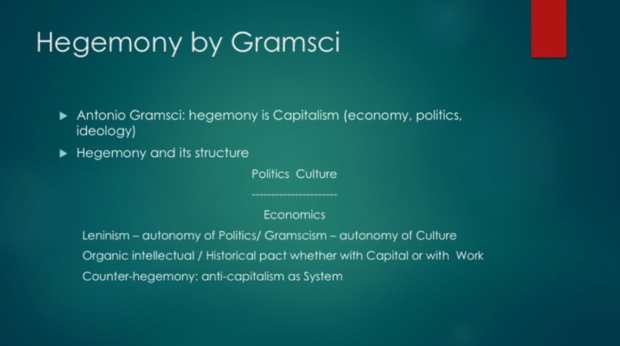
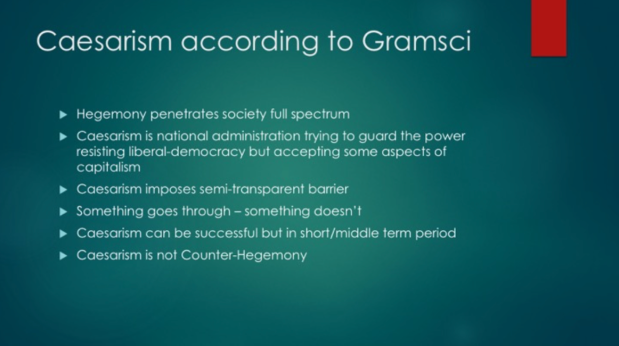
And I suggest Antonio Gramsci, many of whose ideas, such as Caesarism, are very important now and applicable to the present situation. The historical pact of intellectuals and Gramsci’s concept of hegemony, are of use as well.

Screen Shot 2019-02-04 at 9.40.14 PMThe next step is China in International Relations.

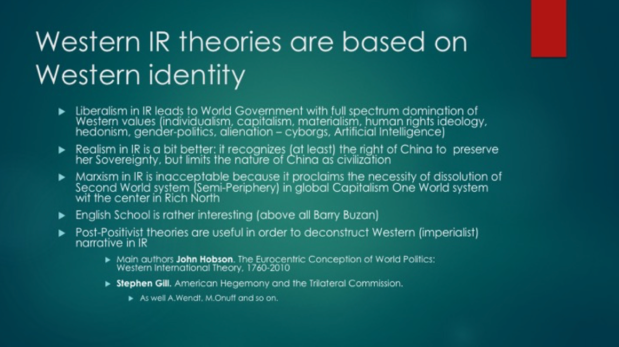
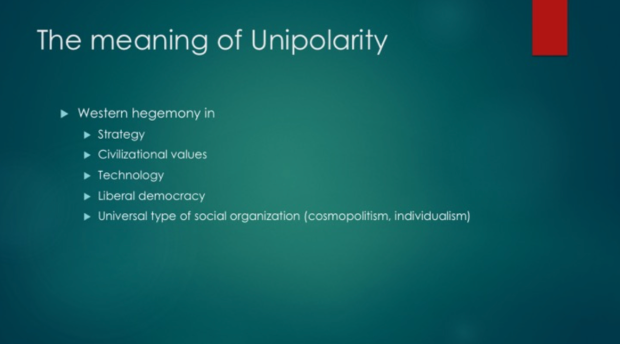
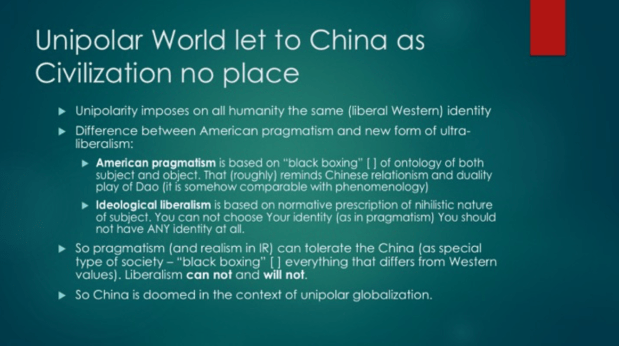
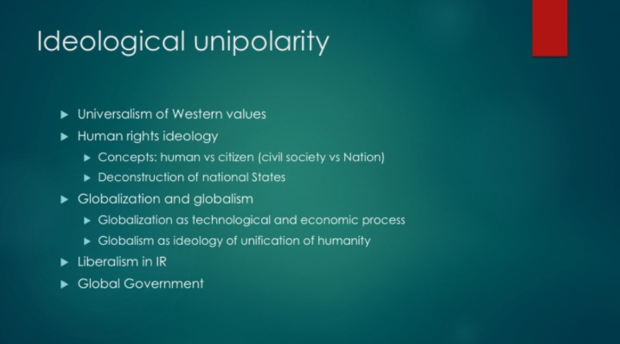
Liberalism in IR is based on the full spectrum-domination of Western values. We should not mistake this situation. All the classical theories of Liberalism in IR are based on the idea that Liberal Western values should prevail on the global level. You have no chance to have Chinese identity or Chinese sovereignty within this concept, because Liberalism in IR explicitly thinks that there should be the dissolution of the nation-states, the dissolution of all forms of collective identities in favor of only one type of identity – the individual – and that there should be an international structure or institution over states whose authority should be recognized as law.

Screen Shot 2019-02-04 at 9.40.19 PM

That would mean the end of China not only as a state, but also Chinatown – the end of Chinese identity as a community. Sooner or later, the liberals will remark that the Chinese prefer their cultural identity, and they will attack that, try to destroy it. This is not religious because all the religions of the West are more or less destroyed already by Liberalism in the West. When the Liberals remark that there is something not so much Western and individualistic with Chinese identity, then they will begin to attack not only the state, but also Chinese culture.

Liberalism in IR excludes China. It is unadaptable. It is a projection of Western hegemony,  the Western system of values, and unipolar model which, in the eyes of Liberals, should be imposed on a global scale.

Realism in IR is Western-centric and modern, but at least it recognizes the right of China to preserve her sovereignty. Realism does not enter into the details of civilization. Civilization does not matter to realists. But realists think that if there is a power that can defend itself, then we should take it into consideration. That is a little better than Liberalism. They will compete with you, maybe fight, maybe conclude an alliance or peace, but a priori this is not planned destruction [of China] as in Liberalism.

Marxism in IR is completely different from what you might think. It is not the idea of Soviet or Chinese international politics. Marxism in IR is based on the idea that all nation-states should be dissolved and global capitalism should prevail; there should be the destruction of all societies, and the transformation of humanity into two classes with no nation, identity, state, or type of civilization. This is cosmopolitanism. The global population is made into a mixture of cultures, peoples, ethnic groups to create a post-national, post-ethnic, post-national confusion of all races and ethnic groups, in order to divide them into two classes: the global proletariat and global bourgeoisie. That is applied to IR by authors such as Wallerstein.

In Wallerstein’s global system, there should be the transformation of the global world with one center of developed countries and the periphery of underdeveloped countries. In between them, China, Russia, India, Brazil, and the semi-periphery, should be destroyed, but the oligarchic, capitalist part of these semi-periphery countries should be integrated into the global elite, and the others should become more and more poor. Immigration is an ideological concept to promote this, a tool, to accelerate this process. Through mass migration, they will transform the world into a culturally homogenous structure with the only dividing line being between poor and rich – and after this will start the global proletarian revolution. Thus, in the short term, Marxists in IR serve the Liberals because they say that first capitalism should prevail. They regard Stalinism, Sovietism, Russian socialism, Chinese socialism, and Maoism not as authentic socialist experiments, but as kinds of “National Bolshevism” or “National Marxisms.” They think that you do not have socialism, but a kind of national-bureaucratic, totalitarian state ruled by a political elite that should be destroyed. Marxists in IR are not friends. Beware of these “Marxists” and “Leftists.” They are a Fifth Column of Liberals in IR. China has nothing to do with them.

The English school is rather interesting – above all, the IR author Barry Buzan. The English school thinks that there should not be a global government, as the Liberals insist, but a set of rules established by a club. The most powerful countries should accept, as a club, some rules and relations that will be a kind of constitution of the club. A club is not an authority, but a matter of self-respect and social position, not something that you are obliged to follow. You are not obliged to follow the rules of the club, but it is “better” that you accept them to increase your status. The “great countries” of the G20 and G7 are a club. Their decisions are not obligatory, but are important to follow. If someone is thrown out of the club, as we, Russia, were after Crimea, we are supposed to feel “awkward” – not in the face of an authority that can punish us like a criminal, but in the face of a kind of “moral disapproval from the club.” The English school of IR explains this perfectly.

Post-positivst theories are useful in order to deconstruct the Western imperialist narrative in IR. The post-positivists propose almost nothing, but their radical criticisms and deconstruction of discourse with post-modern tools are very useful when we have to defend our identity. It is a tool for defense and offense. If a Chinese specialist in IR can understand what post-positivist IR theories are all about, they will be completely free from any kind of complexes – they could speak with any Western critics of the Chinese system using their own tools. This is a marginal sector of IR that is growing in importance. I recommend above all two authors that should be carefully read and which are very important for Chinese IR in general: that is the Australian scholar now living in Great Britain, John Hobson, and his The Eurocentric Conception of World Politics. He is anti-racist, rather left-wing and a Gramscianist, but his work is perfect, remarkable. He is accepted as a normal scholar, as not too much of a radical, but his work is quite a miracle in its criticism of all kinds of IR theory based on the manifestation of Eurocentric and racist -isms. His offers the best criticism of racism that I have met in the field of IR. The next, maybe more technical author is Stephen Gill and his work, American Hegemony and the Trilateral Commission, which is a Gramscian application of deconstruction to the temptation to create global government on the part of some American internationalist, liberal institutions.

You can use these two books in order to not only defend Chinese identity and politics, but as well to lead the intellectual attack on those who come and say that you have no human rights, no democracy, a totalitarian system, and so on. You can immediately cite a few pages from these two books and they will disappear, because their discourse against yours would be a defense of pure imperialism, racism, and nationalism. This is very important from a theoretical point of view.

Screen Shot 2019-02-04 at 9.40.26 PM

There are some versions of Chinese International Relations theory. I think that there is a Chinese way of globalization. Professor Zhao Tingyang thinks that the global world and global governance should be organized based on the Tianxia principle. I don’t believe in that, but it is a very good idea if you insist on your own globalism: “Let’s hear what we, Chinese – strong, powerful, rich, a rising power – have to say with our own version of globalization.” That is a very smart move and very interesting concept, but I hardly can imagine that the globalists who have a completely different understanding of what globalization is, could seriously speak about that.

The Chinese realism of Yan Xuetong as a concept is not pure realism. Yan Xuetong proposes that a realistic understanding of the balance of power, alliances, should include an ethical dimension, something completely unknown to realism. This is a kind of “moral realism” (王道外交) or “ethical realism”. That is Chinese vision of realism in which there is not only the relation of powers, badao, but also an ethical dimension, wangdao.

As for the Chinese analysis of the British school, I could say that the China Model of Professor Zhang Weiwei is kind of that. “Let us have some rules for international behavior, some club, but do not impose on us your rule in an authoritarian way. We can hear you, we are open to debate and dialogue”, and Professor Zhang Weiwei represents this brilliantly with his travels through the West. He perfectly well explains Chinese identity without letting others convince him or insisting too much on the Chinese truth. This English club-school way of promoting Chinese identity is very inclusive, mild, harmonious, polite, and Confucian. 

One interesting idea of Qin Yaqing insists on the Guanxi concept that relations are more important than essences. We need first of all to concentrate on relations between countries and try to moderate relations and meta-relations without going into the essence of “good”, “bad”, “real power”, “pretending power”, etc. On the basis of relations, we can construct some specific balance for the system of IR.

So, while there is not yet a Chinese IR theory, but there are some fruitful approaches.

Screen Shot 2019-02-04 at 9.40.30 PM

Now for China and geopolitics. In classical geopolitics, on Mackinder and Spykman’s maps, it is absolutely clear that China represents Rimland, the coastal area of Eurasia. All zones of Rimland are divided between the pivot area, Heartland, and Sea Power. But at the same time, Rimland, and such a huge part of Rimland as China, could have its own Heartland, its own continental core, next to its coastal component. China is its own world that could apply geopolitical principles to China herself. It is too great to be only a part of Rimland. It could also be an independent part of Heartland, having its own Rimland or coastal area. In traditional geopolitics, Heartland and Land Power are Tradition, and Sea Power is modernization. The same is in the case of China: China’s coastal area is much more modernized and involved in capitalism, while the inner part is more traditional.

Screen Shot 2019-02-04 at 9.40.36 PM

China, as Rimland, is a zone in the balance of global power between two civilizational powers, Land Power and Sea Power, fighting together for control [over Rimland] from Europe through the Middle East and Central Asia to China. All of this region is a kind of zone for world rule.

Screen Shot 2019-02-04 at 9.40.43 PM

There are two classical formula:

“Who controls Eastern Europe, controls Heartland; who controls Heartland, rules the World.” (Mackinder). This version of Mackinder’s was from the beginning of the 20th century.

In the middle of the 20th century, when the importance of other places of Rimland came to be understood in the process of de-colonization, another geopolitician and follower of Mackinder, Spykman, transformed this geopolitical formula:

Screen Shot 2019-02-04 at 9.40.48 PM

“Who controls Rimland, controls Heartland; who controls Heartland, rules the World.” (Spykman)

If Eastern Europe was the most important space to contend Heartland and Russia, according to Anglo-Saxon global politics, then Rimland is in a much broader sense, but with the same logic of the opposition between Sea Power and Land Power.

Now there is a formula for the 21st century, when China is the greatest power of Rimland:

“Who controls China, controls Rimland; who controls Rimland, controls Heartland; and who controls Heartland, rules the World.”

We have this new definition and formula because now that China is not an object, as Rimland was 60 or 70 years ago, and China is a giant, a rising power, it is no longer going to be controlled by external powers. It is quite out of the question and impossible in the present situation that Russia could pretend to control China, and there is no desire, will, resources, possibility, capacity, or ability to do so. The West, Sea Power, is also more and more understanding that it cannot control China.

Screen Shot 2019-02-04 at 9.40.54 PM

Thus, maybe as Graham Allisson says, there is a growing danger of confrontation precisely because the most important part of Rimland today is not controlled by the West. That is a serious challenge to Sea Power. That is Allissons’s interpretation of Thucydides Trap.[2]

Screen Shot 2019-02-04 at 9.40.59 PM

There is only one thing that could change. If China will recognize herself as Heartland, it will rule herself and maybe Rimland, and maybe thereby including the Russian Heartland, the world. But now we cannot imagine that as a result of occupation, expansion, imperialism, and so on. It is only free will, based on China’s free decision. It is very interesting how the balance of geopolitics during the century has changed. I think that the rise of China changes everything.

China has a Land Power dimension (the North, West, rural area, Traditional Empire, and the Chinese Communist Party). China has a Sea Power dimension as well (the East, Coast, capitalism, trade, modernization, globalization, G-2 project). Going in the Sea Power direction, China could be part of the globalist construction. But there is also the core China, the Central China [the Middle Country, Middle Kingdom, Central] dimension of China that is precisely what unites the two sides of China – the Land Power and Sea Power. This is the key to the geopolitical future.

Screen Shot 2019-02-04 at 9.41.05 PM

Western hegemony is represented in strategy, civilizational values, technology, liberal democracy, and universal type of social organization, such as cosmopolitanism and individualism and so on. Unipolarity is something that happened after the fall of the Soviet Union. In that moment, Fukuyama wrote his famous text on the End of History because, according to him, there was only one pole, one system, one hegemony, and no one at the time could imagine a challenge to it. That was the unipolar moment based on the clear domination of the West. That was not globalization as a sum of different cultures and peoples coming and living together and sharing values. The Western values – liberal democracy, global capitalism, individualism, cosmopolitanism, and the Western modern and post-modern liberal understanding of man – were taken as universal and imposed on everybody. The last formal power that fought against that, the Soviet union, had fallen. That was the logic of unipolarity.

Screen Shot 2019-02-04 at 9.41.10 PM

The unipolar world leaves China as a civilization no place. The unipolar world gives a place to Chinese as individuals, but only as how they understand Chinese should be: they should be individuals striving for comfort, a career, good living, materialist standards, and being part of the global world with the same iPhone, jackets, interests, movies, entertainment, food. Chinese as individuals will be accepted as any other, but Chinese identity will be rejected. The password for the unipolar world is “I am an individual, let me in.” You cannot join the unipolar world as Chinese individuals with all the baggage of your Dasein (此在), your existential ground, your Logos, your Communist Party, and Confucius.

This is the special exclusiveness of liberalism. The main book of modern Liberalism and Neo-Liberalism, is Karl Popper’s The Open Society and its Enemies. There is class war in Marxism. There is race war in National Socialism. And there is the war between the Open Society and its Enemies in Liberalism. This is absolutely racist. If you are considered to be one of these enemies, you are out, you are excluded, you are called a fascist, communist, Stalinist, Maoist, and so on, the Gulag and Auschwitz and so on, you are just barbarians. You can enter only accepting what they think you should be, not what you are or want to be. They will try to control your desires, your will, your interests, your sympathies, choices, and demands. You should follow their rules, protocols, system, and only after that will you be a “friend of the Open Society.” The Open Society is an exclusive concept.

What is the difference? Fascists regard other fascists positively. Communists can consider other communists friends. If liberals consider all other liberals friends, then this is the same. But fascists started to destroy the other races, considered to be un-human. The communists, in our experience, almost destroyed millions of our population, considering them to be bourgeois or not revolutionary. Liberals destroy the enemies of the liberal Open Society by bombing Libya, destroying Iraq, and so on. Everyone who is against the Open Society should be eliminated, destroyed, killed. That is nothing new, maybe something simply more or less human, but we should clearly understand what unipolarity and Western hegemony mean. They might be friendly, but they are hiding a knife. We should be aware of this in the very least.

Screen Shot 2019-02-04 at 9.41.15 PM

Here we can see a soft version of unipolarity. The West proposes to the other powers, Europe and China, to be friends, as in the G2 or NATO concept. But what goes on in other parts of the world? Bloody chaos, civil wars, radical political and religious extremist forces, killings – as has already happened in North Africa. The same fate is destined for Russia in the writings of Zbigniew Brzezinski, who said that Russia should be Balkanized. When Bush was in Moscow once in the early 2000’s, he said to Putin: “Please wait, you will have the same democracy as in Iraq.” That was precisely when the US was in the process of killing hundreds of thousands of people there. Putin was very shocked because he somehow imagined Russia’s future differently. But that is the idea of what will go on outside of these zones – a kind of manipulated chaos.

Screen Shot 2019-02-04 at 9.41.21 PM

There are three ways for China to deal with hegemony.

Screen Shot 2019-02-04 at 9.41.27 PM

1. It could accept Western hegemony, which is not so strange, I think. Since Deng Xiaoping’s concept of transformation, there is some kind of threat of Chinese society going to deep into the consumer society, the Western way of life, and capitalism and globalization, towards finally accepting Western hegemony. If we do not care about Chinese identity, maybe accepting Western hegemony is the solution, or at least an option. If every Chinese accepts this global society, with some skills and talents allowed for the Chinese people, maybe there will be some solution, but there will be no Chinese identity. Some people care about Chinese identity and sovereignty; others don’t. I do not think that there are too many of them, but theoretically this could be so, because hegemony is not only the strategic domination of the West, it is also values and standards. So a liberal, pro-Western, pro-Popper, pro-Soros trend could be identified in Chinese society. I presume that there could be some educational structures, professors, and trends in cultures – maybe not dominating, because you have the Communist Party, the main guard of Chinese identity and the present Logos, and tradition. Nevertheless you have taken in a little poison, and poison can be active in some cases.

2. You can affirm and develop Chinese regional hegemony. That is the realist, nationalist trend. You could call this the badao, with wangdao adding an ethical dimension. That will be your Chinese way. But I think that this is the best way for China to consider hegemony. You could say that your hegemony is more or less in some area, maybe in some ways outside of Chinese borders and including other spaces, but you could also make differences – in one situation, political, in another economic, in a third hegemony could be cultural. Hegemony is not bad in itself. But the most important thing is to have a just model for hegemony. For that balance and harmony, Chinese culture has many experiences. Balance is a part of Chinese identity. Chinese hegemony could be based on your own character and identity, not on some universal rules of hegemony.

3. Lastly, you could try to put Chinese hegemony on a world scale, to propose a Chinese globalism. I have heard a kind of fear or idea among serious people in the US, the West, and Russia of the myth of Chinese globalization. Maybe you have no idea or project to impose hegemony on a world scale, but others think that you have such plans. You need to accept them, because if someone thinks that there is something, that means that on the social level there is something, maybe only in their minds, but that is how the world is shaped – by projections of our thoughts. You should not say that you have no such [hegemonic] idea. There are many people in different cultures who are absolutely sure that you have such ideas. You need to take that into consideration. If you know that there are such people, you will speak to them more carefully. You should somehow promote your version taking into consideration how they regard China.

Screen Shot 2019-02-04 at 9.41.33 PM

The theory of the multipolar world, mostly developed by us in Russia, by the Eurasianist school and Russian school of geopolitics, means acceptance of differences between civilizations. Civilization is the main actor in IR, not the state. The difference here is of huge importance. For example, if we develop Huntington’s idea and recognize that it is civilizations and big spaces that are the main actors, then we have a totally different vision of IR system which is not yet present in the manuals of IR. This is not only because it is at the first stage of development, but because it contradicts any kind of globalist, Western understanding.

Screen Shot 2019-02-04 at 9.41.39 PM

What is civilization? Civilization is a relative absolute, or an aspect of the absolute. I would like to stress this. What does it meant to be an aspect of the absolute? It means to be absolutely absolute – but not alone. If you are fully, totally Chinese, you could understand something or someone who is not Chinese only if you have fulfilled this absolute dimension of identity. Then, from the center, not the outside, you can understand the Other. The only way to arrive at a real “globalization”, a real understanding of each other, is to start with ourselves. We cannot understand the Other if we do not understand ourselves. If we are not ourselves, we cannot deal properly with the Other. Then we would be only half Chinese, half Russian, half English, or half German. The real German should be based on the German Dasein (“Being-Here”), German Logos, German Tradition, German Identity. Only in the depth, core of this identity, can they understand others.

All problems are not in this deep realization of identity, but come when we start to pretend that we have already realized this identity, when we are only halfway along the path. People who enter a new religion are more radical and fanatic than people living in that religion for all their life. This is a kind of “too early” reaction. Nationalism, racism, xenophobia, the hatred of the Other, are possible only on the middle-path towards oneself. When we are arriving at ourself,  we cannot be xenophobic, nationalist or racist. When we have fully realized our identity, our self, we are much more open to the other, because we consider, for example, that it is not only Russia that is absolute, but that by being more and more Russian, by discovering more and more the profound Russian identity, we are arriving towards the Absolute. Here, at that central point, we can meet the real, perfect, absolute Chinese. The Absolute Chinese meets Absolute Russian in the center of their civilization. We could compare Laozi or Confucius with Dostoyevsky or the Russian Orthodox Christian tradition. By realizing relative aspects of the absolute, we are coming to the meeting-point of civilizations – not outside, not being totally destroyed as a cultural unity and fragmented into individuals. Individuals cannot understand other individuals, because the pure individual is the most “primitive” form of being, totally limited to simplistic desires. The individual is like a robot, as a robot is a man without tradition or identity, a simulacrum of man.

Civilizations should be understood in the plural. There are Chinese, Russian, European, Islamic, African, Latin American, Western civilizations that can interact, peacefully coexist, try to exchange their identities. For example, to become Russian, you can come to Russia, learn our language, accept our values, if you want or you do not have to. This concept of civilization is therefore inclusive. But we cannot propose a single unique civilization for all of humanity. Maybe it will be the result of the Absolute, when everyone will go to the center of themselves, and we will arrive at the meeting-point of unique civilizations, but in order to do so we must make the long path within ourselves. That is the main meaning of the multipolar world.

A pole is a Big Space + civilization, an idea + power, autarchy + sovereignty, hegemony + culture, force + authority.  These are the formal concepts for understanding what a pole in the multipolar world theory is.

Screen Shot 2019-02-04 at 9.41.43 PM

So, what could be the Chinese version of the multipolar world? This means the application of the same principles to China’s case. China is Identity + Sovereignty. If you stress sovereignty too much, you can lose identity, and if you stress only cultural identity, you could lose the practical capacity to defend your sovereignty. China should unite identity and sovereignty, and that is precisely what modern China is doing and what Xi Jinping wants to do. That is Greater China, the Chinese Dream.

China is a civilization, which must be affirmed. There is the danger that if you forget this, you will be treated as population, masses, and individuals. But you should educationally promote your civilization as such. You should call it a civilization.

China is a regional hegemony in South Asia and the Far East – and beyond, as long as your power, will, and capacity let you expand your hegemony. But such should be linked to your understanding of what is justice, what is balance. If you expand too much, you can overstretch your hegemony. Hegemony should be put in just limits. That was precisely our case. From time to time, Russia overstretched our empire and we couldn’t manage. We should expand only within the limit in which we can assimilate, rule, manage, as well as develop our relations with the people who join us – we should always give them something, not humiliate them. I think that is important in dealing with Xinjiang and Tibet now. You should have them under your control, but you should understand them as the Other and include them somehow. That demands always updating and adjusting.

China is much more than a state, and that is where Zhao Tingyang’s concept is of radical importance: affirming China as Tianxia. The growth of this Tianxia should be in harmony. You could say: let’s not start with the global, but start with our region, let’s install practically now the Belt and Road project, let’s install it here, demonstrate how it works, and if humanity will be seduced by this Tianxia moment, maybe others will accept it. The importance is to start with China within your possible capacities to introduce this inclusive concept based on relations, justice, ethics, and hegemony. China should be recognized as a pole in all senses. There you have already the basic aspects of a Chinese version of multipolar world theory.

Screen Shot 2019-02-04 at 9.41.48 PM

Here on this map we see the basic civilizations which could sooner or later be the poles of the multipolar world. Some of them are already present, such as the West, or European civilization if it will be affirmed as independent outside of globalist American hegemony, and there are the Eurasian, Chinese, and Islamic worlds – the latter of which is trying to affirm its identity, up to now not so successfully – and Africa. It is interesting that in South America multipolar thinking is very developed There are many theorists there, many partisans of multipolar world theory and South or Latin American identity.

Screen Shot 2019-02-04 at 9.41.53 PM

Chinese International Relations theory can be based on multipolarity. In that sense, all the other  factors that I have already mentioned can play an important role. Tianxia theory applied on an original scale could create this constant pole. The theory of moral realism of Yan Xuetong could be as well applied not only to China as a country, but Chinese civilization, and here his idea of ethics plus power acquires its implicit meaning. There are also analogues of the British school, with the relativization of Western rules for the club in which China is supposed to impose rules in the club that China would like to be a member of. In the present situation, the G7 is a Western club which imposes rules that are alien to Chinese culture. Here Zhang Weiwei and Qin Yaqing’s concepts can be very useful.

Here we can see a kind of beginning of the multipolar world in the form of 4+.

Screen Shot 2019-02-04 at 9.41.59 PM

If China is on the side of Land Power, then the world order is already multipolar. We are not so far from multipolarity. If China chooses multipolarity, this is not necessarily an alliance with Russia. China could be Heartland herself, as Europe could be a continental Heartland as in classical geopolitics, and there is of course the Russian Heartland. These three heartlands could cooperate and create multipolarity very soon. This is an invitation to other civilizations as well.

And so, to end, the geopolitical axiom of the 21st century is: Who controls China, controls Rimland; who controls Rimland, controls Heartland; who controls Heartland, rules the World.

We, Russia, cannot change our position in geopolitical space. We can exist as Eurasia, as Heartland, or we could not exist. We have no choice. It is difficult for Europe to make a choice in the present situation with the present elites. The only great power that in the present situation can make a choice, and has enough power to do so, is China. China has the choice as Rimland. Heartland cannot. America cannot, although it is trying to get out of this globalization and Sea Power with Trump – not Trump himself, but his words and the votes for him – the American people tried to get out of this globalist concept, to reaffirm themselves as an American pole, not global. That is a very good sign. But now it is really only China that can make the choice.

Screen Shot 2019-02-04 at 9.42.05 PM

There are three solutions or choices for China.

China can be controlled by the US/NATO. That means that the West will rule Rimland, Heartland, and the World. If the globalists manage to promote their control over China through globalization, through influence on the young generation, technology, global capitalism, and liberal theories, they could rule the world.

Screen Shot 2019-02-04 at 9.42.10 PM

In the old version of geopolitics, China could be controlled by Russia (Heartland). This is absolutely impossible today. It was not so impossible in Tsarist times, or including in Soviet times, when Stalin tried to help Mao and Russia influenced China. But today there is no way, will, desire, possibility, or resources to do so. We cannot control China. China is so huge and developed that this is out of the question. Our weakness is therefore a very good thing for multipolarity. If you logically, rationally no longer fear Russia, you are free to accept us not as a threat, but as an ally, not as asymmetrical as before. The Turks have understood this. The Turks from time to time still commit some errors, but as they they have come to understand that Russia is no longer a threat, they have become “pro-Russian” oriented on many things. It would be great if China would learn this lesson.

Finally, China could be controlled by China herself. In that sense, China should emphasize its Heartland identity, its traditional identity represented today by the Communist Party’s order in Chinese society.

Screen Shot 2019-02-04 at 9.42.17 PM

If the choice will be made in favor of China, that will mean multipolarity. On the one hand, there is the West that proposes its own system of values, identity, and civilization, while on the other hand there is the Russian Heartland, which does not propose anything a-symmetric. Russia does not propose anything, except that China Become China Again and to Make China Great Again.

Footnotes:

[1] Daniel A.  Bell, The China Model: Political Meritocracy and the Limits of Democracy, Princeton University Press, 2015.

[2] Graham Allison,  “The Thucydides Trap: Are the U.S. and China Headed for War?”, The Atlantic (24/9/2015). 

Dugin in Shanghai: Multipolarity, Unipolarity, and Hegemony

“Multipolarity, Unipolarity, and Hegemony: Theories and Concepts”

Author: Alexander Dugin

Transcript prepared by Jafe Arnold

Lecture #3 delivered at the China Institute of Fudan University, Shanghai, China, December 2018 [VIDEO]

Screen Shot 2019-01-22 at 1.39.00 PM.png

Today’s lecture is very charged with meaning. The content of this lecture is very dense. I am going to present a new approach to International Relations. I made the first lecture here on classical and post-positive theories of International Relations, and in the second lecture I presented the basic principles of Geopolitics. Now I will evoke and use these concepts of International Relations as well as Geopolitics in order to explain what unipolarity, multipolarity, and hegemony are.

Screen Shot 2019-01-22 at 1.39.05 PM.png

Let us establish some relations. In order to understand what multipolarity and the Theory of the Multipolar World are, we need to understand what unipolarity is. Unipolarity is precisely what we have in concrete politics after the fall of the Soviet Union. That was declared the “unipolar moment.” 

Multipolarity is the concept or theory that challenges this unipolarity. There is a kind of opposition or confrontation between the unipolar and multipolar world visions. Unipolarity is based on some theoretical principles – geopolitical, ideological, and economic – and the same will be the case for multipolarity.

But unipolarity exists, whereas multipolarity does not exist yet – it is in transition, but not yet achieved. We are speaking about something that is in reality, but that is ending, and something that is new, that hasn’t yet come or been totally realized. We are in a transition from unipolarity towards multipolarity. We know what unipolarity is, but we do not know what multipolarity will be. This is an open, very passionate question. It is a little bit of a futurological perspective.

There are many theories from International Relations. One of the most famous theories is that of the bipolar world system proposed by Kenneth Waltz, with the division into capitalist and socialist camp, or West and East, which, according to Waltz, represented a kind of balance. In this system, one pole limits the other, they can cooperate, and their dialogue, confrontation, and opposition creates this system. The Third World was possible because of bipolarity and a kind of space between the two. Thanks to the bipolar system, everybody else could exist “on the margins” of this general world system.

screen shot 2019-01-22 at 1.39.10 pm

But when the Soviet Union collapsed, the new idea of unipolarity was promoted by some realists in International Relations, first of all Robert Gilpin. Instead of a bipolar system of plus and minus, of two poles interacting in opposition, for example in which the Americans and the West are the plus, and ourselves, the “Eastern”, being the minus, Gilpin proposed a different concept or system for International Relations in which there is one pole, the absolute center of everything, i.e., there is no more minus, only the center on the rise. Robert Gilpin won his theoretical debates with Kenneth Waltz, because Waltz supposed that bipolarity would last forever in some way, because it was a more conservative, stable world system. Gilpin proposed the possibility of a unipolar situation.

Unipolarity gained ground in theoretical debates in International Relations after the collapse of the Soviet Union. That moment was precisely declared the “unipolar moment” by Charles Krauthammer. The “unipolar moment” meant the creation of the concept of a unipolar system with one pole and a periphery in concrete reality. But Krauthammer was not sure if this would last forever, or if it would end in time. He was not sure if it was a world order or some temporary situation. So he called the “unipolar moment” by this very correct term. After the end of the Soviet Union, there was precisely a confirmation of the unipolar system, for example on other levels, such as declared by Francis Fukuyama as the “End of History.” There were no confronting poles or systems, there was only one system: liberal capitalist democracy with the market society, with the West recognized by everyone as the “global leader.” Thus, there was the West and the Rest. The Rest should follow the West – that was the essence of unipolarity. There is only pole, one system, a global system – that is globalization. So unipolarity was the understanding, in realist terms, of the same concept as globalization, the End of History, or the unipolar moment.

It is interesting that in the very beginning of the 2000’s, this same Krauthammer declared that maybe the unipolar moment has ended. This was after the 9/11 attack by Islamic terrorists on the New York Trade Center, and after Putin’s coming to power. Then it seemed that the unipolar moment was no longer a unipolar world order, that something went “wrong” with unipolarity. “Normally” there should not have been such a thing as the terrorist attack of 9/11, because there was no state that could attack the United States, no civilization, no political system, no nuclear weapons – nothing structural or symmetric with American power and American domination. Russia at that moment was in a very low situation with Yeltsin, and was on the verge of collapse after the Soviet Union. But Putin began to reaffirm Russia as a sovereign country. This was a kind of challenge to the unipolar system. For example, in 2007 Putin made his Munich speech which challenged precisely unipolarity and Western hegemony. In 2008, despite American support for Georgia, Russia intervened in Ossetia and Abkhazia. In 2014, we reunified with Crimea, and then we intervened in Syria. In parallel, there has been a huge rise in China’s model – as Zhang Weiwei says – China’s model was a kind of new hegemony appearing on the horizon.

This means that there was something moving against unipolarity. Yet unipolarity still prevails in the global analysis. Unipolarity is ending, but the unipolar moment is lasting, it is still here. It is absolutely clear to everybody that something is wrong with unipolarity, that unipolarity is unstable and in decline, but it is still here, and no other political or international system has arisen. We are living in the end of unipolarity.

screen shot 2019-01-22 at 1.39.17 pmUnipolarity includes different aspects. For example, we could divide unipolarity into groups of concepts – open or “explicit”, and hidden, “secret”, or “implicit” unipolarity.

Open (explicit) unipolarity is Neoconservatism in the United States and the Project for a New American Century promoted by the Neocons. They declare that the Liberal word should rule the world, and that Liberal countries should prevail and openly dominate everybody else. America should rule the world, and give the example and install the norms for other countries and cultures. Niall Campbell Ferguson, an English scholar of IR, has declared that we need to use the word “empire” to qualify what unipolarity is: it is a modern or post-modern Western empire that should dominate the whole planet. Ferguson says that we should not hesitate to use the word “empire”, which has been demonized and criticized, but we are now living in an empire. The metropolis, the center of this empire, is the Western world, the Rich North, and there are other “provinces” of this “empire” that should be ruled from the center. So let us speak about the Western, post-modern, global, liberal, capitalist, neo-colonial empire in all of these senses. This is open, explicit unipolarity as it is presented in IR debates.

The Pentagon’s vision of unipolarity is clear if we take a look at the strategic map of the planet. We will see American military bases all around, except in China and Russia. That is a concrete manifestation of unipolarity. The United States has tried to control the Pacific, Asia, Europe, Africa, the Arab world, and with NATO. The Pentagon vision is still absolutely unipolar. American national interests and American security are considered by the Pentagon to be a universal value. In their vision, it is your duty, for all of you and us, to defend American interests. Everyone who challenges American domination is a “terrorist” and is treated theoretically or practically as very dangerous. Any man, movement, or country who does not agree with this Pentagon vision is an enemy. That is open unipolarity. Regarding Europe, this idea is translated into Atlanticism and represented by NATO. NATO is the European world under the military control of the United States. That is one of the expressions of unipolarity. NATO is a unipolar organization which tries to control the world for the benefit of only one pole. That is explicit, manifested unipolarity.

There is another, “hidden”, “secret” or “implicit” unipolarity, that is globalism, multilateralism, and the so-called “No Polarity” promoted by the chief of the Council on Foreign Relations. We roughly call this “globalization.” Globalization means that all systems, societies, peoples and countries in the world will accept the Western way of progress, development, human rights, democracy, and liberalism. And when this happens, there will be no great differences between the United States, Russia, China, or Africa. Everyone will be “equal.” But in what sense? Everybody will become Americans, Western, and everybody must like liberal democracy and human rights. This is a special kind of globalism. It is not a dialogue between countries, cultures, and civilizations. For example, Russia has proposed Russian values, and China has proposed a Chinese identity. But there should not be any collective identity in this concept of globalization. Everybody should be equal precisely because everyone should only be statistical individuals – no cultures, no religions, no ethnic roots. That is the idea of “human rights”, to put together citizen and man. Every man is already a citizen. There are no countries, no nations, only the “global society” and “global civil society.” This is not openly unipolar, because globalists do not say that America will rule the world, but that “you, citizens of the world, will rule the world in a global government” in which everyone will “participate.” Everyone will be equal “if you accept our system of liberalism, democracy, progressivism, human rights, individualism, and our culture” – you will no longer be treated in a hierarchical manner. The “world citizen” or “cosmopolitan” is a program that is unipolar on the level of values. That is pure unipolarity in a special, hidden sense.

Multilateralism is the geopolitical application of globalism. Multilateralism is a form of unipolarity, but it consists of the proposition that the United States should rule the world “with.” This is a kind of sharing of responsibility for ruling the world through proxies of the United States. Multilateralism is precisely giving to others the responsibility to rule the world with the United States as proxies, as vassals of the US. There are different countries that want to do this because they will have some special preferences within the global world-system.

Screen Shot 2019-01-22 at 1.39.24 PM.pngStrategic unipolarity includes Atlanticism, Sea Power in geopolitical terms, and full spectrum dominance doctrine, which affirms that in order to dominate the world totally, the West should not only use hard power or military power, but also soft power, culture, technology, network services, networks, and social services, that should control other societies from the inside, not only from the outside. That is the idea of full spectrum dominance – domination of the air, the cosmos, space, sea, land, and inside human brains. That is a project of controlling human behavior, psychology, being, and human minds, by coding them through different methodologies.

Here is the geopolitical vision of unipolarity with the United States in the center.

Screen Shot 2019-01-22 at 1.39.30 PM.png

This is also the classical geopolitical map of how Sea Power should control Land Power. From the seas and oceans, Sea Power – the United States and the global West – should control Land Power. The idea is to fight for Rimland, which is the zone between Land Power and Sea Power, the coastal zone. This is the classical vision which is still the main basic map of the Pentagon. The Pentagon understands the world more or less with this map. China belongs to the coastal area, to Rimland, so it is considered to be neither a radical enemy, nor a friend, but a zone to control.

Here is implicit unipolarity,  multilateralism, quite different from unipolarity.

Screen Shot 2019-01-22 at 1.39.36 PM.png

In multilateralism, there is the main power, the global hegemon, and two main satellites – Europe and China. Europe is inscribed and embedded in the latent structure, and for China the globalists have proposed the G2 project. Hillary Clinton came to Beijing in order to propose this to the Chinese government. That is more or less the idea of how the world will be if unipolarity and multilateralism prevail. In the other spaces, there should be only chaos – not pro-American governments, because they don’t need pro-American governments, which are too difficult to manage, and they have indeed already destroyed pro-American governments in Tunisia and Egypt. They don’t care anymore if you are pro-American or anti-American, because you should all only follow the Americans, or you will die in bloody chaos. And they have started this bloody chaos in North Africa, promoting cultural revolutions, supporting all kinds of terrorist groups in order to have reasons to intervene. By creating chaos in this region, unipolarity conserves its power. Russia has the same destiny. If we read carefully Zbigniew Brzezinski’s book, The Grand Chessboard, he has written that Russia should be torn apart and Balkanized, transformed in conflict between different ethnic and religious groups.

There are two parties in the United States and global government – the explicit unipolar and implicit unipolar. There is the “soft” version, and the previous map is the “hard” version. These are the pigeons and the hawks.

Screen Shot 2019-01-22 at 1.39.44 PM.png

Ideological unipolarity entails the universalism of Western values and Human Rights ideology with the concept of human vs. citizen. The concept of human in Human Rights theory is against the nation-state and against the concept of citizen. If you say that the human being has the same rights as the citizen, you destroy citizenship. Migration and the defense of migrants are not purely humanitarian, but ideological. It is the idea to destroy the concept of citizenship, nationality, and the state. That is one of the main goals of the so-called human rights movement. It is purely ideological – as much ideological as Marxism or National Socialism. It is pure propaganda, nothing humanitarian. If you share human rights values, you are globalists on one side, sharing an ideology just like racism in National Socialism or communism and the proletarian position in classical Marxism. Human rights is a liberal ideology. It is not neutral. It is not self-evident. It is purely ideology, just as belongingness to the Aryan race or the capitalist or proletarian classes is. If you are in favor of human rights, you are already totally controlled by ideology.

The deconstruction of the nation-state is the main goal of Liberalism in IR. Globalization is the technological and economic process, and globalism is the ideology of the unification of humanity under a world government. They are different, but are not in contradiction. By promoting the same technology and economy, at the same time you are preparing the ground for political integration – from globalization to globalism there is one step. They are two levels of the same process. You could promote the theory that we need global government in order to avoid war and the destruction of the humanity, or you can put it into practice without expecting that everyone will accept it. So globalism and globalization are two different things, but are converging forces.

Liberalism in International Relations is the theoretical basis for this ideological unipolarity, as it is itself an ideology. The idea of world government is not an obsession of conspiracy theorists. It is part of the classical manuals of International Relations. If you carefully read any and all of the manuals on IR, you will discover that Liberalism in International Relations affirms that there should be a world government, a supranational system that will replace states in the future and progress in order to secure world peace. This is not a conspiracy theory – it is purely a theoretical term from IR as an established discipline.

Screen Shot 2019-01-22 at 1.39.55 PM.png

Hegemony has different meanings. First of all, there is the strategic dimension. This Greek word means “leadership” – a hegemon is a leading force or leading power. Hegemony could be understood and read as unipolarity as in Gilpin’s system. If we use the term hegemony in its singular form, with one hegemon or one empire, then we are speaking about unipolarity. In the singular, hegemony represents the concept of a dominating pole – that is the Western pole.

Relative hegemony is an interesting concept of Mearschmeier, an American specialist in International Relations, who tries to impart a kind of relative approach to hegemony. According to Mearschmeier, there is no clear or abstract law as to whether we should have one or many hegemonies. It is an open question: let us consider hegemony as an existing phenomenon without predicting that there will be only one, two, three, or four.

screen shot 2019-01-22 at 1.40.01 pm

In the case of the globalist vision, hegemony acquires a purely ideological dimension. It is not leadership in the military and strategic domination, but it is ideological and cultural, a domination of values and cultural patterns. Therefore, you are under hegemony, because you follow rules that are not established by you. These rules are so-called “universal” because the West was capable of imposing these on everyone else.

The Neoconservative version is the same as unipolarity – the strategic, open, explicit hegemony of the American Empire. Or there is Trump’s vision for the New Liberal Order which is a little less defined, and not so much scientific. But Trump says “Let’s Make America Great Again.” What he means – nobody knows. He is against the globalist version, which he criticizes. His is not so much Neo-conservative, because he was criticized during his election campaign by Neocons very severely. This is a rather “rare” hegemony, which might not be hegemony at all. Trump uses some concepts with no clear meaning. This is important, because it could serve as a kind of transition from hegemonic order to post-hegemonic order.

Screen Shot 2019-01-22 at 1.40.08 PM.png

The main question of hegemony is whether there is one hegemony or hegemonies. The same question is whether there is one civilization or civilizations in the plural. This letter “s” at the end of the word changes everything – whether you are an enemy or friend, black or white, old or young. If there is only Civilization, there can be but one ideology, but if there are civilizations, there are completely different, even opposite ideologies and world visions. Whether we recognize the multitude of civilizations and hegemonies, or if you consider only one hegemony or empire, one letter divides two world visions.

In the Western mind, there is an implicit hierarchy dealing with different kinds of societies – either in the historical way, or in International Relations. There is a hierarchy in International Relations in a cultural sense as well. All types of societies are clearly divided (by the West) into three categories: Civilization, which is the West, Barbarity, which is the East, and Savagery, which is the South. Civilization is “good” and “perfect order”; Barbarity is not so good and only semi- or quasi-ordered; while Savagery is not order at all. Before the end of the Second World War, before racist National Socialism, the West used the metaphors of skin [color] in order to explain this hierarchy. Civilization was “white”, Barbarity was “yellow”, and Savagery was “black.” That was a normative racist attitude. But after the end of the Third Reich, it was impossible to use this racist approach anymore, and everybody became “internationalists.” This racist mark was abolished and “forgotten.” But the sense of the hierarchy is the same, only in other terms. For example, there is the technologically developed West with Human Rights, liberalism, individualism, and social security. This is a kind of law that cannot be challenged. There is the most developed society that is Western civilized society, there is the second world of the BRICS countries trying to keep up with the West to have the same standards but still in “delay”, and there is the Third World that cannot enter Civilization. Even without biological racism, we have the same concept of racism in this distinction, because there is only one Civilization, only one example, only one norm – the West. Corruption, totalitarianism, and authoritarianism are reserved for the Rest under the West or the “second-hand West”, such as Russia and China. In Wallerstein’s doctrine, there is the core, the Rich North, the semi-periphery, and the periphery. We deal with this hierarchy everywhere – today without “Racism” proper, but racism is embedded in this attitude.

If we consider this concept carefully, we can deconstruct all the discourses in International Relations on the West. John Hobson’s book on the Eurocentric conception of International Relations explains that perfectly.

The very idea of hegemonies and civilizations is based on the fact that there are many civilizations, not only the Western one. Other civilizations are neither barbarous nor savage, but merely of different types. If we are dealing not with barbarity or ‘under-civilization”, the West loses its universal, normative meaning. It is one among different possible civilizations. This hierarchy is destroyed, deconstructed, because there is no common universal measure of more or less “developed.” If you consider living in the forest with animals and without technological devices your choice or destiny, you have all the rights to do so and we will not teach you how to behave – that is a very humanistic attitude.

If we accept the fact of civilizations, then all of this system, the Western colonial system of hegemony and unipolarity, explodes immediately, because it loses ground in International Relations – there is the total decolonization of the world. There could not be any hierarchy between civilizations – all civilizations are equal, not in the sense of similar, but in that their differences cannot be put into an hierarchical taxonomy. We need to accept them as existing not only in different spaces, but different times, ontologies, and anthropologies. We cannot judge one civilization by criteria taken from another.

For example, in your case, the Chinese could think that some rites or rights in Christianity, liberal society, or in African tribes are disgusting or unacceptable. You will treat them from the Chinese point of view. The same for them: they could find something completely unacceptable in your civilization or ours. But nobody can say “you are wrong, we are right.” There are no unique, universal criteria. We need to accept this diversity in a positive way. Let it be like it is. That means a total, absolute epistemological revolution against Western universalism. And that demands de-colonization.

screen shot 2019-01-22 at 1.40.15 pm

Antonio Gramsci used the term hegemony in an ideological sense. How could a Marxist, supposed to be a materialist and explain everything in terms of economic relations, arrive at an ideological understanding of hegemony and capitalism as hegemony? Gramsci proposed a very interesting vision which is very important for the Chinese. Economics is at the base, while politics is on the top as, according to Marx, economics is essential for politics, which are only the expression of economics. But when Gramsci analyzed the Soviet experience and Leninism, he arrived at the conclusion that in the Russian Empire there was no proletarian class. Our country, Russia, in the beginning of the 20th century, was not industrialized and there was no proletarian class. So a revolution from a Marxist point of view was impossible. Marx and Engels affirmed exactly the same thing for Russia and the East – before their full capitalization, including through their colonial experience, towards which Marx was very positive and even in favor of, because it brought capitalism into pre-capitalist societies and prepared the future proletarian revolution. But what was Leninism? How was a proletarian revolution possible without a proletarian class?

Gramsci explained by his theory that sometimes the will of a political group can go ahead of economic processes. In some situations, political will can replace the economic basis and transform the economy in order to satisfy all the conditions of Marxism – to create artificially a proletarian class out of peasants. The other way was Mao’s theory, who recognized – against Marx – the peasantry as a revolutionary class, which was much more honest and sincere in Mao’s case, less so in the case of Lenin, but Gramsci grasped this well. Gramsci developed this idea to affirm that sometimes culture is more important than politics. You can be active in culture without being linked to a political, proletarian communist party and without any relation to politics or economics. You can create a kind of historical pact. Intellectuals can make a pact with capital and serve capital without being part of the bourgeois class. You can serve capital in your mind. Or, even being rich, prosperous, and a part of this bourgeois system, you can choose the working class and fight against capitalism. Thus, culture has the same autonomy from politics as politics has from economics. That is maybe the case of China: you are using capitalism, but in order to promote your society and your ideals.

Screen Shot 2019-01-22 at 1.40.21 PM.png

Hegemony in Gramsci means that the West and global capitalism try to use not only economics and markets, and not only the political expression of such, democracy and parliamentarism, but also culture. Precisely those intellectuals who make the historical pact with capital are the worst.

Hegemony is first and foremost a cultural phenomenon. This means that it is not a political ideology, but a kind of metaphysical decision. You can be in favor of capital as a system, as a metaphysical principle of the total liberation of the individual from any kind of collective identity, or you can choose fidelity to the working class, country, society, identity. It is up to you. Nothing can oblige a human being to serve political or economic interests. The intellectual, who represents all of society, since everybody according to Gramsci is a little bit of an intellectual, represents the integrity of human society as professional thinkers. But an intellectual cannot think outside of the main metaphysical choice between capital and the working class.

So, hegemony is first and foremost a metaphysical principle. You could be on the side of hegemony while living in a socialist society, or being poor, or being a member of a Communist Party. To choose hegemony is an inner orientation. Hegemony penetrates society not only with political and economic structures, but in the mind and heart. It is a metaphysical virus. Hegemony is metaphysical liberalism, under which you work only in its favor.

Now we finally arrive at multipolarity.

Screen Shot 2019-01-22 at 1.40.30 PM.png

In order to clarify what multipolarity is, we need to establish some oppositions. Multipolarity is against unipolarity. Multipolarity is against globalism. Multipolarity is against multilateralism. Multipolarity is against hegemony in the singular. Multipolarity is against hegemony on three levels – first of all strategic, i.e., against the American military domination of the world with American military bases everywhere in the world except for American soil. America for Americans – maybe that’s what Trump meant. “Yankee go Home.” Multipolarity is against ideological hegemony as globalization, liberalism, and human rights. Multipolarity is against hegemony in Gramsci’s concept as a metaphysical, historical pact made by organic intellectuals. The last definition is that multipolarity is pluriversal – this is a concept introduced by Carl Schmitt. In universalism, there is one unique concept of norms and values. “Pluriversal” means free movement in different directions without one measure for all kinds of societies.

Screen Shot 2019-01-22 at 1.40.35 PM.png

Multipolarity in geopolitics also deals with Carl Schmitt’s concepts of Big Spaces or Grossraum, and it is here that we come to the concept of “pole” in multipolarity.  How do we define a pole? A pole is a Big Space and a civilization. A pole is not only strategic or political; it is linked to a civilization as a culture or special type of society with special values. At the same time, it is not only a culture, but also a strategic space. Thus, in the concept of pole, we have both meanings: power and idea. The ideological and cultural levels and military force are inscribed into the pole in space, in political geography, and in cultural geography at the same time.

Screen Shot 2019-01-22 at 1.40.41 PM.png

Here we can see a very approximate map of different big spaces that should or could be poles of the multipolar world order. Some of them are already poles – such as the United States of America. The European big space could exist, and has many possibilities to become an independent pole; China is certainly the main precedent for an independent pole; and Putin’s Russia is trying to be a pole by acting independently from others. That is clear enough in the fact that Russian sovereignty has been regained in Putin’s time. And there is, for example, the Indian big space: economically and demographically India has the possibility to become such a pole. Latin America thinks in the same terms. The Islamic world tries, at least on the theoretical level, to become a pole as well. Africa is less developed and the Pacific big space are less developed. This does not mean “developed” in the sense of culture of civilization – they have their own great civilizations – but as a pole, on the level of power, they might only become poles in the future multipolar system. That is the map of the multipolar world order. I have already shown the maps of the globalists, the Pentagon, and CFR. This is the Russian map of multipolarity.

Screen Shot 2019-01-22 at 1.40.47 PM.png

But what is important on the practical level is what we have now, or what we will have tomorrow, and that is a kind of aspiration towards multipolarity. We can see three poles accepted more or less in the multilateralist, globalist version – the American zone, the European zone, and the Chinese zone. But as we have seen, the multilateralist approach is hidden unipolarity and thinks that there should be chaos everywhere outside of these three.

The majority of Western experts and analysts are totally biased, because the science of International Relations itself is totally biased and Eurocentric. Before being accepted into academic society, you have conclude your pact with capital. They try to use the Gramscian concept as well – they do not let persons who do not share their Western-centric vision. One Canadian-Jewish man, Michael Millerman, wrote a philosophical thesis on my ideas, and he was threatened with being thrown out of the academic field and Western universities because he treated my ideas in a neutral way, and not blatantly. His was a more or less balanced or neutral philosophical analysis, but he was threatened by the academic society with being thrown out, because if you are on the Western side, you should only criticize and demonize the opponent – that is the normal rule.

In mainstream political analysis, there is no recognition of the fourth pole of Eurasia – it is absent in all descriptions of future reality. There are different versions on the fate of Europe, how China will be, whether it will become the main enemy of the United States, and there are many details that differ and different viewpoints that are accepted. But when they approach Eurasia and Russia, there is a univocal decision of all scholars that there will be “no Russia” and ‘no fourth pole.” Because if there is this fourth pole today, then every situation in the world order changes – it is not bipolar world order at all, because Russia is big even after losing half of its territory and population after the collapse of the Soviet Union. With us as a pole, the meaning of China, the meaning of Europe, and the possibility for all other countries and civilizations to affirm themselves as independent poles, is gained. That is a crucial point. Russia, once more in history, is in the right place at the right time. That is the key problem for multipolarity.

If we accept that there will be no more Russia, only a Balkanized, chaotic territory as was more or less the case in Yeltsin’s time, then we have unipolarity, hegemony, and globalization, and China and Europe are proxies of the West in the multilateral world vision. But with the fourth pole, we have a completely different situation thanks to the existence of this fourth pole, which could not be universal, which could not be dominating through hegemony over China or Europe – we just cannot, we have no universal ideology or ideology at all in Russia. Our weakness could be used in our favor, because now we are in a position when we can save Russia by saving others – Europe and China – from Western domination. Without this, we cannot be sure of our future. That is a purely pragmatic vision.

With this fourth pole, we have real multipolarity, with the opportunity for the independence of Latin America, possible independence for the Islamic world, possible independence for the African world, and India – everybody acquires the chance to transform into a pole and defend their own civilization. This time, Russia proposes neither colonialism, as in Tsarist times, nor some ideology. We just want to defend ourselves as a civilization different from both Eastern and Western. In the concept of multipolarity, Russia is not a country or Western country, but an independent civilization that is partly Western, partly Eastern, but neither Eastern nor Western – a particular Russian civilization.

The acceptance of this fourth pole changes the whole picture. Now we have multipolarity. Starting with these four poles, we can go further and propose a special role to India, the Islamic world, and Latin America, as is more or less represented in BRICS.

Screen Shot 2019-01-22 at 1.40.53 PM.png

Here we can see the difference between the multipolar and multilateral maps. They are completely different approaches. I call this “more-than-three-polar” world or “4+ world” the precise dividing line between two world orders that can be established in the future.

Now we are in a transition. We are at the bifurcation point, we can go either way. Nothing is granted. We are living in the end of unipolarity, but we have not yet created a multipolar world order. This process is open. We could be successful or unsuccessful. We are here precisely in-between.

Screen Shot 2019-01-22 at 1.40.58 PM.pngThis state of things is more or less consciously understood by some academic groups in the world. We can call that the “multipolar world theory.” My own book in Russia, The Theory of the Multipolar World, which has been translated into French, is in the process of being published in English, and has been translated into Portuguese, Spanish, and other languages, presents this theory, and tries to put all of these elements that I have explained together.

Eurasianism is also being developed by our group as a political philosophy that insists that Russia is not a country, but a civilization and part of multipolarity. The Fourth Political Theory is another theory developed by us in Russia, along with French and Italian intellectual groups, that invites to overcome the classical Western political ideologies – Liberalism, Communism, and Fascism. The Fourth Political Theory invites to go beyond Liberalism, and to be anti-Liberal, but not to be Communist, Fascist, or Nationalist. It is outside of them, because the Fourth Political Theory does not recognize the universalism of the modern West. For us, it is an invitation to provincialize the West, to show that it is one province of the world, not the center. There are many centers and provinces in multipolarity. The Fourth Political Theory is the political expression of multipolarity.

In China, Professor Zhao Tingyang, with his concept of Tianxia Tixi, has developed the concept of a special Chinese model that is not only pure domination by force of strength, badao, but as wangdao, by moral and ethical hegemony. The concept of wangdao describes not only China as a state, but also other countries that China influences not necessarily in a direct, hegemonic way as in badao. This is a very multipolar approach among Chinese scholars. Yan Xuetong is a realist in International Relations, but his defense of Chinese identity can be regarded as part of multipolarity. At the same time, he challenges the concept of pole and prefers to speak about “units.” Your famous Zhang Weiwei offers a very important defense of the particularity of the Chinese way of development. It is a defense of Chinese identity. There is also Qin Yaqing, who applies to IR a conceptualization of different interactions, casual and ordered, that form a kind of “game”, based on different factors that can be summarized in the traditional Chinese divination system.

In Europe, there is the New Right school. The European New Right is anti-liberal and anti-capitalist, and also includes Traditionalists. It is not the classical, American, or British “new Right” that is liberal. Alain de Benoist is the main philosopher of this school. They have developed a multipolar vision in which Europe should be an independent pole – completely independent from the United States of America, and very friendly towards Russia. They are promoting this in a theoretical way with the concept of Pluriversum, as they are followers of Carl Schmitt. They are a very influential and interesting group of thinkers.

In Latin America, there are different multipolar schools, for example the theory of “foundational non-subordination” promoted by Marcelo Gullo Omodeo in Argentina. There is the “Meridianalism” of Andre Martin in Brazil, concerned with the Global South, which is very close to the Eurasianist vision. There is also Norberto Ceresole, who was a Left Peronist and very influential on Hugo Chavez, his main ideologue, and a partisan for the unification of the Latin American space.

What is interesting here is that there are theories of multipolarity dealing precisely with where the possible poles are. We can see this in Russia, trying to develop multipolarity and affirm herself as a pole, in China trying to be more and more independent from Western hegemony, in Europe, which is trying to challenge Atlanticism, unipolarity, and American domination, and in Latin America. What is strange is that we lack an Islamic concept of a multipolar world. We have only a caricature in the Salafi version of the Caliphate that should be global, and that is impossible as well as theoretically unexplored. But an affirmation of Islamic identity and accepting of the realities of the world is lacking – I do not know why. My works have been translated into Turkish, Persian, and Arabic. There is a huge interest, but I do not know any serious theoretical constructions defending an independence of Islamic civilization. Everyone in Islam is in favor of that, but I am speaking not of the mood in the Islamic world, but of theoretical constructions. The same is the case in India. India pretends to be a very powerful hegemon in South Asia, but there are no texts – it is a very profound, metaphysically developed civilization, but it does not show any signs of a theoretical multipolarity.

Screen Shot 2019-01-22 at 1.41.04 PM.png

So, the theory of the multipolar world, the multipolar approach, challenges Eurocentrism, Modernity, Universalism, and Hegemony. It is based on the presumption of a multitude of civilizations and refuses a hierarchy of them. The multipolar approach is based on anthropological pluralism, a positive evaluation of diversity and a new reading of the concept of Other. The Other is not the same or “more or less the same”, it is completely unknown to the West, for whom the Other is “worse” in the traditional racist colonial attitude, or in the liberal attitude the Other is the same. The West lacks a third definition of the Other. Globalists say the Other is exactly the same as ourselves, while racists, colonialists, and nationalists say that they are better [than the Other]. Nowhere here is there the Other, because both are completely obsessed with themselves in a hyper-egoistic attitude. They put the Other only as the worst or the same, but where is the Other? The meaning of the Other is lost.

The theory of the multipolar world is an anti-Eurocentric project for the re-provoncialization of Europe, a return to the pre-Columbian vision. If we regard the pre-Columbian vision, we immediately discover that there was a perfect world order from a civilizational point of view, with no colonialism or Western domination. There were traditional empires – the Iranian Empire, the Ottoman Empire, the Russian Empire, the Chinese Empire, Arab Empire. Everybody was in the perfect place from a civilizational point of view, but Western Modernity imposed colonialism and hegemony on the planet. The separation between America and Europe that is part of the multipolar world is itself a kind of return to the pre-Columbian time. Now, in the present day, in Syria, the ancient empires have reemerged – we see Iran on the rise, Turkey on the rise, and we can see Russia and China. This is a sign of the return to the pre-Columbian world.

The theory of the multipolar world is anti-modern because modernity is Western. We could say that we propose an alternative modernity or alter-modernity, but we do not agree that modernity is destiny. Modernity was a choice of part of Western society and civilization that led to catastrophe. Maybe it was the path of the historical destiny of the West, but it was not our destiny. Modernity is a Western concept. The theory of the multipolar world rejects the principles of the Enlightenment. The Enlightenment is optional. Here I suggest reading the French author René Guénon, a French-born Catholic, a philosopher who converted to Islam in Cairo and spent the rest of his life there, entering a Sufi order. He is the greatest author, the founder of the Traditionalist school with a radical critique of modernity and Western universalism. I also recommend Julius Evola.

Screen Shot 2019-01-22 at 1.41.11 PM.png

Finally, the theory of the multipolar world is counter-hegemony. The theory of the multipolar world regards the main actor not to be the state, but the civilization. Relations between civilizations are considered more or less in a realist perspective, but the difference between realism and multipolar world consists in the main aspect: the theory of the multipolar world deals with civilizations and Big Spaces, not states like in classical realism. But it does affirm sovereignty. In the multipolar world theory, there is a shift from the sovereignty of the state to the sovereignty of the civilization, after which we can apply realism to the differences of subjects. A pole is a Big Space plus civilization.

The geopolitics of multipolarity entails another shift in our understanding of geopolitics. Classical geopolitics thinks in terms of Sea Power, represented by the West, and Land Power, represented by Heartland, Russia. Now Sea Power, in the geopolitics of multipolarity, is unipolarity, hegemony, and globalism, but Land Power is no longer only Heartland. Land Power is all systems of poles except the United States. Everybody is Heartland in some symbolic sense. This is not bipolar geopolitics, but a multipolar geopolitics that considers Land Power to be traditional civilizations. Land, in Carl Schmitt’s interpretation, is first of all tradition, roots, fixed space that is the civilizational living-space. This is a very important change in the concept of Land Power in the multipolar version of geopolitics.

Screen Shot 2019-01-22 at 1.41.24 PM.pngHere we can see civilizations corresponding more or less to Big Spaces and strategic analysis. Eurasianism and the Fourth Political Theory are a part of this.

Screen Shot 2019-01-22 at 1.41.31 PM.png

Screen Shot 2019-01-22 at 1.58.04 PM.png

Herman Wirth’s Theory of Civilization

Author: Alexander Dugin

Translator: Jafe Arnold

Chapter 22 of Part 2, “Theories of Civilizations: Criteria, Concepts, and Correspondences”, of Noomakhia: Geosophy – Horizons and Civilizations (Moscow, Akademicheskii Proekt, 2017).

***

The Cultural Circle of Thule

Bachofen’s idea of primordial matriarchy and his theory of “cultural circles” were developed by another historian, archaeologist, and specialist in paleo-epigraphy, Herman Wirth (1885-1981).

Wirth’s theories are based on the hypothesis borrowed from the Indian author Bala Gandhara Tilak (1856-1920) [1], that the original Proto-Indo-European civilization was formed in the late Paleolithic (the Aurignacian culture) in the lands of the Northern polar circle. This hypothesis was based on the interpretation of the data of Indian astrology, Vedic texts, and the myths of the Hindus, Iranians, and Greeks which speak of the existence in remote antiquity of a populated country lying in the Far North (Hyperborea). This continent was described in the Vedas as the “land of the white boar”, Varahi, and the “island of light”, or Sweta Dvipa. The Zoroastrian tradition speaks of the ancient abode of the first man, the city of Vara, located in the Far North, from which he was forced to descend southwards as the dark deity Angra Mainyu, the enemy of the god of light, Ahura-Mazda, unleashed a “great cold” across these lands. Tilak argues for the existence of this “Nordic” proto-civilization on the basis of Indian astrology, the symbolism of which, according to Tilak, becomes clear only if we accept that the constellations were originally observed in the circumpolar regions, where the day of the gods is equal to the year of men.

Wirth adopted this hypothesis and constructed his own theory upon it, the “Hyperborean theory” [2] or theory of the “cultural circle of Thule” [3], which represents the Greek name for the mythical city lying in the country of the Hyperboreans. According to this theory, before the latest wave of global cooling, the circumpolar zone in the North Atlantic Ocean was home to inhabitable lands whose inhabitants were the creators of a primordial cultural code. This culture was formed under conditions when the natural environment of the Arctic was not yet so harsh, and when its climate was similar to the modern temperate Central European climate. There were present all the annual and atmospheric phenomena which can be observed in the Arctic today: the Arctic day and Arctic night. The yearly solar and lunar cycles of the Arctic are structured differently than their counterparts in middle-range latitudes. Thus, the symbolic fixations of the calendar, the trajectory of the sun, the moon, and the constellations of the zodiac necessarily had a different form and different patterns.

On the basis of an enormous swathe of archaeological, paleo-epigraphical (cave paintings, Paleolithic symbols, ancient carvings, etc.), mythological, and philological material, Herman Wirth undertook an attempt to reconstruct the primordial system of this Arctic proto-civilization’s cultural code. At its heart he put the reconstructed proto-calendar, the last traces of which Wirth believed are constituted by the Scandinavian runes, which he attributed to remote antiquity. Wirth proposed to examine this calendar, which records the key moments of the Arctic year, as the key to all later versions of mythological, religious, ritualistic, artistic, and philosophical heritages which continued and developed this primordial algorithm over the course of the wave-like migrations of the bearers of “Thulean culture” into the southern regions. When applied to other climatic conditions, however, many of the symbolic patterns of this calendar, otherwise crystal clear in the Arctic, lost their meaning and rationale. They were partially transferred to new realities, partially frozen as relics, and partially lost their meanings or acquired new ones.

First and foremost, this change entailed a fundamentally new understanding of the basic unit of time: instead of the Hyperborean day, equal to a year, the daily circle, which is much more clearly defined in the regions south of the polar circle, became the measure of events of human life. What is more, the localizing points of the spring and autumn equinoxes changed in relation to southward movement. All of this gradually confused the crystal clarity and simplicity of the primordial matrix.

Wirth believed that his reconstruction of the sacred complex of the culture of Thule lay at the heart of all historical types of writing and language, as well as musical tones, the symbolism of colors, ritual gestures, burials, religious complexes, etc.

Studying this culture formed the basis of Wirth’s attempts at reconstructing what he called the “proto-writing” or “proto-script” of humanity. Wirth published the results of his studies in two monumental works, Der Aufgang der Menschheit (The Emergence of Mankind) [4] and Die Heilige Urschrift der Menschheit (The Sacred Proto-Script of Mankind) [5], both equipped with an enormous lot of synoptic tables, comparative illustrations of archaeological excavations, writing systems, etc.

Nordic matriarchy

Wirth embraced Bachofen’s notion of primordial matriarchy and attributed to the “Thule culture” a matriarchal form of civilization. He suggested that the belief that the female gender is inclined towards materiality, corporeality, chthonicity, and empirical specifics is purely a product of patriarchal censorship, and that matriarchy could be no less, indeed even more of a spiritual phenomenon than patriarchy. Wirth believed that societies dominated by women and female priesthoods, religions, and cults represented the more advanced types of Hyperborean culture, which he termed the “culture of White Ladies” (weisse Frauen).

Wirth thus presented an altogether peculiar view on the relationship between matriarchy and patriarchy in the archaic culture of the Mediterranean region. In his point of view, the most ancient forms of culture in the Mediterranean were those established by bearers of the Hyperborean matriarchy, who in several stages descended from the circumpolar regions, from the North Atlantic, by sea (and that ships with shamrocks on the stern were characteristic of them). These were the people mentioned in ancient Near Eastern artifacts as the “sea-peoples”, or am-uru, hence the ethnic name of the Amorites. The name Mo-uru, according to Wirth, once belonged to the very main center of the Hyperboreans, but was transmitted along with the natives of the North in their migration waves to new sacred centers. It is to these waves that we owe the Sumerian, Akkadian, Egyptian (whose pre-dynastic writing was linear), Hittite-Hurrian, Minoan, Mycenaean, and Pelasgian cultures. All of these Hyperborean strata were structured around the figure of the White Priestess.

Patriarchy, according to Wirth, was brought by immigrants from Asia, from the steppe zones of Turan, who distorted the primordial Hyperborean tradition and imposed upon the Mediterranean cultures quite different – rude, violent, aggressive, and utilitarian -values which contrasted (for worse) the pure spiritual forms of the Nordic matriarchy.

Thus, in Wirth we have the following reconstruction: the Hyperborean cultural circle’s primordial, spiritual and highly-developed type of matriarchal culture spread from a circumpolar center, mainly be sea, penetrating the Mediterranean, scraping Africa, and even reaching the southern coast of Asia all the way down to Polynesia, where the Maori culture still retains traces of the ancient Arctic tradition. Another offshoot of the center of Mo-uru in the North Atlantic migrated to North America, where it laid the foundations of the cultural code of many tribes. One of Wirth’s undertakings was to demonstrate a homology between these two branches that dispersed out of the culture of Thule – the European, Mediterranean, and further African and Pacific on the one hand, and the North-American on the other.[6]

Meanwhile, in continental Asia there formed a cultural pole which represented the embryo of proto-patriarchy. Wirth associated this culture with crude naturalism, phallic cults, and a martial, aggressive, and utilitarian type of culture, which Wirth believed to be lower and Asian. We have devoted a whole separate volume to a more detailed outline of Herman Wirth’s views.[7]

The significance of Wirth’s ideas to geosophy

Many aspects of Herman Wirth’s unjustly forgotten works deserve attention in the study of plural anthropology. First of all, his extremely fertile hypothesis of the cultural circle of Thule, which is usually discarded from the outset without any careful analysis of his argumentation, is so rich that it deserves serious attention in itself. If such an hypothesis allows for the resolution of such numerous historical and archaeological problems associated with the history of symbols, signs, myths, rituals, hieroglyphs, the calendar, writing, and the most ancient views of the structure of space and time, then this alone is enough to warrant thorough inquiry. Even though Wirth’s works contain many claims which seem either unequivocally wrong or highly controversial, we can set them aside and try to understand the essence of his theory which, in our opinion, is an extraordinarily constructive version that expands our understanding of the archaic epochs of the ancient history of mankind. The theory of the cultural circle of Thule need not be unconditionally accepted, but an assessment of its interpretive potential is necessary.

Secondly, Wirth’s positive appraisal of matriarchy is extremely interesting and adds weight to sympathy for Bachofen. Indeed, we are dealing with an interpretation of a conditionally reconstructed matriarchal civilization from the position of what is the, in the very least nominal, patriarchy to which our society has become accustomed. Wirth proposes an alternative interpretation of the female Logos, an attempt to view the Logos of the Great Mother through different eyes. This is also an extremely unconventional and fertile proposal.

Thirdly, in Wirth’s theories we can see clear analogues to the reconstructions of both Spengler and Frobenius. If Frobenius and especially Spengler took the side of Indo-European (Turanian, Eurasian) culture, i.e., the side of patriarchy as they interpreted it, then Wirth proposes to look at things from the standpoint of the civilization of the White Ladies, i.e., from the position of the primordial Mediterranean culture that preceded the invasion of the “people on war chariots.”

Footnotes:

[1] Tilak, B.G., Arkticheskaiia rodina v Vedakh (Moscow: FAIR-PRESS, 2001). In English: Tilak, B.G., The Arctic Home in the Vedas: Being Also a New Key to the Interpretation of Many Vedic Texts and Legends (Poona City: Tilak Bros, 1903). 

[2] Dugin, A.G., Znaki Velikogo Norda: Giperboreiskaiia Teoriia (Moscow: Veche, 2008). English translation of introduction available here

[3] Wirth, H., Khronika Ura-Linda. Drevneishaiia istoriia Evropy (Moscow: Veche, 2007). In German: Wirth, Herman. Die Ura-Linda Chronik (Leipzig: Koehler & Amelang, 1933).

[4] Wirth, H., Der Aufgang der Menschheit. Forschungen zur Geschichte der Religion, Symbolik und Schrift der atlantisch-nordischen Rasse (Jena: Diederichs, 1928).

[5] Wirth, H., Die Heilige Urschrift der Menschheit. Symbolgeschichtliche Untersuchungen diesseits und jenseits des Nordatlantik (Leipzig: Koehler & Amelang, 1936).

[6] The full title of Wirth’s Die Heilige Urschrift der Menschheit specifies “on both sides of the North Atlantic.” See footnote 5. 

[7] See footnote 2. 

Dugin in Shanghai: International Relations and Geopolitics – Lecture 2

“Geopolitics: Theories, Concepts, Schools, and Debates” 

Author: Alexander Dugin

Transcript prepared by Jafe Arnold

Lecture #2 read at the China Institute of Fudan University, Shanghai, China, December 2018 [VIDEO]
Screen Shot 2019-01-02 at 1.17.28 PM.png

Geopolitics is a separate branch of strategic analysis. There are some links between International Relations theories and geopolitical theories, but Geopolitics is an absolutely original and independent field of strategic thinking and analysis. In this lecture, we are going to speak about the paradigms, concepts, schools, and main debates of geopolitics.

Geopolitics can be defined as a discipline that studies the relations and interactions between Spaces (Territories), States, Civilizations, Peoples, and Economics. This is a much broader context than that in International Relations, because theories of International Relations study only state-to-state relations. Geopolitics is much broader. First of all, it is centered around the relations between the state and space (territory) – and not only, but also culture-to-culture and people-to-people, all put into space. Space in geopolitics plays the same role as time for history. Geopolitical analysis is based on the centrality of space.
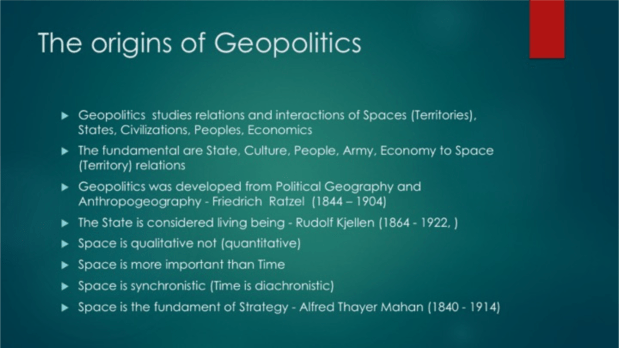
Screen Shot 2019-01-02 at 1.17.57 PM.png

Space, in any sense, not only the material, is synchronicity. It is something that happens simultaneously. It is a synchronistic, not diachronistic approach. Historically, Geopolitics was developed from political geography and “anthropogeography”. It is a kind of political and human geography. Both terms were introduced in the 19th century by the German professor Friedrich Ratzel (1844-1904). Political geography means the relation between the state and territory, or space. The same Ratzel also used in his research the term anthropogeography, which means human geography. The anthropos, or man, is the most important here. In International Relations, nobody speaks about man or the human, but only the state. In Geopolitics, this is not so. Geopolitics tries to involve more levels of analysis than International Relations. This is why there have been problems with this discipline, because some scholars think it is too broad and includes too many levels in one concept, and so is not a precise science.

The next element in Geopolitics was the idea of the Swedish scholar Rudolf Kjellen (1864-1922). He proposed the idea that the state is a living being. This was an organic attitude towards the state. If there are living beings that move, then states move, or they have certain relations to the earth. This is an organicist concept. Kjellen and Ratzel belonged to the same philosophical school of organicism. They considered life, including political life, as something natural, not mechanical, but organic.

So what is the space of Geopolitics? It is qualitative, not quantitative. It is not “physical” space or “scientific” space. The quality of space is something like “life-space.” The concept of living space, or Lebensraum, was introduced by Ratzel. Afterwards, the term was used to mean a space which a growing people needs to occupy in order to satisfy needs. But that was a practical, pragmatic use of the term. Originally, Lebensraum, in the context of Ratzel’s ideas, meant precisely the space that lives – “living space”, in an organic attitude that is qualitative. Space is  quality, where orientations do matter. This is much more of Aristotelian space than the space of modern physics. This is quantum-mechanical space, with different orientations. Space is different if you go to the North, South, East, or West – they are not relative concepts. There is a kind of absolute South or absolute North, absolute West, or absolute East. This space is a kind of category charged with proper characteristics. Space or territory is destiny. With such an attitude, space obtains a kind of historical meaning. Space is not indifferent; it is a very special, organic category. Space is also more important than time. This remark, as well, makes Geopolitics a post-modern discipline, because modernity is centered around time, history, and how everything is changing in the irreversible process of time and progress.

Geopolitics affirms that the most important category of human life and political relations is space. If you, your country, your culture, or your people, live in one kind of space, it will have special values, special politics, and special political organization – if, for example, you live on an island or in a coastal space, you will be obliged to have a different political system, cultural set of values, and so on.

Space, as the foundation of strategy, was also evaluated by the pragmatist and American admiral Alfred Thayer Mahan (1840-1914). The term “Geopolitics” was used for the first time by the Rudolf Kjellen; “political geography” and “anthropogeography” by Ratzel, and “geostrategy” by Mahan. These are the founding fathers or forerunners of Geopolitics.
Screen Shot 2019-01-02 at 1.18.09 PM.png

But properly speaking, Geopolitics as a discipline was formed later, in the beginning of the 20th century. The context of the birth of Geopolitics was British imperial strategy. The real founder of Geopolitics was the British Sir Halford Mackinder, an English imperialist and partisan and promoter of reinforcing the British empire. He thought about the basic principles of the British imperial strategy, and tried to conceptualize them, basing himself on the political geography of Ratzel and the geostrategy of Mahan, and other authors – some British, some Americans.
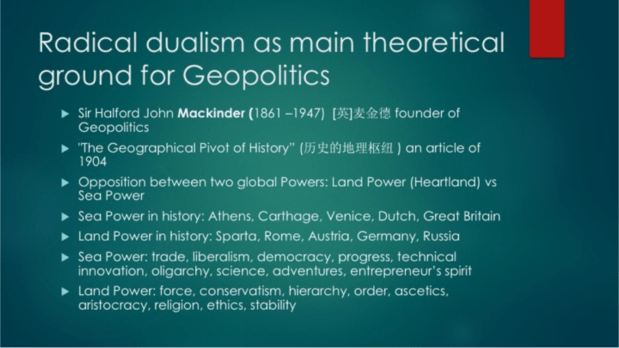
Screen Shot 2019-01-02 at 1.18.14 PM.png

The context is very important. Geopolitics as a discipline was born in the context of the British Empire in the beginning of the 20th century when the British Empire was still flourishing – not at the end or amidst decline, but at what might have been the peak of the British Empire, when the Britons ruled the world through the oceans, and had such colonies as India, China – which was almost a colony, not formally, but under Great British influence – Japan, Iran, the Middle East, Turkey, and almost all of Africa. Whereas the German colonies there were very small, the French and Britain shared most of Africa. The British Empire was alive and flourishing. The context of Geopolitics was thus the “Great Game.”

The “Great Game” was the idea that the most important enemy of the British Empire, just before the “age of geopolitics”, was Imperial Russia, which exercised growing control over Central Asia and threatened English colonies in the Middle East and India, trying to go South to Afghanistan,  and also considering Russian expansion in the Caucasus – all of this growing power of Russia was considered the main enemy of the British Empire. This was the “Great Game.” Many aspects of global international geopolitics during the 19th and the beginning of the 20th centuries can be explained in terms of the Great Game.

It is British imperial strategy, including the Great Game, that was the context of the birth of Geopolitics. The British Empire needed to control trade routes on the continent, but mostly throughout the oceans and seas, as the power of the British Empire was based on the control of trade routes. That was almost the “law” – that the British Empire control trade routes throughout all the world. That was the basic aspect of British strategy, the system of colonies, as Britain controlled and exploited many colonies in Africa, Asia, and so on. The idea, one of the main concerns of British imperialism, was to conserve the British Empire. Geopolitics was born as the theoretical reflection on Anglo-Saxon imperialism. It was a purely Western, imperialist approach. That was the context. It is very important to put science and methods in concrete historical conditions.

The real founder of Geopolitics, Sir Halford John Mackinder, was a political geographer as well as founder of the London School of Economics. He was one of the leading thinkers of British imperialism. In trying to put together all the threats, principles, perspectives, and “logic” of British imperialism, as well as trying to prepare its future in a practical way, Mackinder came to the first vision that was a kind of result of previous approaches to political geography. He published in 1904 in England a very important text composed of small articles, called The Geographical Pivot of History. In these articles, Mackinder laid out the real basis and principles of Geopolitics. We can speak of political geography before Mackinder, but we can speak of Geopolitics sensu stricto only after Mackinder. The line is drawn between the preparation and the creation of the scientific method. Mackinder is a central figure, and that is the main view up to now. His actuality is absolute. We cannot dismiss Mackinder. There is no Geopolitics except Mackinder’s – like in Islam, there is no God but Allah. Mackinder created this science, this method, based on previous ideas, theories, and doctrines, but here is precisely the essence of Geopolitics: Mackinder affirmed that there is a fundamental opposition between two global powers – and that is Geopolitics, precisely.
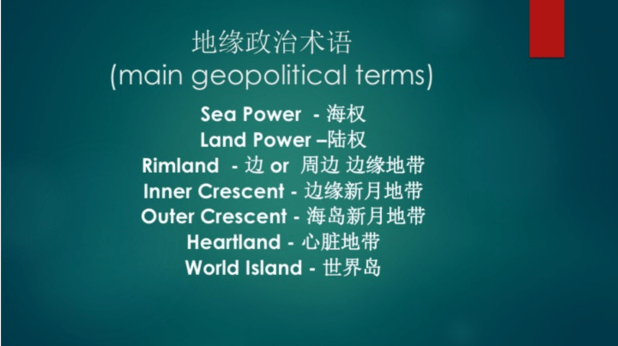
Screen Shot 2019-01-02 at 1.18.21 PM.png

There is Land Power, identified as Heartland, the “geographical pivot” or “axis” of history. All history moves around this pivot, this axis, this Heartland. History is a process, a dynamic, and here is the point of “no dynamics”, the static point, the pivot, around which the wheel moves. That is Land Power.
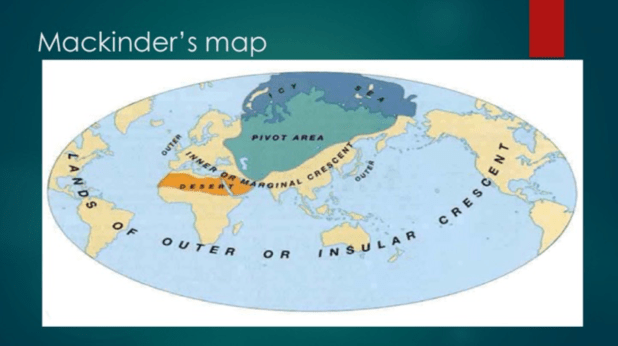
Screen Shot 2019-01-02 at 1.18.30 PM.png

There is Sea Power, which is precisely history. History, or time, is Sea Power. Eternity or the unmoved point is Heartland or Land Power. They represent two kinds of civilization. Land Power is based on constancy and eternity, as Land is fixed, doesn’t move, it is fixed space. It is fixedness itself, which is what Mackinder understood by Land Power. Sea Power is something that moves.

This dualism served Mackinder to explain the meaning of history. According to Mackinder, the fight or dualism between Land Power and Sea Power is the key to understanding history. We can see that this is exactly a kind of explanation or theorization of the Great Game. But this is  also Mackinder’s generalization, because it is not only an explanation of the Great Game. The Great Game – which saw the British Empire trying to control the seas and oceans against the Russian Empire – was a concrete, historical, strategic moment. But Mackinder generalized that the Great Game reflects something deeper, something universal, the basic principles of how human history goes on. This is the basic principle of Geopolitics.

When Mackinder tried to apply his ideas to history, he discovered that there is not only the British and Russian confrontation of the last centuries that can be explained by this geopolitical map, but he saw Sea Power in history, and identified Sea Power in: Athens, as coastal, as  a maritime sea power, in Carthage, the opponent of Rome in the Punic Wars, in Venice as the sea power and trade civilization, in the Dutch colonial empire, and finally in Great Britain. This was a kind of geopolitical continuity between different forms of Sea Power in history. So it is not only an explanation of the Great Game, but is a law. All Sea Powers in history were based on trade, on oligarchies, on technical development, and on control over seas, not land – because Sea Power never goes too deep into the continent. They control the continent by controlling the coast. The coast is much more important than the continental mass. That is, in the final analysis, the control of all space where humans live “from outside”, from the seas and oceans. The standpoint of Ocean, Sea, or Water, is the main element. This is the power of Water, where you cannot trace borders. There is nothing fixed in Water. The ocean, sea, and lakes are ever-changing space. You cannot domesticate creatures living in water. You can only fish them. You cannot feed yourself freely in the water. You need a ship – something artificial. That is the difference between the nature of Water and Earth. Earth is stable. You feel good, safe, and secure on the earth, and you can domesticate animals. The Earth is a kind of natural ambience, while the Ocean is unnatural. You need some kind of technology in order to be there, such as a ship. There is a kind of alienation from space, from ambience, that is at the center of Sea Power. Sea Power already in Mackinder’s work obtains a kind of metaphysical or cultural dimension. It is not only about the Great Game and British imperial strategy – it is about something much deeper. This was expounded only in small remarks in these articles, but it was absolutely underlying.

Land Power in history is quite the opposite. It is Sparta fighting against Athens in the Peloponnesian War. It is Rome against Carthage in the Punic Wars. It is Austria, Germany, and Russia against Western – English and French – imperialism. This analysis is much broader than concrete situations. Mackinder proposed the key to deciphering the logic of history, namely, that all human history is based on this kind of cosmology or mythology, a political mythology of two opposite principles fighting against each other and trying to win – sometimes Sparta wins, sometimes Athens, sometimes Rome, sometimes Carthage, and so on, sometimes Russia, sometimes Britain. There is a balance, an everlasting war of continents.

Already in Mackinder’s works, Sea Power means trade, liberalism, democracy, progress, technical innovation, oligarchy, science, adventure, the entrepreneur’s spirit, and capitalism. All these marks or characteristics created capitalism. Capitalism was born in Britain during its colonial experience. Sea Power is linked to liberal capitalism, to democracy. Sea Power thus also obtains a political and ideological dimension already in Mackinder. This is why Sea Power is “good” for capitalism. Here arises the self-fulfilling prophecy: Sea Power is progress, Land Power is regress or stagnation. Land Power represents force, conservatism, hierarchy, order, ascetics as morals, aristocracy, religion, ethics, and stability. If we compare these concepts, then it is not necessarily socialism. It is something that is not liberalism. It could be a traditional empire, a pre-modern or conservative society, but it could be socialism as well. Everything that is not capitalism and liberalism can be Land Power. This is precisely geopolitics.

The modern geopolitics of the 21st century is the same. It is still good old Mackinder’s point of view. Here we see the main terms and concepts of geopolitics.

Rimland is a very important concept, because it is the coastal zone. In geopolitics, Rimland is precisely the most interesting part of the structure of space, because there is sea space, land space, and Rimland space, which is something “between” land and sea. The coast of Rimland can be controlled from the sea, or from land. Who controls Rimland, controls everything.

Here we can see the famous map of Mackinder, which was published in National Geographic in his article “The Geographical Pivot of History.” Here we see all of geopolitics in one map. It is so “classic” and so fundamental that today all who study geopolitics and apply geopolitical analysis to the modern situation still use this map, drawn in the beginning of the 20th century. This map, drawn more than a hundred years ago, is so actual that it is a kind of prophetic map. What we see here is Sea Power in what is called the Outer and Insular Crescent. This is the territory controlled by the British Empire and the Anglo-Saxon world.  There is the pivot area, the same as Heartland, which is the landmass of Land Power. Here resides Land Power. And there is the Inner or Marginal Crescent, which is Rimland or the coastal area.

World history begins when both Land Power and Sea Power have acquired planetary dimensions. Earlier, the fight was on a reduced scale, but now it has acquired a planetary dimension, and there is only one explanation for what is happening on the planetary level: Sea Power is fighting against Land Power, trying to control the Inner or Marginal Crescent. The object of the fight between the two geopolitical powers, according to Mackinder, is the control of this zone, which could be controlled in one of two ways. The first is by Sea Power, which means that the metropolis, the center of the British Empire, is the master of all this space. Really, actually, in the beginning of the 20th century, all of this space was controlled by the British Empire. They needed (and need) to control Europe, North Africa, the Middle East, Iran, India, at least the coastal part of China, Japan, and the part of the Far East that belongs to Russia. The idea was that the Inner Crescent, or Rimland, should be controlled by Sea Power, and that is the way to global domination by the Anglo-Saxon world. The conceptualization of the British Empire led Mackinder to this conclusion, and drawing this map was the foundational act of the creation of Geopolitics.

But what should Land Power do in the field of history? Mackinder honestly recognized that Land Power will fight back. Land Power, or Heartland, will try to do quite the opposite: to expand its power to the West, to conquer Western Europe, or all of Europe, impose its influence in the Caucasus, the Middle East, and Turkey, trying to use the territory of declining Turkey, and Heartland will try to destroy the British Empire’s control over Afghanistan, Central Asia, and India and, coming to China, to eject British Empire there, as well as in Japan. This was a kind of Great Game, balanced on a planetary scale with – most importantly – some philosophical dimension. Mackinder’s law was: Whoever controls Eastern Europe, controls Heartland, and whoever controls Heartland, rules the world. For Mackinder, it was crucial to control all of Heartland, or Land Power. Eastern Europe is only part of the truth, because all the Inner Crescent should be controlled by Sea Power.
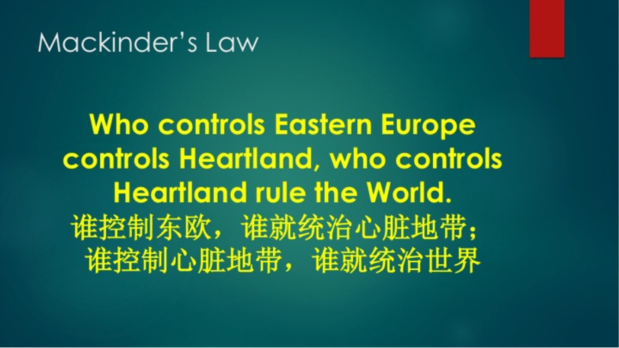
Screen Shot 2019-01-02 at 1.18.39 PM.png

But let us concentrate on this part of the sentence: “Whoever controls Heartland, rules the world.” This is the most important point. If Heartland is controlled from outside, the world is ruled by Sea Power. That means the democratic ideal, progress, modernity, and capitalism on a global scale. If Heartland is ruled by itself, by Land Power, it is something opposite: eternity, tradition, order, hierarchy, conservatism.

In Mackinder’s eyes, Heartland is an object. This object begins with Eastern Europe, as in the Inner Crescent, the coastal line of Eurasia. If the control of this coastal line or zone is strong enough, there is no possibility for direct confrontation between Eurasia, or Heartland, and Sea Power. Heartland becomes an object. But of Heartland. But if Heartland begins to be a subject, affirms itself as a geopolitical subject, is awakened or wakes up on its own, then there is a problem for the global domination of the British Empire. This was the main rule of geopolitics from then on. The fight for Eurasia is an application of this principle.

Mackinder’s follower, Nicholas Spykman (1893-1943), developed his theory of a kind of enlarged version of Mackinder’s, with the emphasis put on Rimland. Spykman said: Whoever controls Rimland, controls Herartland. Whoever controls Heartland, rules the world.” Mackinder was concentrated on Eastern Europe – after all, he was a high commissar of the entente in Ukraine, trying to divide and separate Ukraine from the Russian Empire. The same idea was taken over by Brzezinski and put into practice in 2014 on the Maidan. We are living inside Mackinder’s world, and we cannot get out of it. 
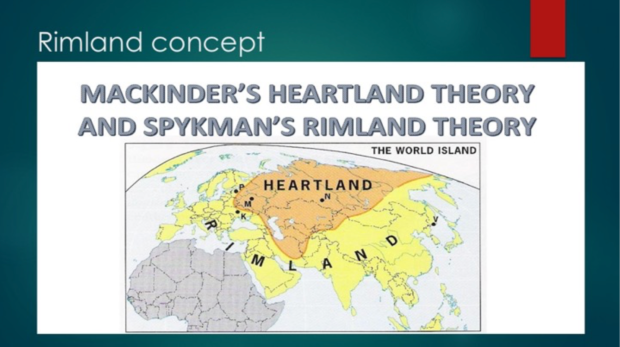
Screen Shot 2019-01-02 at 1.18.44 PM.png

Spykman said that we need to attach the main importance to Rimland in general. In order to rule the world in general, we should separate the Far East from Russia, exercise all control over China from the sea, control the Middle east, Northern Africa, India, Pakistan, Iran, Turkey, and all Europe, and lessen Heartland’s zone of control.
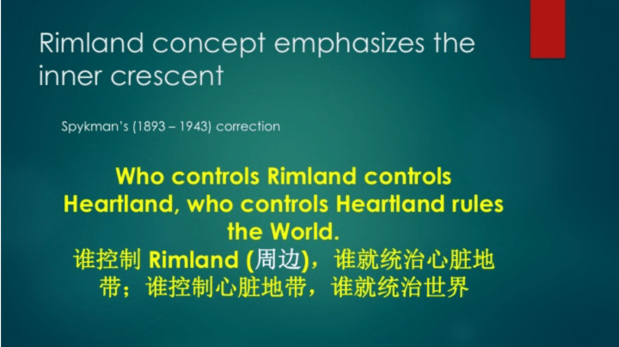
Screen Shot 2019-01-02 at 1.18.51 PM.png

This is the map of the American mind. American strategy follows all of this line. These maps were drawn in the beginning of the 20th century, and this one in the 1920’s. They are so actual today. In the Anglo-Saxon vision, Sea Power is the subject and Land Power is the object. In 2005 I met Zbigniew Brzezinski in Washington, and there was a chessboard between us. I asked: “Mr. Brzezinski, do you consider the game of chess to be for two players?” He said: “No, it is for one.”  That is the typical Western understanding, the Anglo-Saxon vision, of geopolitics. Chess is a game for one player, i.e., there is only one subject, and the other is not a player, but an object, whose hand must be moved. That is the basic attitude of the Anglo-Saxon vision of geopolitics. The main goal of Anglo-Saxon geopolitics is to surround Heartland by controlling Rimland, preventing Heartland from gaining access to the warm seas and breaking through the coastal blockade. The main goal is to rule the world by controlling Eurasia from the sea.

The future decline of Great Britain and the rise of the United States was predicted already in the end of the 19th century by some British imperialists, such as Sir Cecil Rhodes (1853-1902) and his group, the Round Table. Admiral Mahan, as I have already said, considered the US to be Sea Power. It was not evident that the US was a Sea Power when Mackinder wrote his first article. He considered North America to be a kind of Land Power – isolationist, outside of global politics,  and not in competition with Great Britain, but a marginal, peripheral space. But Mahan considered the United States, based on the growth of its navy, to be Sea Power. After Woodrow Wilson involved the US in the First World War, there began a very important geopolitical event or process: the shift of the center of Sea Power from Great Britain to the United States of America. That was accomplished over 20 years from the end of the First World War to the end of the Second World War. During this gap of time, all of Great Britain’s colonies were ‘given’ to the United States. There was a shift of the center of global domination inside the Anglo-Saxon space from Great Britain to the United States. That was the main event on the geopolitical level.
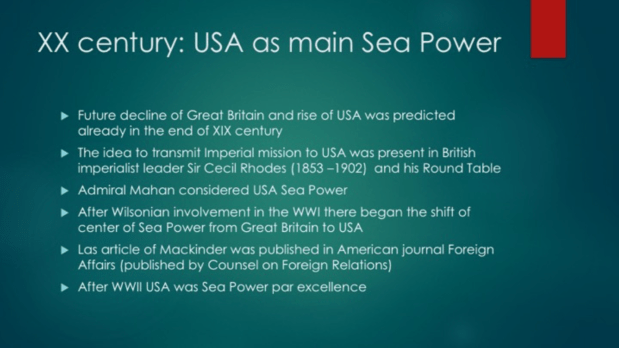
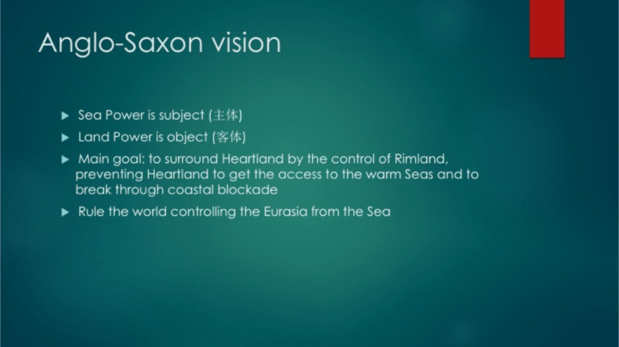
Screen Shot 2019-01-02 at 1.18.58 PM.png

Screen Shot 2019-01-02 at 1.19.05 PM.pngVery symbolically, Mackinder’s last article was published in an American journal, Foreign Affairs, whose editor’s organization, the Council on Foreign Relations, was created by the American elite just after the First World War in order to promote the Wilsonian vision of the United States as a global power operating in defense of capitalism, democracy, and so on. That was a theoretical, intellectual shift of the center of decision-making and the subject. This was a kind of transition of Sea Power. After that, Great Britain became the “old power”, the “senior”, “old man” tending his garden who offers some advice, but is not the real subject.
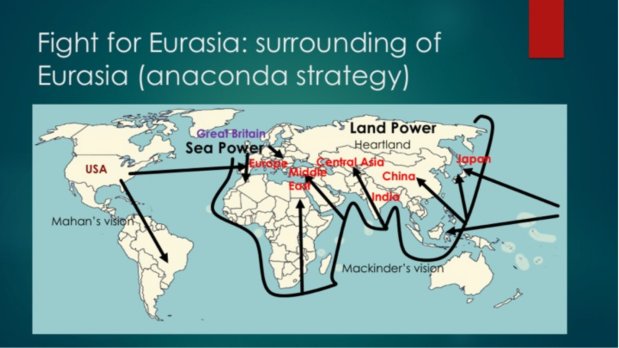
Screen Shot 2019-01-02 at 1.19.11 PM.png

The real subject, from now on, from the first half of the 20th century, has shifted from Great Britain to the United States. Everything that Mackinder said about the strategy of Great Britain was applied, point by point and word by word, to the United States of America, above all in the second half of the 20th century. Before the founding of the Council on Foreign Relations, the United States did not “think of the world”; they had no foreign relations, and were absolutely concentrated on their internal issues before the First World War, before Wilson and his 11 points which declared that the United States of America should be a global power and global defender of liberalism, capitalism, democracy – precisely Sea Power. After the Second World War, the United States became the main, the only Sea Power par excellence. The rest became objects or tools in the hands of the Americans.

The first to carefully read the ideas of Mackinder were the Germans – not the Russians, who were involved in other intellectual and political problems. The Germans awakened to geopolitics and, within the first 20 to 30 years of the 20th century, began to read Mackinder and accept geopolitics.
Screen Shot 2019-01-02 at 1.19.20 PM.png

First there was Karl Haushofer (1869-1946), a German political geographer and general who was military attaché in Japan during the 1920’s. He brought back with him from Japan an interesting word 地缘政治 chi sei gaku, or “geopolitics.” He discovered and accepted the ideas of Mackinder afterwards, and recognized Germany, just as Mackinder affirmed, to be part of the Continent, to be Land Power.
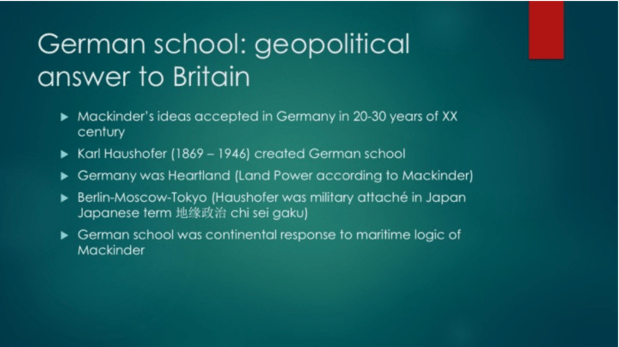
Screen Shot 2019-01-02 at 1.19.28 PM.png

Thus Haushofer began to develop the concept of how to create a Continental geopolitics, not as an object of Anglo-Saxons, but as a subject that will fight back consciously, not only as a tool, but as a kind of conscious power. His idea was exactly opposite to that of Hitler, as Haushofer said that there are only two possibilities for Germany. First, Germany is part of the Continent, or Land Power; it is conservative, traditional, hierarchical, and so on, has almost no colonies or “progress”, but is a traditional society. And if this is so, according to Haushofer, then Germany must be aligned in an axis, on which Haushofer published the article “The Berlin-Moscow-Tokyo Axis.” So, in order to be Land Power in its proper dimension, Germany should be allied with Russia – then, Nazi Germany should be allied with Communist Russia. This was the law of geopolitics that went against Hitler’s idea. But Haushofer said that if you want to follow the rules of geopolitics, you could come to the side of Sea Power, and in that case, Germany should conclude a treaty or alliance with the British and the Americans. But you cannot fight [on two fronts], or you will be destroyed – that was Haushofer’s prophetic saying. Geopolitics is therefore a kind of prophecy that is always fulfilled, whether ignored or open. Hausehofer told Hitler to find a way for an alliance with Russia, as was tried in the Ribbentrop-Molotov Pact, or with the West, as was tried with the Munich agreement between Western countries and Germany. The only thing that was geopolitically impossible was to fight on two lines – this was a geopolitical heresy, according to Haushofer. That was the German school that enriched geopolitics by creating new doctrines, new texts, new intellectual analysis, based on the acceptance of Mackinder’s analysis.

But a deeper understanding of geopolitics, Land Power and Sea Power, was given by another German philosopher, who is much more serious and profound than Karl Haushofer: Carl Schmitt (1888-1985). Schmitt was the greatest political thinker of the 20th century. He is known in all countries and universities of Europe, except in Germany, where he is prohibited. In the United States there is huge interest in Schmitt, and his follower Leo Strauss is considered the teacher of the Neo-Conservatives. There is a huge following of Carl Schmitt on the left as well, on the part of both the post-modern European left and the Latin American, by communists, anarchists, etc. He is the most read author in political science, and I am very happy that he is very well known in China. In Russia he is very popular as well.
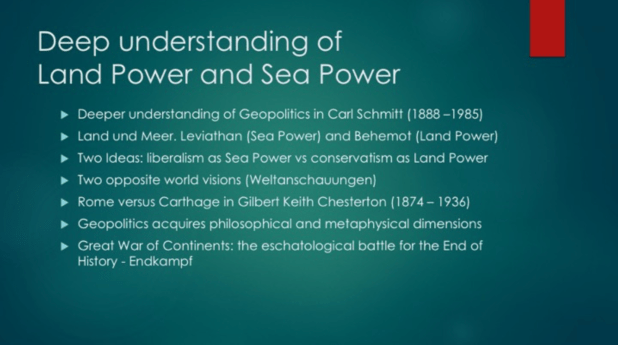
Screen Shot 2019-01-02 at 1.19.37 PM.png

In his book Land und Meer, Carl Schmitt deepened the understanding of what Land and Sea are. He used the biblical names Leviathan, the serpent of the sea, and Behemoth, the Land Power. The fight between Sea Power and Land Power was presented by Schmitt as the eschatological fight between Leviathan and Behemoth, two great monsters, that correspond to two opposite world-visions, or Weltanschauungen in German. He made a clear identification between Sea Power and modernity, capitalism, liberalism, democracy, materialism, modern science – all of these were a kind of ‘result’ of Sea Power. Carl Schmitt gave to the concept of Sea Power a huge, new meaning, that was a development of what Mackinder already had in mind, but was so brilliantly exposed that it transformed geopolitics into a philosophical approach and political philosophy, not only on the strategic map.

The same was declared by the British conservative author – a Catholic like Schmitt – Gilbert Keith Chesterton (1874-1936), who had two wives, both of whom were Serbian. Here as well, geopolitics acquired a metaphysical dimension. The Great War of Continents was considered to be a kind of eschatological, biblical battle for the End Times. It was not only about who controls Heartland and the world, but about what the goal of controlling such is. Carl Schmitt asked what is the goal to control – not power in itself, not only in a pragmatic sense, not as a power play, but as something deeper, as the final battle for the End Times, which in the Christian vision means the Kingdom of the Antichrist or the future Kingdom of Christ. This was a Christian, moral attitude added here. With that dimension, geopolitics obtained an eschatological dimension. Eschatology is the science of the end times, or what should happen as the result of history, at the end of history, in the Hegelian, not Fukuyaman sense.
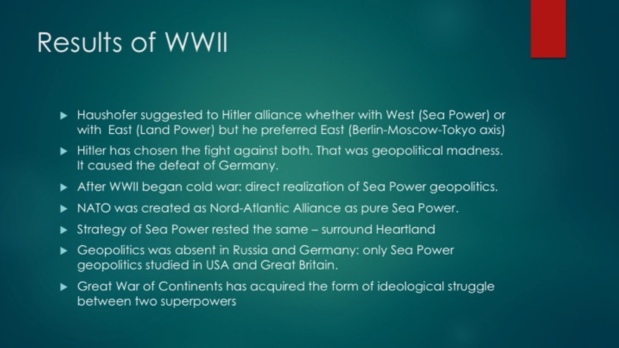
Screen Shot 2019-01-02 at 1.19.44 PM.pngThe result of the Second World War was that Hitler totally neglected Karl Haushofer’s advice. There was no more Germany, no more Hitler, no more National Socialism, because of the suicidal war that cost humanity many millions of victims. Just after the Second World War, the Cold War started, where there was again a pure illustration of the classic map of geopolitics. There was the Soviet camp, of which China was a part, the socialist camp, against the capitalist camp. There was a moment when the Soviet camp and communist, anti-capitalist countries acquired the geopolitical dimension of Behemoth. Communism was Behemothic in some ways. It was Land Power. That’s why communism won not in the industrial, liberal countries which had a big amount of proletarians, but in peasant, agrarian countries like Russia or China – because they were Land Powers. Communism won in Land Power, in the context of anti-liberal, anti-Western, anti-Sea Power. That is the geopolitical explanation of the Cold War.

But the science of geopolitics, and the destiny and fate of this science, was different. In the United States, it was considered to be the main strategy, used always. They did not stop ever since Mackinder and Spykman’s times to use geopolitics as a basic vision of what is going on in the world and politics. But with the German effort to create an alternative geopolitics with the Continent as the subject, this experience bore a kind of demonization due to Haushofer’s relations with Hitler and the crimes committed by the Nazis. The Continental part of geopolitics was destroyed as a “pseudo-science”, while the Anglo-Saxon part of geopolitics continued to be accepted as a main strategy. So, after the Second World War, geopolitics came to have two meanings: (1) something completely rational and positive in the United States, and (2) something impossible, Nazi, and fascist outside of the United States and England. This is precisely like someone who wants to always win in a game of chess – the best solution is to not teach the other how to play. This is the “game of one”, as Brzezinski honestly explained.

Geopolitics was demonized for Europe, but taken as a normal tool for elite-learning in the United States. That is why Brzezinski, Kissinger, the Trilateral Commission, and the Council on Foreign Relations think exactly with the same map and concepts, but geopolitics is prohibited for the others. It is as if there are two geopolitics: “geopolitics” in English, which is a good, correct, and rational science, and German Geopolitik which is pseudo-science. If you look at Sea Power from Land Power, it is “pseudo-science.” If you look at Land Power from the standpoint of Sea Power, it is “science.” This is completely biased by virtue of standpoint.

Unluckily, in the Soviet Union, because of Haushofer’s reputation as well, geopolitics was considered a “bourgeois science.” It was prohibited as well, so we lost Continental geopolitics altogether. There was Sea Power geopolitics, while everyone else was left without geopolitics. So there was a reduced geopolitical awareness on the part of Land, considered to be an object. We do not teach dogs or cats human language or science, so we consider them to be “stupid.” The same is the case with geopolitics. While some declare that geopolitics should be reserved for the Anglo-Saxon ruling elite, they treat the others as enemies who should not be taught this “pseudo-science.” This is why there are so many debates on geopolitics, because it is a prohibited science for the Other, while in the Anglo-Saxon world, it is flourishing as a normal and necessary tool for the learning of the Anglo-Saxon, American elite.

After the fall of communism, Soviet, Russian society lost an understanding of what is going on. Everybody felt that something had gone wrong, but nobody had any explanation. We lost a line. We were no longer communists, but were capitalists and liberals left wondering why NATO is expanding, not accepting us in their club, continuing to still treat us as an enemy after the destruction of the Warsaw Pact and Soviet countries. We were “liberating” Eastern Europe, including some parts of the Soviet Union, while NATO tried to get them, still expanding. Before the North Atlantic alliance was a sea power, fighting on the geopolitical level of Land Power represented on the ideological level by the communists. After the fall of the Soviet Union, there was no longer any “reason” to fight, but the battle went on. This created a kind of stress, an intellectual shock for our political elite, our army, and secret services, because Russian liberals tried to become part of the global world. They didn’t care about sovereignty, tradition, or conserving Russian values, everything of which was for them negative. But the real state, the Russian Deep State, had to react somehow.
Screen Shot 2019-01-02 at 1.19.51 PM.png

The collapse of the communist system disarmed Moscow ideologically, as they could not explain or understand foreign policy. The foreign policy and military strategy of the USSR was based on the concept of confrontation between the socialist camp, the East, and the capitalist camp. The reason of this confrontation was seen precisely only in ideological terms. Outside and beside ideology, there should have been no conflict, yet conflict still continued. When this ideological vision was lost, Russia unilaterally disarmed itself and pretended to be as capitalist, democratic, and liberal as the West. There was no ideological reason to continue opposition. But the West continued to expand NATO to the East, swallowing Eastern Europe and strangling Russia. That created a cognitive dissonance. Something didn’t fit. There was a kind of schizophrenia in the state and society. Why were they against us, when we were no longer against them? We were not defeated in this situation, so it was our free will to stop the confrontation, but they continued the confrontation. Why? Where is the rational, logical reason?
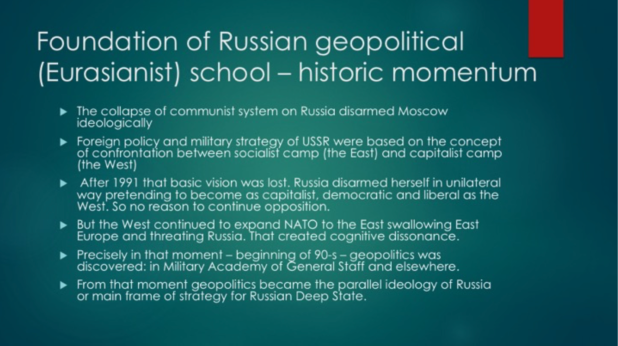
Screen Shot 2019-01-02 at 1.19.58 PM.png

It was precisely at this moment, in the beginning of the 1990’s, that geopolitics was discovered in Russia in the Military Academy of the General Staff and elsewhere. This was done with our help, because I was not a communist; I was very interested in other philosophies, and I discovered conservative values before the fall of communism, being a little bit at a distance from the ruling ideology. Very few people were prepared to respond. I established in the late 1980’s relations with some conservative and traditionalist circles in Europe who were very interested in Carl Schmitt and geopolitics. And when there was the fall of communism, we tried to explain to our generals, our military men, what happened from a geopolitical point of view. That was the only reason: to give a rational explanation of what was happening now, after the end of the Soviet Union, outside of communist ideology, to answer how we can explain this confrontation, opposition, and fight outside of ideology. The liberals in the government and society rejected this approach, because they continued to follow the rules of the West. Geopolitics was a “forbidden” or “pseudo-science” – Soros came to Russia in order to say that “geopolitics is all wrong” – meaning for Russia and for China, but not for them.

Little by little, we have succeeded in establishing geopolitics as the main strategic approach of the Russian Federation. Through the deep state, through military circles, through patriots, we have succeeded in making geopolitics very famous, known, and now in all universities and institutions in Russia, in both the humanitarian and social sciences, they teach geopolitics. That is how geopolitics became the main theoretical field in Russia.

In Shanghai in China, a few months ago in June, I met Dr. Feng Shaolei (director of the Center for Russian Studies at East China Normal University) at a press conference with Prof. Zhang Weiwei organized by guancha.cn, and he said that he had just returned from Russia’s Valdai Club and met Mr. Putin. This Chinese professor asked Mr. Putin: “What is the theoretical basis on which you make your political orientations?” Putin responded: “Geopolitics, not ideology.”

We started in the 1990’s, but there has been a serious paradigm shift with Putin. Now, geopolitics is the prevailing attitude in Russian strategy. That is how the Russian geopolitical school was established, as a continuation of Haushofer’s ideas, except for the role of the subject in geopolitical dualism, as in the case of Russia we had much more of a foundation and many more reasons for this: since Germany was the European Heartland, we are the absolute absolute Heartland, according to Mackinder. This is the Eurasia concept, born at that moment.
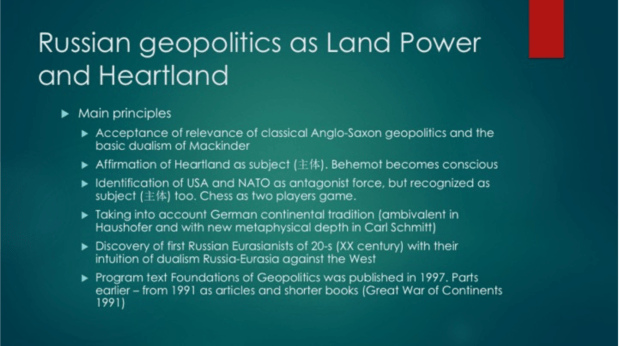
Screen Shot 2019-01-02 at 1.20.03 PM.png

This was the acceptance of the title, rank, or position of a subject on the geopolitical map. This was the acceptance of the relevance of classical Anglo-Saxon geopolitics and the basic dualism of Mackinder. With the affirmation of Heartland as a subject, Behemoth becomes conscious in that moment. There was the identification of the US and NATO as antagonistic forces, but recognized as subjects too – that is a difference. In Eurasian geopolitics, we recognize that Sea Power is a subject. There is not only a one-subject/one-object game. There are two subjects. We are against them, but we recognize them as a formal enemy in accordance with Carl Schmitt’s theory. They constitute themselves as such for us and help us to understand ourselves, as in the pair of Carl Schmitt’s concept of Friend and Enemy. We consider that they have the right to exist, but they have no right to rule us and the space that we consider naturally ours.

All of Putin’s politics is about that: the restoration of sovereignty, getting them out of our space, not letting them impose on us their principles or their Sea Power strategy, because we have a different identity. Taking into account the German Continental tradition, which was ambivalent and not so much really Continental and taking into account the metaphysical depth in Carl Schmitt was very important in the creation of the Russian school of geopolitics. Then we discovered that, already in the beginning of the 20th century, in the White Russian emigration, there was a movement that was called the Eurasianist movement and, to my astonishment, one of the founders of this movement, Petr Savitsky, who was a geographer, had read Mackinder and had already made the first efforts to propose the understanding of Russia as Eurasia, as Heartland, against Sea Power. This was a continuation of the Slavophile tradition in Russian culture.

Starting from the Anglo-Saxons and passing through the Germans, we have discovered in our own proper Russian tradition a marginal [affirmation of such]. Before, the Eurasianists were almost unknown, because they were anti-communist, and therefore were not known in Soviet Russia, but they were in favor of the Soviet Union against the West – they were marginalized in the emigration because they were not in favor of the West, and were anti-Nazi and anti-CIA, while the other part of the White emigration collaborated with Western special services in order to fight communism. The Eurasianists were a small minority in this emigration because they were in favor of Soviet communism for geopolitical reasons, because of hatred for the West, but they were not communists. Thus we re-founded the Eurasianist movement, because we discovered that there was someone like us who precisely predicted earlier that there will be a moment when communism will fall as an anti-Russian ideology – too materialistic and without an understanding of identity, tradition, spiritual traditions, the Christian tradition, having been destroying all that – and after that should come the Eurasianists, in order to continue the fight for independence and sovereignty, which was a positive side of the communist regime, including in Stalin’s opposition to the West and Soviet opposition to the West in general. We discovered our own Eurasianists from a very special way or path, from the Anglo-Saxons to the Germans to our proper roots.

While the first program on this was published in 1997 in my Foundations of Geopolitics, the first texts were published just after the fall of communism, in 1991 in a magazine called Den’ [“Day”], whose editor in chief was Alexander Prokhanov, now the president of the Izborsky Club, one of the main conservative think tanks [in Russia]. That was precisely when we started the promotion of Eurasianism, and the creation of the Eurasian movement came 10 years afterwards. The beginning of the creation of the Russian geopolitical school and Eurasian attitude started just after the fall of the Soviet Union, and that is precisely what the first Eurasianists thought would happen.
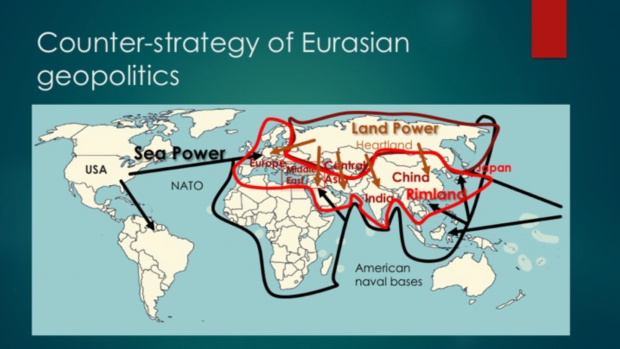
Screen Shot 2019-01-02 at 1.20.10 PM.png

Now for the counter-strategy of the Eurasian geopolitics. If there is one subject, then there is a second one. There is Sea Power and there is Land Power. There is the old Rimland. There is the fight for control, because Sea Power wants to make this zone broader, and Land Power seeks to make this zone smaller. What is important is that now Russia is not the Soviet Union; it is not one of two poles. We have no capacity, no possibility, no resources, and no ideology to impose ourselves as the main ruling power of Rimland. That is a very important shift from bipolarity in the Sea Power-Land Power dualism to multipolarity.
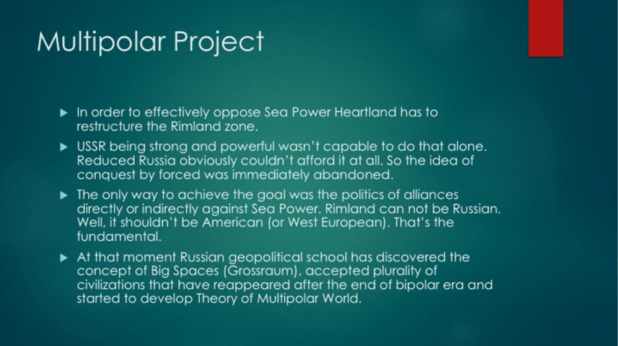
Screen Shot 2019-01-02 at 1.20.20 PM.png

We can make this Rimland safe for us without colonizing it, which is just impossible, by creating friends, an alliance, and helping in a symmetric way different powers to grow and become more and more independent from Sea Power. Now this explains why we have no real desire or capacity to follow the Tsarist or Soviet strategy of more or less bipolarity, and we have no ideology. There is no ideology in Russia – Russia is pragmatic, it is a little bit liberal, but not liberal like in Sea Power, a little bit nationalist, patriotic, and conservative, with a partly traditional society under the growing role of the Orthodox Church and a growing feeling of identity. But that is not ideology: we could not go to Iran and say “accept our ideology”, for we have nothing of the sort, and we could not go to Turkey, India, or China with tanks, and we cannot export anything of the sort.

But how, in that situation, can we save ourselves from Sea Power? By way of friendship, accepting the Other as they are, accepting their identities. For us is not so much important for Rimland to be pro-Russia or not – most important is that Rimland should not be pro-American. That is the main question. You could hate us, but if you don’t like the Americans, if you are not under their control, and if you are independent, that’s enough. We can support you, while being completely indifferent. We don’t suggest any ideology, direct rule, or domination, because we don’t have the power to do so. Compared to the Soviet Union or Tsarist Empire, our weakness is our main privilege. We are playing with our weakness. When the Turks see us, they understand that in such a situation we could not make war against them – we have no idea, no reason for such. If they are Muslims, and we are Christians with many Muslims inside of Russia, we have no problem with them if they do not attack us. When the peoples of our ancient enemies, like Turks or Persians, start to understand that Russia does not represent a threat anymore, they start to see in us a kind of possible ally. And little by little, this alliance is growing. In Syria we have organized such an alliance in a very practical way. This is the fight for the Rimland. Iran is totally anti-Sea Power and Turkey is becoming such. The more anti-Sea Power that Erdogan is, the more he is a friend of Putin. That is all the geopolitics that are actual now.

The main shift was precisely with Putin, who has accepted this vision. Yeltsin and the liberals rejected this vision. Why? Because they were tools of the West, and nothing else. They were not Russian politicians properly speaking, but Western politicians trying to dissolve Land Power. They are called the Fifth Column in Russia, as they tried to open the door for the enemy and let him in.

The new Heartland strategy cannot be bipolar anymore. It can only be multipolar, with all sincerity. This is not a kind of “hidden” version of old bipolarity, as such is impossible in the present situation. We cannot let Sea Power rule Land Power. That is essential, in the end. We can make this possible only with the help of other poles.

At the same time, we have discovered the ideas of another Schmittean concept: Big Spaces. Big Spaces are more or less “poles”, but some Big Spaces are already fully established, some are in the process of being created, while some are in the process of decline.
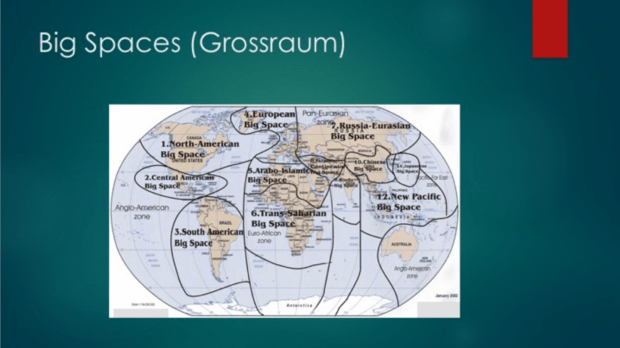
Screen Shot 2019-01-02 at 1.20.26 PM.png

Here is a map where there are the different Big Spaces which we have started to deal with approximately, in a practical sense. Of course, they could be arranged differently. If some are too weak, they can become part of the stronger ones. This is a very dynamic situation, not something fixed. Nevertheless, this map representing Big Spaces is the same as Huntington’s map of civilizations. These Big Spaces roughly coincide with “civilizations.” Hence the concept that a pole in the multipolar world should not be a country or power in the ancient understanding, but new players, who should be civilizations. The forms or strategic expressions of these civilizations are Big Spaces. The content and sense of these are civilizations. We see in these Big Spaces, in this concept, the main power lines of Russian politics.

What we want from the European Big Space is one thing: for NATO to get out, and to create with us a kind of Eurasian strategy. For that reason we are helping everybody who shares with us this idea and who is against Atlanticism – Left or Right, it doesn’t matter. Hence the support for populists. That is our counter-strategy. Putin affirms the concept of Greater Eurasia-Greater Europe from Lisbon to Vladivostok. That is the idea towards Europe. But that is not all: we need something to propose to the Islamic continental Space, including Turkey, Iran, Pakistan, Afghanistan, and we cannot impose on them our vision, Christianize them, or impose some idea – nobody wants that. We should accept them as Islamic and try to establish a strategic alliance with them. The same goes for the Arabo-Islamic space, the same with India, the same with China, the same with Japan. I am speaking of all possibilities.

Why does Putin want to give the Kuril Islands to Japan? In order to try to transform Japan from an enemy, under the control of the West, into a neutral power. Maybe it will not happen, but what is important is the logic I am trying to explain, of how the logic of Big Spaces is reflected in Russia’s concrete foreign policy. That is pure geopolitics. We are coming into the Trans-Saharan space as well together with the Chinese. We are trying to help some forces in the South American Big Space, in the Central American Big Space, and if the North American Big Space will be limited by this region, they can be our friends. Why not? They are very interesting guys, when they are put in their natural civilizational borders. When Trump began his campaign, he promised to stop interventions, to take American forces back from all around the world and to concentrate on inner problems. We didn’t believe him, but we applauded him. That is absolutely the right way to Make America Great Again.

We are not alone in this world with our plans. There is another map, much more terrifying I would say, which is what the globalists of Sea Power want to do. This is a completely different vision. We are shifting from the standpoint of Land Power to that of Sea Power.
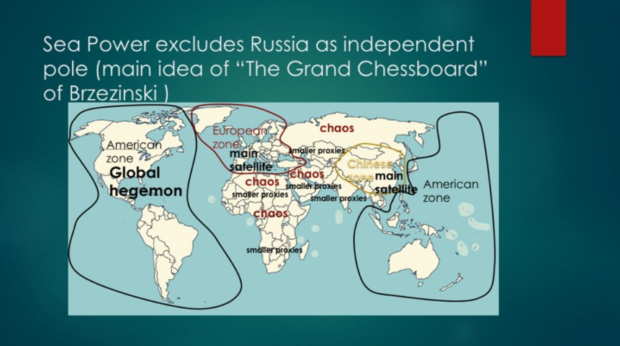
Screen Shot 2019-01-02 at 1.20.34 PM.png

What they propose is a completely different situation. They cannot ignore the Chinese anymore, so their idea is to include China in their future plan, proposed as “G2” by Hillary Clinton when she came here and was accepted very politely, but without much success. China is thinking about what to do in this situation while dealing with all the geopolitical possibilities, not ready to accept anything too early or too easily. But the globalists are ready to include China as a capitalist, liberal Sea Power, with Shanghai, this coastal area of prosperity, but maybe without the inner part of Xinjiang, Tibet, and continental China with its peasantry and traditional society, that is the main basis of the Communist Party that cannot be accepted in the Americans’ plan. So they will bother to change the situation, to push more liberalization, capitalization, and “human rights” here; that is the work of the network of Soros, the Fifth Column, and the Sixth Column, as everywhere. China is to be the main satellite in this concept, with certain conditions. The other main satellite is the European zone. This is more or less the wishful thinking of the American political elite, to see the world as such. They have already sown chaos in North Africa, and in the Middle East, such as by creating a Kurdish state, trying to diminish the influence of Turkey, Iran, Syria, and destroying everything, but not creating anything instead.

Chaos strategy does not suggest creation or a new political system or order instead of the destroyed political systems. It is manipulated, moderated chaos – a new way of strategic thinking. If we carefully read Brzezinski’s book, The Grand Chessboard, it is written that they need a balkanized Eurasia, to transform it into a zone of permanent conflict between different groups – between Muslims, between ethnic groups, between Russians and Ukrainians, for example. This was Brzezinski’s idea. Chaos is already sown in Africa, so they don’t have to bother too much about that, while now the Russians and Chinese are coming here to bring another order, maybe not the best, but not bloody chaos as is the current situation. There are different points – smaller proxies, partly India, partly some pro-Western little states, and Israel for aggravating and make the chaos bigger. Smaller proxies, like Ukraine for example, are not allies in this concept, but just points in order to make chaos bigger. That is more or less how they understand the situation.

That is why the concept of peace and independent poles is absent in any of their plans for the future. It is a kind of self-fulfilling prophecy. They don’t let even a quadripolar system have any appeal; they cannot let it happen, even theoretically, because they know the power of words. They destroy any mention of quadripolarity. All the books of American experts, strategists, “fortune-tellers” as a I like to say, and political analysts try to destroy and eliminate these poles. There should be only chaos, and by having chaos, they can create a world in which they can still have global power and rule the world. They will not properly rule Eurasia with a better government – they don’t need Russia at all; they blame Russia and Putin not because they don’t like Putin, but because they won’t let Russia be. This is ontological. It is Sea Power vs. Land Power. Nothing personal. Putin could follow some concrete agreement with them, but they don’t regard Russia as a subject, only chaos.
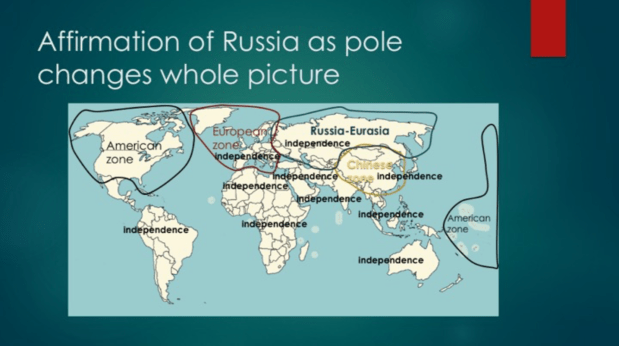
Screen Shot 2019-01-02 at 1.20.43 PM.png

But if we recognize the pole of Eurasia, we see a completely different situation. First of all, the European and Chinese zones immediately become independent. They lose their certain dependence on the West, while not exchanging this dependence for dependence on Russia. In Japan, with the Minister of Foreign Affairs, I have tried to explain this to the Japanese, but they said: “You want to establish Eurasian rule instead of American rule. When the Americans go out, you will come.” I said: “You have not understood the main idea.” If they are here, there will be only chaos. China and Europe will be dependent on the West, whether recognized as “multilateral allies” or something else, but with Russia here, you will be independent – from them, but from us as well, because we cannot threaten you. Everybody else obtains independence.
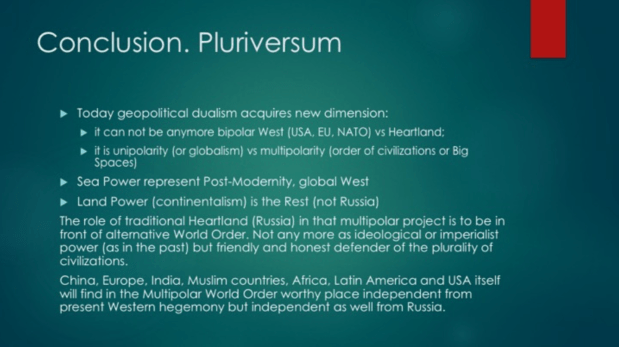
Screen Shot 2019-01-02 at 1.20.53 PM.png

Independence is not happiness or a happy end. It is a challenge, because you should be strong and have an identity. Independence is the burden of the multipolar world. It is not a gift. It is a chance to affirm identity. For the partisans of identity, culture, and the spirit of civilizations, it is a gift, but for governments, it is a huge burden, because you are responsible for organizing and managing without ready-made solutions. Now, in the unipolar world, they suggest you should follow their rule, do this and that, and everything will be alright – maybe not now, perhaps you should pass through some shock therapy, and so on. But independence is real freedom and a real chance, a chance that is open. History does not end there. History is open.

Today, geopolitical dualism acquires a new dimension. It is not anymore bipolar as in the West vs. Heartland. It is unipolarity and globalism vs. multipolarity, the order of civilizations or Big Spaces.

Can we identify the Eurasian project with the famous Chinese win-win strategy? Certainly not. Because Sea Power is going to lose its domination and leading role, as was the case in the unipolar moment. They had the chance after the fall of communism to have global domination and rule. They enjoyed this chance, this possibility, over 10 years. But with 9/11 and Putin’s coming to power, their domination has been limited. So why not a win-win? Because someone has to pay for multipolarity. If there is multipolarity, someone has to lose. Will Continental Heartland pay for multipolarity? Or will there be the global domination of the West, that will lose? This is a win-lose strategy that is an open, continental fight in which there is no neutral solution.
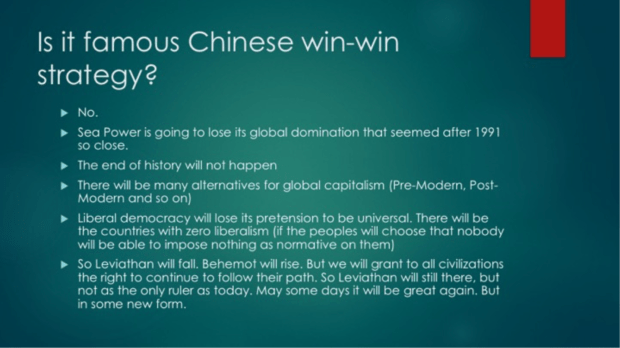
Screen Shot 2019-01-02 at 1.21.00 PM

One solution is multipolarity. On the other side is unipolarity and globalization. That is not a win-win. But at the same time, the exit, the success, or the end of all this is not granted. It is open history. The end of history has ended. I spoke about this with Fukuyama in Washington, and he has since recognized that he was in too much of a hurry to declare that the end of history has already happened. Now the end of history is finished. There is no more end of history. History is here, with all the possibilities, dangers, all the risks, all the open ends, and moving ends within the context of open history. In history, there is no win-win. Someone should lose. The conclusion, according to the Eurasianist world-vision, is that Sea Power should lose this time, and we should win.

Bibliography

Abe I. Chiseigaku nyumon. Tokyo: Kokon-Shoin, 1933.

Achcar G. Greater Middle East: the US Plan – www. mondediplo.co. 2004. [Электронный ресурс] URL: http://mondediplo.com/2004/04/04world (дата обращения 03.09.2010).

Agnew J. Geopolitics: Re-Visioning World Politics. Londres: Routledge, 1998.

AgnewJ., Mitchell K. & O’Thuatail G.(eds.) A Companion to Political Geography. London: Blackwell, 2002.

Al-Rodhan N.R.F. Neo-statecraft and meta-geopolitics. Berlin: Lit Verlag, 2009.

Aldrich R. J. The Hidden Hand: Britain, America and Cold War Secret Intelligence. Duckworth, 2006.

Ambrosio Th. Challenging America global Preeminence: Russian Quest for Multipolarity. Chippenheim, Wiltshire: Anthony Rose, 2005.

Amin S. Eurocentrism. New York: Monthly Review Press, 2010.

Amin S. The Liberal Virus. London: Pluto Press, 2005.

Amin S. Transforming the revolution: social movements and the world-system. Delhi: Aakar Books, 2006.

Ancel J.  Géopolitique. Paris: Bibliothèque d’Histoire et de Politique, 1936.

Ancel J. Geographies des frontiers. Paris: Gallimard, 1938.

Aras B. The new geopolitics of Eurasia and Turkey’s position. London: Frank Cass, 2002.

Armstrong D. Drafting a plan for global dominance // Harper’s Magazine. October 2002.

Attali J. Lignes d’horizon. Paris:Fayard, 1990.

Axelos K. Vers la pensée planétaire. Paris: Les Éditions de Minuit, 1964.

Barnett T. P. M. Great Powers: America and the World after Bush. New York: Putnam Publishing Group, 2009.

Barnett T. P. M. The Pentagon’s New Map. New York: Putnam Publishing Group, 2004.

Beales A. C. F. The history of peace; a short account of the organised movements for international peace. New York: Garland Pub., 1971.

Beck U. Risikogesellschaft. Auf dem Weg in eine andere Moderne. Frankfurt a.M.:Suhrkamp, 1986.

Behar P. Une géopolitique pour l’Europe, vers une nouvelle Eurasie. P.: Editions Desjonquères, 1992.

Benoist A. de. Europe, Tiers Monde Meme Combat. P.:Laffont, 1986.

Benoist A. de. L’idée d’Empire/ Actes du XXIVe colloque national du GRECE. Nation et Empire. Histoire et concept. Paris: GRECE 1991.

Bhagwati J. N. Free Trade Today. Princeton, N.J.: Princeton University Press, 2002.

Bhagwati J. N. In Defense of Globalization. New York: Oxford University Press, 2004.

Bowman I. Geography in relation to the social sciences. New York: C. Scribner’s Sons, 1934.

Bowman I. Geography vs. Geopolitics. New York: American geographical society, 1942.

Bowman I.  International Relations. Chicago: American Library Association, 1930.
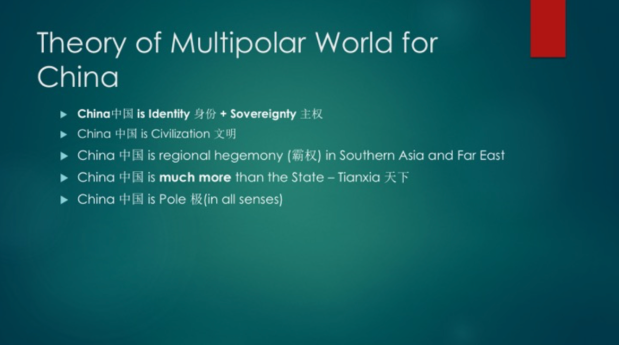
Bowman I. The new world: problems in political geography. Chicago: World Book Company, 1928.

Braudel F. (dir.) La Méditerranée. L’espace et les hommes. Paris: Arts et métiers graphiques, 1977.

Braudel F. Civilisation matérielle, économie et capitalisme (XVe-XVIIIe siècles). 3 volumes. Paris, Armand Colin, 1979.

Brechtefeld J. Mitteleuropa and German politics. New York, 1996.

BRICs and beyond. Goldman Sachs Global Economics Group. NY, 2007.

Bruhnes J. Geographie humaine. Paris: Michelet, 1910.

Brzezinski Z. America and the World: Conversations on the Future of American Foreign Policy. New York: Basic Books, 2008.

Brzezinski Z. Between Two Ages : America’s Role in the Technetronic Era. New York: Viking Press, 1970.

Brzezinski Z. Game Plan: A Geostrategic Framework for the Conduct of the U.S.-Soviet Contest. Boston: Atlantic Monthly Press, 1986.

Brzezinski Z. Grand Failure: The Birth and Death of Communism in the Twentieth Century. New York: Charles Scribner’s Son, 1989.

Brzezinski Z. Power and Principle: Memoirs of the National Security Adviser, 1977-1981. New York: Farrar, Strauss, Giroux,1983.

Brzezinski Z. The Choice: Global Domination or Global Leadership, New York: Basic Books, 2004.

Brzezinski Z. The Grand Chessboard: American Primacy and Its Geostrategic Imperatives. New York: Basic Books, 1997.

Brzezinski Z. Second Chance: Three Presidents and the Crisis of American Superpower. New York: Basic Books, 2007.

Brzezinski Z. Soviet Bloc: Unity and Conflict, N.Y. Harvard University Press, 1967.

Burnham J. The Struggle for the World. New York: The John Day Company, Inc, 1947.

Canagarajah A. S. A geopolitics of academic writing. Pitssburgh: University of Pitssburgh Press, 2002.

Chauprade A., Thual F. Dictionnaire de géopolitique. Paris: Ellipses,  1999.

Chauprade A. Géopolitique – Constantes et changements dans l’histoire. Paris: Ellipses, 2007.

Chauprade A. Introduction à l’analyse géopolitique. Paris: Ellipses, 1999.

Chauprade A. Les Balkans, la Guerre du Kosovo (en collaboration). Paris/Lausanne: L’Âge d’Homme, 2000.

Chauprade A. Géopolitique des États-Unis (culture, intérêts, stratégies). Paris: Ellipses, 2003.

Chauprade A. Une nouvelle géopolitique du pétrole en Afrique //Chronique du choc des civilizations. Editions Chronique. Janvier, 2009.

Cheradame A. L’Allemagne, дa France et la question de l’Autriche. P.:Plon, 1902.

Chomsky N. The Cold War and the Superpowers// Monthly Review. Vol. 33. № 6. November 1981. С. 1–10.

Chomsky N. Profit over people: neoliberalism and global order. New York: Seven Stories Press, 1999.

Chomsky N. Hegemony or survival: America’s quest for global dominance. New York: Penguin, 2007.

Cohen S.B. Geography and Politics in a World Divided. New York: Praeger, 1963.

Cohen S.B. Geopolitics of World System. NY: Rowman&Littlefield publishers, 2002.

Cohn N. The Pursuit of the Millennium: Revolutionary Millenarians and Mystical Anarchists of the Middle Ages. London; New York: Oxford University Press, 1957.

Coudenhove-Kalergi R. Paneuropa. Wien, 1923.

Coutau-Bégarie H. 2030, la fin de la mondialisation? P.: Artege, 2009.

Coutau-Bégarie H. Géostratégie du Pacifique. P.: Economica, 2001.

Coutau-Bégarie H. La Lutte pour l’empire de la mer. P.: Economica, 1999.

Coutau-Bégarie H. Marins et océans. 2 v. P.: Economica, 1999.

Coutau-Bégarie H. Pensée stratégique et humanisme. P.: Economica, 2000.

Crocker D. A. Ethics of Global Development: Agency, Capability, and Deliberative Democracy. Cambridge: Cambridge University Press, 2008.

Cunningham L. A. From Random Walks to Chaotic Crashes: The Linear Genealogy of the Efficient Capital Market Hypothesis//George Washington Law Review. 1994. Vol. 62

Daly H. E. Globalization and Its Discontents// Philosophy and Public Policy Quarterly. 2001. 21, 2/3.

Daly H. E. Globalization’s Major Inconsistencies//Philosophy and Public Policy Quarterly. 2003. 23, 4.

Debrix F., Lacy M. The geopolitics of American insecurity: terror, power and foreign policy. Abingdon: Routlede, 2009.

Desan W. The Planetary Man, Vol. 1: A Noetic Prelude to a United World. Washington,DC: Georgetown University Press, 1961.

Dodds K. Geopolitics: A Very Short Introduction. New York: Oxford University Press, 2007.

Dodds K. Geopolitics in a changing world. London: Prentice Hall, 2000.

Dodds K. Global geopolitics: a critical introduction. Harlow: Pearson Education Ltd, 2005.

Dolman E. C. Geostrategy in the Space Age: An Astropolitical Analysis/ Gray Colin S., Sloan G. (ed.) Geopolitics, Geography and Strategy. London: Frank Cass, 2003.

Dorrien G. Imperial Designs: Neoconservatism and the New Pax Americana. New York: Routledge, 2004.

Douguine A. Le prophete de l’eurasisme. Paris:Avatar, 2006; Idem. La grande guerre des continents. Paris:Avatar, 2006.

Douhet G. Command of the Air. New York : Coward, McCann & Geoghegan, 1942.

Dughin A. Continente Russia. Parma: All’isegno di Veltro, 1992.

Dughin A. Eurasia. La Rivoluzione Conservatrice in Russis. Roma, 2005.

Dughin A. Fundamentele geopoliticii. Bucarest.:Andersen Media, 2010.

Dugin A. A grande guerra dos continentos. Lisboa, 2010.

Dugin A. Geopolitikis safudzvlebi. Rusetis geopolitikis momavali. Tbilisi: Gamomgtsemloba, 1999.

Dugin A. Misyonin avrasyagilik Nursultanain Nazarbaevin. Ankara, 2006.

Dugin A. Moska-Ankara aksiaynin. Istambul: Kaynak, 2007.

Dugin A. Osnove geopolitike. Beograd, 2004.

Dugin A. Rusia. Misterio de Eurasia. Madrid:Grupo Libro 88, 1992.

Dugin A.Rus jeopolitigi avrasyaci yaklasim. Ankara, 2003.

Dugin A. Seminal writings. 3 v. L., 2000.

Dugin I. Feisaliny jeopolitidgi. Beyruth, 2004.

Dyer G. Climate War. Montreal: Random House of Canada, 2009.

Ebeling F. Karl Haushofer und die deustche Geopolitik 1919-1945. unpubl. diss. Hanover, 1992.

Engdahl F.  Full Spectrum Dominance: Totalitarian Democracy in the New World Order. Boxboro, MA: Third Millennium Press, 2009.

Engdahl F. Century of War: Anglo-American Oil Politics and the New World Order. London: Pluto 2004.

Foster J. B. Imperial America’ and War// Monthly Review. 2003. May.Vol. 55.№. 1. С. 1–10

Fouere Y. Contre les etats: regions d’Europe P.:Presse d’Europe, 1971.

Fouere Y. Europe aux cents drapeaux. P.:Presse d’Europe, 1968.

Foucher M. Fronts et Frontières, un tour du monde géopolitique. P.: Fayard, 1988; Idem. L’invention des Frontières. P.: FEDN, 1986.

Foucher M., Dorion H. (dir.) Frontière(s), scènes de vie entre les lignes. P.: Glénat, 2006.

Friedman T. L. The Lexus and the Olive Tree: Understanding Globalization .New York: Farrar, Straus & Giroux, 1999.

Friedman T. L. The World Is Flat: A Brief History of the Twenty-First Century. New York: Farrar, Straus and Giroux, 2005

Fukuyama F. 2004. State-Building: Governance and World Order in the 21st Century. New York: Cornell University Press, 2004.

Gallois. P.-M. Géopolitique, les voies de la puissance. P.:Plon, 1990.

Gill S. American Hegemony and the Trilateral Commission. Boston: Cambridge University Press, 1991.

Gray C.S. The geopolitics of the nuclear era: heartland, rimlands, and the technological revolution. New York: Crane Russak & Co, 1977.

Gray C.S., Sloan G. Geopolitics, geography and strategy. London: Portland, OR: Frank Cass, 1999.

Gray C.S. Strategy and History: Essays on Theory and Practice. Abingdon, UK:Routledge, 2006.

Gray C.S. Strategy for Chaos: Revolutions in Military Affairs and Other Evidence of History. London: Frank Cass, 2002

Gray C.S. The Geopolitics of Super Power. Lexington, KY:University Press of Kentucky, 1988.

Gray C.S. The Leverage of Sea Power:The Strategic Advantage of Navies in War. New York: The Free Press, 1992.

Gray C.S. War, Peace, and Victory:Strategy and Statecraft for the Next Century. New York: Simon and Schuster, 1990.

Greenberg A. S. Manifest Manhood and the Antebellum American Empire. Cambridge U. Press, 2005.    .

Grossouvre de H. Paris, Berlin, Moscow: Prospects for Eurasian cooperaion // World Affairs. Vol 8. Jan–Mar 2004. №1.

Haass R. The Age of Non-polarity: What will follow US Dominance?//Foreign Affairs. 2008. 87 (3). p. 44-56.

Hackmann R. Globalization: myth, miracle, mirage. Lanham: University Press of America, 2005.

Haushofer K. Bausteine zur Geopolitik. Heidelberg: K. Vowickel, 1924.

Haushofer K. Dai Nihon. Betrachtungen uber Gross-Japans Wehrschaft und Zukunft. Berlin:E.S.Mittler, 1913.

Haushofer K. Das japanische Reich in seiner geographischen Entwicklung.Wien, Seidel, 1921.

Haushofer K. Das Reich: Grossdeutches Werden im Abendland. Berlin: Karl Habel Verlagsbuchhandlung, 1943.

Haushofer K. Der Kontinentalblock. München : Eher, 1941.

Haushofer K. Geopolitik der Pan-Ideen. Berlin: Zentral-Verlag, 1931.

Haushofer K. Geopolitik des Pazifischen Ozeans: Studien über die Wechselbeziehungen zwischen Geographie und Geschichte. Mit sechzehn Karten und Tafeln. Heidelberg: K. Vowickel, 1924.

Haushofer K. Grenzen in ihrer geographischen und politischen bedeutung. Heidelberg: K. Vowinckel, 1939.

Haushofer K. Japan baut sein reich. Berlin: Zeitgeschichte Verlag, 1941.

Haushofer K. Weltmeere und Weltmachte. Berlin: Zeitgeschichte Verlag, 1941.

Haushofer K. Weltpolitik von heute. Berlin: Zeitgeschichte Verlag, 1936.

Held D., McGrew A. Globalization Theory: Approaches and Controversies. Polity, 2007.

Held D., McGrew A., Goldblatt D., Perraton J. Global Transformations. Stanford: Stanford University Press, 1999.

Heim M. The Metaphysics of Virtual Reality. Oxford, 1993.

Hesse F. Das gesetz der wachsende Raume/Zeitschrift fuer Geopolitik. 1924. 1 Jg. С. 1-10.

Hettner A. Die Geographie, ihre Geschichte, ihr Wesen und ihre Methoden. Breslau: Ferdinand Hirt, 1927.

Hettner А. Die Geographie, ihre Geschichte, ihr Wesen und ihre Methoden. Breslau: Ferdinand Hirt, 1927.

Higgott R. Multi-Polarity and Trans-Atlantic Relations: Normative Aspirations and Practical Limits of EU Foreign Policy. – http://www.garnet-eu.org. 2010. [Электронный ресурс] URL: http://www.garnet-eu.org/fileadmin/documents/working_papers/7610.pdf (дата обращения 28.08.2010).

Hiro D. After Empire: The Birth of a Multipolar World. Yale: Nation Books, 2009.

Hirst P., Thompson G. Globalization in Question: The International Economy and the Possibilities of Governance.Cambridge: Polity Press, 1996.

Hock D. Birth of the Chaordic Age. San Francisco: Berrett-Koehler Publishers, Inc., 1999.

Holbrooke R. America, A European Power.//Foreign Affairs. March/April, 1995.

Horowitz D. From Yalta to Vietnam: American Foreign Policy in the Cold War.  N.Y., 1967.

Hugon P. African geopolitics. Princeton, NJ: Markus Weiner Publishers, 2008.

Hulsman J. Cherry-Picking: Preventing the Emergence of a PermanentFranco-German-Russian Alliance. – http://www.heritage.org. 2003. [Электронный ресурс] URL: http://www.heritage.org/Research/Reports/2003/08/Cherry-Picking-Preventing-the-Emergence-of-a-Permanent-Franco-German-Russian-Alliance (дата обращения 03.09.2010).

Huntington S. P. The Clash of Civilizations and the Remaking of the World Order. New York: Simon and Schuster, 1996.

Iimot N. Iwayuru chiseigaku no gainen/Chirigaku Hyoron, 1928.

Immerman R. H. John Foster Dulles: Piety, Pragmatism, and Power in U.S. Foreign Policy. New York: SR Books, 1998.

Johnson R. Spying for Empire: The Great Game in Central and South Asia, 1757-1947. London: Greenhill, 2006.

Jones St. B. Boundary-making: A Handbook for Statesmen, Treaty Editors and Boundary Commissioners. Washington: Carnegie Endowment for International Peace, Division of International Law, 1945.

Jones St. B. Unified Field Theory of political Geography//Annals of the Association of American Geographers. 1954. June. V.XLIV  n.2 С. 111-123.

Joyaux F. Géopolitique de l’Extrême-Orient, Espaces et politiques. Bruxelles: Éditions Complexe, 1991.

Kagan R. Dangerous nation. New York: Vintage, 2007.

Kagan R. Of paradise and power: America and Europe in the new world order. New York: Vintage, 2004.

Kagan R. The Return of History and the End of Dreams. New York: Vintage, 2009.

Kagan R., Kristol W. Present dangers: crisis and opportunity in American foreign and defense policy. New York: Encounter Books, 2000.

Kagan R. The Case for a League of Democracies// Financial Times. 2008. May 13.

Kaplan R.D. Imperial Grunts: On the Ground with the American Military, from Mongolia to the Philippines to Iraq and Beyond. NY: Vintage, 2006.

Kaplan R.D. The coming Anarchy: Shaterring deram of the Cold War. NY: Random House, 2000.

Katz M. Primakov Redux. Putin’s Pursuit of «Multipolarism» in Asia//Demokratizatsya. 2006. vol.14 № 4. C.144-152.

Kennan G. F. The Sources of Soviet Conduct//Foreign Affairs, July 1947.

Kennan G. F. Russia, the Atom, and the West. New York: Harper, 1958.

Kennedy P. The Rise and Fall of Great Powers. New York: Random House, 1987.

Keohane R., Nye J.S.Jr. Power and Interdependance in the Information Age//Foreign Affairs. 1988. 77/5 (Sept.Oct.). С. 81-94.

Khanna P. Der Kampf um die zweite Welt – Imperien und Einfluss in der neuen Weltordnung. Berlin: Berlin Verlag, 2008.

Kilinc T. Turkey Should Leave the NATO – http://www.turkishweekly.net. 2007. [Электронный ресурс] URL: http://www.turkishweekly.net/news/45366/tuncer-kilinc-%F4c%DDturkey-should-leave-the-nato-.html (дата обращения 03.09.2010).

Kincaid  C.  McCain, Soros, and the New «Global Order» – http://www.aim.org. 2008. [Электронный ресурс]URL: http://www.aim.org/aim-column/mccain-soros-and-the-new-global-order/ (дата обращения 20.09.2010.)

King A., Schneider B. The First Global Revolution: A Report by the Council of Rome. London: Simon and Schuster, 1992.

Kirk W. Historical geography and the concept of behavioral environnement//Indian geographical journal& Silver Juvelee volume. 1952. С.152-160.

Kissinger H. Crisis: The Anatomy of Two Major Foreign Policy Crises. New York: Simon & Schuster, 2004.

Kissinger H. Diplomacy. New York: Simon & Schuster, 1994.

Kissinger H. Does America need a foreign policy?: toward a diplomacy for the 21st century. New York: Simon & Schuster, 2002.

Kissinger H. White House Years. New York: Little, Brown and Company, 1979.

Klare М. Rising Powers, Shrinking Planet: The New Geopolitics of Energy. New York: Henry Holt & Company Incorporated, 2008.

Krasner S. Sovereignty: Organized Hypocrisy. Princeton, N.J.: Princeton University Press, 1999.

Krauthammer Ch. The Unipolar Moment// Foreign Affairs. 1990/1991 Winter. Vol. 70, No 1. С. 23-33.

Kristol I. Neoconservatism: the autobiography of an idea. Lanham: Ivan R. Dee, 1999.

Lacoste Y. Dictionnaire geopoliqiue. Paris: Flammarion, 1986.

Lacoste Y. Geopolitique: la longue histoire d’aujourd’hui, Paris: Larousse, 2006.

Lacoste Y. Géopolitique de la Méditerranée. Paris: Colin, 2006.

Lacoste Y. La Géopolitique. Paris: Centre national de documentation pédagogique, 1990.

Larson A. Geopolitics of oil and natural gas // Economic Perspectives vol. 9. №2. May 2004.

Lash S., Featherstone M. (eds.) Spaces of Culture: City, Nation, World. London: Sage, 1999.

Lash S., Szerszynski B., Wynne B. (eds.) Risk, Environment and Modernity. London: Sage (TCS), 1996.

Lash S., Featherstone M., Szerszynski B., Wynne B. Spaces of Culture: City, Nation, World. London: Sage, 1999.

Lash S., Lury C. Global Culture Industry: The Mediation of Things. Cambridge: Polity, 2005.

Laurant J.-P. Le Regard ésotérique. Paris: Bayard, 2001.

Layne C. The peace of illusions: American grand strategy from 1940 to the present. Ithaca: Cornell University Press, 2006.

Le Billon P. Geopolitics of resource wars: resource dependence, governance and violence. Abingdon: Frank Cass, 2005.

Lechner F. J.,  Boli J. The Globalization Reader. Oxford: Wiley-Blackwell, 2003.

Leech H. J. The public letters of the Right Hon. John Bright. London: Low, Marston & Co., 1895.

Lefebvre H. La production de l’espace. Paris: Anthropos, 1974.

Liu Henry C. K. Obama, change and China.Brzezinski’s G-2 grand strategy – Asian Times. 2009.22.04. [Электронный ресурс] URL: http://www.atimes.com/atimes/China_Business/KD22Cb02.html (дата обращения 24.08.2010).

Lohausen H.J. von. Denken in Völkern. Die Kraft von Sprache und Raum in der Kultur- und Weltgeschichte. Graz: Stocker 2001.

Lohausen H.J. von. Ein Schritt zum Atlantik: Die strategische Bedeutung d. Ostverträge. Wien: Österr. Landsmannschaft, 1973.

Lohausen H.J. von. Les empires et la puissance: la géopolitique aujourd’hui. Paris: Le Labyrinthe, 1996.

Lohausen H.J. von. Denken in Kontinenten. Berg am See: Kurt Vowinckel Verlag, 1978.

Lohausen H.J. von. Reiten für Russland: Gespräche im Sattel. Graz: Stocker, 1998.

Lohausen H.J. von. Zur Lage der Nation. Krefeld: Sinus-Verlag, 1982.

Lonsdale D. J. Informational power: strategy, geopolitics and the fifth dimension/ Gray Colin S., Sloan G. (ed.) Geopolitics, Geography and Strategy. London: Frank Cass, 2003.

Lorenz E. The Essence of Chaos. Washington: University of Washington Press, 1996.

Lorot P. Guellec J. (ed.) Planète Océane. L’essentiel de la mer. P.: Choiseul, 2006.

Lorot P., Thual F. La Géopolitique. P.: Montchretien, 1997.

Luttwak E. Sea Power in the Mediterranean: Political Utility and Military Constraints. California, 1979.

Luttwak E. Strategy: The Logic of War and Peace. Cambridge, Massachusetts, 1987.

Luttwak E. The Grand Strategy of the Byzantine Empire. Cambridge, Massachusetts, 2009.

Luttwak E. The Grand Strategy of the Roman Empire from the First Century AD to the Third. Baltimore, 1976.

Luttwak E. The Political Uses of Sea Power. Baltimore, 1974.

Luttwak E. Coup d’État: A Practical Handbook. London, 1968.

Luttwak E. From Geopolitics to’Geoeconomics. Logic of Conflict, Grammar of Commerce//The National Interest.1990.Summer. С. 17—23.

Luttwak E. The Endangered American Dream: How To Stop the United States from Being a Third World Country and How To Win the Geo-Economic Struggle for Industrial Supremacy. New York, 1993.

Luttwak E. Turbo-Capitalism: Winners and Losers in the Global Economy. New York, 1999.

Mackinder H. J. Britain and the British Seas. Charleston: BiblioLife, 2010.

Mackinder H. J. Democratic Ideals and Reality: A Study in the Politics of Reconstruction. Washington, D.C.: National Defense University Press, 1996.

Mackinder H.J. On the Scope and Methods of Geography//Proceedings of the Royal Geographical Society and Monthly Record of Geography. 1887. New Monthly Series, Vol. 9, No. 3 (Mar.).

Mackinder H. J. Situation in South Russia 21 Jan. 1920//Documents on foreign policy 1919-1939. Fisrt series. V. III, 1919. London, 1949. p. 786-787.

Mackinder H. J. The geographical pivot of history The. Geographical Journal.1904.№ 23, С.421–437.

Mackinder H. J. The Nations of the Modern World: An Elementary Study in Geography and History. London: George Philip, 1924.

Mackinder H. J. The Round World and the Winning of the Peace//Foreign Affairs. 1943. Vol. 21& № 4 (July).

Mackinder H. J. The Scope and Methods of Geography and the Geographical Pivot of History. L., 1951.

Mackinder H. J. The world war and after: a concise narrative and some tentative ideas. London: G. Philip & Son, Ltd., 1924.

Mahan A.T. The Problem of Asia and Its Effect upon International Policies. London: Sampson Low, Marston and Co., 1900.

Mahan A.T.  The Interest of America in Sea Power, Present and Future. London: Sampson Low, Marston & Company, 1897.

Mahan A.T.  Sea Power in Relation to the War of 1812. Boston: Little, Brown, and Company, 1905.

Malraux A. La Tentation de l’Occident. Paris: Grasset, 1926.

Manifeste de la GRECE. Paris: Labyrinthe, 2001.

Mann St. R. Chaos Theory and Strategic Thought//Parameters. 1992. Autumn. № 55. Русский перевод:  Манн С. Теория хаоса и стратегическое мышление. – http://www.geopolitika.ru. [Электронный ресурс] URL: http://geopolitica.ru/Articles/890/ (дата обращения 05.08.2010).

Markedonov S. Unrecognized Geopolitics // Russia in Global Affairs. № 1. January — March 2006.

Maull O. Das Wesen der Geopolitik. Leipzig: B.G. Taubner, 1941.

Maull O. Politische Géographie. Berlin: Gebrüder Borntraeger, 1925.  Mauss M. Sociologie et anthropologie. P.:P.U.F.,1966.

McCain J. League of Democracies (op-ed)//Financial Times. 2008. March 19.

McFaul M. Advancing Democracy Abroad: Why We Should and How We Can. Lanham: Rowman & Littlefield Publishers, 2009.

McFaul M. Russia’s unfinished revolution: political change from Gorbachev to Putin. Ithaca: Cornell University Press, 2002.

McFaul M. U.S.-Russia Relations in the Aftermath of the Georgia Crisis. Washington: U.S. House of Representatives, House Committee on Foreign Affairs,  2008.

Meyer J., Boli J., Thomas G., Ramirez F. World Society and the Nation-State// American Journal of Sociology. 1997.№ 103(1). С. 144-181.

Meyer J. The World Polity and the Authority of the Nation-State/ Bergesen A. (ed.) Studies of the Modern World-System. New York: Academic Press, 1980.

Mill J.S. On liberty and other essays. Oxford: Oxford University Press, 1998.

Millin S. G. Rhodes. London : Chatto & Windus, 1952.

Mittelman J. Globalization and Its Critics/ Stubs R., Underhill G.(eds.) Political Economy and the Changing Global Order. Oxford: Oxford University Press, 2006.

Mondialisation without the world. Interview with Kostas Axelos – http://www.radicalphilosophy.com, 2005. [Электронный ресурс] URL: http://www.radicalphilosophy.com/pdf/mondialisation.pdf (дата обращения 02.08.2010)

Moreau Defarges Ph. Où va l’Europe ? P.: Presses de Sciences Po, 2006.

Moreau-Defarges Ph. L’ordre mondial. P.: Armand Colin, 2003.

Moreau-Defarges Ph. La géopolitique pour les Nuls. P.:Générales First, 2008.

Moreau-Defarges Ph. La mondialisation. P.: PUF, 2010.

Mowle Th. S.,  Sacko D. H. The unipolar world: an unbalanced future. NY.: Palgrave Macmillan, 2007.

Murray D.,  Brown D. (eds.) Multipolarity in the 21st Century. A New World Order. Abingdon, UK: Routledge, 2010.

Naumann F. Mitteleuropa. Berlin: G. Reimer, 1916.

Nishida K. An inquiry into the Good. New Haven and London: Yale University Press, 1990.

Nishida K. Intelligibility and the Philosophy of nothingness. Honolulu: East-West Center Press, 1958.

Nozomi-Horiuchi R. Chiseigaku Japanese geopolitics. Ann Arbor: University Microfilms, 1980.

O’Sullivan P. Geopolitics. Beckenham: Croom Helm Ltd, 1986.

Ó Tuathail G. Rethinking Geopolitics. Londres, New York: Routledge, 1998.

Ó Tuathail G. Critical Geopolitics : The Politics of Writing Global Space. Minneapolis: University of Minnesota, 1996.

O’Thuatail G., Dalby S., Routledge P.(eds) The Geopolitics Reader. London & New York: Routledege, 1998

Ó Tuathail G. The geopolitics reader. New York: Routledge, 2006.

Ó Tuathail G. Understanding Critical Geopolitics: geopolitics and risk society/ Gray C.S., Sloan G.(eds) Geopolitics, geography and strategy. London,Portland, OR: Frank Cass, 1993.

Obst E. Grossraumidee in der Vergangenheit und als tragender politischen Gedanke unserer Zeit. Breslau, 1941.

Oppenheimer F. The State: Its History and Development viewed Sociologically. New York: B.W. Huebsch, 1922.

Overholt W. Asia, America, and the transformation of geopolitics. Cambridge: Cambridge University Press, 2007.

Owens M. T. In Defense of Classical Geopolitics // Naval War College Review, Autumn 1999. Vol. LII. № 4.

Owens W. A. Lifting the Fog of War. Washington: The Johns Hopkins University Press, 2001.

Parker G. Geopolitics: past, present and future. London: Pinter, 1998.

Parvulesco J. Les Fondements géopolitiques du grand gaullisme. P.: Guy Trédaniel, 1995.

Parvulesco J. Une stratégie transcendantale pour la «Grande Europe». P.: Arma Artis, 2004.

Parvulesco J. Vladimir Poutine et l’Eurasie. P.: Amis de la Culture Européenne, 2005

Peral L. (ed.) Global Security in a Multi-polar World. Paris: The European Union Institute for Security Studies (EUISS), 2009.

Pfaff W. Barbarian Sentiments: America in the New Century. New York: Hill and Wang, 2000.

Pirchner H. Reviving greater Russia?: the future of Russia’s borders with Belarus, Georgia, Kazakhstan, Moldova and Ukraine. Wash. D.C.: American Foreign Policy Council. Lanham: Univ. Press of America, 2005.

Rahr A., Krause J. Russia’s new foreign policy. Berlin: Research Institute of the German Society for Foreign Affairs, 1995.

Rahr A. Putin nach Putin: das kapitalistische Russland am Beginn einer neuen Weltordnung. Tübingen: Universitas, 2009.

Rahr A. Wladimir Putin: Präsident Russlands – Partner Deutschlands. Tübingen: Universitas, 2002.

Ramonet I. Géo-politique du chaos. Paris: Galilée, 1997; Idem. Guerres du xxie siècle – Peurs et menaces nouvelles. Paris: Galilée, 2002.

Ramonet I. Nouveaux pouvoirs, nouveaux maîtres du monde. Montréal: Fides, 1996.

Ratzel F. Anthropogeographie – Die geographische Verbreitung des Menschen. Stuttgart, 1882 – 1891.

Ratzel F. Das Meer als Quelle der Völkergrösse – eine politischer- geographische Studie. München / Berlin: Oldenbourg, 1900.

Ratzel F. Die Gesetze des raumlichen Wachstums der Staaten. Ein Beitrag zur wissenschaftlichen politischen Geographie/ Petermanns Geographische Mitteilungen. 1986. Jg. 42. С. 97-107

Ratzel F. Die Vereinigten Staaten von Nord-Amerika. Muenchen: Oldenbourg, 1878.

Ratzel F. Politische Geographie oder die Geographie der Staaten, des Verkehrs und des Krieges. München, 1897.

Ratzel F. Deutschland. Einführung in die Heimatkunde. Leipzig : FW Grunow, 1898.

Ratzel F. Die Erde und das Leben. Leipzig, 1902.

Ratzel F. Die geographische Lage der grossen Stadte/Grosstadt, Jahrbuch der Gehe-Stiftung. Vol. 9. Dresden: Zahn&Jaensch, 1903.

Ratzel F. Städte- und Culturbilder aus Nordamerika. Leipzig: F.A. Brockhaus,1876.

Ratzel F. Uber den Lebensraum//Die Umschau. 1897. Vol.1. С. 363-366.

Renner G. Human geography in the air age. NY:Macmillan, 1942.

Richard H. The Recent Progress of International Arbitration. London, 1884.

Robertson R. Globalization: Social Theory and Global Culture. London: Sage, 1992.

Rockefeller D.  Memoirs. New York: Random House, 2002. p. 405.

Ronson J. Who pulls the strings? (part 3)// The Guardian. 2001. 10 March.

Roosevelt C. The science of government, founded on natural law. New York: Dean & Trevett, 1841.

Rosamond B. Theories of European Integration, Palgrave Macmillan, 2000.

Rosenberg F. The avant-garde and geopolitics in Latin America. Pittsburgh: University of Pitssburgh Press, 2006.

Rufin J.-C. L’Empire et les nouveaux barbares. Rupture Nord-Sud. P.:Hachette, 1996.

Sadowski Y. The Myth of Global Chaos. Washington: Brookings Institution Press, 1998.

Savin L. Necessity of the Fourth Political Theory.// Ab Aeterno. Issue No. 3. June 2010. p. 48-50.

Schmitt С. Das Begriff des Politischen. Berlin-Grunewald: W. Rothschild, 1928.

Schmitt С. Die planetarische Spannung zwischen Ost und West (1959)/Schmittiana – III von prof. Piet Tommissen. Brussel, 1991.

Schmitt С. Der Nomos der Erde im Völkerrecht des Jus Publicum Europaeum. Koeln: Hohenheim,1982.

Schmitt С. Das Reich und Europa. Leipzig, 1941.

Schmitt С. Land und Meer. Koeln: Hohenheim, 1981.

Schmitt С. Politische Theologie. Munchen-Leipzig, 1922.

Schmitt C. Raum und Grossraum im Volkerrecht// Zeitschrift fur Volkerrecht. 1940. Vol. 24. No. 2.

Schmitt C. Völkerrechtliche Großraumordnung und Interventionsverbot für raumfremde Mächte. Ein Beitrag zum Reichsbegriff im Völkerrecht. Berlin;Wien;Leipzig, 1939.

Shiva V. Earth democracy: justice, sustainability and peace. London: Zed Books Ltd, 2006.

Sempa F. Geopolitics: from the Cold War to the 21st Century. New Brunswick: Transaction Publishers, 2009.

Seversky A. de. Air Power: key to survival. NY: Imon & Schuster, 1950.

Siegfried A. Géographie économique. Cours de Université de Paris, Institut d’études politiques, année 1953-1954. Paris: Centre de documentation universitaire, 1954.

Siegfried A. Géographie électorale de l’Ardèche sous la 3e République. Paris.: A.Colin, 1949.

Siegfried A. La Crise britannique au xxe siècle. Paris: A. Colin, 1931.

Siegfried A. La Crise de l’Europe. Paris.: Calmann-Lévy, 1935.

Siegfried A. La Mer et l’empire. Série de vingt-deux conférences faites à l’Institut maritime et colonial. Paris, J. Renard, 1944.

Siegfried A. Tableau politique de la France de l’Ouest sous la Troisieme Republique. Paris: A. Colin, 1913.

Siemple. E C. Influences of Geographic Environment: On the Basis of Ratzel’s System of Anthropo-Geography. New York, Henry Holt and Company, 1911.

Singer H. W., Ansari Javed A. Rich and Poor Countries: Consequences of International Disorder. London:Routledge, 1988.

Slater D. Geopolitics and the post-colonial: rethinking North-South relations. Malden: Blackwell Publishing, 2004.

Sloan G. Geopolitics in United States Strategic Policy, 1890-1987. Brighton: Wheatsheaf Books, 1988.

Sloan G. The geopolitics of Anglo-Irish relations in the Twentieth Century. Leisester: University Presss, 1997.

Smith N. American Empire: Roosevelt’s Geographer and the Prelude to Globalizaton. Berkeley: University of California Press, 2003.

Smith N. Uneven Development: Nature, Capital, and the Production of Space. NY.: Basil Blackwell, 1984.

Smith E. A. Jr. Effects-based Operations. Applying Network-centric Warfare in Peace, Crisis and War. Washington: DC:DoD CCRP, 2002.

Sombart W. Handler und Helden. Patriotische Besinnungen. Munchen/Leipzig: Duncker & Humblot, 1915.

Soros G. The Way Ahead – Open Society Institute.  2009.October 30. [Электронный ресурс]URL:.http://www.soros.org/resources/multimedia/sorosceu_20091112/wayahead_transcript (дата обращения 24.08.2010).

Spencer H. The Proper Sphere of Government. London: W. Brittain, 1843.

Spencer H. First Principles. London: Williams and Norgate, 1904.

Spencer H. The Principles of Sociology.3 vols.  London : Williams and Norgate, 1882-1898.

Spykman N. America’s Strategy in World Politics: The United States and the Balance of Power. New York: Harcourt, Brace and Company, 1942.

Spykman N. The Geography of the Peace. New York: Harcourt, Brace and Company, 1944.

Starr F. A ‘Greater Central Asia Partnership’ for Afghanistan and Its Neighbors – www. http://www.stimson.org. 2005. [Электронный ресурс] URL: http://www.turkishweekly.net/article/319/the-greater-central-asia-partnership-initiative-and-its-impacts-on-eurasian-security.html (дата обращения 03.09.2010).

Stephanson A. Manifest Destiny: American Expansion and the Empire of Right (Critical Issue Book), Hill and Wang, 1996.

Stiglitz  J. Globalization and its discontents. Norton, 2002.

Stirk P. (ed.) Mitteleuropa. History and prospects. Edinburgh, 1994.

Strausz-Hupe R. Geopolitics. The struggle for space and power. New York: G.P. Putnam’s sons, 1942.

Strausz-Hupe R. The Balance of Tomorrow. Power and Foreign Policy in the United Stales. New York: G. P. Putnam’s Sons, 1945.

Terracciano C. Nel Fiume della Storia//Orion. 1986-1987. №№  22-30.

Terracciano C. Rivolta contro il mondialismo moderno. Torino: Noctua, 2002.

Thiriart J.F. La grande nation: 65 thèses sur l’Europe (L’Europe unitaire, de Brest à Bucarest. Définition du communautarisme national-européen). Bruxelles: Gérard Désiron, 1965.

Thiriart J.F. L’empire Euro-Sovietique de Vladivostock a Dublin l’aprés-Yalta: la mutation du communisme : essai sur le totalitarisme éclairé. Bruxelles: Edition Machiavel, 1984.

Thiriart J.F. Un empire de quatre cents millions d’hommes, l’Europe: la naissance d’une nation, au d?part d’un parti historique. Etampes: Avatar Editions, 2007.

Thual F. Contrôler et contrer. Stratégies géopolitiques, Paris, Ellipses, 2000

Thual F. Encel F.Géopolitique d’Israël : Dictionnaire pour sortir des fantasmes. Paris: Seuil, 2004.

Thual F. Géopolitique de la franc-maçonnerie, Paris, Dunod, 1994.

Thual F. Géopolitique de l’Orthodoxie. Paris: Dunod, 1993

Thual F. Géopolitique des Caucases, Paris, Ellipses, 2004.

Thual F. Géopolitique des religions. Le Dieu fragmenté. Paris: Ellipses, 2004.

Thual F. Géopolitique du Bouddhisme. P.:Editions des Syrtes, 2002.

Thual F. Géopolitique du chiisme. P.: Arléa, 1995.

Thual F. La crise du Haut-Karabakh. Une citadelle assiégée ?, Paris, IRIS, 2003.

Thual F. La nouvelle Caspienne. Les nouveaux enjeux post-soviétiques (avec André Dulait), Paris, Ellipses, 1998.

Thual F. La planète émiettée. Morceler et lottir, un nouvel art de dominer. P.: Arléa, 2002.

Thual F. Le désir de territoire. Morphogenèses territoriales et identities. Paris: Ellipses, 1999.

Thual F. Le Fait juif dans le monde : Géopolitique et démographieю Paris: Odile Jacobs, 2010.

Thual F. Les conflits identitaires. Paris: Ellipses, 1998.

Thual F. Méthodes de la géopolitique. Apprendre à déchiffrer l’actualité. Paris: Ellipses, 1996.

Thual F. Repères géopolitiques. Paris: La documentation française, 1995.

Thual F. Repères internationaux. L’évènement au crible de la géopolitique. Paris: Ellipses, 1997.

Thual F. Services secrets et géopolitique (entretiens avec l’amiral Pierre Lacoste). Lavauzelle, 2004.

Tomlinson J. Globalization and Culture. Cambridge: Polity Press, 1999.

Turner S. Russia, Chine and the Multipolar World Order: the danger in the undefined// Asian Perspective. 2009. Vol. 33, No. 1. p. 159-184.

Ueda Y. The Road To Chaos. Santa Cruz: Aerial Press, 1993; Smith P. Explaining Chaos. Washington:Cambridge University Press, 1998.

Vidal de la Blache P. La France de l’Est.. Paris: Livres Herodote, 1994.

Vidal de la Blache P. Tableau de la geographie de la France. Paris: Hachette et Gio, 1903.

Wallerstein I. The Modern World-System: Capitalist Agriculture and the Origins of the European World-Economy in the Sixteenth Century. New York: Academic Press, 1974.

Wallerstein I. The Modern World-System III: The Second Era of Great Expansion of the Capitalist World-Economy, 1730-1840s. New York: Academic Press, 1989.

Wallerstein I. Geopolitics and geoculture: essays on the changing world-system. Cambridge: Press Syndicate, 1991.

Wallerstein I. After Liberalism. New York: The New Press, 1995.

Wallerstein I. The Twentieth Century: Darkness at Noon? Keynote address. Boston: PEWS conference, 2000. p. 6.

Wallerstein I. Utopistics: Or, Historical Choices of the Twenty-First Century. New York: The New Press, 1998.

Waters M. Globalization. London: Routledge, 1995.

Weatherford J. Genghis Khan and the Making of the Modern World. New York: Three Rivers Press, 2004.

Weinberg A. K. Manifest Destiny. A Study of Nationalist Expansionism in American History. Baltimore: Johns Hopkins, 1935.

Whittlesey D. The Earth and the State: A Study of Political Geography. New York: H. Holt and company, 1939.