Author: Alexander Dugin
Translator: Jafe Arnold
Chapter 1 of Noomakhia – The Yellow Dragon: The Civilizations of the Far East (Moscow: Academic Project, 2018)
***
China is recognized to be an independent and unique civilization by virtually everyone, and therefore there is no need to prove this. Rather, we are faced with attempting to reveal the structure of this civilization’s Logos and to determine as much as is possible its geosophical map both within the borders of China and beyond, as well as in its dialogue with neighboring civilizations.
Chinese culture has exercised an enormous and at times decisive influence on neighboring peoples, first and foremost on Korea, Vietnam, and Japan, all of which during certain eras held themselves to be part of Great China – not in the sense of political unity, but as indelible and organic parts of Chinese civilization and the Chinese horizon. This horizon also substantially impacted the peoples of Tibet as well as the nomads of Turan bordering China from the North. Moreover, we can encounter definite influences of the Chinese element among the peoples of Indochina and South-East Asia, such as in Cambodia, Laos, Myanmar, Thailand, Malaysia, as well as, although to a lesser extent, Indonesia and the Philippines.
On the other hand, China itself has in some cases re-translated tendencies and influences originating in other civilizations. China was heavily influenced by the peoples of Turan, who often came to form the core of the ruling elites (such as among the Xianbei, the Mongols, the Manchurians, etc).[1] In the most ancient periods of Chinese history, the Indo-European factor was significant, as the Indo-Europeans remained the main force of the Eurasian Steppe up to the first few centuries AD.[2] It is from the Indo-Europeans that the ancient Chinese borrowed the horse, the chariot, and a number of cultural forms, above all the art of war, which the Indo-Europeans of Turan had developed with priority.
Also Indo-European in semantics and origins was Buddhism, which became widespread in China from the first to third centuries AD and came to constitute an important component of the Chinese tradition. Buddhism spread to China directly from India [3], as well as from Central Asia and the Tarim Basin, which were inhabited by Indo-European peoples. A certain role in this process was played by Tibet which, on the one hand, itself experienced Chinese influence while, on the other hand, represented a civilization in which the Indo-European vector was decisive.[4]
In studying China, we can apply our traditionally employed methodologies of civilizational analysis which have helped us to attain the level of ultimate generalizations which we have in the topography of noology.[5] If we succeed in hinting at the priorities in the noological structure of Chinese civilization, if we can approach the revelation of the main characteristics (existentials) of the Chinese Dasein, and if we can reveal just which Logos or Logoi of the three main ones is dominant in China, then we will consider our task to be fulfilled.
The Significance of the Works of Marcel Granet: “We, Chinese”
In unraveling the intricacies of the deeply original, unparalleled, unique Chinese culture, we will be guided by the works of an author who, from our point of view, while himself a European, nevertheless maximally profoundly delved into this culture’s structures and provided a most reliable description of it. We have in mind the French sociologist Marcel Granet (1884-1940), who devoted all of his scholarly life to studying China. Granet built his methodology along the following principles:
- Western European authors studying China have all, without exception, proceeded in their interpretations from the Eurocentric positions and paradigms of Modernity, reinterpreting social relations, political ideas, philosophical terms, religious practices, and so on in their own key, and thereby constructing an artificial Chinese historial seen from the position of either a detached observer nevertheless claiming universalism and truth in the final instance, or from direct (even if unconscious) colonial attitudes. Thus, any European interpretations will certainly remain within the paradigmatic treatment of China as a “society of barbarians”, that category into which all developed (“non-savage”) civilizations qualitatively differing in their structures from the European societies of Modernity automatically fall. Thus, Eurocentric Orientalism is one-sided, biased, and unreliable.
- Chinese historians themselves, in reflecting on the essence and structures of their civilizations, have erected an historial founded on one or another dynastic, philosophical, ideological, or at times religious preference, which also thereby presents a one-sided and ideologized version that cannot be taken as the final truth, and which must be constantly verified and corrected.
- We are left with pursuing a third way, that of immersion into Chinese civilization, its language, history, philosophy, customs, rites, art, politics, and society as a whole, attempting to identify its immanently inherent patterns on the basis of sociological and anthropological methodologies, and trying to adhere as close as possible to how the Chinese understand themselves without losing sight of the distance necessary for correcting social self-consciousness (the collective consciousness a la Durkheim) with regards to the general process of its historical changes and dynastic, religious, and geographical versions and alternatives.
Marcel Granet’s method applied towards China is in many respects similar to that of Henry Corbin (1903-1978) in his deep study of Iranian and Irano-Islamic civilization, a methodology which Corbin himself called the “phenomenology of religion.”[6] It is impossible to correctly describe a society’s self-consciousness if it is deliberately held that everything in which they themselves believe is “ignorant prejudice” or “empty chimeras.” Yet China can be understood only upon taking the position of the Chinese, agreeing to consciously trust how they see the world and just which world they constitute with their view. Just as Corbin said in his study of Iranian Shiism “We, Shiites”, Marcel Granet could well say of himself “We, Chinese” without any intention of irreversible altering his identity from being European to Chinese. In studying Chinese identity, European (or in our case Russian) identity ought, temporarily and in accordance with quite specific anthropological and sociological methodologies, be forgotten, so as to later (insofar as one desires) return to such, being enriched with radically new and previously inconceivable civilizational and even existential experience.
In his approach, Marcel Granet combined the holistic sociology of the Durkheim school and the methodologies of the “annals school”, which resulted in the conceptualization of society as a whole phenomenon and the treatment of the changes in society’s structure over the course of long historical periods not as differing, strictly discontinuous periods, with which conventional historical chronicles usually operate, but as processes of continuous and gradual mutations. The foundations of this methodology were substantiated in detail by Fernand Braudel with his famous concept of the “long durée.”[7] Granet devoted a number of fundamental works to China, namely: The Ancient Festivals and Songs of China, The Religion of the Chinese, The Dances and Legends of Ancient China, Sociological Studies on China, and his two generalizing and most important works, Chinese Civilization and Chinese Thought.[8-13]
Georges-Albert de Pourvourville and the Traditionalists
In addition to Granet, a substantial contribution to the comprehension of Chinese civilization has been supplied by Georges-Albert Puyou de Pourvourville (1862-1939), who wrote under the name Matgioi and studied Chinese civilization from within, spending many years in China. Pourvourville-Matgioi was initiated into the Taoist tradition by a Chinese teacher and passed on his acquired knowledge in his works on Chinese metaphysics, The Rational Way and The Metaphysical Way, in his books The Middle Empire and The China of the Learned, and in his translations of Lao Tzu’s Tao Te Ching and Quangdzu’s The Spirit of the Yellow Race.[14-19] Another outstanding Traditionalist, Julius Evola (1898-1974), subsequently translated the Tao Te Ching into Italian.[20]
Pourvourville formulated his aim in the following words:
“I shall try to reveal to the Western twentieth century this treasure, hidden for five thousand years and unknown even to some of its keepers. But first I wish to establish the main features of this tradition, by virtue of which it is the first and, as follows, the true Tradition, and to mainly determine, by way of the tangible evidence accessible to man which this tradition’s authors have left us, how the relics of this tradition date back to the era when in the forests covering Europe and even the West of Asia wolves and bears were nearly no different from people who, clothed like them in skins, devoured coarse flesh.”[21]
Matgioi thus emphasized that he believed the Chinese tradition to be the most ancient and primordial (similar to how other Traditionalists, such as Guénon and Coomaraswamy, saw the Primordial Tradition in Hinduism). At the same time, Pourvourville-Matgioi did not simply try to prove that the Chinese tradition is comparable to the European but, as can be seen in the preceding passage, he was convinced that in all of its completeness, depth, and antiquity, it was superior to European culture as a whole, not to mention the European culture of Modernity, which Traditionalists univocally regard as degenerate and in decline.
Pourvourville was close to René Guénon (1886-1951), the founder of European Traditionalism, and was one of Guenon’s main sources of acquaintance with the Chinese tradition. Guénon himself devoted a fundamental work, The Great Triad, to Chinese metaphysics, and therein largely relied on the ideas of Matgioi.[22] Matgioi and Guénon’s works are important in that they approach Chinese metaphysics from within, accepting the religious point of view of the Taoist tradition to the extent that such is accessible to people of European culture. Further important accounts of the Chinese spiritual tradition are contained in the works of the historian of religions and author close to Traditionalism, Mircea Eliade (1907-1986), particularly his work Asian Alchemy, a considerable portion of which is devoted to the Chinese tradition.[23]
The Han Horizon: The People of the Milky Way
As is the case with any people, in examining the Chinese it is difficult to definitively determine just which layer of identity, which is necessarily multilayered and dialectically changing in its proportions over time, ought to be taken as our point of reference. Without a doubt, we are dealing with a civilization, and this means with a formalized and reflexive Logos embodied in philosophy, tradition, culture, politics, and art. In antiquity Chinese civilization achieved full disclosure, that is to say the Ausdruck stage in Leo Frobenius’ terminology. We can study this Logos, analyze and comment on it by studying and systematizing its elements and layers. In and of itself, this is already an extremely complex task, as Chinese civilization has gone through multiple principal phases entailing qualitative semantic shifts and, as follows, substantial adjustments have been ingrained into the fundamental paradigm of the Chinese Logos.
As we have shown in the volume of Noomakhia dedicated to Geosophy, the Logos of Civilization represents the highest layer of civilizational formation, from the “sowing” of the principal vertical Logoi (of Apollo, Dionysus, and Cybele) to its yields and crops in the form of culture. The Logos is the final stage when the yields of culture are harvested over the final stage of the agrarian cycle. At the base of civilization lies a cultural or existential horizon, or Dasein (in this case the Chinese Dasein). The latter precedes the formation of civilization, but is at the same time its semantic foundation. Dasein, as an existentially understood people, as an existing people (whose existing presupposes history, i.e., time) also presupposes Logological structures on which it is founded. [24-25] Therefore, we must study Chinese civilization by constantly taking into account the existential foundations on which it has been erected.
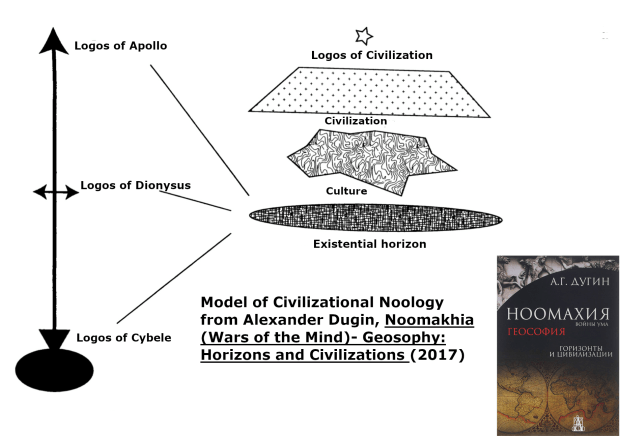
Yet in order to correctly examine and interpret the Chinese historial, i.e., the forms of the historical being of this people, it is necessary to discern the main horizon to act as the semantic axis taken as the point of reference. This always requires a choice, insofar as every horizon is complex, composite and is co-participated in simultaneously by multiple sub-horizons or layers with often differing noological orientations and trajectories. Thus, from the very outset, we must make a choice and recognize as the main existential core one Dasein which will be the “subject” of this historial. In the case of the Chinese horizon, the Han should be considered this axis as the people embodying the Chinese Logos that built this civilization, this Empire, and its special Chinese world.
The Han people emerged as a self-designation only with the Han Dynasty from 206-220 BC, which replaced the short-lived Qin Dynasty, when the unification of Chinese territories was accomplished. The name “Han” (Chinese: 漢) literally means “Milky Way”, which points towards the symbolic connection between Han identity, the sky, and cyclical movement.[26] In the Qin and Han eras, different tribes inhabiting the territory China and belonging predominantly to the Sino-Tibetan language group began to recognize their unity – culturally, historically, religiously, and so on. It is also evident that a certain unity of tradition was necessarily characteristic of even earlier forms of tribal associations, such as in the Zhou and more ancient periods, memory of which was imprinted in myths and legends. In any case, it is the Han people that ought to be taken, in a broad sense, as the foundational pole of the Chinese historial. We can define the earlier stages of the Han historial as proto-Han, after which Han identity later began to spread to neighboring horizons both within China and beyond, thereby including in the composition of its Dasein other ethnic and cultural groups. Yet at all of these stages, we are dealing with a semantic whole that is predominant and dominant in the space of Chinese history and Chinese geography. The Han Chinese are the subject of Chinese civilization, and they can be regarded as the main bearers of the resulting Logos, whose noological nature we are tasked with discerning over the course of our study.
Therefore, the phenomenological formula by which we shall be guided should be clarified: moving from “We, Chinese” to “We, Han” reflects our intention to be in solidarity with the Han Dasein in the reconstruction of the Chinese historial and to look through its eyes at the history, mythology, politics, and religion of China.
Footnotes:
[1] Alexander Dugin, Noomakhia: The Horizons and Civilizations of Eurasia – The Indo-European Legacy and the Traces of the Great Mother (Moscow: Academic Project, 2017)
[2] Alexander Dugin, Noomakhia: The Logos of Turan – The Indo-European Ideology of the Verticle (Moscow: Academic Project, 2017)
[3] Alexander Dugin, Noomakhia: Great India – Civilization of the Absolute (Moscow: Academic Project, 2017)
[4] Dugin, Noomakhia: The Horizons and Civilizations of Eurasia.
[5] Alexander Dugin, Noomakhia: Geosophy – Horizons and Civilizations (Moscow: Academic Project, 2017).
[6] Ibid. See also: Alexander Dugin, Noomakhia – Wars of the Mind: The Iranian Logos: The War of Light and the Culture of Awaiting (Moscow: Academic Project, 2016)
[7] Braudel F. Écrits sur l’histoire. Paris: Arthaud, 1990. See also: Alexander Dugin, Noomakhia: Geosophy.
[8] Granet М. Fêtes et chansons anciennes de la Chine. Paris: Albin Michel, 1982.
[9] Granet M. La Religion des Chinois. Paris: Albin Michel, 2010.
[10] Granet M. Danses et légendes de la Chine ancienne. Paris: Les Presses universitaires de France, 2010.
[11]Granet M. Études sociologiques sur la Chine. Paris Les Presses universitaires de France, 1953.
[12] Granet M. Китайская цивилизация. Moscow: Algoritm, 2008.
[13] Granet M. Китайская мысль от Конфуция до Лао-цзы. Moscow: Algoritm, 2008.
[14] Matgioi. La Voie Rationnelle. Paris: Les Éditions Traditionnelles, 2003.
[15] Matgioi. La Voie Métaphysique. Paris: Les Éditions Traditionnelles, 1991
[16] Matgioi. L’Empire du Milieu. Paris: Schlercher frère, 1900.
[17] Matgioi. La Chine des Lettrés. Paris: Librairie Hermétique, 1910.
[18] Le Tao de Laotseu, traduit du chinois par Matgioi. Milano: Arché, 2004.
[19] L’esprit des races jaunes. Le Traité des Influences errantes de Quangdzu, traduit du chinois par Matgioi. Paris: Bibliothèque de la Haute Science, 1896.
[20] Evola J. Tao te Ching di Lao-tze. Rome: Edizioni Mediterranee, 1997. Other of Evol’s texts on Taoism are collected in the small brochure: Julius Evola, Taoism (Rome: Fondazione Julius Evola, 1988).
[21] Matgioi. Метафизический путь, p. 41 —42.
[22] Guénon R. La Grande Triade. Paris: Gallimard, 1957.
[23] Eliade М. Азиатская алхимия. М.: Янус-К, 1998.
[24] Dugin, Noomakhia: Geosophy – Horizons and Civilizations
[25] Dugin А.G. Мартин Хайдеггер. Последний Бог [Martin Heidegger: The Last God]. Мoscow: Academic Project, 2015.
[26] It is also possible that the name of the Han Dynasty was derived from the river Hanshui or Han River which runs through Central China.

 Eurasianist Internet Archive