Alexander Dugin

Noomakhia: The Three Logoi – Apollo, Dionysus, and Cybele

Alexander Dugin, Noomakhia – Wars of the Mind: The Three Logoi – Apollo, Dionysus, and Cybele (Moscow: Academic Project, 2014)

Table of Contents: 

Introduction: The Aims and Tasks of Noomakhia 

Chapter 1: Deconstructing the “Contemporal Moment”: New Horizons in the History of Philosophy

Chapter 2: The Three Logoi: An Introduction to the Triadic Methodology

Chapter 3: Plato: Death, Love, and the Soul

Chapter 4: Aristotle Uncomprehended: The Experience of Phenomenological Reading

Chapter 5: Plotinus: The Radical Challenge of Solar Philosophy

Chapter 6: Valentinus the Gnostic: Sophia and the Structures of the Feminine Logos

Chapter 7: Proclus: The Absolute Philosophy of the Sun

Chapter 8: Hermetism

Chapter 9: Cybele

Chapter 10: Noomakhia and its Vertical Topography

“Noomakhia is the struggle in the sphere of the ideal. The author presents humanity as an ensemble of civilizational paradigms which hold continuous dialogue (whether agreement, struggle, understanding, solidarity, or opposition) between one another over the course of all of world history. The panorama of modern humanity presents a diversity of philosophical Logoi, types of rationalities, and mythological matrices – from the European (bringing together Western European and Eastern European components), the Russian, American, Semitic, Iranian, and Indian to the Chinese, Japanese, African and Oceanic (Polynesian). In deconstructing his reflections on the studied material, the author insists that deconstruction should also be accomplished with respect to the observatory point itself.

The first book of the Noomakhia cycle, The Three Logoi: Apollo, Dionysus, and Cybele, is dedicated to studying the question of the multiplicity of the Logoi and philosophical and mytho-symbolic paradigms which define the structures of different civilizations. This book represents the philosophical and methodological introduction to the Noomakhia cycle; it describes the models of the three Logoi – of Apollo, Dionysus, and Cybele – which, in the author’s opinion, lie at the heart of diverse philosophical, religious, scientific, and political systems. From this angle, the author examines in detail the philosophy of Plato, the Neoplatonists (Plotinus and Proclus), Aristotle’s doctrine of categories, Christian Gnosticism, Hermetism, and various forms of materialist and nominalist worldviews.”

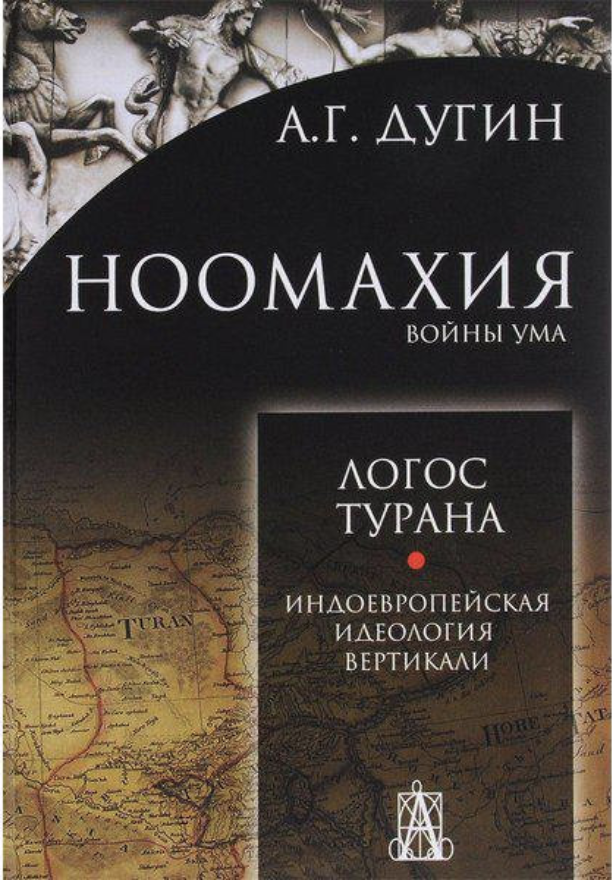
Noomakhia: The Logos of Turan – The Indo-European Ideology of the Verticle

Alexander Dugin, Noomakhia – Wars of the Mind: The Logos of Turan – The Indo-European Ideology of the Verticle (Moscow: Academic Project, 2017)


Screen Shot 2019-04-22 at 12.12.31 PM.png

Table of Contents:

Introduction: Turan as an Idea

PART I: The Indo-European Logos

Chapter 1: Cultures, Peoples, and Languages

Chapter 2: Indo-European Structures

Chapter 3: The Indo-European Proto-Religion: Exclusive Patriarchy

Chapter 4: Dumézil and the Tripartite Ideology

Chapter 5: The Indo-European Foundations of Philosophy

Chapter 6: Marija Gimbutas and the Indo-European Historial

Chapter 7: The Indo-Europeans of the Polar Myth

PART II: The Indo-Europeans Leave the Homeland: The War of Interpretations in Ancient Anatolia

Chapter 8: The Hittites

Chapter 9: The Phrygians and the Descendants of the Hittites

Chapter 10: The Semantic War of Anatolian Horizons: Mutterrecht and Vaterrecht

PART III: The Indo-Europeans Unbroken: The Tocharians, Armenians, and Kurds

Chapter 11: The Tocharians and the “Turanian Language” Hypothesis

Chapter 12: The Armenians: Faithfulness to the Sun

Chapter 13: The Kurds: The Rustling Wings of the Peacock Angel

PART IV: Great Scythia and its Rays

Chapter 14: The Metaphysics of the Great Steppe

Chapter 15: The Scythians: Nomadic Might

Chapter 16: The Peoples of Turan of the Scythian Type

Chapter 17: Afghanistan/Pakistan: The Third Empire

Chapter 18: The Sarmatians: Empire of the Nart

Chapter 19: The Thracians and the Turanian Heritage

Chapter 20: The Germanic Peoples and the Steppe

Chapter 21: The Slavs and Balts in the Horizon of Turan

Conclusion: Turan and the Logos of Apollo in the Indo-European Ecumene

Martin Heidegger, Russia, and Political Philosophy

Author: Leonid Savin

Translator: Jafe Arnold

The works of Martin Heidegger have recently been met with heightened interest in a number of countries. While interpretations of his texts vary widely, it is interesting that Heidegger’s legacy is constantly criticized by liberals across the board, regardless of where and what the object of criticism is – be it Heidegger’s work as a university professor, his interest in Ancient Greek philosophy and related interpretations of antiquity, or his relationship with the political regime in Germany before and after 1945. One gets the impression that liberals intentionally strive to demonize Heidegger and his works, yet the profundity and depth of this German philosopher’s thought gives them no break. Clearly, this is because Heidegger’s ideas harbor a message which is relevant to the creation of a counter-liberal project that can be realized in the most diverse forms. This is the idea of Dasein applied to a political perspective. We will discuss this in more detail below, but first it is necessary to embark on a brief excursion into the history of the study of Martin Heidegger’s ideas in Russia.

In the Soviet Union, Martin Heidegger’s ideas were not known to the general public, primarily because the peak of his activities coincided with Nazi rule in Germany. Heidegger himself, like many ideologists of the conservative revolution in Germany, criticized many aspects of National Socialism, but in the Soviet period any philosophy that did not follow the Marxist tradition was treated as bourgeois, false, and harmful. Perhaps the only exception is the work of Vladimir Bibikhin, although his translations of Heidegger’s Being and Time and Time and Being were published in Russia only after the collapse of the Soviet Union. Moreover, these translations have been repeatedly criticized for having too simplistic of an approach, incorrect terminological interpretations, linguistic mistakes, etc. Bibikhin’s lecture courses on early Heidegger at Moscow State University were delivered only in 1990-1992, i.e., during late Perestroika when the horizons of what was permissible in the USSR were expanding. That being said, it bears noting that a circle of followers of Martin Heidegger’s ideas had formed in the academic sphere in Moscow in the 1980’s. A similar situation took shape in St. Petersburg, which later found manifestation in translation and publishing activities.

Starting in the late 1990’s, other works by this German thinker began to be translated and published. The quality of translations improved considerably (and was done by different authors), and Heidegger’s legacy began to be taught at different Russian universities. Heidegger’s main philosophical concepts became obligatory for students at faculties of philosophy. However, the study of philosophical ideas does not mean that students will become philosophers or appeal to certain such concepts with regards to political processes. Plato and Aristotle are studied from the school-bench early on, but who is seriously engaged in using these philosophers of Ancient Greece’s ideas in discussing socio-political issues today?

Interest in the ideas of Martin Heidegger in the context of Russian politics was triggered in the early 2000’s by the various articles and presentations of the Russian philosopher and geopolitician Alexander Dugin.

Later, these materials were systematized and presented in voluminous texts. In 2010, the publishing house “Academic Project” released Alexander Dugin’s book, Martin Heidegger: The Philosophy of Another Beginning, which was logically succeeded in the following year by Martin Heidegger: The Possibility of a Russian Philosophy. In 2014, both works were released by the same publishing house in a single volume entitled Martin Heidegger: The Last God. Dugin’s interpretation of Heidegger’s ideas is tied to the history of Russian ideas, Orthodox Christianity, and a special path of state development including the theory of Eurasianism.

Needless to say, recounting Heidegger’s philosophical doctrine in a short journal publication would be senseless. Hundreds of volumes have been published in Germany alone which include whole works, lectures, and diaries. For our scope, let us focus merely on some provisions which, in our opinion, are applicable in a political context.

Firstly, it is worth pointing out that Heidegger employed many neologisms to describe the unfolding of time and being. One such key concept is Dasein, which is often translated as “being-here”. The French philosopher Henry Corbin translated this term as “human reality”, but for the sake of genuine, complete understanding, this and many other of Heidegger’s terms are best left untranslated. They should be provided in the original alongside something similar in one’s native language. Other possible variations should also be considered. For example, das Man expresses inauthentic Dasein that has fallen into banality, whereas in authentic existing, Dasein has the property of being-towards-death – Sein zum Tode – which represents existential terror. Terror is counterposed to fear, which imbues the world with external things and the internal world with empty worries. Interesting to note in this regard is the fact that modern Western policies and liberalism as such are built on fear. This tendency dates back centuries and is directly connected to the formation of Western (European) philosophy.

Let us add that another one of Dasein’s properties is spatiality, as space depends on Dasein, while on the other hand it is not a function of time. Dasein conditionally exists between the outer and inner, the past and present, the margin and the instant. Dasein has existential parameters – being-in-the-world (In-der-Welt-Sein), being-in (In-sein), being-with (Mit-sein), care (die Sorge), thrownness (Geworfenheit), Befindlichkeit (attunement, sofindingness, disposedness), fear (Furcht), understanding (Verstehen), discourse (Rede), and mood (Stimmung).

Another important element of Heidegger’s philosophy is the fourfold encompassing Sky, Divinities, Earth, and Mortals – which are depicted in the following manner: the Sky in the upper left, the Divinities (immortals) in the upper right, mortals (people) in the bottom left, and the Earth in the lower right. An axis runs between people and gods and another between Sky and Earth. The center of the fourfold is the most authentic modus of the existence of Dasein.

It should also be noted that Heidegger distinguishes between past and that which has passed, what is present and what is now, and the future and what is forthcoming. Dasein, according to Heidegger, must make a fundamental choice between the forthcoming and the future, i.e., the choice of authentic existing and directly confronting being (Seyn). Then the forthcoming will become the future. If Dasein chooses inauthentic existence, then the forthcoming will only be forthcoming, and therefore will not come into being.

Upon describing all of these elements of Heidegger’s philosophy in detail, Alexander Dugin poses a question: can one speak of a specific Russian Dasein? What are its existentials? In what does it differ from the European Dasein? Dugin arrives at the conclusion that a special Russian Dasein does exist, and not only a Russian one, for at the heart of each civilization lies a particular “thinking presence”, Dasein, which determines the structure of a given civilization’s Logos. As follows, every people (civilization) has its own special set of existentials.

And here we can find the political dimension of Dasein as Dugin sees it in his proposed concept of the Fourth Political Theory. Dugin focuses on three political theories claimed to be universal – Liberalism, Marxism and Fascism (National-Socialism). Each of them has their own subject of history.

Historical experience has proven that the Western liberal world has tried to forcibly impose its will upon all others. According to this idea, all public systems of the Earth are variants of the Western – liberal – system1 and their distinctive features should disappear before the approach of the conclusion of this world epoch.2.

Jean Baudrillard also states that this is not a clash of civilizations, but an almost innate resistance between one universal homogeneous culture and those who resist this globalization.3.

Apart from Liberalism, two more ideologies are known for having tried to achieve world supremacy, namely: Communism (i.e. Marxism in its various aspects) and Fascism/National Socialism. As Alexander Dugin rightly notes, Fascism arose after the first two ideologies and disappeared before them. After the disintegration of the USSR, the Marxism that was born in the 19th Century has been definitely discredited as well. Liberalism, based mainly on individualism and the atomistic society, human rights and the Leviathan-State described by Hobbes, emerged because of bellum omnium contra omnes4 and has long held on.

Here it is necessary to analyze the relation of the aforesaid ideologies in the contexts of their contemporary times and the loci from which they emerged.

We know that Marxism was a somewhat futuristic idea – Marxism prophesied the future victory of Communism at a time that nonetheless remained uncertain. In this regard it is a messianic doctrine, seeing the inevitability of its victory that would usher the culmination and end of the historical process. But Marx was a false prophet and this victory never eventuated.

National Socialism and Fascism, on the contrary, tried to recreate the abundance of a mythic Golden Age, but with a modernist form5. Fascism and National Socialism were attempts to usher in a new cycle of time, laying the basis for a new Civilization in the aftermath of what was seen as a cultural decline and death of the Western Civilization (hence the idea of the Thousand-Year Reich). This was abortive too.

Liberalism (like Marxism) proclaimed the end of history, most cogently described by Francis Fukuyama (as “the End of History and the Last Man)6. Such an end, nonetheless, never took place; and we have instead a nomadic-like “information society” composed of atomized, egoist individuals 7 that consume avidly the fruits of techno-culture. Moreover, tremendous economic collapses are taking place worldwide; violent conflicts occur (numerous local revolts, but also long-term wars on an international scale); and disappointment dominates our world rather than the universal utopia promised in the name of “progress.”8

From such an historical perspective, it is possible to understand the links between the emergence of an ideology within a particular historical epoch, or what has been called the zeitgeist or “spirit of the age.”

Fascism and National Socialism saw the foundations of history in the state (Fascism) or race (Hitlerian National socialism). For Marxism it was the working class and economic relations between classes. Liberalism on the other hand, sees history in terms of the atomized individual detached from the complex of cultural heritage and inter-social contact and communication. However, nobody has hitherto considered as the subject of history the People as Being, with all the richness of intercultural links, traditions, ethnic features and worldview.

If we consider various alternatives, even nominally ‘socialist’ countries have adopted liberal mechanisms and patterns that have exposed regions with a traditional way of life to accelerated transformation, deterioration and outright obliteration. The destruction of the peasantry, religion and family bonds by Marxism were manifestations of this disruption of traditional organic societies, whether in Maoist China or the USSR under Lenin and Trotsky.

This fundamental opposition to tradition embodied in both Liberalism and Marxism can be understood by the method of historical analysis considered above: Marxism and Liberalism both emerged from the same zeitgeist in the instance of these doctrines, from the spirit of money.9

Several attempts to create alternatives to neo-Liberalism are now visible – such as the political Shia in Iran, where the main state goal is the acceleration of the arrival of the Mahdi and the revision of socialism in Latin America (reforms in Bolivia are especially indicative). These anti-Liberal responses, nonetheless, are limited within the borders of their relevant, single statehood.

Ancient Greece is the source of all three theories of political philosophy. It is important to understand that at the beginning of philosophical thought, the Greeks considered the primary question of Being. However, they risked obfuscation by the nuances of the most complicated relation between being and thinking, between pure being (Seyn) and its expression in existence (Seiende), between human being (Dasein) and being in itself (Sein).10

It is noteworthy that three waves of globalization have been the corollaries of the aforementioned three political theories (Marxism, Fascism, and Liberalism). As a result, we need after them a new political theory which will generate a Fourth Wave: the re-establishment of (every) People with its eternal values. In other words, Dasein will be the subject of history. Every People has its very own Dasein. And, of course, after necessary philosophical considerations, political action must proceed.

Let us continue the preceding discussion about Heidegger’s ideas in Russia in the context of politics. It is significant that in Russia in 2016, Heidegger’s notebooks, Ponderings II-VI, known as his “Black Notebooks 1931-1938”, were published by the Gaidar Institute – a liberal organization which Russian conservative circles consider to be a network of agents of Western influence. Yegor Gaidar was the author of the liberal economic reforms in Russia under President Yeltsin and held the post of Minister of Finance in 1992. Gaidar was also acting Prime Minister of the Russian Federation and acting Minister of Economics in 1993-1994. Due to his reforms, the country was subject to inflation, privatization, and many sectors of the economy were ruined. The latter work of Heidegger’s is considered his most politicized, in which he speaks not only of philosophical categories, but of the role of the Germans in history, upbringing and education, as well as the political project of National Socialism. The Gaidar Institute most likely intended to discredit Heidegger’s teachings with such, but the opposite has happened, as the publication of Heidegger’s diaries has been met with widespread interest.

Paradoxically, in this work Heidegger criticizes Liberalism in the following manner: “The ‘liberal’ sees ‘connectedness’ in his own way. He sees only ‘dependencies’ – ‘influences’, but he never understands that there can be an influencing which is of service to the genuine basic stream of all flowing and provides a path and a direction.”11 Let us present a few more quotations from this work which, in our opinion, are of interest with regards to our approach.

The metaphysics of Dasein must become deeper in accord with the innermost structure of that metaphysics and must expand into the metapolitics ‘of’ the historical people.”12

The worthiness for power out of the greatness of Dasein – and Dasein out of the truth of its mission.”13

Education — the effective and binding realization of the power of the state, taking that power as the will of a people to itself.”14

At issue is a leap into specifically historical Da-sein. This leap can be carried out only as the liberation of what is given as endowment into what is given as task.”15

As Dugin has pointed out, if early Heidegger assumed that Dasein is something given, then later Heidegger concluded that Dasein is something that must be discovered, substantiated, and constituted. To this end, it is necessary first and foremost to accomplish a serious intellectual process (see Heidegger’s What is Called Thinking).

It is crucial to understand that although Heidegger’s ideas are considered to be a kind of culmination of European philosophy (which began with the Ancient Greeks, a point which is symbolic in itself since Heidegger built his hypotheses on an analysis of Ancient Greek philosophers), Heidegger is also often classified as a thinker who transcended Eurocentrism. For this reason, still during his lifetime, many of Heidegger’s concepts were welcomed in regions that had developed critiques of philosophy with regards to the European heritage as a whole. For example, enormous interest in Heidegger’s works could be found in 20th century Latin America. In Brazil, Heidegger’s works were addressed by Vicente Ferreira da Silva, in Argentina by Carlos Astrada, Vicente Fantone, Enrique Dussel, and Francisco Romero, in Venezuela by Juan David Garcia Bacca, and in Colombia by Ruben Sierra Mejia. Additional confirmation of this can be found in the words of the Iranian philosopher Ahmad Fardid to the effect that Heidegger can be seen as a figure of global significance, not merely as a representative of European thought. Given that Fardid, who is known for his concept of Gharbzadegi, or “Westoxification”, was a consistent critic of Western thought, which he believed contributed to the emergence of nihilism, such recognition of Heidegger is rather telling.

Indeed, Heidegger has had followers not only in Iran, but in many Asian countries as well. In Japan in the 1930’s, Heidegger’s student Kitaro Nishida founded the Kyoto School of Philosophy. Although in Japan Heidegger was largely considered a bearer of the European spirit (following the Meiji reforms, Japan was swept with excessive enthusiasm for everything European, especially German culture and philosophy), it is interesting to note that Heidegger’s notion of “existence” was redrafted in a Buddhist spirit as “true being” (genjitsu sonzai) and “Nothing” (“Oblivion”) was interpreted as “emptiness” (shunya). In other words, the Japanese interpreted Martin Heidegger’s basic concepts in accordance with their own concepts and often blended his terms with the concepts of such European existentialists as Jean-Paul Sartre, Albert Camus, and Gabriel Marcel. Another Japanese philosopher, Keiji Nishitani, has adapted Heidegger’s ideas to traditional Eastern models, as is so often done in the East. Parallels between traditional Eastern philosophy and Heideggerian analysis have also been drawn in Korea by Hwa Yol Jung.

In this regard, Russia and the study of Martin Heidegger’s legacy form a kind of bridge between Europe and the East, between the rigid rationalism that has subsumed European consciousness since the Middle Ages, and the abstract contemplative thinking characteristic of Asian peoples. Let us say even more directly that Eurasianism and Heideggerianism are in some sense interconnected and spiritually close tendencies among contemporary ideological currents in Russia.

Although these two schools can also be examined as independent philosophical doctrines, as is often done by secular scholars and opportunistic political scientists, any deep understanding of one can be had only upon grasping the other.

Footnotes:

1 For example, the insistence that all states and peoples should adopt the Westminster English parliamentary system as a universal model regardless of ancient traditions, social structures and hierarchies.

2 « Les droits de l´homme et le nouvel occidentalisme » in L’Homme et la socié (numéro spécial [1987], p.9

3 Jean Baudrillard, Power Inferno, Paris: Galilée, 2002. Also see for example Jean Baudrillard, “The Violence of the Global” (< http://www.ctheory.net/articles.aspx?id=385>).

4 In English: War of all against all.

5 Hence the criticism of National Socialism and Fascism by Right-Traditionalists such as Julius Evola. See K R Bolton, Thinkers of the Right (Luton, 2003), p. 173..

6 Francis Fukuyama The End of History and the Last Man , Penguin Books, 1992.

7 G Pascal Zachary, The Global Me, NSW, Australia: Allen and Unwin, 2000.

8 Clive Hamilton, Affluenza: When Too Much is Never Enough, NSW, Australia: Allen and Unwin, 2005.

9 This is the meaning of Spengler’s statement that, “Herein lies the secret of why all radical (i.e. poor) parties necessarily become the tools of the money-powers, the Equites, the Bourse. Theoretically their enemy is capital, but practically they attack, not the Bourse, but Tradition on behalf of the Bourse. This is as true today as it was for the Gracchuan age, and in all countries…” Oswald Spengler, The Decline of the West, (London : George Allen & Unwin , 1971), Vol. 2, p. 464.

10 See Martin Heidegger on these terms.

11 Martin Heidegger, Ponderings II-VI: Black Notebooks 1931-1938 (Bloomington, Indiana University Press, 2016), 28.

12 Ibid, 91.

13 Ibid, 83.

14 Ibid, 89.

15 Ibid, 173.

Civilization as a Discursive Tool of Western Politics

Author: Leonid Savin

Translator: Jafe Arnold 

The following is an excerpt from a forthcoming book on multipolarity…

The notion of civilization was introduced into broad scholarly circulation in the late 18th century by the Scottish philosopher Adam Ferguson, who meant by such a stage in the development of human society characterized by the existence of social classes, cities, writing, and other phenomena. The preceding stages, according to this thinker, were savagery and barbarism. In his Essay on the History of Civil Society, Ferguson remarked: “This progress in the case of man is continued to a greater extent than in that of any other animal. Not only the individual advances from infancy to manhood, but the species itself from rudeness to civilization.”[1] A similar approach was subsequently taken up by many scholars, especially in Soviet times, due to the fact that this view was maintained by Friedrich Engels. This imperative wields influence to this very day, hence such expressions as “civilizational approach”, and “civilized society”, etc. Around the same time, a similar idea was expressed by the English scholar, John Boswell.

The German sociologist Norbert Elias argued that the concept of civilization “expresses the self-consciousness of the West”, and: “By this term Western society seeks to describe what constitutes its special character and what it is proud of: the level of its technology, the nature of its manners, the development of its scientific knowledge or view of the world, and much more.”[2] Elias notes further:

But ‘civilization’ does not mean the same thing to different Western nations. Above all, there is a great difference between the English and French use of the word, on the one hand, and the German use of it, on the other. For the former, the concept sums up in a single term their pride in the significance of their own nations for the progress of the West and of humankind. But in German usage, Zivilisation means something which is indeed useful, but nevertheless only a value of the second rank.[3]

As is characteristic of the German school, Elias shares Spengler’s distinctions between culture and civilization, suggesting that civilization signifies a process or, in the very least, the result of a process. If civilization “plays down” national differences, insofar as the “concept of civilization has the function of giving expression to the continuously expansionist tendency of colonizing groups, the concept of Kultur mirrors the self-consciousness of a nation which had constantly to seek out and constitute its boundaries anew, in a political as well as a spiritual sense, and again and again had to ask itself: ‘What really is our identity?’”[4]

Examining the origins of the contrast between culture and civilization, Elias cites Kant’s 1784 Idea for a Universal History from a Cosmopolitan Point of View, which reads: “The ideal of morality belongs to culture; its use for some simulacrum of morality in the love of honor and outward decorum constitutes mere civilization.” In other words, according to Kant, civilization is a special kind of behavior, even if it is artificially created with the aim of legitimizing social status.

The sociogenesis of the notion of “civilization” is seen analogously in France. “The first literary evidence of the development of the verb civiliser into the concept civilisation is to be found, according to present-day findings, in the work of the elder Mirabeau in the 1760s.”[5]Maribeau wrote:

I marvel to see how our learned views, false on all points, are wrong on what we take to be civilization. If they were asked what civilization is, most people would answer: softening of manners, urbanity, politeness, and a dissemination of knowledge such that propriety is established in place of laws of detail: all that only presents me with the mask of virtue and not its face, and civilization does nothing for society if it does not give it both the form and the substance of virtue.

Elias thus summates:

Concepts such as politesse or civilité had, before the concept civilization was formed and established, practically the same function as the new concept: to express the self-image of the European upper class in relation to others whom its members considered simpler or more primitive, and at the same time to characterize the specific kind of behaviour through which this upper class felt itself different from all simpler and more primitive people.”[6]

This, let us note, means that people from the very same state or nation were seen as backward “barbarians” in the eyes of court-aristocratic and bourgeois circles. If earlier the upper class in all regions of Europe fundamentally opposed the lower strata, the “mobs”, then in the epoch of bourgeois revolutions, the idea appeared that all of society could be “finished up” and led to the state of “civilization.” It was often under this idea that the bourgeoning bourgeoisie fought against caste restrictions and everything that might interfere with their trade and interests. “The consciousness of their own superiority, the consciousness of this ‘civilization’, from now on serves at least those nations which have become colonial conquerors, and therefore a kind of upper class to large sections of the non-European world, as a justification of their rule, to the same degree that earlier the ancestors of the concept of civilization, politesse and civilité, had served the courtly-aristocratic upper class as a justification of theirs.[7] Thus, Elias argues that “civilization” was needed by the West in order to extend its power and influence to other regions of the world through a system of coercion and subordination in various forms. He emphasizes: “In this way civilizing structures are constantly expanding within Western society; both the upper and lower strata are tending to become a kind of upper stratum and the centre of a network of interdependencies spreading over wider and wider areas, both populated and unpopulated[8], of the rest of the world.”[9]

The “spread of civilization” is therefore the penetration of Western institutions and behavioral standards into other countries. Non-Western countries can voluntarily join this process insofar as they see the need for their own survival, the point of which is not only the borrowing of technical skills, but also forms of “civilized” behavior which allow them to enter the network of interdependencies. But the center of this network remains occupied by the people of the West.

 In fact, what Norbert Elias was describing is what is now called “globalization”, although the latter author arrived at these conclusions in the interwar period. In the present time, criticisms of Western civilization in its “exclusive form” have only intensified. For example, Raymond Aaron notes that “suspected, explicit racism could not endlessly resist the opening up of the greatness of other civilizations or the obvious fragility of European supremacy.”[10] Hamid Dabashi from Columbia University argues that the idea of Western civilization was for European nations a kind of umbrella structure asserting the universal identity of European national cultures and to “unify these cultures against their colonial consequences.” Dabashi thus surmises:

Islamic, Indian, or African civilizations were invented contrapuntally by Orientalism, as the intelligence arm of colonialism, in order to match, balance and thus authenticate ‘The Western Civilization.’ All non-western civilizations were therefore invented exactly as such, as negational formulations of the western, thus authenticating the western. Hegel subjected all his preceding human history into civilizational stages leading to the Western Civilization, thus in effect infantilizing, Orientalizing, exoticizing and abnormalizing the entire human history…[11]

Footnotes: 

[1] https://oll.libertyfund.org/titles/ferguson-an-essay-on-the-history-of-civil-society; Accessed in Russian in: Бенвенист Э. Цивилизация. К истории слова Civilization. Contribution a l’histoire du mot // Общая лингвистика. — М.: URSS, 2010.

[2] Norbert Elias, The Civilizing Process: Sociogenetic and Psychogenetic Investigations (Oxford: Blackwell, 2000), 5.

[3] Ibid, 6.

[4] Ibid, 7.

[5] Ibid, 33-34.

[6] Ibid, 34.

[7] Ibid, 43.

[8] The Russian translations reads “colonized and un-colonized”: Норберт Элиас. О процессе цивилизации. Изменения в обществе. Проект теории цивилизации. Т. 2. М.: Университетская книга, 2001. p. 256.

[9] Norbert Elias, The Civilizing Process: Sociogenetic and Psychogenetic Investigations (Oxford: Blackwell, 2000), 381.

[10] Реймон Арон. Избранное: Измерения исторического сознания. – М.: РОССПЭН, 2004. С. 97.

[11] Dabashi Hamid. For the last time: civilizations. Rethinking civilizational analysis// Intern. sociology – L., 2001. – Vol. 16, N3 (Special issue), P. 364.

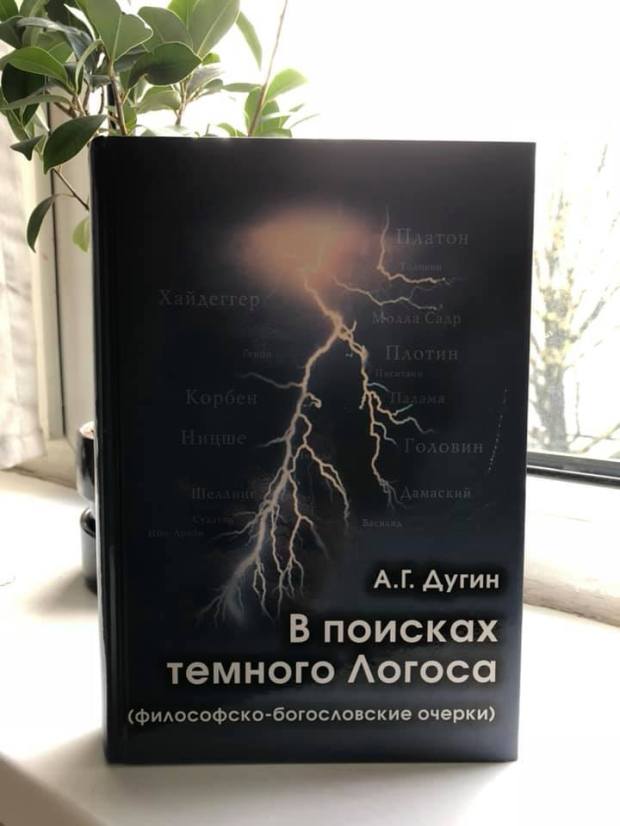
In Search of the Dark Logos

Alexander Dugin, In Search of the Dark Logos: Philosophico-Theological Outlines 

(Moscow: Academic Project/Department of the Sociology of International Relations, Faculty of Sociology, Moscow State University: 2013).

54727479_113018849866166_7704352583703330816_n

TABLE OF CONTENTS: 

Part I: The Moment of Russian Philosophy

Chapter 1: The Hermeneutics of the Russian Languages

Chapter 2: The Moment of Russian Philosophy

Part II: Man and his God

Chapter 3: Three Theologies

Chapter 4: Notes on Humanism

Chapter 5: The Metamorphoses of the Angel (Oppositions and Mediations)

Part III: Open Platonism

Chapter 6: The Pre-Platonists: Sacred Thinking in Pre-Socratic Philosophy

Chapter 7: The Vertical Topography of Plato’s Philosophy

Chapter 8: Non-Dualist Platonism: Noetic Structures in Neo-Platonist Systems

Chapter 9: The Challenge of Valentinus (Dualist Platonism, Pneumatics, and the Soteriology of the Gnostic Valentinus)

Chapter 10: Christianity and Platonism: A Clarification of Proportions

Chapter 11: Platonism in Islam

Chapter 12: Kabbalah and Neo-Platonism

Chapter 13: Traditionalism as a Theory: Sophia, Plato and the Event

Chapter 14: Platonopolis (Plato and the Platonists’ Philosophy of Politics)

Part IV: The Negative Spirit and the Secret of the Urgrund

Chapter 15: Deconstructing Hegel

Chapter 16: Schelling: The Dynamic God and Hierohistory

Part V: The Logos and its Double

Chapter 17: Thinking Chaos and the ‘Other Beginning’ of Philosophy 

Chapter 18: Hallucination and its Structures (Towards a Deconstruction of the End of the World)

Chapter 19: Overcoming Modernity with the Philosophy of Zen (On the Kyoto School of Kitarō Nishida)

Chapter 20: The Radical Subject and the Metaphysics of Pain

Chapter 21: Evgeniy Golovin’s Philosophy of Water

Chapter 22: The Last God (Martin Heidegger and the Eschatological Project of an Alternative Logos)

Chapter 23: The Logos of Dionysus


In the book, In Search of the Dark Logos: Philosophico-Theological Outlines, the contemporary Russian philosopher, sociologist, and political scientist Alexander Dugin explores models of thinking alternative to those that have been perceived as “universal” over the course of the Western European philosophical and theological tradition. The author demonstrates that other forms of the Logos are possible and, based on the methodologies pertaining to the ordering of Logological oppositions, are distinctly different from the typical forms of classical European thought. To explain the structure of this “Dark” or “Dionysian” Logos, the author draws on extensive materials from religious, theological, philosophical, mystical, political, and social doctrines – from Plato and Christianity to Heidegger and the “philosophy of chaos”. According to the author, the rebirth of Russian philosophy must begin with the search for the unclear and elusive reality of the new Logos that remains unreachable to straightforward, “frontal” analysis. This book is of interest to a broad circle of readers, particularly students of the Humanities, philosophers, sociologists, political scientists, culturologists, and theologians.” 

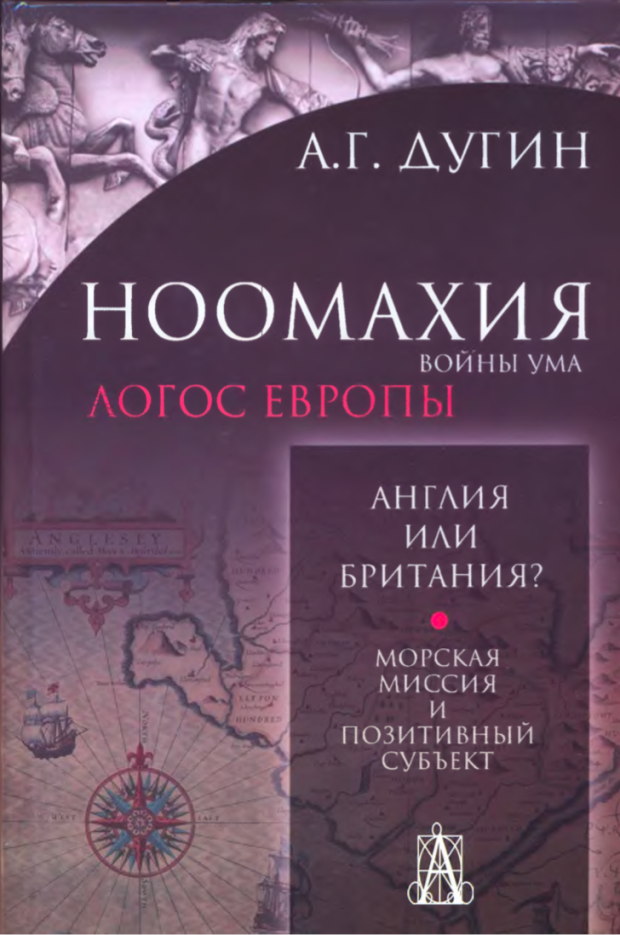
Noomakhia: England or Britain? The Maritime Mission and Positive Subject

Alexander Dugin, Noomakhia – Wars of the Mind: England or Britain? The Maritime Mission and the Positive Subject (Moscow: Academic Project, 2015).

Screen Shot 2019-03-28 at 12.43.43 PM

TABLE OF CONTENTS:

Introduction: England – The Homeland of the “Modern World”

Part I: England or Britain?

Chapter 1: From Britain to England: Ethnoi and States

Chapter 2: Anglo-Britain in the Middle Ages: Two Churches

Chapter 3: The Norman Invasion and the House of Plantagenet: The Franco-English Epoch

Chapter 4: English Theology

Chapter 5: Knights, Damsels, and Fairies in the Anglo-British Lai

Chapter 6: The Reformation

Chapter 7: English Thought at the Foundation of the Paradigm of Modernity: Locke’s Heartland

Chapter 8: Dreams on the Eve of Modernity

Chapter 9; The Yates Paradigm

Chapter 10: Pax Britannica: The Mercantile-Maritime Empire

Chapter 11: In Love with the Mind and in Trust of Feelings

Chapter 12: The Romantics: Gods and Titans in the Meadows of Green England

Chapter 13: Liberalism: The Positive Individual Subject

Chapter 14: Realism and Irony

Chapter 15: The Subtle Charm of Decadence: Pre-Raphaelites, the Dandy, and Satanists

Chapter 16: The 20th Century: Historial and Empire

Chapter 17: English Positivity

Chapter 18: Imperialism, Tradition, and Utopia in English Literature

Chapter 19: The British Invasion

Chapter 20: Conclusion

Part II: The Celtic Pole

Chapter 21: The Celtic Pole of Anglo-British Civilization

Chapter 22: Wales: The Titanomachy of Trees

Chapter 23: Scotland: The Drowsy Titans

Chapter 24: Ireland

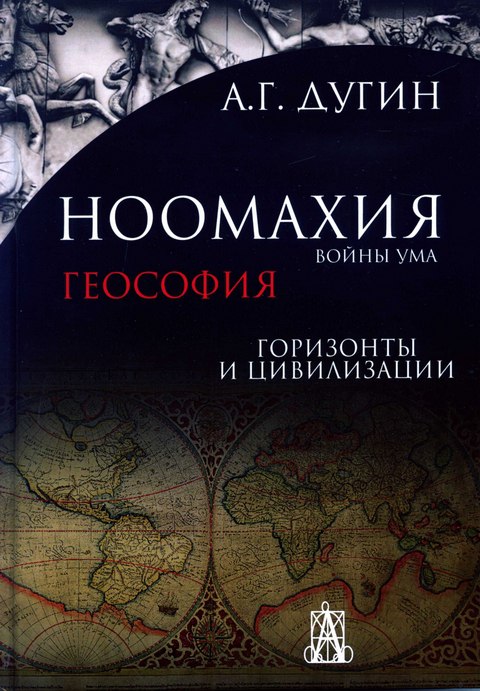
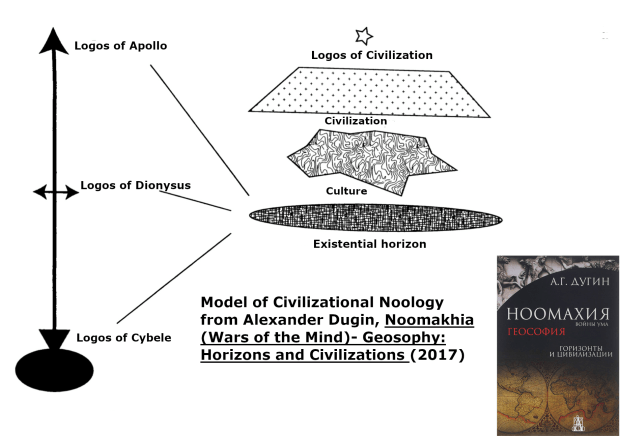
“NOOMAKHIA – Geosophy: Horizons, and Civilizations”

Alexander Dugin, Noomakhia: Wars of the Mind – Geosophy: Horizons and Civilizations (Moscow: Academic Project, 2017).

“A philosophical-methodological introduction and companion to the Greater Noomakhia cycle

geosofiya

TABLE OF CONTENTS: 

Part I: The Basic Concepts of Geosophy

Chapter 1: The Horizons of Cultures: The Geography of Logoi

Chapter 2: Deconstructing Eurocentrism

Chapter 3: Defining Civilizations

Chapter 4: The Topography of Geosophy

Part II: Theories of Civilizations: Criteria, Concepts, Correspondences

Chapter 5: Proclus

Chapter 6: Joachim de Flore

Chapter 7: Giambattista Vico

Chapter 8: Johann Gottfried Herder

Chapter 9: Friedrich von Schelling

Chapter 10: Georg Hegel

Chapter 11: Nikolai Yakovlevich Danilevsky

Chapter 12: Johann Bachofen

Chapter 13: Friedrich Ratzel

Chapter 14: Halford Mackinder

Chapter 15: Carl Schmitt

Chapter 16: Robert Graebner and Wilhelm Schmidt

Chapter 17: Moritz Lazarus, Wilhelm Wundt, and Alfred Vierkandt

Chapter 18: Franz Boas

Chapter 19: Oswald Spengler

Chapter 20: Richard Thurnwald

Chapter 21: Leo Frobenius

Chapter 22: Herman Wirth

Chapter 23: Marija Gimbutas

Chapter 24: Robert Graves

Chapter 25: Károly Kerényi

Chapter 26: Sigmund Freud

Chapter 27: Carl Gustav Jung

Chapter 28: Johan Huizinga

Chapter 29: René Guénon

Chapter 30: Julius Evola

Chapter 31: Mircea Eliade

Chapter 32: Ioan Culianu

Chapter 33: Georges Dumézil

Chapter 34: Pitirim Sorokin

Chapter 35: Gilbert Durand

Chapter 36: Nikolai Trubetzkoy

Chapter 37: Petr Savitsky

Chapter 38: Lev Gumilev

Chapter 39: Arnold Toynbee

Chapter 40: Fernand Braudel

Chapter 41: Samuel Huntington

Chapter 42: A Common Nomenclature of Basic Terminologies

Part III: Pluriversum: Geosophy and its Zones

Chapter 43: A Nomenclature of Horizons and the Plans of Greater Noomakhia

Chapter 44: The Logos of Europe: A History of Rise and Fall

Chapter 45: The Semitic Horizon

Chapter 46: The Horizons of the Two Americas

Chapter 47: The Eurasian Horizon

Chapter 48: The Iranian Logos

Chapter 49: The Indian Logos

Chapter 50: Chinese Civilization

Chapter 51: Japan and its Logos

Chapter 52: African Horizons

Chapter 53: The Horizons of the Pacific

Conclusion


64507530_2036340066661385_799996456982282240_o.png

Distributed Heartland: Towards a Multipolar Geopolitics

Author: Alexander Dugin

Transcript prepared/edited by Jafe Arnold

Dugin’s Expertise – Geopolitica.ru 

Today we must begin discussing a geopolitical problem which, in my view, is central to the construction of a multipolar world. Those who know geopolitics, know that one of the main laws or concepts of geopolitics is the notion of Heartland. All the classical schools of geopolitics – including the models of Mackinder, Spykman, Haushofer, Brzezinski, etc. – recognize a deep dualism between Heartland – the Continent, the Civilization of Land – and the Civilization of Sea, embodied today in the Anglo-Saxon world, first and foremost the US and its maritime policy. The Civilization of Sea, or Sea Power, attempts to surround Heartland – the Continent, Eurasia – from the sea and control its coastal territories. Sea Power strives to deter the development of Heartland, and thereby realize its domination on a global scale. As Mackinder said, “he who controls Eastern Europe, controls Heartland, and he who controls Heartland, controls the world.” This idea was subsequently developed by Spykman into: “He who controls Rimland (the coastal zone from Europe to China and South-East Asia), controls Heartland, and he who controls Heartland, controls the world.”

The fight to rule Heartland – by Sea Power from without, or in Heartland itself from within – is the main formula of geopolitical history, the very essence of geopolitics. Geopolitics is the battle for Heartland. All schools of geopolitics are founded upon and proceed from this model.

In the bipolar world of the Cold War, Heartland was represented by the Eastern camp, first and foremost the USSR, while Sea Power was the Western camp (Western Europe, the countries loyal to the West in the Middle East, etc.). Heartland, in the face of the USSR, lost this war in the early 1990’s, which marked the beginning of the unipolar moment. The defeat of Heartland in the Great War of Continents initiated the unipolar moment, a unipolar architecture in which the civilization of Sea and Sea Power achieved total domination. Fukuyama thus proclaimed the End of History. Sea Power ruled Heartland externally, such as by means of the Fifth Column at the head of Russian state, as was the case in the 1990’s. Heartland was blocked. Since Putin came to power, Russia has once again begun to step onto the path of sovereignty, and NATO has continued to blockade Russia. In the 1990’s, the battle against Heartland was won by Sea Power, and Heartland was “withdrawn from the system.” Thus began the unipolar moment: the global victory of Sea Power.

Today we often speak about a multipolar world and how Russia, despite its terrible losses, has preserved its identity, come to its senses, returned to itself, returned in history, and has ever so slightly squeezed itself out from under the total domination of the Fifth Column within Russia itself. At the same time, the unipolar domination of Sea Power has somewhat retreated, as Russia has won certain gains. It is obvious that Fukuyama declared the End of History and the global victory of liberalism prematurely. We were indeed close to this being the case, and we can say that we have lived in the unipolar world, but this unipolar world could not be made eternal, could not affirm itself, and thus became but a moment, an episode.

Just as the multipolar world arises, so does a contradiction. If we take into consideration only one Sea Power and one Heartland, then when it comes to speaking of a multipolar world, Russia cannot possibly be the only Heartland. Russia cannot achieve a multipolar world on its own. In the very least, multipolarity entails four or five of the most important poles in the world. Russia could be the center of this multipolar world or only one of its poles. But Russia cannot be the only Heartland.

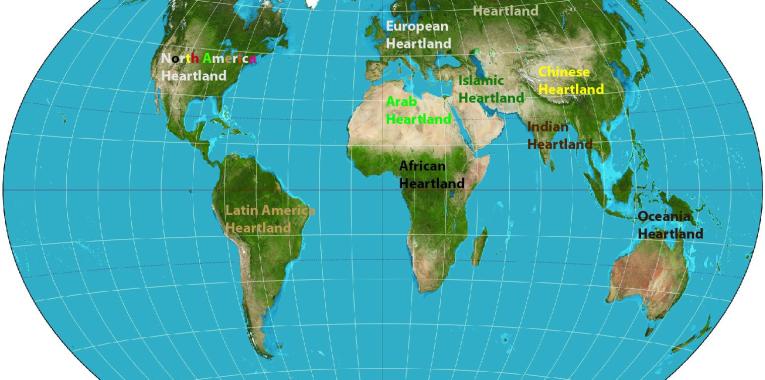
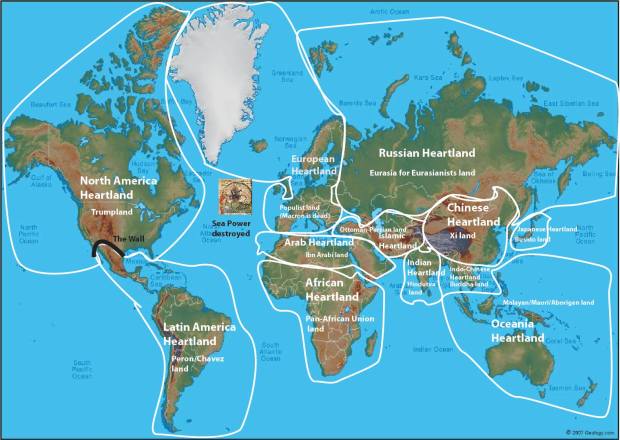
Over the course of numerous discussions, conferences, speeches, lectures, and articles, I have come to the conclusion that it is high time to introduce the notion of an apportioned, or “distributed Heartland.” To this end, I think it is important to attentively examine the German geopolitics of the 1920-’30’s, which proclaimed Germany to be the European Heartland. Of interest to us is not so much Germany itself as the very possibility of considering an additional Heartland.

Naturally, there is the Russian, Eurasian Heartland, but it cannot assert itself as Land Power alone. As follows, it is necessary to look attentively into a European Heartland, a European pole: for example, a Franco-Germanic alliance, or the Paris-Berlin-Moscow axis. Continental Europe can be seen as one Heartland which could and should be friendly towards the Russian Heartland, while being an independent phenomenon.

A Chinese Heartland is an altogether different question. China, after all, is Rimland, a coastal zone. If we recognize China as bearing the status of a Heartland, then we are recognizing China as an independent strategic space. If we qualify China as Heartland, then we are emphasizing the conservative aspect of China – China as Land Power. But if China declares itself to be a Heartland against Russia, just as Hitler’s Germany declared itself to be the heart of Eurasia against Soviet Russia, then conflict will immediately arise.

If Russia retains the status of an independent pole, then this “distributed Heartland” acquires a completely different meaning. Then it is possible to consider such Heartlands as a Russian Heartland, as in all traditional geopolitical maps as the “geographical pivot of history”, and a European Heartland. We also arrive at considering a Chinese Heartland, and this means that we consider China as a traditional, conservative, independent, and sovereign state as it is today – and it will only become more so in the future. In the very least, it is important to reconcile the Chinese Heartland with the Russian Heartland, and partially even the European Heartland. But even this is insufficient to constructing a multipolar world. We necessarily have to consider an Islamic Heartland (covering the historical spaces of at least 3-4 empires, stretching from Turkey to Pakistan). The concept of a distributed Heartland can further be expanded to India, and projected onto Latin America and Africa as well.

As follows, there should be an American Heartland in the multipolar system. We have become too accustomed to thinking in the terms of classical geopolitics that the US and Anglo-Saxon world can only be Sea Power. In a multipolar world, America will not be able to play this role, its global maritime range will naturally be reduced, thereby changing the very nature of America. As follows, an American Heartland should arise which, in a multipolar system, should not be seen exclusively as in opposition to other Heartlands. The vote for Trump represented the contours of this American Heartland.

If we begin to conceive of Heartland as a distributed type of culture associated with the reinforcement of conservative identity, then “Make America Great Again” is the thesis of an American Heartland. Stop being a Sea Power, and you will be Great Again. As a Sea Power, you will be miserable, the Deplorables, but you will be Great Again when you become an American Heartland.

Distributed Heartland is the imperative of the new geopolitical model, of multipolar geopolitics. I think that this concept deserves very serious cogitation, pondering, and description. There should be a number of conferences, or an even entire volume devoted to this inevitable question. The efficacy of this concept of distributed Heartland is, in my opinion, extremely important, insofar as the construction of a multipolar world now demands clearer and more precise roadmaps.

In my opinion, the notion of a distributed Heartland is the main, most key moment in the development and materialization of the Theory of the Multipolar World.

53729326_2400054030004623_2596949200977526784_o.jpg

The Gnostic

Author: Alexander Dugin

Source: Open Revolt 

Originally published in 1995 in Limonka, the official newspaper of the National Bolshevik Party.

The time has come to reveal the truth, to expose the spiritual essence of what boot-licking ordinary people call “political extremism.” We have confused them enough by changing the labels of our political sympathies, the color of our heroes, and by passing from fire to cold, from “rightism” to “leftism” and back again. All of this has been but an intellectual artillery barrage, a kind of ideological warm-up.

We have frightened and tempted the extreme right and extreme left, and now both, and others, have lost their way, strayed from the beaten tracks. This is amazing. As the great Evgeniy Golovin liked to repeat: “He who goes against the day, should not fear the night.” There is nothing more pleasant than when the ground is slipping out from under your feet. This is the first experience of flight. It kills vermin. It tempers angels.

Who are we, really? Whose menacing face is it all the more clearly peering out from the paradoxical, radical political movement with the terrifying name “National Bolshevism?”
Today we can respond without any ambiguity and vagueness. But this necessitates a brief excursion into the history of the spirit.

Mankind has always had two types of spirituality, two paths – the “Right Hand Path” and the “Left Hand Path.” The first is characterized by a positive attitude towards the surrounding world, in which harmony, balance, bliss, and peace are seen. All evil is but a particular instance, a local deviation from the norm, something insignificant, transient, having no deep, transcendental causes. The Right Hand Path is also called the “Milky Way.” It does not subject man to any particular suffering; it protects him from radical experiences, leads him away from immersion in suffering, and away from the nightmare of being. This is a false path. It leads to slumber. It leads to nowhere.

The second path, the “Left Hand Path”, sees everything in the reverse. There is no milky bliss, but black suffering; no silent calm, but the festering, fiery drama of split being. This is the “path of wine.” It is destructive, terrifying. Wrath and rage reign on it. In this path, all reality is perceived as hell, as ontological exile, as torture, as submersion into the heart of some kind of unthinkable catastrophe originating from the very heights of the cosmos.

If on the first path everything appears to be good, then on the second path everything appears evil. This path is monstrously difficult, but it is the only true one. On this path it is easy to stumble and even easier to disappear. It guarantees nothing. It entices no one. But only this path is correct. He who takes this path will gain fame and immortality. He who survives it will prevail and receive an award that is higher than being.

He who goes down the Left Hand Path knows that it will end. The dungeon of matter will collapse and be transformed into a heavenly city. A chain of initiates passionately prepares the desired moment, the moment of the End, the triumph of total liberation.

These two paths are not two different religious traditions. Both are possible in all religions, in all confessions, in all churches. There are no external differences between them whatsoever. They concern the most intimate parts of man, his secret essence. They cannot be chosen. They themselves choose a man to be their victim, their servant, their instrument, their weapon.

The Left Hand Path is called “gnosis”, “knowledge.” It is just as bitter as knowledge and it generates sorrow and cold tragedy. Once upon a time in antiquity, when mankind still attached decisive importance to spiritual things, the Gnostics created their own theories on the level of a philosophy, a doctrine, the cosmological mysteries, and on a cult level. Gradually people degenerated, stopped paying attention to the sphere of thought, and plunged into physiology in search of individual comfort in everyday life.

But the Gnostics did not disappear. They moved the dispute to a level of things understandable to modern citizens.

Some of them proclaimed slogans of “social justice”, developed theories of class struggle, and communism. The Mystery of Sophia became “class consciousness”, and the “struggle against the evil Demiurge, the creator of the cursed world” took the shape of social battles. The threads of ancient knowledge stretched to Marx, Nechaev, Lenin, Stalin, Mao, and Che Guevara. The wine of socialist revolution, the joy of rebellion against the forces of fate, and the sacred, berserker passion for total destruction of all that was black for the sake of obtaining a new, otherworldly Light.

Others opposed the ordinariness of everydayness with the secret energy of race, the noise of blood. Against mixing and deformity they raised laws of purity and a new sacrality, a return to the Golden Age, the Great Return. Nietzsche, Heidegger, Evola, Hitler, and Mussolini draped the Gnostic will in national, racial teachings.
It is quite right that the communists didn’t care much for workers, nor Hitler for Germans, but not out of cynicism. Both were obsessed with a deeper, more ancient, more absolute aspiration, the common Gnostic spirit, the secret and terrible light of the Left Hand Path. What workers, what “Aryans”… The point is totally different.

Other creative personalities summoned to the Left Hand Path, the path of gnosis, also floundered between “reds” and “blacks” and “whites” and “browns” in their spiritual quests. Entangling themselves in political doctrines, going to extremes, and yet unable to clearly express the metaphysical contours of their obsession, artists from Shakespeare to Artaud and from Michelangelo to Eemans, from the troubadours to Breton, have drunk the secret wine of suffering, greedily soaking up in society, passions, sects and occult brotherhoods the disparate fragments of a terrible teaching that leaves smiling impossible. The Templars, Dante, Lautréamont. They never smiled in their lives. This is a sign of a special chosenness, a trace of a monstrous experience of something that has been common for all Left Hand Pathers.

The Gnostic looks at our world with his severe gaze – the same gaze as that of his predecessors, the links in the ancient chain of the elect of Horror. A repulsive picture reflects in his eyes. A mad West in consumer psychosis. An East whose dullness and pathetic submissiveness disgusts. A sunken world, a planet lying on the bottom.

“In underwater woods, rush is useless and motion ceases…” (Golovin)

But the Gnostic does not abandon his cause. Not now, not tomorrow, not ever. Moreover, he has every reason to celebrate on the inside. Did we not tell the naive optimists of the “Right Hand Path” where their excessive ontological trust will lead? Did we not predict the degeneration of their creative instinct down to the grotesque parody that is today’s conservatives, who have reconciled with everything that horrified their more sympathetic (but no less hypocritical) predecessors just a few millennia ago? They didn’t listen to us. Now let them blame themselves and read New Age booklets or marketing handbooks.

We have forgiven no one. We have forgotten nothing.

We have not been deceived by the changes in social decorations and political (wanna-be) actors.

We have a very long memory. We have very long hands.

We have a very severe tradition.

The labyrinths of being, the spirals of thoughts, the whirlpools of anger…

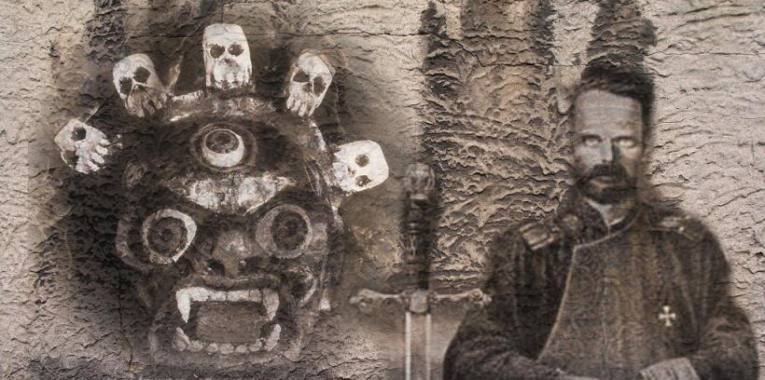
Baron Ungern: God of War

Author: Alexander Dugin

Source: Open Revolt

Episode 6 of Alexander Dugin’s “Historico-Magical Meditative Radio Show” FINIS MUNDI

Petrograd, 1920. Feliks Edmundovich Dzerzhinsky is finishing up a report for comrade Lenin:

It seems that Ungern is more dangerous than Semenov. He is stubborn and fanatical. Clever and ruthless. He occupies key positions in Dauria. What are his intentions? To attack Urga in Mongolia or Irkutsk in Siberia? To swing around to Harbin in Manchuria, and then on to Vladivostok? To march on Beijing and restore the Manchurian dynasty to the Chinese throne? His monarchical plans are limitless. But one thing is clear: Ungern is preparing a coup. He is our most dangerous enemy to date. Destroying him is a matter of life and death.”

Dzerzhinsky attached to his report to the Supreme Soviet an excerpt from a letter that had fallen into the hands of Siberian partisans:

The Baron pronounces the words ‘commissar’ and ‘communist’ with hatred, often adding ‘will be hanged.’ He has no favorites, he is unusually firm, adamant in matters of discipline, very cruel, and very gullible…He lives surrounded by Lamas and shamans…Out of addiction to the scandalous and unusual, he calls himself a Buddhist. It is more likely that he belongs to some far-right Baltic sect. His enemies call him the ‘Mad Baron.’”

Baron Roman Fedorovich von Ungern-Sternberg was born on December 20th, 1885 in Graz (Austria) to a family of Baltic aristocrats living in Estonia. His family can be traced back to at least the 18th century. According to reliable data, two of his ancestors belonged to the Knights of the Teutonic Order and fell at the hands of the Poles. His family members served the Order, then Germany, and, finally, the Russian Tsar and Russian Empire. According to the baron himself, his grandfather converted to Buddhism while in India, after which his father and he himself also became Buddhists. The baron graduated gymnasium in Reval (Tallinn) and attended a cadets school in St. Petersburg, where in 1909 he was sent to a Cossack corps in Chita. During an officers quarrel in Chita, the baron challenged his opponent to a duel and wounded him. The baron himself sustained a serious injury, as a result of which he would experience severe headaches throughout the rest of his life, to the point that at times he lost the ability to see.

Because of this duel, the baron was expelled from the corps in July of 1910, from then onwards beginning a journey around Siberia accompanied by only one companion – his hunting dog Misha. Somehow he ended up in Mongolia, which was destined to be his fate. This strange, desert-stretched, wild, ancient and harsh country fascinated Ungern. In Mongolia, the baron managed to get into personal contact with the living Buddha, Kutuktu, the supreme figure of Mongolian Lamaism. At the time, Mongolia was experiencing a revival of imperial sentiments and was seeking independence from China. In Urga, the Mongolian capital, the baron’s determined character was soon noticed, and Kutuktu himself appointed Ungern commander of the Mongol cavalry. Taking advantage of the unrest and revolution in China, the Mongols succeeded in expelling the Chinese occupants from their country, and in 1911 the “living Buddha” established an independent monarchy in Mongolia. 

The baron’s military services for Kutuktu were duly noted, and he became a deeply revered figure in the Mongol world. Before his departure from Mongolia, Baron Ungern, accompanied by his friend Prince Djam Bolon. At the latter’s insistence, Ungern visited a clairvoyant of a most ancient and respected shamanic line. In this fateful moment, in a trance, the clairvoyant revealed to Baron Ungern the secret of his spiritual nature:

I see the God of War…

He rides a gray horse across our steppes and our mountains. You will

Rule over a vast territory, oh white God of War.

I see blood, lots of blood…

A horse…

Lots of blood.

Red blood…

I see no more. The White God of War has disappeared.”

In 1912, Ungern visited Europe – Austria, Germany, and France. According to the testimonies offered in Krauthof’s book on Ungern, Ich Befehle (“I order”), in Paris the baron met and fell in love with the woman of his heart, Danielle. This was just on the eve of the First World War. True to his duty and on the order of the Tsar, the baron was compelled to return to Russia to take his place in the ranks of the imperial army.

Ungern set off back to the Homeland with his sweetheart, Danielle. But in Germany he was threatened with arrest for being an officer of the enemy army. The baron took an extremely risky journey on a small boat across the Baltic Sea. The little vessel was wrecked in a storm, and the lady was killed. The baron’s survival was nothing more than a miracle. From that time on, the baron would never be the same. Thenceforth he paid no attention to women. He became extremely ascetic and extremely, inhumanely cruel. In his review of Krauthof’s book, Julius Evola wrote: “Great passion incinerated all the human elements inside of him, and from then on only the sacred force that stands above life and death remained in him.”

The maelstrom of war pulled him in. The baron fought with inimitable courage against the Austrians, sustaining multiple wounds and being awarded the Cross of St. George and the Sword of Honor for his bravery and selflessness. After the Bolshevik revolution, Ungern was one of the first to engage in merciless battle with the Reds under the command of Ataman Semenov. And in this war, he distinguished himself with unbridled courage, steadfastness, and superb knowledge of military strategy.

Ungern gradually organized his own division consisting of Russian officers, Cossacks, and indigenous Siberians (especially Buryats) who remained faithful to the Emperor. Its full name was the Asian Cavalry Division. Incredible, inhuman discipline reigned in Ungern’s units. The slightest offenses were punished in the most merciless manner up to the death penalty.

Major Antoni Aleksandrowicz, a White officer of Polish origins and former Mongolian artillery instructor, wrote:

Baron Ungern was an outstanding man, extremely complex both psychologically and politically. (1) He saw in Bolshevism the enemy of civilization. (2) He despised Russians for having betrayed their legitimate sovereign and failing to cast off the communist yoke. (3) Nevertheless, among Russians he singled out and liked ordinary peasants and soldiers while he fiercely hated the intelligentsia. (4) He was a Buddhist who was obsessed with the dream of creating a knightly order in the likes of the Teutonic Order and Japanese Bushido. (5) He strove to create a gigantic Asian coalition, with which he wanted to set off on a conquest of Europe to turn it towards the teaching of the Buddha. (6) He was in contact with the Dalai Lama and the Muslims of Asia. He wielded the title of Khan of Mongolia as well as the title of ‘bonze’, or an initiate of Lamaism. (7) He was ruthless to an extent that only an ascetic could be. The absolute absence of sensitivity that was typical of him can be encountered only among beings who know neither pain, joy, pity, nor sorrow. (8) He possessed an extraordinary mind and considerable knowledge. His ability as a medium allowed him to completely accurately understand the nature of whomever he spoke with from the first minute of conversation.”

This account of Baron Ungern, left by a man who served him, was published in 1938 by none other than René Guénon himself in the main Traditionalist organ, the journal Études Traditionnelles.

***

Mongolia once again lost its independence, and its capital, Urga, was occupied by Chinese troops who actively cooperated with Bolshevik agents and provocateurs among the local population. Kutuktu, the living Buddha, was arrested. The absolutely sovereign, spiritually-incarnated, theocratic ruler of Great Free Mongolia was made into a pathetic prisoner.

The White Cause gradually lost on all fronts. After Kolchak’s defeat, only Ataman Semenov and Baron Ungern posed serious, fierce resistance in the East. Pressed on all sides by the Reds, the Asian Cavalry Division entered Mongolia. Its ranks were composed of representatives of many peoples – both European and Asia. Having lost the Russian Empire, the heroes of the Asian Cavalry Division, faithful to the Principle, marched on to restore the Mongol Empire.

Ungern gradually devised a desperate geopolitical plan to create a unique zone in Asia, or more precisely in Mongolia, free from both Bolshevik influence and the troops of the profane West. It would be a unique world in which the ancient laws of the Sacred Tradition would be in force. Ungern was familiar with the books of Saint-Yves d’Alveydre, and knew of the existence of the secret, underground country of Agarttha, where the laws of time are not in effect and where the King of the World, the Chakravarti, resides. Like the Knights Templar, who not only guarded European pilgrims from the Saracens, but also protected the great mysteries of spiritual knowledge from degenerate Catholicism and the secularizing French monarchy, Ungern aimed to create a special zone between the shrines of Tibet, where according to legend lies the entrance to Agarttha, and the rest of the world.

The Name of Mongolia – Khalkha – means ‘Shield.’ It is the ancient homeland of Genghis Khan, the restorer of the Empire of Ram. The mission of Mongolia is to serve as an obstacle in the path of the rabid hordes of apocalyptic humanity – the Gogs and Magogs of Bolshevism, democracy, and the profane world, the freaks of the modern world…Here, and none other than here, Tradition must be restored and a fight be put up against the forces of the West, the citadel of perversion, the source of Evil. The whole destiny of my line is that of going to the East, to the Rising Sun. I have no heirs and I have reached the Eastern edge of Eurasia myself, on my own. There is nowhere further to go. From this magical point of sacred geography shall begin the Great Restoration…Khalkha – the sacred steppes, the Great Shield.”

Ungern entered Mongolia not as a leader of the last unit of an army battered by the Reds, but as a “mythological hero”, an incarnation of the God of War, as the fulfiller of the Swedish mystic Swedenborg’s testament that “only the sages of the Eurasian steppes of Tartary” – Mongolia – “can find the key to the mysteries of the sacred cycles and the original mystical manuscript long ago lost by humanity under the strange title “The War of Jehovah.”

Ungern’s troops neared Chinese-occupied Urga. On February 3rd, 1920 the baron ordered an attack on the Mongol city of Urga, defended by a Chinese garrison which greatly outnumbered the baron’s warriors. Thanks to a rapid and frantic operation in which Ungern himself took part, his men managed to free Kutuktu, the living Buddha, who was guarded by a large and well-armed Chinese unit. Afterwards, the Asian Cavalry Division, together with Mongol units that joined the baron, attacked Urga. It was a brilliant and extremely important Victory. Tradition and Order were restored in Mongolia. Kutuktu appointed the baron the absolute dictator of Mongolia. Baron Ungern became the first European to receive the title Khan of War, Khan-Chan-Chun.

The first part of this mad plan, parallels to which can only be found in the magnificent and brilliant Middle Ages, not in the “skeptical” and “cynical” 20th century, seemed to be coming true. Henceforth, the dictator of Mongolia, Khan-Chan-Chun, or simply Ungern-Khan, the cruel and noble ascetic, initiated his plan to restore the sacred meaning of Khalkha, the magical Shield of the earth.

No, this is not a fairy tale, not a hallucination. This really happened. Relatively recently.

In dark times, the purity of a hero draws such resistance from the degenerate surrounding environment that curbing and subordinating it necessitates extraordinary means. It is only a matter of course that the majority of officers and soldiers of the Asian Cavalry Division, the Russian Cossacks, and servants did not comprehend the sacred ideals of the mad baron. Kolchak and Wrangel’s failures, apathy, and fatigue all demoralized the army. Many could not resist drinking, stealing, looting, and deserting…The corrupting spirit of the decomposing emigration, the Harbin Russian saloons, and vacant spaces among Parisian taxi drivers – all with Russian tears, saliva, and sighs – all irresistibly tempted the broken fragments of Kolchak’s army.

The Khan of War had to resort to extreme measures. He organized a system of severe punishments. 18 officers, some of whom were decorated veterans personally loyal to Ungern, were thrown into the icy, stormy Mongolian river for drunkery. He spared no one and nothing. Some of those who could swim survived. Some didn’t. But the drinking stopped among them and the rest of those who saw the frozen-blue, frostbitten corpses of their comrades. Such was a kind of forced conversion of the Cossacks to shamanism – after all, swimming in the river in winter in one’s clothes by virtue of internal heat, tapas, and then drying one’s clothes on the shore with the warmth of one’s own body, is a typical shamanic practice. There could not have been more appropriate conditions for indulging in such a national custom.

Colonel Sipailov, Ungern’s shadow, nicknamed the “Thug” in the army, behaved even more grimly. Sipailov was a typical “dark twin” [to Ungern]. Such grotesque characters very often accompany the personal path of great men, embodying the dark aspects of the soul of the hero. If Ungern’s brutality was founded on high spiritual asceticism and was akin to a kind to holiness, then Colonel Sipailov was a genuinely mad sadist. For abusing a yard dog, Sipailov shot the best Cossack commander in all of Ungern’s army and put his corpse on public display. Some were beaten to death with whips for all types of faults, even the tiniest spoils. Sipailov was Ungern’s Dzerzhinsky. All the means by which Ungern imposed order in Mongolia and his army strikingly resembled the Bolshevik terror – no wonder the Bolsheviks respected Ungern more than other leaders of the White movement. Behind it all one could glimpse some kind of inner affinity, a unity of common type at that magical point where extreme right meets extreme left, where opposites coincide.

Sipailov’s atrocities were wild and senseless. Only for a short time did this “black double” of Ungern soften, when he met a girl who melted the stale heart of this sadist. For some time, the officers and soldiers sighed with relief as Sipailov, so it seemed, devoted all his time to pretty little Mashenka.

However, according to eyewitnesses, the following scene eventually took place in Ungern’s quarters. Mashenka had prepared a pie for the commanders. Ungern made an exception and allowed for some champagne to be drunk. Sipailov was extremely lively and unexpectedly kind. When the officers asked him to call Mashenka to thank her for such an amazing dish, Sipailov turned pale, went out, and came back with a strange bag in his hands. He pulled the bloody, severed head of his lover out of it and, with a yellow gleam in his eyes, dumped it on the table in front of the dumbfounded officers. He added laconically: “Bolshevik agent.”

***

Mongolia was still in good hands, but the situation became increasingly ominous. The Bolsheviks were winning on all fronts. Ungern gathered his officers at his quarters in Urga:

Gentlemen, bad news. Ataman Semenov has left Chita. The Soviet General Blücher, a Red Teutonic pig, has just occupied the city. His headquarters are in Verkhneudinsk near Lake Baikal. All of Siberia is now Bolshevik.”

And Crimea?”

Crimea is gone. The remnants of Wrangel’s army have fled on the ships of our Western pseudo-allies.”

The situation was as simple and deadly as the tip of a sword. The Baron summed up in one simple phrase:

Gentlemen, there is only one combat-ready White army left: the First Asian Cavalry Division.”

Well, we are the last ones then.”

This is a catastrophe.”

No, Boris Ivanovich, it is not a catastrophe. It is an honor.”

For Ungern, Honor meant Faithfulness. Or, as the profound contemporary poetess Savitri Devi Mukherji said on an altogether similar matter: “‘Faithful when all become unfaithful—while we never forget, never forgive.”

The storm clouds were gathering. Jean Mabire’s book on Baron Ungern describes Ungern’s last meeting with Kutuktu before the Khan of War left Urga forever to move North, to Siberia, where he would put up one last fight against the Bolsheviks.

Kutuktu, the Living Buddha, took his place. His face, in black glasses, was impenetrable as always, but his terrible fatigue was felt in all its force. Only with great difficulty did the old man restrain a nervous shiver. A huge throne with a high gilded back, littered with yellow silk pillows. Ungern bowed. He glanced around. The Baron was not one to deliver long speeches, he restricted himself to an announcement of his decision:

In a few days I am leaving Mongolia. I am going to Baikal to fight our common enemy, the Reds. Your country is henceforth free, and its sons, scattered around the world, should return to their Homeland. Soon the Empire of Genghis Khan will be reborn. You must preserve the freedom that we have won.’

But in his [Kutuktu’s] soul, a storm raged: without Ungern’s support he was nothing, just a blind old man, too feeble and impotent to drive young revolutionaries like Sukhbaatar and Choibolsan out of the country.  Kutuktu asked the Baron to follow him into his office to talk one-on-one.

The divine Kutuktu walked over to a safe oddly framed against the oriental decor of the room. He fumbled with the lock for a long while. Finally, a heavy door slowly opened…Kutuktu reached up the metal shelves for a casket carved out of ivory. Inside was a ruby ring with a solar sign, the Hackenkreuz, the symbol of ancient Aryan conquerors.

Genghis Khan never took this ring off of his right hand.’

Roman Fedorovich von Ungern-Sternberg stared at the jewel in a daze. As if in a dream, he extended his hand to Kutuktu. The old man was shaking and hardly managed to put the ring of the great conqueror onto the Baron’s finger. The Living Buddha blessed Ungern. Putting his hands on his head, he pronounced:

You will not die. You will be re-incarnated in a more perfect form of being. Remember this, living god of war, Khan to whom Mongolia is owed.’

Ungern felt as if the ring was burning his hand.

The Prince of Mongolia and loyal vicar of Kutuktu went out of the palace of Nogon-Orgo. The Lamas parted in front of him. In his resolutely ringing spurs, Ungern swiftly exited the corridor, never once turning back, and went beyond the palace, where he powerlessly collapse into the back seat of a car.

To headquarters’, he told Makeev.

The Baron felt the circle closing.”

Ungern’s forces once again marched onto Russian land. Now it was no longer a war they were waging, but guerrilla operations. Nevertheless, Ungern very seriously worried the Reds. He appeared where least expected, like lighting, suddenly, and would leave destruction and death in his wake. For him, the God of War, this was natural. The best units of the Red Army in Siberia were thrown at him, and General Blücher was made personally responsible for the whole operation.

But this was already agony. In the material world, everything reaches its fateful, fatal point. Ungern, however, was submerged in another reality, where he saw pictures of triumph and victory and the realization of a cherished dream. His being imperceptibly passed on to another, subtle plane which began to interfere with ordinary reality. His subordinates increasingly came to understand that their commander was insane.

Ungern rose, brought out maps, and unfurled them. Laying them out on the grass, with a bamboo cane he traced an imaginary route. He told his faithful assistant, General Rezukhin:

More fantasy, Boris Ivanovich! We go up to Selenga. It’s worse with Urga. We need to choose. Remnants of the White armies are hiding in western Mongolia. They will start to flock to us. Not all the Atamans and Cossacks have died. Together we will go further to the west. Now we are in Altai amidst mountains, caves, gorges, and shepherds who still believe in the incarnated god of war. We can easily cross the border of western Turkestan.’

In Xingjiang the Chinese will arrest you.’

We’ll deal with them quickly and head further south. We have to go through China. Does such a possibility scare you, Boris Ivanovich? The country is falling apart, revolution is in full swing. The only people we’ll come across are cowardly looters and deserters. All together it’s some thousand kilometers, and we are in an impregnable fortress. And we can start everything all over again. Absolutely everything.’

Tibet?’

Yes. The roof of the world. The Dalai Lama, the highest priest of Buddhism, is in Lhasa. Kutuktu occupies the third tier in the hierarchy compared to him. I made a mistake in the very beginning: the center of Asia is not in Mongolia. Mongolia is only the outer circle, the Shield. We should go to Tibet.’

The baron slapped the map with his bamboo stick right on the mountain chain of the Himalayas.

There, among the peaks, we will find people who have not forgotten their Aryan ancestors. On the dizzying border of India and China, my empire will be reborn. We will speak Sanskrit and live according to the principles of the Rig Veda. We will gain the law that Europe has lost. And once again the light of the North will shine. The eternal law, dissolved in the waters of the Ganges and Mediterranean, will prevail.’

The baron rose. His eyes shined. His voice broke into a rasp. A light stubble covered his sunken, fatigued cheeks. He threw back his hair, revealing an enormous forehead. He was the lone and fragile commander of a people absorbed by the shadow of centuries. He continued:

My Order will be on the mountain tops. Between Nepal and Tibet, I will open a school where I will teach strength, which is needed more than wisdom.’

With feverishly shining eyes, he shouted:

Everything is ready! They are waiting for me in Lhasa! I will reveal the secret of the runes that came from the North and hidden in the secret caches of temples. My Order of warrior-monks will be transformed into an army the likes of which have never been seen before. Asia, Europe, and America will tremble.’

‘No’, Rezukhin said.

For the first time, a little general had dared to stand up to Ungern. But this time, it was beyond his own power. He could no longer obey unconditionally. He forgot about discipline and friendship. His hands trembled, his eyes filled with tears. He repeated:

‘No, Roman Fedorovich, no.’

The Baron winced and looked at him. It was as if the word “no” had suddenly destroyed his dream, as if a runaway avalanche had swept away his Buddhist temple perched on a cliff and he flew into the abyss with his mills for prayers and bonzes in saffron robes.

I don’t understand your plans’, Rezushin, ‘I know only one army – the Tsarist. And one religion – Christianity. But that is not the point. The point is that we will never make it to Lhasa. Look at the map. We can’t cross Chinese Turkestan. And Manchuria is just a stone’s throw away. It’s enough to just head East.’

Never!’, the Baron cried out, ‘Only Tibet!’

Ungern was almost alone, if not for the lot of those who had not been killed and who remained loyal, who had Honor, like him, and Faithfulness too. Ungern rode across the Altai highlands on his favorite filly, Masha, and visions overcame him.

Here on the fortress monastery flies a banner with the golden horseshoe and solar sign of Genghis Khan. The waves of the Baltic Sea break against the mass of Tibet. The ascent, the eternal ascent to the roof of the world, where there is light and force. Ascent…”

The grey horse stumbled on a stone. The dream disappeared, absorbed by mirage that enveloped the sweltering earth.

The dreams of the God of War were a premonition of what is sure to happen – not now, but on another turn of the Eternal Return. He who is truly alive will never know death.

1921. The end. Betrayal. Ungern was captured by the Reds. General Blücher had ordered that Ungern be treated like a Soviet officer. The Red Guards took him to the company command post of the revolutionary military committee of the Yenisei.

Blücher personally met Ungern and proposed that he join the Bolsheviks. Both spoke in German. Blücher spoke of Eurasianists, National Bolshevism, and a special line in the Soviet leadership, a national one, which was merely superficially covered with “Marxist phraseology”, and which was striving to build a gigantic, continental, Traditionalist state not only in Mongolia, but throughout all of Eurasia. Blucher promised the Baron full amnesty and a high position. At the same time, in a secret department of the OGPU, headed by the Martinist Gleb Boki, plans were being developed for an expedition to Tibet, for the transformation of spiritual Bolshevism into a new kind of spiritual reality.

The Baron refused all the offers. Or at least that’s what official history maintains. On September 12th, 1921, Baron Ungern-Sternberg was shot. The God of War was dead.

But do Gods die? If you are asking this, you are absolutely right. They can go away, but they cannot die.

To this day, a legend circulates through Mongolian and Buryat religious circles: “From the North came a white warrior who raised the Mongols, called on them to break the chains of slavery fettering their free land. This white warrior was the embodiment of Genghis Khan, and he predicted the coming of an even greater one…”

The “even greater one” is the Tenth Avatar, the Avenger, the Triumphant, the Fearsome Judge. All Traditions call him by different names. But the essence does not change. The defeat of “ours” is only an eschatological illusion. To embrace it is immoral. Our duty is to stand to the end. It does not matter if we lose every last one and everything losable. Our Honor is in Faithfulness.

To challenge the doom of the dark ages – this gesture itself already harbors the highest reward.

And then a little later the avengers will catch up…the Last Battalion…the Wild Hunt of Odin. “Our” forces – with a golden banner flaunting the black rune UR, the sign of the Cosmic Midnight, the personal standard of the God of War, Baron Roman Fedorovich Ungern-Sternberg, harbinger of the Avatar.