Alexander Dugin

Prince Nikolai Trubetzkoy and his Theory of Eurasianism

Author: Alexander Dugin

Translator: Jafe Arnold

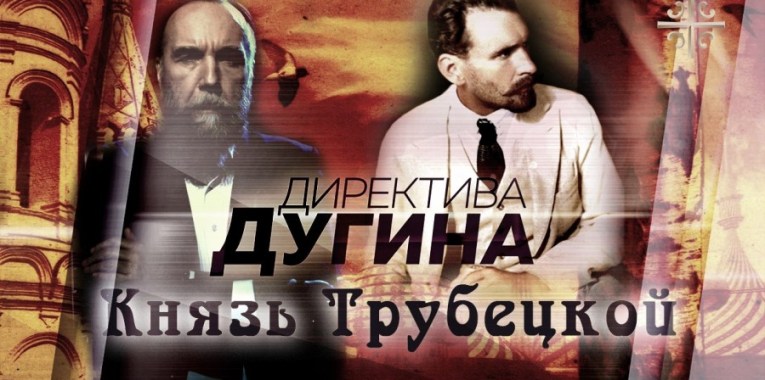
Dugin’s Guideline – 

On April 16th, 1890, Nikolai Sergeevich Trubetzkoy, the great Russian thinker, linguist, and founder of the ideological movement of Eurasianism, was born. Trubetzkoy’s main idea was that Russia is not simply a European country, as the Russian Westernizers insisted, but a particular, separate civilization, the Russian World. This is the most important point.

We are no less different from Europe than Iranians or Indians. Sure, we share common roots with Greco-Roman civilization, but this civilization underwent a schism that began in the 6th century when the Western Empire fell away from Byzantium and then disappeared under attack by Germanic tribes. Already back then, two identities formed: a Catholic identity in the West, and an Orthodox identity in the East. The two gradually drifted away from one another further and further until, in 1054, the Orthodox and Catholic worlds parted ways once and for all. We, Russians, adopted Christianity from Byzantium and have kept none other than this Eastern Christian tradition to this day.

After the fall of Constantinople to the Turks, we took over the Byzantine mission. This is not merely the mission of a country, Trubetzkoy asserted, but the pole of self-conscious and independent Orthodox civilization, its center. But the Slavophiles also recognized this. The innovation of Trubetzkoy and the other Eurasianists after him lies in that they added to this Byzantine religious and cultural heritage the Turko-Mongol component and drew attention to the fact that Russia’s expansion to the East precisely replicated the contours of Genghis Khan’s empire. We once again built this empire, only not from East to West as the Mongols did, but from West to East. This only strengthened Russia’s self-identity. Russians differed from the West religiously thanks to Byzantium, and geopolitically thanks to the Mongols and Turks, from whom we took the baton of ruling over the enormous space of Eurasia, this time Russian and Orthodox.

Trubetzkoy proposed this Eurasian idea for Russia, as an Orthodox and continental civilization, to lie at the heart of a new world view that was supposed to replace communism.

Trubetzkoy literally prophesied that communism would collapse insofar as it had no spiritual, religious dimension, no Christ at its head. But in order not to slide into the abyss of the West, which is an alien civilization to us, the Communist Party was to be replaced with the Eurasian Order.

According to Trubetzkoy and other Eurasianists, this Order was supposed to continue the course toward social justice and opposition to the West, but complete this ideology with an Orthodox, Byzantine dimension and put faith in Christ at the head. Trubetzkoy gave this a special term: ideocracy, or rule by idea.

Eurasianism was neither nationalism nor a mere restoration of the monarchy. Trubetzkoy called for appealing to the deepest essence of the Russian people and other fraternal peoples building the Great Empire together with it. The Eurasian elite was to become a new aristocracy serving God and the people. The Eurasianists named the West the main enemy, a complete antipode to our own civilization, or the main enemy of humanity as Trubetzkoy called it in his first programmatic book, Europe and Mankind. The message of his book boiled down to the need for humanity to save Europe, which was already rotting away by the beginning of the 20th century. And only the Russians had the strength to do this.

Only half of the prophecies of this great Eurasianist came true. The USSR collapsed as the wonderful idea of social justice was established without God and even against God. Instead of a Christian socialism, an anti-Christian socialism was built. And it collapsed. A Eurasian Order failed to be established and take over power from the communists. Instead, the worst enemies of Russia came to power – the liberals, a human enemy far worse than communists.

Now much is becoming clear. It is obvious that Trubetzkoy was right. We have proclaimed the construction of a Eurasian Union and we all the more clearly understand the true nature of the West. The second half of Trubetzkoy’s prophecy, the construction of a Eurasian Order, is, from the point of view of the Eurasianists, the meaning of the historical moment in which now we find ourselves.


© Jafe Arnold – All Rights Reserved. No reproduction without expressed permission. 

The Dormition of the Mother of God

Author: Alexander Dugin

Translator: Jafe Arnold 

Chapter 13 of Mysteries of Eurasia (Moscow, Arktogeya: 1991) 

Theological symbolism

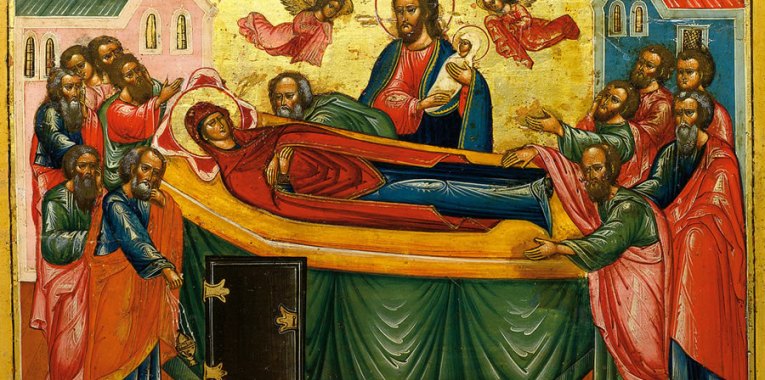
The “Dormition of the Mother of God” is one of the most revered icons in Rus. It is this icon that was first miraculously delivered from Constantinople to Kiev where it consecrated with its divine presence not only the Kiev-Pechersk Lavra, but all of Holy Rus, the new (and final) bastion of Orthodoxy.

In the traditional depiction of this icon, we see on the lower level the Virgin falling into slumber on her deathbed surrounded by saints, and on the middle level we see the figure of Jesus Christ standing, holding the soul of the Virgin Mary in the form of an infant in his hands.

In considering the symbolism of this depiction, it is necessary to immediately point to the reverse analogy between the central figure of the Dormition of the Mother of God and the classical “Mother of God” icon. If in the traditional depiction of the Mother of God (for example, the “Vladimir Mother of God”, “Kazan Mother of God,” etc.) we see the ‘adult’ Mother of God holding Jesus, then in the Dormition of the Mother of God we see the inverse: the ‘adult’ Jesus Christ and the ‘infant’ Virgin Mary. Explaining this contrast will help us discover the universal, ontological character of the Christian tradition which, like any fully-fledged tradition, in addition to a historical aspect bears a deeply metaphysical, supra-historical charge directly tied to the spiritual understand of reality at large.

Thus, the very fact of the Incarnation of the God-Word in the material, human universe necessarily implies a certain “diminishment” of the fullness of the second hypostasis of the Holy Trinity, not an essential “depreciation” (the Trinity always remains self-resembling), but an external, apparent, visible depreciation. Christ is described in the Gospel as “suffering.” In the First Coming, the true nature of the Son remains veiled, hidden, and can only be guessed by chosen disciples. But for subsequent generations of Christians, defining this divine nature becomes the basis of Faith – Faith, not Knowledge, since Knowledge is associated with the ontological obviousness of a certain sacred fact, and the obviousness of the Son’s divinity manifests itself only at the moment of the Second Coming, the Coming of the Sacred in Power, in Glory, i.e., in his original ‘non-diminished’ quality. Therefore, the classical image of the Mother of God with the infant has a symbolic meaning that is central to prayer and Church practice. In this icon, as in the sacred map of reality, a ‘diminished’ spiritual center is shown surrounded by the human or, more broadly, material cosmic nature which externally ‘surpasses’ this center, is ‘predominant’ compared to it, and is ‘bigger’ than it is. The Mother of God with the infant describes the ontological status of the world between the First and Second Coming where the Son is already revealed to the world, but in a ‘diminished’ quality thereby demanding Faith, personal effort, and spiritual devotion on the part of believers for ‘dynamic,’ willed transformation of Faith into Confidence.

The Dormition of the Mother of God icon presents us with the inverse proportion. Rising above the concrete historical fact of the Virgin Mary’s personal death, the Orthodox tradition here offers a prototype of an eschatological situation, valuably pointing to the meaning of the sacraments of the End Times. The depiction of Christ holding the infant Virgin in his arms describes the true proportions of the spiritual world in which the Center, the Pole of Being, the God-Word is presented not as diminished, but in its full metaphysical extent. In the heavenly world, the ‘diminished’ is the ‘material,’ the ‘earthly’ cosmic portion, while the Spirit itself appears in its entirety. Here the Word is omnipresent and obvious and all-fulfilling.But the material world is not simply destroyed in heavenly reality. It is transformed, it is ‘drawn’ to the spiritual regions and rises to its heavenly and supra-material archetype. Hence, in fact, the special term ‘dormition’ (a calque from Greek “koimesis,” or sleep, rest, lie; in Latin ‘assumptio”) in contrast to the usual word ‘death.’ Dormition means ‘solace’, i.e., the transition from the state of ‘unrest’ inherent to material, physical reality to a state of ‘peace,’ in which all things abide in the regions of Eternity. Thus there is not ‘destruction,’ but ‘final disappearance’ understood by the word ‘death.’ It would be interesting in this regard to pay attention to the Russian etymology of the word ‘uspenie’ (dormition), which is akin to the Ancient Indian term ‘svapiti’ (literally ‘to sleep’). This Indian term literally means ‘to enter oneself’ or ‘dive into one’s inner self.’ As follows, our word ‘uspenie’ etymologically means ‘entering the inner world’, the ‘inner ‘world’ being a synonym for the ‘spiritual’ or ‘heavenly’ world. In the troparion for the celebration of the Dormition of the Mother of God, it is said: “in falling asleep she did not forsake the world.” This refers not only to the compassionate participation of the Mother of God in worldly affairs after her departure, but also the fundamental ontological event of the ‘casting of the material world’ into the spiritual sphere as a result of a special, unique sacred event. What metaphysical event is symbolized by the Dormition of the Mother of God?

This event is the End Times. It is at this moment, the moment of the Second Coming, that happens the final affirmation of true spiritual proportions in correlation to the material and the spiritual. The ‘material’ (the Virgin Mary) turns out to be an infinitesimal point in the Infinity of spiritual Light, the Light of the God-Word, Christ. Consequently, the Dormition icon reveals to the Christian the deep mystery of the End Times, which is not a global catastrophe, not the destruction or disappearance of the physical world as is seen most often by those who are only superficially familiar with Orthodox eschatology, but the essential and total restoration of the normal, natural, harmonious ways of being where the spiritual, heavenly Light completely incorporates the physical, material darkness. Therefore, from a Christian perspective, the End Times is the single most important event of an entirely positive, salvational meaning. The End Times is not a catastrophe, but the end of catastrophe since, from a spiritual point of view, any ‘unrest’, ‘worrying’, or ‘movement’ is essentially catastrophic for the spirit and, in addition, signifies the triumph of inferior, Satanic forces. The End Times, the End of the World, and Judgement Day act as something repulsive and negative only for the enemies of God, only for those who identify their fate with the dark course of restless, demonic fate. For believers, on the contrary, this is salvation, a celebration, and transformation – the universal and final ‘dormition’ of matter together with the universal and final ‘awakening’ of the spirit.

Thus, we can now distinguish three levels in this spiritual teaching manifesting such abundant wisdom in the icon of the Dormition.

  1. Historically, this icon tells of the death of the Mother of Our Lord Jesus Christ and her subsequent mercy for the believers and suffering of this world.
  2. Ontologically, it embodies the affirmation of true spiritual proportions of material reality in the larger picture of being, where the spirit fills everything while physical reality is ‘diminished’ to an infinitely small point.
  3. Eschatologically, it points to the meaning of the End Times, i.e., the restoration of true existential proportions and the affirmation of the absolute triumph of the Heavenly, Divine element. The ‘diminishing’ of matter in the End Times does not mean its destruction, but its ‘induction’ into the fullness of light and peace.

Universal symbolism

The symbolism of the Dormition icon (if we juxtapose it to the Mother of God icon) also has analogies outside of a Christian context. The clearest such similar spiritual concept of the structure of being is reflected in the Chinese symbol of Yin-Yang, in which the white dot against the black background signifies the diminishing of the spirit in matter, while the black dot against the white background is, conversely, matter in spirit. However, the Chinese tradition is characterized by contemplation and and the absence of an eschatological orientation. Thus, the Chinese are inclined to consider this symbol as a sign of eternal harmony while Christians see ontological plans in an historical and eschatological perspective, hence Christianity’s distinctly ‘dynamic’ character supposing the personal, volitional engagement of man in the outcome of the fate of the spirit. The Chinese believe that this volitional aspect is not so important insofar as the Tao ultimately arranges everything in the best way. Undoubtedly, similar symbolism can be found in many other traditions in reference to the correlations between the material and spiritual worlds, but the Chinese example represents something so clear and comprehensive that all similar parables can be reduced to it.

The sacred sign of Russia

The fact that the icon of the Dormition of the Mother of God was the first to be miraculously brought to Russia and the fact that its presence graced the Kiev-Pecharsk Lavra (which was the first center for the spread of Orthodoxy in Russia) leaves one to believe that Russia is under the special patronage of this icon. The Russian Orthodox tradition and Russian Church believe this. If we take into account all of the theological and ontological, as well as eschatological content of this icon’s message, then it is only natural to associate it with the sacred mission and spiritual fate of Russia itself.

On a historical level, such symbolism, applied to Russia, points to the constant participation of the Mother of God in the history of the Russian state, not only during periods of its fully-fledged Orthodox existence, but also during the dark periods of neglect and decline. As if it were a fulfillment of predestination that began with the spread of the Orthodox faith throughout Russian lands, approximately over the thousand years following the founding of the Kiev-Pecharsk Lavra to the moment of the collapse of Orthodox order in Russia, the Mother of God was a believer and declared that ‘henceforth She takes responsibility for Russia and sovereign Power therein.” The icon known as “The Sovereign” is dedicated to this. “And in falling asleep she did not forsake the world.”

On an ontological level, our symbolism might very well explain the cultural and psychological specificity of Russian Orthodox civilization, which was always contemplatively-oriented, drawn by the spirit to the heavenly sphere where true proportions are set once and for all, while sometimes neglecting earthly, practical, material things which seemed to the religious consciousness of Russians to be just as infinitesimal as the tiny figure of the Mother of God in the hands of the Savior.

Finally, on the eschatological level, the idea of Russia’s mission being tied to the End Times is clearly present in Orthodox thought. Hence, in particular, the rise of the idea of “Moscow as the Third Rome” or “Last Rome” who is destined to stand until the final moment of earthly history. If the Dormition icon ontologically describes the ideal essence of the Russian Orthodox soul, then in eschatological terms it points to the active side of Russian civilization, the mission it is destined to fulfill in human history. This mission is, without a doubt, connected to the realization of the End Times and the providential preparation of the Second Coming.

It is also important to recall the omens sent to Saint Anthony of Kiev before the construction of the first and main temple of the Kiev-Pechersk Lavra in honor of the Dormition of the Holy Mother of God. Anthony prayed to God to send him a sign pointing out the place where a church should be built. In the morning, all of the ground was covered with dew, but in one place the earth was left completely dry. The next day, the miracle was repeated, but in the reverse order. The dew was nowhere to be found other than in the place where there had been no dew the day before. Finally, when the saint was gathering firewood, Fire rained down from the sky and set it alight. After this, no doubts remained as to the place to be chosen.

All three of these miracles have a strictly symbolic and doctrinal interpretation connected to the spiritual meaning of the Dormition. The dry place of the future Church in the middle of the dew-covered space is symbolically identical to the icon of the Mother of God in the which the fiery, dry, light element, Christ, is surrounded by the wet, earthly element, the Virgin Mary. The next day, the opposite occurs, which is the essence of the Dormition icon in which the dryness (i.e., fieriness, spirituality) of the earth surrounds a small, wet space (matter). The third miracle directly concerns the secret of the End Times, when the prepared firewood (the Church of true believers) will be lit on fire and transfigured by heavenly light force, the force of the Second Coming.

In this mysterious story of the founding of the Kiev-Pechersk Lavra is captured the deepest prophecy of the fate of Russia, the fate of Christianity and Orthodoxy, and its glorious and great future.


© Jafe Arnold – All Rights Reserved. No reproduction without expressed permission. 

Pan-Eurasian Nationalism

Author: Nikolai Trubetzkoy

Translator: Jafe Arnold 

Written in 1927, republished in the compilation Foundations of Eurasianism (Moscow, Arktogeya: 2002) 

If before the main factor consolidating the Russian Empire into a single whole was the belonging of the entire territory of this state to a single overlord, the Russian people headed by their Russian Tsar, then now this factor has been destroyed. The question arises: what other factor can now solder together all of the parts of this territory into a single, integral state?

The revolution put forth the realization of a famous social ideal as such a unifying factor. The USSR is not simply a group of separate republics, but a group of socialist republics striving to realize one and the same ideal of a social system. It is precisely this common ideal that unites all of the republics together.

The commonality of this social ideal, and therefore its trajectory along which strives the state will of all the individual parts of the contemporary USSR is, of course, a powerful unifying factor. Even if the character of this ideal will change with time, the same principle of binding participation in the common ideal of social justice and the common will to reach this ideal will continue to lie at the heart of the statehood of all the peoples and regions currently unified in the USSR. But the question is whether this one factor for unifying different peoples into one state is sufficient. In fact, that the Uzbek Republic and Belarusian Republic are both guided in their domestic politics by the desire to achieve one and the same social ideal by no means means that both these republics will necessarily unite under the canopy of one state. What’s more, it does not follow that these two republics will not quarrel or fight amongst themselves. It is clear that a single common social ideal is insufficient, and that nationalist-separatist aspirations in individual parts of the USSR must be opposed with something else.

In the contemporary USSR, the antidote against nationalism and separatism is class hatred and the consciousness of the proletariat’s solidarity in the face of constantly impending danger. In each of the peoples comprising the USSR, only proletarians are recognized as full citizens and the Soviet Union itself is essentially composed not so much of peoples as the proletarians of these peoples. By seizing power and exercising its dictatorship, the proletariat of the USSR’s different peoples feels itself simultaneously threatened by its internal enemies (insofar as socialism has not been established, the existence of capitalists and even a bourgeoisie within the USSR in the ‘transition’ period must be admitted) as well as foreign enemies (in the face of the rest of the world left at the mercy of the rule of international capitalism and imperialism). In order to successfully defend the power it has seized against the machinations of its enemies, the proletarians of all the peoples of the USSR must unite in a single state.

Thanks to this view of the meaning of the USSR’s existence, the Soviet government has turned out capable of fighting against separatism. In this view, separatists are striving to destroy the state unity of the USSR, but this unity is needed by the proletariat in order to defend its power and, as follows, separatists are the enemies of the proletariat. The fight against nationalism thus turns out possible and necessary for the same reason, as such can easily be interpreted to be covert separatism. In addition, according to Marxist doctrine, the proletariat is void of nationalist instincts, as such are attributes of the bourgeoisie and the fruit of the bourgeois system. The struggle against nationalism is realized by the very fact of shifting the center of the people’s attention from the sphere of national emotions to the sphere of social emotions. The consciousness of national unity, being the precondition of any form of nationalism, is undermined by the aggravation of class hatred, and the majority of national traditions are tarnished by their relationship to the bourgeois order, aristocratic culture, or “religious prejudices.” Moreover, the ambitions of each people are to a certain degree flattered within their own borders, as their languages are recognized, administrative and other positions are supposed to be filled with people of the given local environment, and the region itself is often named after the people inhabiting it.

Thus, it can be said that the factor linking all the parts of the contemporary USSR into a single integral state is the official recognition of a single overlord of the entire state territory. Only before, the Russian people, headed by its Tsar, was recognized as such an overlord, while now such is considered to be the proletariat of all the peoples of the USSR led by the Communist Party.

The disadvantages of the above-described contemporary resolution of the issue are obvious. Not to mention the fact that the division into proletariat and bourgeoisie is, in relation to many peoples of the USSR, either entirely impracticable or completely irrelevant and artificial. It is particularly worth emphasizing that the resolution of this question in itself bears an indication of its temporality. In fact, the state unity of the peoples and countries in which the proletariat has seized power is feasible only from the standpoint of the current stage of the proletariat’s struggle against its enemies. The proletariat itself as an oppressed class, according to Marxism, is a temporary phenomenon subject to be overcome. The same is said of the class struggle. Thus, state unity in the above-described solution does not rest on any fundamentally permanent basis, but on a fundamentally temporary, transitory foundation. This gives rise to an absurd situation and a whole number of entirely unhealthy phenomena. In order to justify its existence, the central government must then artificially inflate the danger threatening the proletariat, must itself create the objects of class hatred in the form of a new bourgeoisie against which the proletariat must be incited, etc. In a word, it comes to supporting the idea in the consciousness of the proletariat that its position as the unified overlord of the state is extremely fragile.

The purpose of this article is not to criticize the communist conception of the state as such. We are examining the idea of the dictatorship of the proletarian in only one aspect, namely, as the factor unifying all the peoples of the USSR into an integral state opposed to nationalist-separatist tendencies. It should be recognized that even though this aspect of the idea of the dictatorship of the proletariat is still effective, it cannot become a lasting, enduring solution to the issue. The nationalism of the separate peoples of the USSR is evolving as these peoples increasingly come to grips with their new position! The development of education and literature in different national languages and the filling of administrative and other posts first and foremost by locals deepens the national differences between individual regions and creates among native intellectuals a jealous fear of competition with “alien elements” and a desire to more firmly strengthen their positions. At the same time, class partitions within each individual people of the USSR are fading just as class contradictions are gradually withering away. All of this creates the most favorable conditions for the development of nationalism with a separatist slant in each of the peoples of the USSR. The idea of the dictatorship of the proletariat turns out impotent against this. The proletariat, having come to power, turns out to wield sometimes even strong doses of nationalist instincts which, according to the doctrine of communism, should be absent among the real, contemporary proletariat. And such a proletariat ascending to power turns out to care far less for the interests of the global proletariat than the doctrine of communism suggests…

Thus, the idea of the dictatorship of the proletariat, the consciousness of the proletariat’s solidarity, and the incitement of class hatred shall ultimately turn out to be ineffective means against the development of nationalist and separatist aspirations among the peoples of the USSR.

The current resolution of the state unification of parts of the former Russian Empire is a logical consequence of the Marxist teaching on the class nature of the state and Marxism’s typical neglect for the national substrate of statehood. It should be recognized that, for the supporters of this doctrine, there is no other way than replacing the idea of the rule of one people with the idea of the dictatorship of one class, i.e., substituting the class substrate for the national substrate of statehood. And this substitution itself implies everything that follows. In any case, communists are thus more right and consistent than those democrats who, rejecting the national substrate of Russian statehood, preach broad regional autonomy or a federation without class dictatorship, failing to understand that the existence of a unified state is impossible under such circumstances.

For the individual parts of the former Russian Empire to continue to exist as parts of a single state, the existence of a single substrate of statehood is necessary. This substrate can be national (ethnic) or class-based. The class substrate, as we’ve seen above, is capable of uniting individual parts of the former Russian Empire only temporarily. A durable and permanent union is therefore possible only in the presence of an ethnic (national) substrate. Such was the Russian people up until the revolution. But now, as indicated above, it is already impossible to return to the situation in which the Russian people was the sole owner of all the state territory. It is also clear that no other people living on this territory can fulfill the role of the sole proprietor of all of the state’s territory.

Consequently, the national substrate of the state which was before called the Russian Empire but now the USSR can only be the totality of peoples inhabiting the state, considered as a special, multinational nation and as such one wielding its own nationalism.

We call this nation Eurasian, its territory Eurasia, and its nationalism Eurasianism.

Applied to Eurasia, this means that the nationalism of each people of Eurasia (the modern USSR) must be combined with a pan-Eurasian nationalism, i.e., Eurasianism. Every citizen of the Eurasian state should be aware not only of the fact that he belongs to such a people (or such a variety of a people), but also that this people itself belongs to the Eurasian nation. The national pride of the citizen should find satisfaction in both the former and latter consciousness. Accordingly, a nationalism should be built out of every one of these peoples. A pan-Eurasian nationalism should present itself as an extension of the nationalism of each of the peoples of Eurasia, a kind of merging of all of these individual nationalisms together.

Between the peoples of Eurasia, some kind of fraternal relations have always existed and easily formed which suggest the existence of subconscious attractions and sympathies (the opposite cases, i.e., cases of subconscious repulsion and antipathy between two peoples in Eurasia are very rare). Of course, there is not enough of some of these subconscious feelings. What is necessary is making the brotherhood of the peoples of Eurasia a fact of consciousness and, moreover, a vital fact. What is necessary is for each people of Eurasia, by recognizing itself, to recognize itself above all as a member of this brotherhood and occupying a certain place in it. And what is needed is for the consciousness of belonging to the Eurasian brotherhood of peoples to become stronger and brighter for each of these peoples than the consciousness of belonging to any other group of peoples. After all, some individual features can include an individual people of Eurasia in another, not purely Eurasian group of peoples. For example, by virtue of language the Russians are included in the group of Slavic peoples, and the Tatars, Chuvash, Cheremis, and others can be included in the group of so-called “Turanian” peoples, just as the Tatars, Bashkirs, Sarts, and others are included in the group of Muslim peoples on religious grounds.

These ties must be less binding and vivid for all these peoples than those unifying these peoples in the Eurasian family. Neither Pan-Slavism for the Russians nor Pan-Turanism for the Eurasian Turanian peoples nor Pan-Islamism for Eurasian Muslims should be in the foreground, but Eurasianism. All these “pan-isms”, strengthening the centrifugal forces of these individual nations’ nationalisms, emphasize a one-way connection from one people with others only by virtue of one characteristic, and are therefore incapable of creating a real and lively multinational nation and character out of these peoples.

In the Eurasian brotherhood, peoples are connected with one another not by one or another unilateral number of characteristics, but by the community of their historical fates. Eurasia is a geographical, economic, and historical whole. The fates of the Eurasian peoples are intertwined, firmly tied into a massive knot that is impossible to untangle to the extent that one people can refuse this unity only by artificial violence against nature, which can only lead to suffering.

Nothing similar can be said of those groups of peoples that lie at the basis of the concepts of Pan-Slavism, Pan-Turanism, or Pan-Islamism. Not one of these groups’ peoples are united to such a degree by historical fate. None of these “pan-isms” are as pragmatically valuable as pan-Eurasian nationalism. This nationalism is not only pragmatically valuable, but even directly, vitally necessary. After all, we have already seen that only the awakening of the consciousness of the multinational Eurasian nation’s unity is capable of giving Russia-Eurasia that ethnic substrate of statehood without which it will sooner or later begin to disintegrate to the great misfortune and suffering of all its parts.

In order for a pan-Eurasian nationalism to successfully fulfill its role as a factor unifying the Eurasian state, it is therefore necessary to re-cultivate the consciousness of the peoples of Eurasia. Of course, it can be said that life itself is handling this re-cultivation. The very fact that all the Eurasian peoples (like no other people in the world) have for a few years already experienced and outgrown the communist regime – this fact alone creates a thousand new psychological and cultural-historical ties between these peoples and forces them to clearly and really feel the commonality of their historical destinies. But this, of course, is not enough. It is imperative that those individual people who have now clearly and vividly realized the unity of the multinational Eurasian nation preach this conviction in each of the Eurasian nations in which they work. Here awaits an uncharted land of work for philosophers, publicists, poets, writers, artists, musicians, and scholars of the most different specializations. It is necessary to reconsider a number of sciences from the standpoint of the unity of the multinational Eurasian nation and construct new scientific systems to replace the old, dilapidated ones. In particular, this necessitates constructing a new history of the peoples of Eurasia, including that of the Russian people…

In all of this work of re-cultivating the national self-consciousness from the standpoint of the symphonic (choral) unity of the multinational nation of Eurasia, it might be the Russian people that will have to strain its hand more than any other Eurasian people. Firstly, the Russian people need more than others to deal with the old attitudes and points of view that situate the Russian national identity outside of the real context of the Eurasian world and divorce the past of the Russian people from the common perspective of the history of Eurasia. Secondly, the Russian people, which until the revolution was the sole lord of all of the territory of Russia-Eurasia, and is now the first (in number and significance) among the Eurasian peoples, naturally needs to set an example for the others.

At the present moment, the Eurasianists’ work on re-educating this national self-consciousness is taking place in extremely difficult conditions. Such work, of course, cannot be openly carried out on the territory of the USSR. The emigration is predominated by people who are cognitively incapable of recognizing the objective shifts and results of the revolution. For such people, Russia continues to exist as a set of territorial units conquered by the Russian people and belonging to the Russian people alone by full and indivisible right. Therefore, these people cannot understand the issue of creating a pan-Eurasian nationalism and affirming the unity of the multinational Eurasian nation. For them, the Eurasianists are traitors because they replace the concept of “Russia” with that of “Eurasia.” They do not understand that it is not Eurasianism, but life itself that has produced this “replacement.” They do not understand that their Russian nationalism is in modern conditions simply Great Russian separatism, and that the purely Russian Russia which they want to “revive” is possible only given the separation of all the “outskirts” within the boundaries of ethnographical Great Russia. Other trends in the emigration attack Eurasianism from the opposite side, demanding that any kind of national identity be abandoned, and they suggest that Russia can be built only on the basis of European democracy without putting forth any unified national or unified class-based substrate for Russian statehood. Being representatives of the abstract Westernizing sentiments of the Russian intelligentsia’s old generations, these people do not want to understand that for a state to exist, what is needed first and foremost is this state’s citizens to be conscious of organically belonging to this whole, to this organic unity, be it either ethnic or class-based. In modern conditions, only two solutions are possible: either the dictatorship of the proletariat, or consciousness of the unity and originality of the multinational Eurasian nation and pan-Eurasian nationalism. 


© Jafe Arnold – All Rights Reserved. No reproduction without expressed permission. 

Russian Orthodoxy and Initiation

Author: Alexander Dugin

Translator: Jafe Arnold

Chapter 8 of Mysteries of Eurasia (Moscow, Artktogeya: 1991) 

Our study of the sacred-geographical layout of Russia and in a broader sense Eurasia has led us to the necessity of considering the purely religious aspect of “Russian uniqueness”, i.e., the aspect directly connected to the Orthodox Church in which one of the most important elements of the identity of “Continent Russia” is concentrated. The vastness of such a topic compels us to choose but a single layer of the problem and determine an angle that will form the basis of our study. We believe that the most essential and most interesting perspective would be a consideration of the specificity of Russian Orthodoxy in the context of René Guénon’s works. In order to accomplish this or, more precisely, in order to lay the groundwork for such an approach which would offer unlimited possibilities for a deep and unexpected understanding of Russian Orthodoxy, we must first briefly outline Guénon’s most important propositions in regards to exotericism, esotericism, initiation, and counter-initiation. Basing ourselves on these provisions, we can then better and more clearly grasp the secret of Russia and the meaning of its historical mission.

Religion and Initiation according to Guénon

According to Guénon, Tradition (the entirety of sacred knowledge dating back to the primordial and inhuman divine source) has, in the final period of our cycle – the Kali Yuga, which has already been counting down for several millennia – been divided into two parts: exotericism and esotericism. Exotericism can manifest itself in the form of religion (Judaism, Christianity, Islam) or in a non-religious form (Hinduism, Confucianism, Buddhism, etc.) and represents the socio-psychological, ordering aspect of Tradition, i.e., the face of Tradition oriented exclusively outwards toward people and made available to all members of traditional society without exception. Esotericism, for its part, is the purely spiritual sphere. On this level, Tradition appeals to the “elite” and the “chosen” who have been called to go deep into sacred doctrines and myths. Esotericism is the underside of Tradition, while exotericism remains the outer side.

Religious society conventionally has two types of rituals intended for the initiation of the neophyte into the bosom of the Sacred. The first is acceptance into an exoteric organization (“conversion”) and the second is initiation, this time into an esoteric organization. Initiation is the foundation of esotericism, and in certain cases it can be constructed not only as a ritual, but also a complex of associated esoteric and symbolic doctrines, or even as a manifestation of concrete spiritual influences exceeding the scope of the outer, exoteric tradition. According to Guénon, the existence of precisely such a dual structure in traditional society is a necessary condition for any society to be considered normal and fully-fledged.

The uniqueness of Christianity

Such a schematic presentation, however, requires special explanation in regards to the Christian religion. Guénon believed that the Christian tradition, unlike Judaism and Islam, was originally incomplete, possessing only an esoteric and initiatic level. As evidence of this is cited the absence of any consideration in the New Testament of any legal or social dimension, which constitutes the essence of any exotericism. Only in later eras did Christianity “descend” to the exoteric level in adopting the socio-religious basis of a revised code of Roman law. This original and essential esotericism of the Christian tradition should be borne in mind in order to understand further considerations.

The Shiite problem through the lens of Henry Corbin

The image of Tradition as divided into internal and external spheres is particularly inapplicable in the special case of Shiism in the Islamic tradition. The most authoritative Western scholar of Islam, Henry Corbin, pointed out this very interesting feature of Iranian Islam, which is by and large Shiite. On the one hand, Shiite Islam is replete with numerous explicit references to esotericism and the foundation of Shiite doctrine rests on the recognition of the central place of the “light of the Imamate” and the sacred mission of Ali, the first of the imams whose figure corresponds to the deeply esoteric level of the Muslim religion. On the other hand, “Sufi” initiatic organizations are least widespread of all in Shiism. Corbin asserts that Shiite Sufism is a rare encounter and, thus, Shiite Islam does not comply with the norm of the strict division of tradition into external and internal planes as is the case in Sunni Islam. Guénon himself, however, recognized that Iranian Islam was a special phenomenon, and he associated its lack of bans on the depiction of humans or animals in sacred art (such bans are strictly observed in Sunni Islam) with the specific Aryan origin of the Iranians who, in comparison to Semites, are much less inclined toward idolatry.

In Shiism, and particularly in Iranian Shiism, we are thus dealing with an esoteric tradition more open and less formalized or institutionalized than at-Tasawwuf and Sufism. In the case of extreme Shiism (“Islamism”), this is totally evident given the virtual absence of any exotericism at all. It should also be noted that the Iranians occupy the more “eastern” geographical and intellectual regions of the Islamic Umma, or in more general terms the Caliphate (let us recall the “Oriental Theosophy” of Suhrawardi).

Orthodoxy and the East

Taking the above-mentioned into account, an analogy can be suggested between Catholicism and Sunnism on the one hand and Orthodoxy and Shiism on the other. Firstly, unlike in Catholicism, it is practically impossible to record any special esoteric organizations in the history of the Eastern Church, whether hermetic orders, companionships, or gnostic brotherhoods. Despite their absence, however, the esoteric underpinnings of Orthodoxy can be clearly traced and are evident in the sacred architecture of churches, initiatic iconography, and a widespread apophatic theology (which was practically erased by exoteric Catholicism with the introduction of the dogma of the Filioque [1]), as well as in the monastic contemplative practices in Hesychasm, the Old Believers, and the traditions of the Holy Fools, etc.

Secondly, Orthodoxy never evolved into a purely social religion, but remained above this level. The Orthodox Patriarch, unlike the Pope, is first and foremost the spiritual center of the Church, who does not directly influence public and political life. The social role of the Roman Pope was indeed the subject of severe criticism of Catholicism expressed by the Orthodox. It can be said that this “descent” of Christianity into society in the West never happened in the East. In some sense, the “Ghibelline archetype” was realized in Russia with the Sacred Emperor as the center of the state and the Patriarch fulfilling strictly sacred functions.[2] 

Thirdly, this “Ghibelline archetype” mentioned above was embodied in the sacred attitude towards the Russian Tsars. It was the Tsar who was the sacred center of the Russian imperial ecumene in whose figure were concentrated all of the immanent religious energies of the [empire’s] peoples. Unlike Catholic eschatology, in which the “anti-Pope” and the usurpation of the throne of St. Peter are discussed in an apocalyptic sense, Orthodox prophecies never mentioned an “anti-Patriarch.” Instead, all negative, counter-sacred forces are gathered in the singular personage of the “anti-Tsar,” the “Antichrist-Emperor.” In principle, this “Ghibelline” aspect is typologically close to the Shiite understanding of the sacred nature of Authority, as Shiite doctrine (unlike Sunni) insists on the rule of only the Aliites, the sacred descendants of the first of the Imams. The Shiites believe that no-one outside of this line has any “sacred” or “initiatic” right to rule.

Fourthly, the eastern geographical location of Russian Orthodoxy logically puts it in close proximity to the lines of the eastern fathers, i.e., the saintly fathers from Greece, Anatolia, Syria, Lebanon, Cappadocia, etc.

Fifthly, the tradition of “Hesychasm”, or “light gnosis” from the first anchorites and the Athos monastery was not the product of some kind of formal organization within the framework of Russian Orthodoxy. Hesychasm literally permeates the Orthodox tradition all the way to the point of its external aspects. Of course, the division between internal and external aspects remained, but there have never existed any structural differences between the Hesychasts and Old Believers on the one hand, and the clergy and believers on the other. This differs from the strict organization of initiatic orders in Catholicism, where this border is clearly marked.

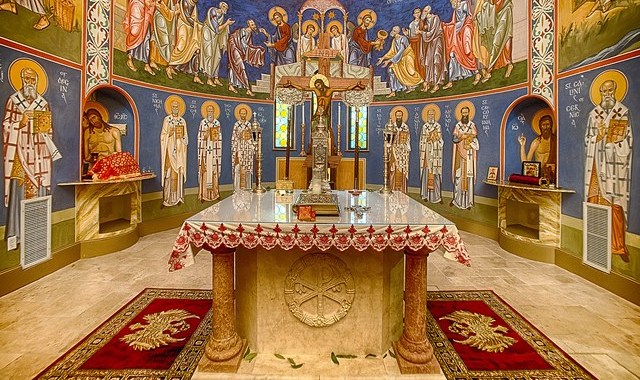
Sixthly and finally, the esoteric specificity of Orthodoxy has been preserved in Church ritual itself and particularly in the presence of iconostasis which separates the altar of the Sacrament from the laity. Catholic ritual involves the openness of the altar, its accessibility to viewing by all the laity at any time during service and outside of it. [3] Thus, the sacrament of the altar is genuinely exoteric and “descends” to the outer level. In Orthodoxy, however, the gates of Iconostasis – the Royal Gates – are open only for a short period during the key moments of the liturgy (the exception being on certain holidays). This symbolizes the unique revelation of the apophatic, unknowable Principle on the other side of the cataphatic vision of the sacred world which in a normal state is presented only by symbols – the images of iconostasis, the Deesis near, etc., as if they replace the altar. This unique feature of Orthodox ritual is connected to the historical absence of a developed “scholastic” and rational theological tradition in Russia, as theology itself in the Orthodox Church relates to the initiatic and super-rational level, whereas the openness of the altar in the Catholic Church relates the sacrament to the sphere of the rational and dogmatic. When the Catholic believer is in search of initiation, he must to appeal to special non-church authorities (esoteric societies, brotherhoods, associations, etc.), but the Orthodox can attain such as desired in the liturgy itself and enter into the most profound transcendent dimension without the aid of other sacred institutions.

Thus, it should be grasped that the Orthodox Church, similarly to the Shiite trend in Islam, is not subject to the strict division into exoteric and esoteric levels, this being true at least on the level of its archetypal organization of the sacred system. However, this does not mean that all of Orthodoxy is esoteric or that all the Orthodox are esotericists. Without a doubt, the division of “internal” and “external” planes is maintained in Orthodoxy as it is everywhere else, depending on the personal qualities and “spiritual caste” of this or that human being. However, in our case, this division is not formalized, and the degree of initiatic quality depends exclusively on the internal nature of the believer and his efforts to realize his given spiritual possibilities.

Of course, the degree of spiritual realization strictly corresponding to the general structure of the initiatic sphere is preserved in Orthodoxy, but its character is more flexible and less structured than it is in closed esoteric organizations.

The question of “virtual initiation”

Speaking of initiation, Guénon distinguished between “virtual initiation” and “effective” or “realized” initiation. From his point of view, the Christian religion, since becoming “exoteric,” cannot offer any sort of “initiation.” In Catholic ritual and in the Catholic sacrament, purely spiritual energies of the same nature as in initiatic rituals are also in action, but they are not oriented towards perfect interiorization and, consequently, affect only the outer side of the individual structure of believers. “Salvation” is guaranteed, but the path to higher, super-individual levels of existence is not opened as happens in purely esoteric mysteries.

An initiation received by means of esotericism might remain a forever “virtual,” untapped possibility if there is a lack of knowledge of the secrets of the “initiatic work,” the “Great Work,” or if the “initiated” prefers to use the “wealth” attained for goals opposite to the great goal of spiritual exaltation and the realization of purely heavenly, spiritual states.

Orthodox Initiation

Building on the particularities of the Orthodox Tradition and basing ourself on the typological parallel with the Shiite tradition, an extremely important conclusion can be drawn: Orthodoxy is an operative instrument for transferring “virtual initiation.” Thus, Orthodox ritual itself, unlike Catholic ritual, preserves an initiatic character peculiar to original Christianity.

On the symbolic level, the Church of St. Andrew the First-Called – the Orthodox Church – never fully separated itself from the esoteric Church of St. John, as happened in the case of the Church of St. Peter.

In addition, the Medieval legend of “the Kingdom of Prester John” located somewhere in the East, can be symbolically related not only to the main sacred center of the Primordial Tradition, but also by analogy to Russia itself where, in fact, “John” (Ivan, Ioan) has always been the most widespread name.

This particularity and uniqueness of Russian Orthodoxy has its doctrinal reflection in the Orthodox “Formula of Faith,” in which the rejection of the Catholic innovation of the “Filioque” – i.e., the assertion that the Holy Spirit comes not only from the Father, the First Entity of the Trinity, but also from the Son, the Second Entity – bears the character of a rejection of “mediating” entities between the sacred, spiritual Cosmos (the “Holy Spirit”) and the Genesis. In other words, it rejects exotericism as a mediating force between the believer and initiation. The omnipresence of the Holy Spirit and its direct link to the Father, along with the apophatic hypostasis of the Trinity, means a direct totality of the “Spiritual Light” accessible to the Orthodox which permeates Being in every sense and opens the initiatic “dispensation” in Orthodox life. This Orthodox principle of “divine housebuilding” which is central to the entire Eastern Church and its practices, precisely corresponds to the “church-building” line of Western Christian initiation pronounced in the sphere of special non-church organizations of the initiatic type later concentrated in “Christian Masonry” and “companionships”.[4]

Such an initiatic phenomenon in Orthodoxy and especially the absence of the Filioque explain the fact that, unlike Catholic esotericism, in Orthodoxy there are no traces to be found of “hermeticism” as a separate and independent discipline. As a sacred cosmology, “hermeticism” actually focuses on the consecration of the Sacred Cosmos – the realm of the Holy Spirit – as the direct product of the Father, i.e., in the forthright “God-likeness” of the Cosmos, the “theophany” of the Cosmos free from the passage of the “censorship of Logos.” If in full-fledged theology the Logos-Son is naturally shifted onto the supra-individual level that is transcendental in relation to the human mind, then in terms of the degeneration of theological consciousness this hypostasis of the Holy Trinity is in danger of being identified with the human mind, which is precisely what happened in Catholic theology beginning with the exclusion of the apophatic approach. This reaches its conclusion with “rationalism” and “humanism” of a semi-profane character. Orthodox doctrine, by virtue of its natural, “informal Hermeticism”, did not undergo a similar transformation and has preserved its initiatic, super-individual and super-rational nature.

Here it should be noted that there is a second, equally troubling aspect of the arrangement under examination. Being common to the entire people without strict division into “elite” and “common” forms of spirituality, the Russian Orthodox Church is also faced with the risk of offering mere “virtual initiation,” albeit of a different type than that in the Catholic tradition. In the majority of cases, the “virtual initiation” afforded by Orthodoxy to all Christians can fail to be taken to its logical conclusion in the form of a positive and final goal which, on the one hand, is totally understandable taking into account the necessary difference between the inner nature of people and the overall exclusivity of a fully-fledged initiatic path (there are many “called”, but very few “chosen”). On the other hand, however, this orientation towards the “super-personal” or “beyond-personal” aspects of apophatic Orthodox theology serves almost exclusively the discursive and rational forms of initiatic doctrines, sometimes extremely important at the preparatory stage. Thus, the realization of “virtual initiation” gradually becomes more and more problematic.

Of course, the chosen, the saints, the elders, and the monks, or any simply exceptional personalities, can indeed reach the end of this path, but the majority are compelled to limit themselves to mere “virtual initiation.” Such a stipulation especially explains the phenomenon of the widespread tradition of “holy fools” in Rus, i.e., those people who have acquired the opportunity of spiritual contemplation, but are incapable of harmoniously combining it with the normal functioning of the individual, rational level of their personality. On the other hand, “holy foolishness”, as a phenomenon of Russian spirituality, is a particularly telling aspect of Russian Orthodoxy which once again confirms the Eastern Church’s initiatic nature (after all, without any special “initiation,” no holy fools would have existed). The difficulty associated with the complete realization of “virtual initiation”, however, is thus quite clear.

The dark mystery of Cosmism

When René Guénon spoke of “counter-initiatic” organizations of the West, he of course did not put quotation marks around the issue, as the very nature of this topic demands certain precautions. After all, if one summates all of what Guénon said on this question (including in the form of innuendos and assumptions), the following picture unfolds: in the past centuries, “counter-initiation” has manifested itself all the more clearly in the degraded initiatic organization of the “hermetic type” in the West. This can refer to the “offshoots of Masonry” as well as neo-Rosicrucianist or neo-alchemical organizations. These groups, which inherited the secrets and rituals of “virtual initiation”, gave rise to a whole range of pseudo-initiatic occult and theosophist societies in the 19th century which later formed the basis of what has come to be  called “neo-spiritualism” (Guénon ranked magnetism, spiritism, the Theosophism of Madame Blavatsky and Besant, the occultism of Papus, the Anthroposophy of Steiner, and all the extensions and variations of such neo-mysticist and pseudo-esoteric trends as “neo-spiritualisms.” Today the majority of such neo-spiritualist organizations are united under the sign of the syncretic New Age movement. Neo-spiritualism itself is not directly “counter-initiatic”, but is an instrument aimed at the destruction of the remnants of the true Tradition in the West under the guise of a “return to spirituality”, which in turn leads the profane into the abyss of dissolution in psychic chaos. In turn, “counter-initiation” belongs to a much deeper level of reality, being associated with what has been called the “Devil’s Mission.”

René Guénon considered the Hermetic Brotherhood of Luxor [5] to be one of the most dangerous counter-initiatic organizations. The line is drawn from this to all the more massive neo-spiritualist tendencies, including even those sometimes opposed to its teachings, such as Theosophism, occultism, perverted neo-Hinduism (“Auroville,” Sri Aurobindo Ghosh) and others. It is extremely telling that the doctrine of the Hermetic Brotherhood of Luxor was called “the Cosmic Philosophy,” “the Cosmic Doctrine”, or sometimes “Cosmism.” The essence of the “Cosmism” of the Hermetic Brotherhood of Luxor consists of contact with the “cosmos” or “cosmic consciousness”, which means the attainment of the “light nature” of the Cosmos (the “light” theme is embodied in the very name of the order, Luxor, the Egyptian city whose name is similar to the Latin word Lux or “light” and the name Lucifer, or “light-bringer”). The “Cosmic Doctrine” concentrates all attention on the “psychic” or “subtle” plane, practically identifying the “spiritual” and the “super-psychic” with that of the “soul” or “mental” element. [6] This is not a special form of philosophically abstract “pantheism”, but a “magical,” “concrete”, “operative” and “aggressive” one. Besides actually ignoring the transcendental aspects of the Spirit, the Hermetic Brotherhood of Luxor’s Comism also threatened transferring many “initiatic” sacred and spiritual symbols and rituals to the “mental” and material level, which entails a “parodying” of true initiation, and its grotesque and dangerous imitation. The members of the Hermetic Brotherhood of Luxor, possessing indisputable paranormal capabilities, were not only the first to formulate the foundations of “neo-spiritualist” theories, but also, through provoking mysterious phenomena, achieved their speedy introduction into the most diverse cultural and scholarly environments. Historically, the roots of this secret society date back to several German Masonic lodges of the 18th century in which the members of the highest degree practiced “operative magic.” Roots can also be traced back to the unconventional Masonry of the Egyptian Rite (the Memphis-Mizraim) and the “sexual magic” groups of Randolph which displayed considerable “Satanic characteristics.” In fact, the Cosmism of the counter-initiatic Hermetic Brotherhood of Luxor was later inherited by openly Satanic centers such as the Order of the Templars of the Orient (O.T.O.) of Kellner and Aleister Crowley, who called himself the “Beast of 666.”

If we turn to Russia in the second half the 19th century, we discover a quite striking phenomenon which was called “Russian Cosmism”, whose most famous representative was Nikolay Fedorovich Fedorov, the author of the famous work The Philosophy of the Common Cause. In Fedorov’s biography there is no mention of any contact with “counter-initiatic” organizations, but his works remain a compendium of counter-initiatic doctrines that almost exactly match those of the Hermetic Brotherhood of Luxor. Fedorov even maintained the theory of “artificially resurrecting the dead” which Tradition considers to be an outspoken sign of the “Kingdom of the Antichrist.” In addition, Fedorov’s ideas to a certain extent formed the paradigm for the transfer of spiritual, symbolic, and religious doctrines to the psychic-materialist level. Among these we find the theories of “the management of atmospheric phenomena,” the “conversion of churches into museums,” and, finally, the “project for establishing a universal and indivisible human brotherhood to include all the ‘resurrected love of the ancestors’ and become the crown of history.” Fedorov’s moral utopianism and pantheistic messianism inspired a number of Russian philosophers, scholars, writers, and theoreticians and, what’s more, his “Cosmism” was extremely popular in Bolshevik circles, who identified the “brotherhood of the risen and resurrected” (sic!) with communism. In some sense, the ideas of Fedorov reflected the exalted revolutionary messianism of the era.

However, Fedorovist Cosmism in fact possesses a purely Orthodox Christian form which was not the only (although perhaps the most striking) manifestation of counter-initiatic Cosmism in Russia. In a broader sense, Russian Cosmism can be called a clearly formulated tendency of Orthodox “virtual initiation” which (if we recall its universal nature ensured by the mere fact of confessional belonging) was realized not by means of positive ascent from the mental world to the purely spiritual, heavenly, super-individual one, but by means of “fusing” with the intermediately psychic world, that is, the “thin Cosmos.” This Cosmisist specificity of “natural” Russian “counter-initiation” negatively reflected the issue of the Filioque, for if the path from the spiritual universe, from the Cosmos of the Holy Spirit to the apophatic Principle of the Father itself is not completed, then no mere “rational” or “formalized” structures can hold back individual beings from “fusing” with the subtle plane and immersing in the Chaos and excitement of what Tradition calls the “Lower Waters.” Russian Cosmism is thus the ultimate form of degradation of the “Orthodox Holy Fooldom”, a demonic form of this foolishness in which the “Holy Fools of Christ” become the “Holy Fools of the Antichrist.” It is this character of Cosmism which sharply distinguishes practically all of Russian philosophy, science, and culture from European profanity, as “Cosmisist” consciousness is drawn specifically to the non-rational, paradoxical, and powerful node of “subtle” energy which breaks through the structure of logical constructions.

If in Russia in the 20th century the most heinous persecution of the Church was indeed carried out under the communist regime, then we should see in this the “natural counter-initiation” of the Orthodox nation deprived of its vertical, holy perspective which, for lack of rational, “logos-related” boundaries, lapsed into the extreme forms of demonic, aggressive, and anarchic Cosmisist “foolishness”, and above all the “foolishness of the Antichrist.”

Conclusion

The unique features of the Russian Church and its specificity which we have broken down might help understand the bizarre and strange world of the Russian conscience, which is similar neither to Western nor to Eastern forms. In his book East and West, Guénon identified the Russians as a “people which imitates” the archetypes inherent to the “truly Eastern” peoples. In another place, he noted how “occultist” and “spiritualist” practices are widespread in Russia, something which he saw as evidence of Russians’ special propensity for “psychism.” Finally, he put forth the quite mysterious statement that “Russian communism” is most likely something other than what it is commonly believed to be. Despite their criticality, these assessments indeed very fairly describe this Orthodox people, whose true spiritual elite, albeit too small and too weak, pushed “virtual initiation” to the point of universality, while at the lowest levels it is as if the masses imitated the possession of the true spiritual mystery of the East.

Perhaps the Russian idea of sobornost (“catholicity”) and “universality” (such as that of the Slavophiles) and later the communists and socialists’ idea of “universal equality” were in fact the expressions of a vague consciousness of the “general initiation” of the nation, its “universal brotherhood” (indeed, members of esoteric organizations call each other “brothers” as do “lodges,” “orders”, and monastic communities). It also cannot be excluded that the Bolshevik Revolution was an explosion of part of this justified conviction of “universal initiation” seeking to cancel the “exoteric” hierarchy, the “master system,” as something unnecessary and vicious imposed by the “alien West,” the “Grand Inquisitor” of Dostoevsky, and as a social Filioque which remained a barrier between the people and the “light Cosmos of the Holy Spirit.” But properly speaking, these same tendencies, only on a closed, conspiratorial level, also enlivened the majority of “counter-initiatic” organizations which were not only anti-Catholic but also foreign to the “socialist” and “communist” pathos. For example, Theodor Reuss, who initiated Aleister Crowley, the Beast of 666, into esotericism, was a known anarchist and socialist. However, in no other country or region of the Earth have such counter-initiatic, thoroughly Cosmisist, and mystical-communist trends manifested themselves to such an extent as in Russia, which for more than 70 years became the epitome of the “Red Woman” of the Apocalypse, the Whore of Babylon.

But even long before this period, in the dark political mysticism and plotting of the Time of Troubles (coupled with the succession of the Impostors), in the grandiose stagings of the Apocalypse by the sinister Emperor Peter I [7], in the grotesque parody of the Russian Enlightenment of the time of Catherine and, finally, in the disturbing and psychedelic literature (Gogol, Dostoevsky, Chekhov, Sologub) and philosophy (Khomyakov, Solovyov, Rozanov, etc.) of Russia, the sprouts of “the red Cosmos sowed by the virtual initiation of Russian Orthodoxy” matured and produced flowers that pointed not upwards towards the sun of Russian Holiness, the spiritual sun of Sergey Radonezhsky, Nil Sorsky, and Seraphim Sarovsky, but downwards.

The current state of Russia cannot be defined in purely economic or political terms. The seeds of “virtual initiation” (it should not be forgotten that even under the communist dictatorship the majority of Russians baptized their children!) are too significant and active to expect any kind of transformation of Russia into a purely secular, capitalist, or profane state of the “Western” model. The roots of the “Russian phenomenon” are too deep and tragic to count on such an outcome. The Russian soul and, more precisely, the complexity of those “Russians virtually initiated” who form the mystical body of the “Inner Church” cannot abandon their “initiatic” and crucial function. Either there will be a catastrophe even more frightening and profound than under communism or, contrary to all external circumstances, a “spiritual elite” will appear which will halt the rapid decline into the abyss, “instantly” casting the “Nation of the Red Beast” into the Spiritual Heavens of the Holy Trinity much like Christ himself, freeing Old Adam from the snares of hell. If the possibility of salvation still exists for our “counter-initiatic” civilization, then does “initiatic” Orthodox Russia not remain the best place for ascension?


[1] See “Ver la Tradition”; Nicolas Vardikhas “Est et Oest” N. 43 (1991). The Filioque is the dogma concerning the Holy Spirit’s coming not only from the Father, but also the Son (Filio) which was introduced at the insistence of Charlemagne.

[2] Guénon considered such a relationship between “spiritual authority” and “temporal/secular authority” to be the only normal form, since it strictly adheres to the hierarchical structure of reality as a whole. It is important to note that “temporal power”, or the “authority of emperors and kings” is not considered to be something profane in Tradition. On the contrary, imperial sacrality is practically identified with the exoteric side of Tradition. Hence why Guénon, in his “Christianity and Initiation”, quotes Christ saying “Render unto Caesar.” This can be seen as a recognition and “sanctification” of imperial sacrality. The desire of representatives of “spiritual sovereignty”, i.e., the Church, to interfere in administrative and political issues (which is characteristic of Catholicism) is a sign of the degeneration of the spiritual nature of this form of government, and an attempt to restore the dignity of the imperial function which thus appears not as a phenomenon of usurpation by the Kshatriyas (warriors; the second caste) of the first caste (“priests”), but rather the legitimate defense of certain sacred rights. This observation helps to explain why Guénon himself, being a radical opponent of the “revolution of the Kshatriya” and an unequivocal supporter of the superiority of the “Brahmins” (the first caste) over the Kshatriyas (as opposed to Julius Evola), so sympathetically treated the Ghibelline tradition and in particular the great Ghibelline poet Dante Alighieri.

[3] It is important to note that the appearance of Iconostasis in the Ancient Church chronologically coincides with the transition from esotericism to exotericism. If parallel to the actual “exotericization” of the Western Church the altar, as the “super-heavenly” (iperuranios) element of the Church became visually and spatially open, then the preservation of the altar in the Eastern Church meant its “refrain” from complete “exotericization” by keeping the esoteric element in the center of the church itself, not outside of it as in the case of Catholicism. Indeed, the “super-heavenly,” “hyper-Uranian” relevant cannot be exhibited for public meditation without changing the very quality of spiritual influences “theurgically” associated with this space. But if the alter is kept a mystery behind the forbidden (for the exoteric) wall of iconostasis which both “unveils” the essence of the sacrament of the alter through the holy presence of icons of the Diesis type as well as “hides”such from unqualified view, thus allowing for a delicate balance to be maintained between esotericism and exotericism even without strict formalization. This in fact is the meaning etymologically contained in the term revelare which means both “to hide” and “to open.” A similar idea is inherent in the Latin word coelus or “sky”, which comes from the root meaning of “cover” or “cover over” thus connoting both “hidden” and “open.” It is also important to note the symbolism of the division of the Orthodox church into three parts: the altar, or “super-heavenly component,” the church itself, or the “heavenly component,” and the vestibule, or “terrestrial component.” Simeon of Thessolonica compared these three parts to the Holy Trinity, the three triads of Angelic orders, and the three categories of the Orthodox people – the priests, the “totally faithful” and the “leaning and converts.” Passing through these three stages of the Orthodox hierarchy typologically (or virtually) corresponds to the three phases of initiation: the “work of black,” “work of white,” and “work of red.” It is possible, however, that during the transfer of the initiatic rituals of Orthodoxy to the masses of people, special shifts are undergone in the preparatory, first phase of “proclamation” and “repentance”, as the baptized infant obviously cannot repent or become a convert, i.e., accept the theoretical aspects of the doctrine. The “work of black” is transferred to the post-baptism stage of a person’s spiritual realization, and the responsibility of “repentance and conversion” is taken over by godfathers and godmothers who act as a kind of “collateral” for the effective realization of the stage which is completed upon the infant’s baptism. In some cases, such a peculiarity yields an extremely negative result, since the the spiritual absence of initiatic grain received at the time of the “second birth” ritual chronologically precedes the basic intellectual entry into the teachings of the Church. Consequently, such a presence is bound to establish a special status for a person which, although raising him above the level of the profane, nevertheless makes it difficult to achieve consistent spiritual realization. Orthodoxy calls this prelest. The extremely widespread distribution of this phenomenon in Russia among parishioners demonstrates the seriousness of the cost which the Eastern Church has to bear in order to preserve its initiatic nature.

[4] Undoubtedly, in the last century Western Freemasonry has significantly altered its operative and initiatic character typical of earlier Masonry. In this case, we are dealing with the transformation of “virtual initiation” into “counter-initiation.” Only in such terms is it possible to consider the activities of all of later Masonry to be anti-Christian, anti-Church, and anti-Tradition.

[5] As we have learned from a competent representative of one Western initiatic organization, Guénon was in the possession of the most accurate information concerning the Hermetic Brotherhood, since he himself apparently joined it in his youth!

[6] In Guénon’s opinion, this confusion is the main source of diabolical substitution which is unleashed by counter-initiatic forces. In his book The Reign of Quantity and the Signs of the Times, Guénon explains in detail the “mechanism” of this phenomenon. The Devil belongs to the subtle, psychic world, the world of the soul. Purely spiritual regions, such as the realm of the Spirit, are closed to him. In the world of the soul, during special periods in cyclical history (such as at the end of a cycle), he may occupy a “central” position, but this “centrality” is imaginary and illusory. This illusion is obvious in reference to purely spiritual reality. Thus, the creation of the illusion of the “omnipotence of the devil” is possibly only under the condition of “concealing” the actual spirit level and placing the main emphasis on the medium, spiritual world in which the efficiency of the Devil is indeed overwhelming at times. As follows, mixing the spiritual with that of the soul is not only misleading, but a dangerous and malignant trend actively and consciously introduced into life by “Satan’s agents” or “Satan’s saints” (ali ash-Shaytan).

[7] See the colorful description of the “eschatological” amusements of Peter in Merezhkovsky’s Antikhrist (Petr i Aleksei).

© Jafe Arnold – All Rights Reserved. No reproduction without expressed permission. 

The Crusade Against Us

Author: Alexander Dugin

Translator: Jafe Arnold

Chapter 7 of Mysteries of Eurasia (Moscow, Arktogeya: 1999)

Liberalism: A Totalitarian Ideology

What is the dominant ideology of the contemporary West and its geopolitical vanguard, the United States of America? This is an absolutely urgent question as it absolutely affects every one of us. Let us be frank: we have lost the global geopolitical conflict. We are defeated. Therefore, we have been obliged to precisely and rigidly know the answers to the following questions: who is the boss in the new planetary arrangement of forces? What are the basic features of his worldview? What does he think about the world, history, the fate of humanity, and about us? The latter question in particular is just as necessary for anyone who intends to reconcile with and humbly serve the new masters as it is for anyone who refuses to accept such a state of affairs and strives to rise up and reconquer newfound geopolitical freedom.

The belief has been instilled in us that there is no ideology in the West, that a pluralism of positions and convictions reigns there, and that everyone there is free to believe, think, speak, and do whatever they want. This is an absolute lie, a simple propagandistic ploy borrowed from the Cold War arsenal (a war against us). In fact, there is a dominant ideology in the West which is no less totalitarian or intolerant than any other ideology. Only its forms and principles are peculiar, its philosophical roots different, and its historical basis differing from those ideologies which are more familiar to us. This is the ideology of liberalism. It is based on the dogma of the “autonomous individual”, i.e., consistent individualism, “applied rationalism,” faith in technological progress, the notion of the “open society,” and the introduction of the “market” and “free trade” principle into not only the economic, but also the ideological, social, and philosophical absolute.

Liberal ideology is “right” in a narrowly economic sense and “left” in the sense of humanitarian rhetoric. Moreover, all combinations of right with left, or simply right and left by themselves, are rejected, disassembled, marginalized, and are forced into the background by liberalism. Liberalism is totalitarian in its own way. Instead of the direct, physical repression of dissidents, it resorts to tactics of soft strangulation, gradually pushing opponents into the margins of society, the economic disadvantaging of dissidents and opponents, etc. But a fact is a fact: the dominant ideology of the West (Liberalism) actively fights against alternative political and ideological projects, using merely subtler, “softer,” and more refined methods to achieve its goals than other forms of totalitarianism. This does not mean that it is any less effective. Liberal totalitarianism is veiled, ghostly, and invisible rather than openly brutal, but it is no less cruel.

The existence of a “dominant ideology” in the West is gradually becoming more clearly recognized in our society. The reality of liberalism and liberal ideology has become obvious and, consequently, we have gained greater certainty as to its existence. The supporters of the West are now necessarily distinguished by their sharing of all the specific ideological premises of liberalism (and not merely some kind of vague “democracy” under which everyone is free to understand anything vague and uncertain), and its opponents are united by a simple hostility to this ideology. Yet liberalism has one more, more hidden layer: the distinct theological and religious assumptions which ultimately led the West to the ideological model which once took root in it and has now come to prevail. This layer is not as universally and unambiguously recognized as the vulgar cliches of the “open society” and “human rights,” but, nevertheless, it is precisely this part which is the basis and secret source of the liberal ideology which rules the planet, which itself is just the tip of the iceberg.

The matter at hand is none other than Protestant eschatology.

The USA – the quintessence of the West

Today, there is no longer any doubt that the world is ruled by the only remaining, fully-fledged superpower, the United States of America. This is not only the most powerful state in the West in a military sense, but is also the product of the entire Western path of development, its peak, its maximum achievement. The USA was founded and built as an artificially constructed formation devoid of historical inertia, traditions, etc. measured by only the most radical recipes worked out over the course of Western civilization. The US is the pinnacle of Western civilization, the crown of its becoming.

The US is the sum of the West and its geopolitical, ideological, and religious vanguard. Only in the US have the principles of liberalism been so totally and consistently implemented. For quite some time, the West and liberalism have come to be authoritatively identified with the USA.

America is the hegemon of the modern world, a gigantic geopolitical, strategic, and economic empire which controls all of the most important processes on the planet not in the capacity as merely another, usual state, even a strong or developed one, but precisely as an ideological model, a path of development, and as the judge and shepherd of mankind which imposes its distinct system of ideological, philosophical, and political values. The US Empire is the empire of liberalism, the empire of capital, the empire of the post-industrial society as the highest stage of the bourgeois system’s development.

Without a doubt, the US is the direct descendent of Europe and European history, but the uniqueness of this formation consists in that the US took from Europe only the most refined and purified trajectory of its civilization in the form of liberal rationalism, the theory of the “social contract,” individualism, dynamic technological industrialism, and the absolutized notions of the “trade system.” Earlier, these tendencies were concentrated in Protestant England, and the British Empire was the first (if we do not take into account Ancient Phoenicia) purely “trade civilization” model to which all of Western history logically led. It is no accident that the major theoreticians of Liberalism were Englishmen – Adam Smith, Ricardo, etc, as were the philosophers of individualism – Locke, Hobbes, Mandeville, etc. Max Weber and the even brighter Werner Sombart have shown how Western capitalism was born out of the Protestant ethic and just how essential the ethno-religious factor is to the emergence of particular socio-economic forms.

The baton of the “trade system” was gradually passed from England to the US whose leadership, since the second half of the 20th century, has become an indisputable historical fact in the general context of Western civilization.

The USA is the epitome of the West, Western capitalism, and its center and axis, its essence. Now, from the standpoint of our experience, in which the US has become the sole boss of the entire planet, for which it had been striving for so long, we can easily recognize the logic of history as leading in focus up to a single point (which, for historical reasons, could not have been seen by those thinkers who did not live to see the dramatic turning point of the geopolitical, social, and economic Cold War confrontation).

Thus, all of Western history leads up to the United States of America.

The “West” as a geopolitical phenomenon actually emerged out of the schism of the Christian Church into Orthodoxy and Catholicism. The Catholic zone became the basis for what has since then been known as the “West” as a concept. From this point on, the people of the Catholic world identified themselves with all of humanity and identified their history with world history and their civilization with civilization in general. All remaining civilizations and traditions were contemptuously likened to “savages” and “barbarians.” It is telling that not only Christian nations but the entire Orthodox world, which in fact was the zone of real, undistorted, authentic Christianity, fell into such an “inhuman” category. In fact, the Orthodox countries – at first Byzantium and later Russia – were Christians and were the ones to challenge the Catholics’ aggressive hostility. Orthodoxy presented an example of a different Christianity, a universal, open, non-sectarian, radically alternative civilizational model which prevailed in the West prior to the time when it claimed to be the only form of Christian statehood. It follows that the seed of the dialectical development of civilization and geopolitical processes in the succeeding centuries is to be sought in Catholicism’s opposition to Orthodoxy.

The history of the West is to be accounted for only after the schism of the Church. At that time, Catholicism became the head of purely “Western” trends. After a certain period of time, however, certain elements of Catholic teachings retained from the heritage of the Orthodox unity of the Church came into contradiction with the main trajectory of the West’s development. The Reformation appeared as a fracture. At that moment, the most “Western” trends isolated themselves and became concentrated in the Protestant type. Protestantism spread precisely in those countries and among those peoples who moved in the direction dictated by the schism – estrangement from the East, arrogant contempt for “savage peoples,” the identification of themselves and their technological development with the peak of civilization, and the individualistic and rationalistic trends which were no longer satisfiable within the Catholic framework (although they, in turn, were an essential step away from the traditional and faithful spirit of the original teachings of Orthodoxy)

The Protestant countries, and first and foremost England, represented the path of “sea civilization” and gravitated to the absolutization of the liberal model and the universalization of the “trade system.” Henceforth the English began to play the role of the vanguard of the West, the “Far West.”

The most extreme and radical Protestant sects of England later formed the basis of American civilization and designed and realized the project of the United States of America. They went to the extreme West to the “promised land” to build a perfect society, the “ideal” and “absolute West.” The United States of America as a state was established by the consensus of fundamentalist Protestant sects, and the overwhelming majority of the American political class to this day remain unchanged as the representatives of these Protestant confessions. This, nevertheless, is quite logical. The country is still ruled by the legal, ideological heirs of those who created, organized, and led it to material prosperity and the rank of a planetary power.

The Americans themselves call this “Manifest Destiny.” In other words, the Americans see their history as a consistent upward path towards civilizational triumph and the victory of this philosophical model upon which American civilization is founded as the quintessence of the entire history of the West.

Protestantism as an Ideology

The following argument can be made: “Contemporary Western society, and especially American society, have already long been atheist, religion maintaining only a small number of followers. Thus, fundamentalism, such as of the Protestant type, can in no way be equated to the official ideology of the USA, much less to that of the West as a whole.”

In fact, it is necessary to point out that religion is not obliged to act as a cult or as a set of doctrines. In the contemporary world, religion manifests itself implicitly as a set of psychological predispositions, as a system of cultural and existential cues, and as a semi-conscious geopolitical intuition. Religion can even be compared to ideology – some (the minority) master the entirety of the conceptual system, while others (the majority) merely intuitively grasp the ideology. More often than not, today religion functions more through the cultural background, family psychology, and the norm of social ethics. In this regard, the US is absolutely a Protestant country, and this “Protestantism” affects not only this confession’s open believers, but also the vast masses of people of other religious beliefs and even atheists. The Protestant spirit can be easily spotted not only among Puritans, Baptists, Quakers, Mormons, etc., but also in American Krishnaism, the Moon sect, among the American Jesuits, and even in the plainly non-religious American citizen. All of them are to a certain degree affected by “Protestant ideology” even though it may be recognized as a cult and dogma only by a relative minority.

The second argument that could be made is that the political class in the US does not proportionally reflect all of society. In this view, it is sufficient to look at the negligible number of colored politicians and administrators. The traditional, “majority-type” American politician, after all, is a “WASP” – a “White Anglo-Saxon Protestant.” Consequently, a fully-fledged Protestant fundamentalism is more probable among the elites than among other layers of society.

Finally, more concretely, the US Republican Party, one of the two parties possessing a de facto political monopoly, is openly and consistently guided by a Protestant, fundamentalist worldview fully in line with the axis of American civilization and the dogmatic religious incarnation of the US’ Manifest Destiny. An intermediate layer between the generally-accepted secular liberalism of the masses and the Protestant, eschatologically fundamentalism of the political elite is filled by geopolitical centers of analysts serving the government who employ a synthetic technique in their projects in which the main religious and philosophical postulates of Protestantism are taken  minus the details and the prophetic fanaticism of their preachers and combined with the more pragmatic sides of liberal doctrine, albeit freed from the pathetic demagogy of “human rights” and “democracy.” In other words, the geopolitical thinking which is extremely developed among the US political elite is non-antagonistically combined with eschatological fundamentalism which in turn forms the idea of the “US as the New Israel called to rule peoples at the end of history” as well as the idea of free trade as the maximal rationalization of social order based on the priority of “rational egoism” and the “atomic individual.”

The Protestant messianism of American geopolitics is thus combined with the proposal of a universal market model of governance and the liberal system of cultural values.

“The Evil Empire”

For many centuries, the main geopolitical and ideological opponent of the West has been Russia.

This is entirely natural. On a theological level, this is rooted in the confrontation between Catholicism (+ Protestantism) and Orthodoxy and the opposition of the Western Roman Empire to Byzantium. The Western and Eastern forms of Christianity represent two choices, two paths, two incompatible, mutually exclusive ideals. Orthodoxy is oriented towards the spiritual transformation of the world in the rays of the uncreated Tabor light, while Catholicism focuses on the material restructuring of Earth under the administration of the Vatican [40]. Orthodox Christians praise contemplation above all, while Catholics worship action. Orthodox political doctrine insists on the “symphony of authorities” which strictly delineates the secular (the Basileus, the Tsar) and the spiritual (the patriarch, the clergy). Catholicism strives to spread the Pope’s power into secure life, thereby provoking responsive usurpation on the part of secular monarchs who aspire to subjugate the Vatican. Orthodox Christians consider Catholics to be “apostates” breeding “apostasy” which Catholics consider the Orthodox to be a “barbarian spiritualist sect.”

The most anti-Orthodox traits – including the refusal of service and many dogmas – were stretched to their limit by Protestants.

Rus was the direct and sole spiritual, political, and geopolitical successor to Byzantium after the fall of Constantinople. For this reason and this reason alone was it called “Holy Rus.” It was made “holy,” “God-bearing,” and “chosen by God” by the providential adoption of the Byzantine heritage and full faithfulness to the Orthodox tradition (including its socio-political and even economic aspects). It is especially important to emphasize that it is not merely a fact that Orthodoxy spread as a confession and lent this holiness. Orthodox churches exist in other countries and among other peoples. What is important is that the combination of the Orthodox faith with a powerful and free political empire, the Tsardom, and the Tsar in conjunction with the national Russian Patriarch ensured the dogmatic and theological, eschatological validity of its name. Strictly speaking, Rus ceased to be “holy” when the “symphony of powers” and the Orthodox political system was rejected firstly by the second Romanov (the split) and then by his son Peter the Great, the Westerner and liquidator of this sacred heritage.

Be that as it may, since the 16th century Rus acted as the main ideological and civilizational opponent of Europe. Later followed the prolonged geopolitical duel with England in the East, and, most recently, the Cold War.

History is not linear. It often backtracks, sidetracks, projects nuances, and accentuates paradoxes and anomalies. But the central line is evident. Without a doubt, there exists some kind of “Manifest Destiny” in a broad sense. It led the West to the American model, the American way of life, and to being a superpower. The East, on the other hand (at least the Christian East), became embodied in Russia over the course of centuries. The socialist faith in the golden age of the Soviet Russians was an absolutely symmetrical antithesis to the market-based eschatologism of the Protestant Anglo-Saxons. There was the “end of the world” according to the liberal scenario and its opposite, the “end of the world” according to the Orthodox-Russian, social, Eurasian, Eastern scenario. For them, this means total enslavement and rationalization. For us, this means total transformation and liberation.

The logic of history constantly highlights this fundamental dualism on many different levels, whether in the form of the USA vs. USSR, West vs. East, or America vs. Russia. In economics, politics, geopolitics, theology, and culture there is a frighteningly clear antithesis which has clearly unfolded in front of us, the plot of a global drama involving two poles of a physical and spiritual continental duel, a great war of continents.

Dispensationalism

Do Americans themselves recognize the theological background of their geopolitical confrontation with Eurasia and Russia? Undoubtedly, they do, and sometimes even more clearly than Russians.

There exists a particular Protestant eschatological teaching known as “Dispensationalism” (from the Latin word “despensatio” which can be translated as “plot”, “plan,” or “design”). According to this theory, God has one “plan” for the Anglo-Saxon Christians, another one for the Jews, and a third for all other peoples. The Anglo-Saxons consider themselves to be the “descendants of the ten tribes of Israel who did not return to Judea from Babylonian captivity.” These ten tribes “recalled their origins and adopted Protestantism as their main confession.”

According to the adherents of Dispensationalism, the “plot” for the Protestant Anglo-Saxons is the following: a troubling era will arrive before the end times (the “great tribulation”). At this moment, the forces of evil and the “Evil Empire” (when Reagan called the USSR the “Evil Empire,” he had in mind precisely this eschatological Biblical meaning) will attack the Protestant Anglo-Saxons (as well as other “born again” peoples), and a short period of “the abomination of desolation” will reign. The main villain of this “troubled epoch” (tribulation) is King Gog, and here lies a very important point: in Dispensationalist eschatology, this character has steadily come to be identified with Russia.

This was first formulated most clearly during the Crimean War in 1855 by the Evangelist John Cumming when he identified Russian Tsar Nikolai II with the Biblical “Gog, the Prince of Magog” – the leader of the invasion of Israel foretold in the Bible [41]. This line was once again unleashed with particular force in 1917 and in the Cold War era when it became the virtually official position of the “moral majority” of religious America.

God has yet another “plan” for Israel according to Dispensationalist teachings. By “Israel” they understand the literal restoration of the Jewish state before the end times. Unlike Orthodox and all other normal Christians, Protestant fundamentalists believe that they are related to the Jews still practicing Judaism today and are convinced that the Biblical prophecies on the nation of Israel’s participation in the events of the “end times” are to be understood literally, strictly according to the Old Testament. In the end times, the Jews are supposed to return to Israel, restore their state (this “Dispensationalist prophecy” strangely enough was literally fulfilled in 1947) and then be subjected to the invasion of Gog, i..e, the “Russians,” the “Eurasians.”

Then begins the strangest part of “Dispensationalism.” It is presumed that at the moment of the tribulation, the Anglo-Saxon Christians will be “taken up” (“raptured”) to Heaven as if on a “space ship or saucer” and there they will ride out the war between Gog (the Russians) and Israel. Then, the Anglo-Saxons, together with the Protestant “Christ,” will descend to Earth again where they will meet the Israeli victors over Gog, who will convert to Protestantism. Then begins the “thousand-year reign” and America, together with Israel, will dominate the stable paradise of the “open society,” the “one world.”

This extravagant theory, if not for certain circumstances, would remain in the domain of marginal fanatics. But…

First of all, one such convinced “Dispensationalist”, a sincere believer in the literal fulfillment of such an eschatological scenario, was none other than Cyrus Scofield, famous for being the original producer of the popular English Bible, the “Scofield Reference Bible.” which has sold many millions of copies. In America, this book can be found in every corner, and it was Scofield who inserted his own historical commentary and prophecies on future events authored in the spirit of Dispensationalism into Biblical text, thus rendering it difficult for the inexperienced reader to distinguish the actual Biblical text from its treatment by Scofield. Christian propaganda in the Anglo-Saxon world, and particularly in the US, thus intrinsically presents such “patriotic” American education, Manifest Destiny, Russophobic eschatological indoctrination, and outright Zionism. In other words, the newest form of the centuries-old ideology that lies at the heart of the dualism of the West in opposition to the East which we have discussed is fully embodied in Dispensationalism.

In some contemporary Dispensationalist texts, such “plans” are connected to the newest technological advancements, which then gives rise to a “nuclear Dispensationalism,” i.e., the consideration of “nuclear weapons” as some kind of apocalyptic asset. Once again, Russia (and earlier the USSR) is presented as among the “forces of evil” of the “nuclear King Gog.”

The person responsible for popularizing this “atomic Dispensationalism” was the evangelist Hal Lindsey, the author of a book interpreting prophecies titled The Late, Great Planet Earth [42] which has sold 18 million copies (in its time, it was the second bestseller after the Bible itself). An ardent follower of Lindsey was none other than Ronald Reagan who regularly invited Lindsey to lecture nuclear strategists at the Pentagon [43].

Another “nuclear Dispensationalist” is the televangelist Jerry Falwell, who became Regan’s closest government advisor and participated in Reagan’s private meetings and top military consultations in which questions of nuclear security were discussed. Thus, archaic religious, eschatological notions perfectly coexist with secular and progressive ones in American society along with high technology, geopolitical analysis, and brilliantly efficient systems of political management.

In fact, Dispensationalism itself remains inexplicable without considering the unconditional pro-Israeli position of the US which in fact quite often directly contradicts the geopolitical and economic interests of the United States. Protestant fundamentalists’ solidarity with the fate of earthly Israel as restored in 1947 – which in the eyes of Protestants was a direct and impressive confirmation of Scofield and his Bible’s interpretations – is founded on these deeply theological and eschatological tales.

For us, it is very important just how profound and sustained are the anti-Russian, anti-Eastern, and anti-Eurasian principles of American thinking. These are the depths of denial and hatred rooted in and carefully nurtured over the course of centuries.

The Final Trick of the Antichrist

Putting all the pieces together, we obtain a quite frightening picture (for Russians). The forces, groups, worldviews, and state formations collectively called the “West”, which after victory in the Cold War became the sole rulers of the world behind the facade of “liberalism”, profess a concrete eschatological, theological doctrine in which the events of secular history, technological progress, international relations, social processes, etc. are interpreted from an apocalyptic perspective. The civilizational roots of this Western model date back to deep antiquity and, in some cense a certain archaism has been preserved in them up to the present day parallel to technological and social modernization. These forces consistently identify us, Russians, as the “spirits of hell,” demons of the “order of King Gog from the land of Magog”, and as the bearers of “absolute evil.” The Biblical reference to the apocalyptic “princes of Rosh, Meshech, and Tubal” are revealed as an unambiguous identification of Russia – “Rosh” being Russia, “Meshech” being Moscow, and “Tubal” being an ancient name for the Scythians. In other words, the West, and particularly the United States’ Russophobia does not arise merely out of pharisaical care about the “victims of totalitarianism” or notorious “human rights.” Instead, we are dealing with a consistent and “rationalized” doctrinal demonization of Eastern European civilization in all of its aspects – historical, cultural, theological, geopolitical, ethical, social, economic, etc.

Particular attention should be paid to the multi-dimensional coincidence of the remotely distant conceptual levels of “Western ideology,” i.e., the convergence of the supporters of capitalism in the economic sphere with the theoreticians of individualism in the socio-philosophical realm, geopolitics on the strategic level of continents, and the brand of theology operating with the eschatological and apocalyptic doctrines of Dispensationalism. All of these elements converge in an unambiguous and constant identification of Russia as the “Evil Empire”, as the historical negative, and as the repugnant villain of world drama.

This is all very, very serious. World wars, the collapse of empires, the disappearance of entire peoples and races, class conflicts, and revolutions are but episodes of a great conflict, the culmination of which is supposed to be the final, apocalyptic battle, the Endkampf, in which we will play the most important role. In the eyes of the West, our role is overall and entirely negative. The role assigned to us is that of the planetary scapegoat.

The Western Antichrist is striving to convince the world that his planetary and spiritual enemy is the real “Antichrist,” that is, Continent Russia and its secret pole: us.

Footnotes:

[40] See F.M. Dostoevsky’s The Grand Inquisitor and The Brothers Karamazov

[41] Ezekiel 38-39

[42] Hal Lindsey, The Late, Great Planet Earth, New York, 1977

[43] See Gregory Krupey’s The Christian Right, Zionism, and the Nearing Penteholocaust in Adam Parfery’s Apocalypse Culture, New York,1988

© Jafe Arnold – All Rights Reserved. No reproduction without expressed permission. 

America the “Green Country”

Author: Alexander Dugin

Translator: Jafe Arnold

Chapter 6 of Mysteries of Eurasia (Moscow, Arktogeya: 1999)

The role of the USA, the last remaining superpower in the world, is central to global geopolitics today. Beginning with the end of the 19th century, this peripheral, marginal continent, previously but a European province secondary and complimentary to the Old World, increasingly became an independent political and cultural power. After the Second World War, the USA even came to act as the paradigmatic, universal model for the countries of Europe themselves and even Asia. The significance of the steady growth of America and the totality of the American ideological, cultural, psychological, and even philosophical complex goes beyond the framework of purely economic or military influence. “Mythological America,” “America as a concept,” and “America as the American Ideal” are today manifesting themselves all the more visibly. 

There must be compelling reasons why the “American idea” has taken root and implanted itself as something “neo-sacred” in global geopolitical consciousness connected to the collective unconsciousness of humanity and the mysterious continental geography that can be traced back millennia, the memory of which still lives in the archetypes of the psyche. Considering the “mythological” underpinnings of America as an “internal continent” is the main task of this chapter.

The Secret Map

Today, hypotheses on the Old World’s discovery of America long before Christopher Columbus’ voyage are becoming all the more popular. It has been proven that Scandinavian Vikings visited North America (Vinland) with their ships, and runic inscriptions are being found across the eastern coast of Canada, the Labrador, in Newfoundland, etc. There exist, moreover, the sufficiently reasonable theories of the scholar Jacques de Maio on the link between Incan civilization and these same Vikings, and there are other versions which claim that Europe had always known of the existence of the American continent, yet for specific reasons related to its sacred nature, did not widely disseminate this information. But, the most interesting instance in this regard is the mysterious story of the map of Muhiddin Piri Reis. Let us dwell on this map in detail. 

In 1520, Muhiddin Piri Reis, an admiral in the Turkish navy, published the navigational atlas Bahriye which is still preserved in the National Museum of Istanbul. Some of the maps contained in this atlas depict North and South America, Greenland, and Antarctica with remarkable precision, yet these areas simply could not have been known to mariners at that time unless, of course, official historians are to be believed. 

Admiral Piri explains the origin of these maps as being discovered among one of the Spaniards who participated in the three expeditions of Christopher Columbus and later captured by the Turkish officer Kemal during a naval battle. In his remarks, Piri Reis notes that only thanks to these maps was Columbus able to discover the New World, and this fact was indirectly confirmed in the book of Christopher Columbus’s son, Fernando, The Life of Admiral Christopher Columbus. It reads: “He [Columbus] worked through mounds of information before he came to the conviction that he would discover a number of countries lying to the West of the Canary Islands.” Columbus’ maps, which fell into the hands of Piri Reis, were drawn in 1498. But Piri Reis himself claims that the collection dated back to the times of Alexander the Great long before Columbus. Indeed, some of the maps’ details – such as the portrayal of Antarctica and Greenland as having no ice cover, which allows one to note that Greenland in particular consists of two islands (a fact confirmed only recently by a French expedition) – could only be relevant to a geographical map of the world from five-thousand years ago! The analysis by Dr. Afetinan Tarikh Kurumu in his book The Oldest Map of America(Ankara, 1954), along with the examination carried out by the American Institute of Marine Hydrocartography, have revealed the incredible accuracy of these maps which, among other things, display the mountain ranges of Antarctica and Greenland which were only recently discovered by geologists. In addition, according to some experts, such precision could only be obtained today with the aid of aerial photography. 

No matter what, knowledge of America’s existence necessarily had to have been present among the peoples of Eurasia before Columbus. Knowledge never disappears, but merely descends into the sphere of the unconscious or into the depths of esoteric secrets. That being said, the American continent is, by all logic, an important link in the “sacred geography” of the ancient peoples, and America’s modern role as a distinct civilization represents none other than the awakening of dormant archetypes.

Why not “Columbia?”

Many explain the modern naming of the continent after Amerigo Vespucci and not after Christopher Columbus as an historical misunderstanding and accidental injustice. In no way can we agree with this, as it is not difficult to note that even on the most local scale among purely “rational” name christenings, only those names survive which accord with the semi-conscious archetypes manifested in the well-known phenomenon of so-called “folk etymology.” At times, the similarity of words’ soundings plays an important role, but the identification of concepts on the basis of similarities in sound does not so much demonstrate their “erroneousness” (as the purely “positivist” and “anti-psychological” science of the 19th – 20th centuries presumed) as it does the stability of semantic structures on the level of entire words as well as on the level of the autonomous meaning of letters and letter-combinations. On a basic level, elements referring to “folk etymology” are based on such metaphysical, complete, and far from “folk” sacred methods such as Hindu Nirukta or Jewish Kabbalah. Be that as it may, we presume that the word “America”, in order to match the giant continent’s importance by virtue of its geopolitical mission, should consist of sound concepts associated with the archaic models of the proto-language rudimentarily preserved by the sub-consciousness of the nations of Eurasia. 

First and foremost in the sacred form (and, accordingly, the name) of America, the idea of its “extreme Western” origin should be reflected. According to the works of Professor Wirth [35], the ancient Western sacred center was the land of Mo-Uru, or the islands of Mo-Uru located in the Northwestern Atlantic. This name is mentioned in the Bundahishn, a Zoroastrian scripture, in which it is named third after the Ariana-Vedja, the land of the great Aryan ancestors. (Ariana-vedja itself lay directly at the north pole, the Arctic continent “Arktogeya” which disappeared many thousands of years ago). It is precisely with the aid of this key word “Mo-Uru”, and based on the decoding of the oldest runic and proto-runic symbols (and in particular, the decoding of the liner pre-dynastic writing of Egypt and the Minoan inscriptions, and even ancient rock tracings), that Professor Wirth was able to penetrate the secrets of many of pre-history’s ethnic and racial cataclysms. In its phonetic variations, Mo-Uru is mentioned in the Bible (Moria is the name of the country where Moses was supposed to offer Isaac as a sacrifice to God) and in the Celtic sagas, where the country of “Morias” or “Murias” is referred to as the homeland of the divine northern tribes of Tuatha Dé Danann, as well as in the Scandinavian cults in which the famous stone circle of the cultic pagan center in Uppsala was called “Mora-walls” or “Stone of Mora,” etc. Wirth proposes (and convincingly proves in his detailed and throughly-reasoned works The Origin of Mankind and The Sacred Proto-Writing of Mankind) that the “Amorites,” “Moors,” and even the oceanic “Maori” were the descendants of the ancient natives of this sacred center in the Northern Atlantic, and that the geography of this land was later transferred into the historical toponyms of the “peoples of Mo-Uru’s” new settlements. Curiously enough, “Amorites” means “People of the West” (am uru) in ancient Hebrew. There also exists the sacred doctrine mentioned by Guenon which claims that the Jewish tradition itself is “Western” in its symbolic and pre-historical origins as evidenced by, in particular, the Jewish custom of celebrating the New Year in the fall and the change of day in the evening, stressing the importance of the “Western” orientation corresponding to the universal historical correlations between evening and autumn, the “sunset” period of the day or year. In this perspective, Chaldean Ur, which Abraham left for the promised land is perhaps a substitute of Mo-Uru, the “North-Atlantic Ur”, just as the Zohar asserts that “Ur”, where Abraham originally resided, symbolizes “the highest spiritual state” from which Abraham “descended” downwards by virtue of providential necessity. (It is curious to note that Jews themselves often share this point of view stressing this Western origin of their tradition, as can be seen among the early Zionist projects of the “Jewish state” organization in America, in Simon Wiesenthal’s books on the Jewish pre-history of America, and in Edmund Wiseman’s America: The New Jerusalem). 

So, the mysterious Mo-Uru denotes a sacred continent beyond Europe which lies to the West in the Atlantic. Moreover, “mouru”, “amuru,” or “amoru” (such forms are encountered in historically different traditions) are phonetically similar to the word “America.” It can thus not be excluded (and it is indeed quite likely) that precisely such a “coincidence,” or, more precisely, a providential correspondence, served the unconscious or half-conscious basis for consolidating such an externally profane yet internally sacred name for the New World. 

Atlantis and Beyond Atlantis: the mystery of the dollar

It is only natural that “America” and “Mo-Uru” have a direct relationship to the myth of Atlantis, the paleo-continent about which Solon, Plato, and many before and after them spoke. Atlantis was the Western, sacred continent upon which a spiritual civilization flourished only to be destroyed as a result of a great cataclysm and flood. The death of the continent is most often described as comprising several stages. After the sinking of the mainland located to the West of Eurasia and Africa, for some time after separate islands in the North Atlantic were preserved on which the last tribes of the Atlantians were concentrated, the carriers of the ancient tradition. In Wirth’s opinion, Mo-Uru was such a remnant of Atlantis which in turn came to be flooded only much later, perhaps a few millennia following the main cataclysm. 

Judging by everything, the American continent was not the westernmost continent in sacred geography as Atlantis was, but rather its further-Western “continuation.” In other words, America was “beyond Atlantis”, the lands located “on the other side of the West.” It is possible that the sacred, symbolic location of America explains the disturbing secrets associated with it in the sacred geography of Eurasia’s traditional civilizations. 

According to this sacred geography, located in the West is a “Green Country,” the “Land of the Dead,” or some kind of quasi-material world resembling Hades or Sheol. This is the country of dusk and dawn in which there is no escape for mortals and whom only the initiated can reach. It is believed that the name Greenland (literally “Green Land”) refers to this same symbolic complex. But this “Green Country” is not Atlantis (and not even Mo-Uru!). This has to be one laying even further West as the “world of death,” the “kingdom of shadows.” And it is thus the supernatural dimension of the American continent which is quite miraculously revealed in such a, at first glance, banal thing as the dollar sign. Rene Guenon once noted that this symbol on American money is the graphic simplification of the sacred seal found on ancient coins of the Mediterranean zone. Originally, the two vertical bars were depictions of the two “pillars of Hercules” which, according to legend, stand in the far West beyond the Gibraltar Strait. The loop on this mark was once a slogan with the symbolic inscription “nec plus ultra”, which literally means “onward to nowhere.” Both of these symbols were meant to mark the border, or the Western limit of human sacred geography beyond which were found “inhuman worlds.” This “border” symbol, which indicates that it is impossible to go beyond the Gibraltar, paradoxically became the financial emblem of America, the country lying “beyond the borders” precisely “where it is impossible to go,” where the inscription on the original dollar sign categorically prohibited travel. It is here that the “otherworldly” symbolism of America appears, revealing the shady, forbidden sacred-geographical aspects of human civilization.[36] 

In this view, Columbus’ newfound discovery of the American continent bears a rather sinister meaning, as it signifies the emergence of “sunken Atlantis” on the horizon of history. But not even Atlantis itself, but its “shadow,” its negative continuation of the symbolic West to the point of the “world of the dead.” It is quite characteristic in this regard that this “new discovery” temporally coincided with the beginning of the severe decline of European (and pan-Eurasian) civilization, which rapidly began to lose its spiritual, religious, qualitative, and sacred principles from this time on. 

On a cultural, philosophical level, it is America that went on to become the perfect projection of purely profane, atheistic, and poly-atheistic utopias. Social models based on purely human rationality, beginning with Thomas Moore, increasingly settled on this continent.

Here once again, we see how it is not only the “unexplored” quality of these lands rendering it favorable for the realization of utopia, but also the archetypes of the “land of the dead where eternal peace and order reigns” and the image of the “green country” of the West that influenced the choice of this geographical space. 

The historical cycle of America, its rise from the watery depths as the “New Atlantis,” can be likened not to the true and risen[37] return of the “golden age”, but to the chimerical, fake, and illusory bearing the noxious smell of a continental grave. 

Sunrise in the West, Sunset in the East 

The well known metaphysician and Traditionalist Geydar Dzhemal once pointed to an interesting peculiarity stemming from the geographical location of the American continent: for Americans, every morning the sun rises from the direction of Europe (that is, from the side which sacred geography constantly associates with the West) and sets on the side of Asia (the symbolic East). In a strange way, such a shift in the symbolism of orientations in the natural “worldview” of this continent’s residents resonates with the famous eschatological prophecy foreseeing that “in the last days” the sun will rise in the West and set in the East. Such an exception necessarily influences the archaic dimension of the continental American psyche, complementing the already entirely specific role of America as the re-emerging Beyond Atlantis, the “green country of the dead.” If we add to this the “rationalist utopianism” characteristic not only of the theorists of the Old World but also the founding fathers of the North American states, then, indeed, we derive a variant of an eschatological, messianic complex forming the paradigm and structure of American continental consciousness as a whole, and particularly those aspects which are most deeply connected with geopolitics, universalism, and self-identity. This eschatological scenario, in its most general features, is the same in the most remotely distant religions. In Christianity, Islam, Judaism, and in the majority of the Aryan pagan traditions, and even in the Melanesian cargo-cults, the “messianic era” is characterized by “the resurrection (or return) of the dead,” “the restoration of heavenly prosperity”, the “revealing of everything lost over the course of history,” the “appearance of new lands and new heavens,” the “presence of everlasting grace,” etc. If one more attentively looks at the American mentality in its North American variation, we see nearly all aspects of this eschatological plan. The “resurrection of the dead” is reflected in the practice of freezing the corpses of wealthy Americans searching for resurrection with the aid of scientific techniques in the coming century, as well as in a number of American neo-spiritualist sects who preach thanatophilia and scientifically (using quack devices) prove the “immortality of the soul.” Such “heavenly prosperity” is translated into the concept of “material prosperity”; the “new land” is the American continent itself, the base of the new “golden age” termed in some occult and astrological milieus as the “Age of Aquarius” or “New Age” (the widespread pseudo-religious movement highly developed in the US). 

This eschatology permeates the very concept of “new world order” producing the current slogan of a “global community” (repeating and developing American ideological projects), and these notions presume the expansion of the American model to every last bit of territory on the planet. Thus, the “New World” or “new land” emerging from the depths of disturbing mystery and esoteric secrets pretends to be the new, spiritual land foretold of the Apocalypse which is to appear after the End Times. For continental America, the post-apocalyptic epoch has already arrived. The Allies’ victory in the Second World War that led the US to world domination, the persecution of Jews in Germany (provably explaining the accomplishment of the apocalyptic “Holocaust”), the symbolism of the state of Israel’s re-establishment, and the recent collapse of the USSR, the last planetary opponent of the West, are interpreted by the leaders of America as the undoubtable signs of global victory and the arrival of the “new eon”, the epoch of sole world domination, the “end of history,” and the triumph of the world market. 

In the USA, the countdown to messianic times has already begun. 

Holy America 

The archaic, unconscious complex of the “American ideal” is an entirely clear, straightforward expression manifested in the the “political theology of Americanism.” We have in mind the neo-Protestant concept of “America the promised land.” In this notion, the energy of the continent yields a particular theological construction, and if certain terms of this mystical “Protestant Americanism” are perceived not as rhetorical metaphors, but as a precise formation of eschatological constructions, then a rather unexpected and disturbing picture emerges. For example, George Washington himself stated that the “United States is the New Jerusalem determined by Providence as the territory on which man should attain his full development, where science, freedom, happiness, and fame shall spread with peace.” Here it is important to note the concept of the “New Jerusalem” which, in the language of a Christian (even a Protestant) necessarily points to the Apocalypse and refers to the last stage of the eschatological scenario, the descent of the spiritual “Hail of the Lord,” the “New Jerusalem” from heaven. [38] 

For his part, John Adams clearly defined globalism as an American mission, calling the USA “a pure and virtuous republic whose task is to rule the world and establishes the oneness of people.” 

In recent times, this special “patriotism” has gained new energy thanks to the development of television, which has led to the formation of the “televangelism” phenomenon which Isidro Palacios called “e-Christianity.” For example, the famous televangelist Jerry Howell now formulates the “American ideal” in the following way: “The USA is a country blessed by Almighty God which like no other country on earth is now exposed inside and out to the attacks of devilish machinations which could end in the destruction of the American nation. The devil is battling with the will of God, which put the US above all other nations, like ancient Israel…” These theological motives of Protestant eschatology are typical of modern American presidents. In 1984, Reagan stated: “I don’t think that the Lord, who blessed this country like no other, would ever want want us to trade it away because of its weakness.”

Without taking into account the symbolic role of Beyond Atlantis in its supra-temporal, supra-historical complex, this messianic pathos remains unclear, and the mass-scale spiritual fraud behind it cannot be completely assessed and understood. In the most general sense, as in all parodical eschatologies, we are dealing with the displacement of the spiritual golden age which is supposed to arrive immediately after the End of History, its shift to the period preceding the End. 

Apollo, Diana, and the Truncated Pyramid 

This same parodical logic, when applied to the material level of spiritual reality, distorts sacred meaning and stands behind the technological progress of “America the continent” especially in such illustrative spheres as space research. It is quite revealing that the Americans were the first to land on the moon where, according to various archaic traditions, the “souls of our ancestors” reside. (It is especially important that Soviet cosmonauts belonging to a similarly significantly eschatological political formation did not manage to achieve this). In esoteric tradition, there exists a direct link between the “green land of the dead” and the Moon, and this very link can be traced to the objective, material, and spiritually profane history of modernity. 

American cosmonauts’ space flights consciously bore a “ritualistic meaning”, as is evident even in the name of the “Apollo” spacecraft, Apollo being the traditional mythological companion of Diana, the moon. Moreover, as was reported even in the secular press, the American astronauts brought Masonic rings with them to the moon. This in fact means that the “ritualistic” character of the events could not have but been obvious to them, given that “entering the sphere of the moon” means passing through the lesser mysteries in Masonic ritual. Here once again there is a symbolic parallel: the initiation into the lesser mysteries brings a Mason into the so-called “Edenic (heavenly) state” returning him to the spiritual completeness which characterized the people of the Golden Age. In the case of the individual, all of this is realized on an internal, “microcosmic” level. The flight to the moon ritual took on an external, material, “macrocosmic” character, then “sacralized” not only by the individual, but also the entire “continent”, the messenger of which is the individual. On a symbolic level, the interplanetary journey from America to the moon was equivalent to the journey from “America” to “America,” and this paradoxical ritual strengthened and intensified the messianic pride of America as a whole, the American subconscious. It should also be noted that the Masonic tradition is extremely developed in America, and in this regard there exist certain theories that insist on the originality, uniqueness, and “chosenness” of American Masonry in comparison to other branches. In American Masonic lodges, the legend is widespread that the last Knights Templar, having been in hiding for some time since their persecution by French monarchs and Catholic authorities in Europe, later fled to America and brought their treasures and relics with them. Some have even claimed that the Holy Grail itself was brought to America. Be that as it may, American Masons are convinced that the true “sacred” center of Masonry is to be found in the USA, while European Masonry is “too archaic and helpless” and is nothing other than a “relic of the past.” It is undeniable, moreover, that Masonic signs make up many of the US’ state symbols, such as the white five-pointed star (the symbols of “Adam of Paradise” – again the “heavenly” theme) and the truncated pyramid whose peak is separated from the base by a ring of 13 stars symbolizing the 13 tribes of Israel. (Joseph’s tribe is often symbolically represented as the double tribe of Ephraim and Manasseh, which yields 13 instead of 12 and such a doctrine is peculiar to Masonic arithmetic). The truncated pyramid bears a disturbing symbolic meaning, as it refers to hierarchy devoid of its sacred peaks and its sacred center. It is possible that this emblem was originally designed to express the anti-authoritarian and anti-monarchical orientation of the US political system and the absence of a single ruler, but the symbol itself has never been limited to a purely emblematic function. The truncated pyramid necessarily implies the idea of “interrupted consecration,” and precisely this incompleteness in the initiative cycle is completely characteristic of “black magicians” as understood by Tradition. 

Gifs from the “Ancestors’ World”

Mircea Eliade and other scholars dealing with the structure of archaic beliefs have dwelled in similar terms on the logic of the so-called “cargo-cults” [39] and the Melanesian, eschatological “local religions” associated with the abolition of all religious rules and the onset of a special “Messianic” age in which promiscuity, unlimited alcoholic ecstasy, and idleness are permitted and which is characterized by “the return of the dead” bearing gifts on huge ships from “America.” In addition to the symbolic underpinnings of these cults, it is impossible to rule out the rudimentary subconscious archetypes in them known to forgotten sacred geography. On this note it is important that the relationship between cargo-cultists and white “Americans” is ambiguous. One the one hand, “Americans” are considered to be usurpers of the goods “produced” by the natives’ ancestors and their “gods,” while on the other hand, in certain aspects, cargo-cultists themselves begin to imitate the whites, imitate some of their mannerisms, behaviors, habits, and postures. No matter if “Americans” are the usurpers and no matter if they do or do not look like the “real” inhabitants of the land of the dead, they have nonetheless had direct contact with them. And this alone renders them distinguished, special. Over all, the cargo-cult complex predicts the nearing beginning of a “golden age” and absolute abundance beyond all conceivable limits. 

In analyzing cargo-cults, Eliade showed just how much in common they have, with only minor variations, with those found in Africa and among the Hindus, the peoples of Oceania, and elsewhere. Thus, eschatological cargo-cultism represents a fairly universal complex characterized by rooted structures of the unconscious to which is attached a primordial sacred meaning submerged over the course of thousands of years in the the psychic and rudimentary spheres. The cargo-cultist complex is something in the likes of an perfecting component of the “land of the dead” – “mystical America,” “Beyond Atlantis.” The indigenous consciousness of non-American territories being pulled away from the vertical and genuine eschatological perspective at the expense of metaphysical value commit a shift similar to the one which occurs in the American conscience itself. The spiritual is translated into the material and the other-worldly is translated into that which is of this world. It is this and nothing else which explains the complex relationship of many archaic peoples to Americanism and its representatives. On the one hand, Americans attract rejection, repulsion, and the desire to shut off their influence (and sometimes even “expose” or “expropriate” them), but on the other hand, the “magical presence of the dead ancestors” behind “Americans”, as a guarantor of their material success, evokes an irresistible desire to imitate them. 

Bury America (1) 

That disturbing and sinister country on the other side of the ocean. Without history, without tradition, without roots. Artificial, aggressive, an intrusive reality completely devoid of spirit, focused only on the material world and technical efficiency; cold, indifferent, glowing with neon advertisements and senseless luxury, shrouded in pathological poverty, genetic degeneration, and the rupture of any and all connections between people, things, nature, and culture – the result of a pure experiment by the European utopian rationalists.

Today, America is asserting its planetary domination, the triumph of its lifestyle, and the need for all peoples of the earth to adopt its civilizational model, imposing it upon us. America sees in herself and only in herself “progress” and the “norms of civilization,” thus denying everyone else the right to their own path, their own culture, and their own system of values. How accurately does this all precisely recall the prophecy of the coming of the Antichrist…the King of the “green country” of the dead rising from the abyss of ancient crime…

Burying America is our religious duty.

Translator’s notes:

(1) In Russian, Dugin uses the verb zakryt’, which could be translated as “to close”, “to un-discover”, “to cover”, etc., hence “to bury”.

Footnotes: 

[35] H.Wirth “Heilige Urshrift der Menshheit”

[36] On the symbolism of the “green country” and the West, see Gustav Meyrink’s Angel zapadnogo okna, St. Petersburg, 1991

[37] The English visionary, poet, and artist William Blake established a mythological image of America as a “positive Atlantis” designed for the purpose of putting an end to the alienation and degradation of contemporary Europe. But this proved to be an incorrect mythologem. 

[38] The Revelation of St. John the Evangelist 21:10-27. 

[39] See M. Eliade’s “The Cosmic Renovation” in Konets sveta

© Jafe Arnold – All Rights Reserved. No reproduction without expressed permission. 

Mysteries of Eurasia: Continent Russia

Author: Alexander Dugin

Translator: Jafe Arnold

Chapter 1 of Mysteries of Eurasia (Moscow, Arktogeya: 1991/1999)

 ***

The country within

Land-masses hold symbolic meanings which are as much linked with cultural stereotypes as with real-life experiences. Europe holds different meanings for the European who lives there, for the American who originated from it, for the African who is freeing himself from its influence, for the Pacific islander, and so on. Stereotypes of the continents have not remained purely and simply products of cultures born of more or less accurate knowledge, more or less lively feelings and more or less clear awareness. They have sunk into the unconscious with so strong an emotional charge as will emerge in dreams or in spontaneous reactions, often linked with unconscious racism. At this point a continent will no longer represent one of the Earth’s five land-masses, but will symbolize a world of images, emotions and desires. For example, Dr Verne has clearly shown in the analysis of one of his patients’ dreams that she did not regard Asia as a memory of, goal of, or desire for intercontinental travel, but as a symbol of ‘the return to something holy, to the world of the absolute, the mystery of out of the body experience, the way towards the oneness which bears the message of the true and real’. Asia had become an inner continent, like Africa, Oceania, or Europe. These continents and what they symbolize will differ from person to person. This inner dimension may fasten upon any place, be it town or locality; what is important is to know what it means to each individual, what images, feelings, emotions, and prejudices it carries, since these comprise the subjective truth of the symbol. Geography generates as much geosociology and geoculture as it does geopolitics.”[1]

Such is the content of the entry “Continent” from the French Dictionary of Symbols by Jean Chevalier and Alain Gheerbrant. We have permitted ourselves to give such a long quotation in full since it immediately defines the plane upon which our study will unfold. Often amidst a rise of national feeling and even racism, and in flashes of patriotism among different peoples, irrational elements stand out on the surface which, at first glance, cannot be explained by logical reasoning or an analysis of egotistical motives behind such an ideological complex. The awakening of national, racial, or continental memory often occurs without any external reason. Deep archetypes of the unconscious simply and suddenly burst and, like a chain reaction, awaken the whole complex of a collective worldview that seemed to be long gone. Examples of this include the stability of Celtic-Irish, Jewish, Korean, African, and Japanese nationalisms which continue to live and grow despite all the social and historical preconditions objectively contributing to their extinction.

In principle, this is exactly the same case with the “enigma of Russian patriotism.” Mystical Russia, the “White India” of Klyuev, the “Holy Rus” which Yesenin set above Paradise and which Tyutchev equated to a religious principle in which one has to believe – imagine how absurd “Holy Australia” or “Faith in the Czech Republic” would sound! – is undoubtedly a deep reality of national psychology, an “Inner Continent” synthesizing in itself the worldview of a giant nation. The memory of “Continent Russia” may lurk and sleep in the depths of consciousness for many long years, but sooner or later it will come to life and, when the time of Awakening arrives, it will become a storm, a vortex, a scream.

However, the psychological reality of “Inner Russia,” in order to be effective and specified, should have an archetypal structure fully corresponding to objective historical processes and geographical areas. In this way, it is not merely a passive reflection of the external, but a paradigm which forms and structures the surrounding temporal and spatial space. In this regard, the famous historian of religions, Mircea Eliade, keenly observed: “Nature is something determined by culture (culturalmente condizionata); some of the ‘laws of nature’ vary depending on what the peoples of this or that culture understand by ‘nature.’”[2]

Russian Sweden

What is the archetypal structure of “Inner Russia?” On what is the concept of “Holy Rus” based? What are the origins of the complex of the imperial God-bearing people? We can find traces of this ancient tradition in the linguistic archetypes that date back to the formation of Indo-European unity and which, with remarkable resistance, are preserved in toponyms, myths, legends, and even in the ordinary correspondences between symbols and words. In addition, this entire complex of purely religious symbolism is closely linked with this ancient tradition. Otherwise, the baptism of Rus could not have happened so harmoniously and easily. The totality of Christian doctrine, in its ritualistic and symbolic paradigm, is consistent with the logic of older cults which were not abolished but transformed by Christianity into a new synthetic unity. The cycles of Russian lives and the specifics of Russian Orthodoxy present us with thousands of pieces of evidence of this. One canonical example of this is the summer festival of the prophet Elijah, who became the Orthodox expression of the old Aryan “god” of thunder, sky, and light, Il (from the same root of the ancient Russian word for “sun,”, solntse, which in old Aryan means “good light”).[3] Let us consider some aspects of the archetypal combinations which define the logic of the Russian national mentality. We will start with the concept of “Holy Rus.”

It is curious to note that evidently long before the arrival of the Slavs to the territory of Russia, the region of the Southern Russian steppes from the Black Sea to the south of the Urals was named by the Aryans inhabiting it “Dwelling of the Gods – Great Sweden” or “Cold Sweden,” and only much later did this shift with the Germanic tribes to Scandinavia, which became “Dwelling of people – Little Sweden.” The sacred rivers of the ancient Aryans flowed into this “Great Sweden”: the Don (Tanaquisl or Vanaquisl – “the branch of the river where the Vanir live”) and the Dnieper (Danapru or, in Greek, Borisphen). The very Russian word for Sweden, Shvetsiia – Sweden, Suetia – most likely meant “bright, white, luminous.” And this Indo-European root szet is possibly, and quite logically, etymologically similar to the Russian word for holy, svyaty. In addition, the Hindu tradition to this day still remembers Śveta-dvīpa, the “White Island” or “White Continent” lying to the North of India.

In most cases, Śveta-dvīpa meant the symbolic island of Vārāhī, the place where the Hindus’ ancestors originally resided at the North Pole. By analogy, it is appropriate to transfer this name to the territory of the temporary settlement of the Aryans before their migration to India. That the ancestors of the Hindus – the carriers of the Vedantic tradition in its earlier form – lived for a certain period of time on the territory of what is now Southern Russia is confirmed by modern archaeological excavations. Therefore, the light, white holy country was associated in ancient times with the Russian lands, a view which could take deep root in the consciousness of peoples, such as the Aryans, contact between whom was maintained even after their linguistic and traditional unity was destroyed, as well as other indigenous paleo-Asiatic peoples who on more than one occasion have demonstrated the unique capacity to preserve the mythological complexes which they received from the Indo-Europeans for entire millennia.

The second component of the combination of “Holy Rus” is the very name “Rus.” One of the most likely and acceptable etymological interpretations of this word is the Aryan root ros (compared with German rot, Latin russus, French rouge, English red, and Sanskrit rohita) which means red, ginger, or pink. It is entirely unimportant if Russia was named after a Slavic or Scandinavian tribe. The main point is that, on a subconscious level, red is closely associated with Russia, and was one of the favorite colors of the Russian princes, and the very Russian word krasny, besides denoting the color red, in the ancient Slavic language meant “beautiful”, “distinguished,” etc. It is also curious that another Russian word for designating the color red is chermny, which is etymologically close to the word cherny for black. In ancient Indian, the root krisna also meant “black” and “beautiful.” It cannot be ruled out that this etymological connection was somehow imprinted in language associations and in half-effaced semantic structures of linguistic thinking lending the meaning of the word red a kind of semi-conscious connection with the word black (i.e., “distinguished,” “clearly defined,” etc.). If we combine these two lines, then we see that the concept of “Holy Rus” might be translated into the colorful symbolic dyad: “white – red” or even “light – dark.” And, not incidentally, the combination of “white-red” was one of the most common among Russian princely heraldry, national costumes, ornaments, paintings, etc.

Khvarenah – Royal happiness

One of the most significant aspects of “Inner Russia” was the sacred mission of the Russian monarch. Holy Rus always had its sacred center. Just as it had its capital (first Kiev, then Moscow), it also had a living and personified pole of national sanctity: the Tsar, the Anointed by God. Interestingly enough, some of the Turkic peoples preserved the tradition of venerating the Russian monarch up into the 18th century. For example, the Buryats believed Catherine to be the incarnation (embodiment) of the White Tara, one of the greatest Bodhisattvas of Lamaism. Such  universal importance assigned to the monarchy within the framework of the Empire once again shows that Russia has never recognized itself to be something purely ethnic. By contrast, she is a reality of a higher level, a reality of the geosacred Tradition in which different peoples had their proper place. Therefore, the Russian White Tsar was simultaneously the Tsar of all ethnoi inhabiting the Empire.

The Russian monarchical tradition began, as is known, with the calling of Rurik from the Varangians to kingship over a group of Slavic and Finno-Ugric tribes. In the later period, descent from the first prince Rurik was the spiritual and genealogical justification of royal authority, its legitimacy and sacred legality. This tradition was so persistent and deep, so self-evident and absolute in Russians’ understanding, that it simply could not have been inconsistent with the indigenous archetypes of ancient forms of consciousness which, although moved into the sphere of the unconscious, nevertheless did not lose their efficiency and validity. In our opinion, the calling of Rurik from among the Varangians was seen as a great, nationwide mystery embodying in itself the script of the supernatural origin of royal power that is characteristic of all ancient, traditional dynasties.

Let us try to clarify the sacred underpinnings of this mystery which confirmed the sacred-dynastic center in the space of “Inner Russia.” First of all, we can refer to Zoroastrianism, in which the mystical side of royal power was elaborated in detail and had a significant impact on the structure of the consciousness of the peoples who have inhabited the ancient Russian lands. Zoroastrians believed that the emperor has a special, more than merely given, right to rule. This sanction is embodied in the possession of a light-bringing force – Khvarenah. Khvarenah (or farn) is a condensed light energy which renders a person equal to a god. The symbol of Khvarenah was traditionally believed to be the falcon Vargan and sometimes the ram. On the other hand, Khvarenah was identified with the element of fire, which only naturally strives upwards towards heaven. Every Iranian king had his own personal fire symbolizing the possession of Khvarenah.

If we return to Rurik, called from among the Varangians to kingship, we see that he etymologically embodies this entire complex of Zoroastrian ideas (and apparently, some common Aryan ones). Rurik, in Scandinavian, means “falcon,” that is, the predominant symbol of Khvarenah. In addition, the word rurik is startlingly close to the Old Church Slavonic rarog, i.e., “fire” or “spirit of fire” (in fact, the old Church Slavonic rarog also meant “falcon”). With the baptism of Rus, Tsar Rurik also became anointed by God, endowed with the power of Christ, and referred to as the “Lamb.” Thus, the idea of the Christian monarch was the spiritual development and sacred confirmation of the ancient monarchical tradition perceiving the calling of Rurik as a nationwide acquisition of heavenly blessing, or Khvarenah. In this case, as in many others, Christianity did not abolish, but rather exalted and confirmed the ancient, pre-Christian faith.

Now about the Varangians. Without entering into the debates over the ethnic identity of this tribe (which is unimportant for us), we will try to identify the symbolic meaning of this name. Zoroastrianism once gave us some keys, so we turn to it once again. The word “Varangian”, in terms of sound and possibly also in terms of origin, is close to the name of the Zoroastrian god Varhorn (or Verethragna). Varhorn is one of the seven supreme “gods” of Mazdaism, the god of victory. It was none other than this god who was believed to be the fundamental carrier and bearer of Khvarenah, and he was traditionally associated with the falcon Vargan (compare: vargan, varingr, i.e., varyag which is Russian for “Varangian” or “viking”), as his constant companion or even his incarnation. Thus, the Varangians, in addition to their historical specificity, could represent some kind of symbolic meaning, the embodiment of full Khvarenah, royal happiness, one precious part of which – Rurik-Falcon – descended, like manna, on the grace-hungry tribes. But the mythological, etymological chain doest not end there. The word varyag is also quite comparable with the Sanskrit root svar, or “sky,” “sunlight,” (in fact, it is also very close to the Persian hvar from which Khvarenah is derived). It is possible that the Russian word for north, sever, is also related to svar, as the North was considered to be of a “heavenly, divine orientation” by the ancient Aryan peoples. Therefore, the correlation between the Varangians, the North and the sky perfectly corresponds to the very mysterious logic of the calling of the first Tsar.

It is possible to go still further. Varharn is the Persian equivalent of the Sanskrit word vritra-han, i.e. “Slayer of Vritra,” the epithet of the Heavenly Tsar, the god Indra. Indra is the Hindu archetype of all kings, who dwells and is found, according to traditional Hindu cosmography, in the sky – svar. The very name “Indians” and “Hindi” is by all means likely the theophoric (god-bearing) name of the “people of Indra,” and therefore a god-bearing people. The Varangians, for their part, as one of the Indo-European tribes, could have essentially been the theophoric people of Vargan or Vergarn-Veretragna, i.e., essentially the same as Indra, the “Slayer of Vritra.” Nor can it be excluded that the distant echoes of these mythological correspondences, living on in the depths of the national unconscious, gave rise to the concept of Russia as the “White India” among poets of a folk-mystical orientation, such as Klyuev and Yesenin. The Russian monarchical emblem, the Byzantine, two-headed eagle, can also be compared to Falcon-Rurik, the carrier of the magical power of Khvarenah. Another curious detail is that Moscow, the capital of the Russian state and the seat of the Russian Tsar, has as its emblem St. George slaying a serpent (the emblem of Prince Yuri Dolgoruky). Varharn (the god of Khvarenah) is first and foremost the god of victory, and St. George is also the victory-bearer. In addition, the very name Varharn-Veretragna, as we said above, means “Snake-Slayer,” or “Slayer of Vritra,” and St. George is usually depicted as killing the Serpent. It is also characteristic that Iranian mythology contains a number of tales depicting a struggle between a solar hero (Kersaspa, Traeton, etc.) and a Serpent or Dragon, the conflict of which is over the right to possess the mystical power of Khvarenah, a right for which the opponents challenge each other. Thus, the combination of these symbols in the coat of arms of the capital – the residence of the Tsar – along with the eagle as the symbol of Russia in general, yield the paradigm of the ancient structure of the monarchical mystery.

Another traditional symbol of royal authority and the state is the orb mounted with a cross – the symbol of the earth in ancient astrological texts. The state of the Russian Tsar, naturally, is identified with the Russian land. And here once again we are talking about “Inner Russia,” which we spoke about in the beginning. It is especially important that in the national sacred tradition, it is precisely the Tsar, the Anointed by God, the messenger of heaven, and the bearer of supernatural fire, who protects and keeps in his hands a gigantic land (hence the title “autocrat” from the seven secret saints of the Christian tradition on whom the whole weight of the world rests).

All of Russian history is permeated with the deepest understanding of the sacred role of the Tsar. This understanding contributed to a much more religious relationship between the Orthodox and the monarch than that seen between the Catholics and their kings.[4] Moreover the Orthodox idea of the Tsar sharply differs on a theological level from the corresponding Catholic concept. In Russia, there was never a division between purely spiritual life, subordinated to the spiritual hierarchy, and purely secular life, subordinated to kings, as in the case of the Catholic West. In the idea of Holy Russia and Tsarist Russia, all levels of the sacred way of life are combined. The Church, as the spirit of Russia, did not set itself above the Tsar, but recognized his supernatural and legal authority, and gave blessing to his power, without which the state would have lost its sacred pole. Thus, the “inner continent,” Russia, had its “inner center,” the sacred monarch. Their merging (their symbolic hierosgamos) accounts for the specific Russian fate and the deep dimension of Russian history.

The mystery of the pole

Now we would like to mention a study by the French Traditionalist Gaston Georgel devoted to historical cycles and the logic of the cultural development of ancient civilizations, which bears direct relevance to our topic. Georgel’s book under consideration is called Rhythms in History.[5] In this extremely interesting work, there is a small section which examines the patterns of the movement of the centers of this or that ancient civilization around the Eurasian continent. Without delving into the essence of the author’s interpretation of certain patterns, we will simply provide the facts which are given and which have direct relevance to “Inner Russia.” Studying the geographical location of the centers of ancient civilization, Georgel noted one astonishing peculiarity. Starting with Elam (around 4,000 B.C.) and finishing in our times, we can observe a shift of certain cultures from East to West. Georgel endeavored to draw a single line connecting the ancient center of Elamite civilization, located not far from the town of Kelat, the ancient Sumerian city of Ur, Greek Athens, and French Paris. The result exceeded all expectations.

screen-shot-2018-07-26-at-12.21.58-pm.png

The arc connecting these centers turns out to divide them almost exactly into sectors of 30 degrees. According to the author’s notes, at exactly 30 degrees along the eclipse, the point of vernal equinox moves over a period of time equal to 2,160 years, that is, the time separating the epochs of these cultures is 4,000 years up to Elam, 2,000 up to Ur, a bit more than 2,000 years ago to Athens and, finally, to the contemporary “capital of Europe”, Paris. The arch extending over the East at 30 degrees leads to the location of the capital of Tibet, Lhasa, and the same arc of the same curvature, merely belonging to a circle of a larger radius, connects Jerusalem and Rome. But where does the center of this circle reside? Here once again is a strange thing: it lies at the intersection of the Meridian at 60 degrees east of the Arctic circle, i.e., on the territory of Russia, North of the Ural mountains (let us note that Moscow is located near to the radius which connects Athens with the center of the circle). It is with this, in fact, that Georgel ends his account.

We can go one step further and point to even more bizarre patterns. It is generally known  that the line of the North Pole is the projection of the circle of the celestial sphere, along which the North Pole of the World shifts (due to a phenomenon termed in astronomy the precession of equinoxes) around the pole of the eclipse. But if the celestial sphere is stationary, then the globe rotates in space relative to it, or more precisely, relative to the eclipse plane which is identical to the plane of the orbital rotation of the earth at 23.5 degrees. This shift of 23.5 degrees is fixed on the line of the Arctic circle. If we compare the point of the North Pole of the earth with the current north star – Alpha Ursae Minoris – then the center of the eclipse, and hence the true pole of the sky (the most immobile of all, as the earth’s axis makes a circle around it over a vast period of time – 25,960 years), will be projected on the line of the Arctic circle. But how can we determine which exact point?

Here the first globes of the Renaissance era come to our aid, on which at the same angle of 23.5 degrees, a projection of the eclipse inclined towards the earth’s equator and marking respectively the northern Tropic of Cancer and the southern Tropic of Capricorn was marked. What is important is on what meridian the projection of the sign of Capricorn is placed, which then allows one to logically determine the order of the projection of constellations on the globe, as well as to find in the Arctic circle the point corresponding to the center of the eclipse. All old maps and globes answer this question unambiguously: on the basis of late Medieval and Renaissance geographical knowledge, the sign of Capricorn, the southernmost point of the eclipse, is projected on the meridian which passes through the Ural mountains (the Ripheans, as the Greeks called them), the symbolic border between Europe and Asia. On this very meridian, 60 degrees East longitude, Gaston Georgel conducted his study of the geography of ancient civilizations! This means that the pole of the eclipse, the true celestial pole, when projected onto the globe, corresponds to the pole of the circle around which the focus of civilizations shifts over millennia.

screen-shot-2018-07-26-at-12.22.07-pm.pngIf today we are now capable of making similarly logical inferences on the basis of an elementary knowledge of astronomy and geography, then why should it be excluded that the  ancients, holding such knowledge (this is proven by a swathe of modern research on the ancient observatories of the Chinese, Sumerian, Celtic, and other traditions), and not being burdened by technocratic and agnostic prejudices, were perfectly well aware of the correlations between the earth and the sky, and built on these correspondences their sacred geography and the logic of their sacred history? It is most likely that the completeness of this synthetic knowledge gradually drifted into the realms of mental archetypes, fairy tales, fables, and legends, manifesting itself most openly in especially rotary periods in the history of mankind.

Russians and Hyperboreans

This French Traditionalist’s empirical discovery of the hypothetical pole of civilizations might help explain not only a number of enigmatic facts of humanity’s past, but also yield the keys to understanding one of the most strange secrets of our time – the secret of “Russian patriotism”, which can in no way be reduced to the banal nationalism of a particular ethnic group. “Russian patriotism,” in its deepest dimension, is universal and “pan-human” has F.M. Dostoevsky said, himself connected with the “inner continent,” with the central continent located in the vicinity of the fixed point of the “wheel of life,” the circle of the wandering human soul. And perhaps it is only appropriate that the city closest to the point of this Northern center was the city of Inta, which is similar to the name of the Peruvian sun god Inti and the Aryan Indra. Moreover, if we project celestial constellations onto land on the basis of the above-mentioned correlations, then our center, as well as the center of the eclipse, falls on the constellation of the Dragon, the eternal enemy of Indra and the “sun gods” of victory.

Interestingly enough, the abode of Indra in Hinduism is believed across various accounts to be in the North-East, and the name of Indra’s elephant, Airavata, coincides with the Jain name of the northernmost countries on earth. But this land, as we have already said, was also called Varahi, i.e., “land of the Wild Boar,” which precisely corresponds to the Greek root bor, i.e., “North”, the country of Hyperborea (“lying in the Far North”), the abode of the Sun of Apollo, who is also a “dragon slayer.” It is no coincidence that Ancient Greek sources tell of the Hyperboreans sending symbolic gifts of wheat to Delphi via the Scythian and more Northern Russian lands. It is curious that the word varahi reminds us also of varyagi, i.e., the legendary people who gave the Russians the sacred monarch.

In legends of the Hyperboreans, the “herbal” nature of their gifts, such as ears of wheat, is always emphasized. The ancient tradition believed that agriculture was the most important ancient occupation of people, prior to livestock breeding. The metaphysical view of the ancients on this reflects a fundamental peace and fixation (the sedentariness of farmers) which is put above dynamism and variability (nomadism and pastoralism). Moreover, the most characteristic occupation of Russians has always been agriculture. In this regard, the following fact is of interest: one of the old names for the Slavs in general was vene or Venety, as was one of the names of one of the Slavic tribes. And to this day, the Estonians and Finns still call Russians vene. In all of this it is impossible not to notice the obvious parallels with the Vanir of the Nordic sagas. The Vanir are the group of gods engaged in agriculture (in contrast to the nomads and pastoralists of the Aesir), who embody the traits of sacred peace-loving and, according to the ancient sagas, inhabited the lower reaches of the Dnieper and the Don. Here it is appropriate to recall that one of the favorite and most frequent Russian names is Ivan. Although the latter is derived from the Hebrew name John, it can be assumed that the self-designation of the Slavs survived in this Christian form. Moreover, there is a peculiar symbolic coincidence between the gospels’ tale about the head of John the Baptist and the ancient Germanic myths of the Vanir and the head of the giant Mimir, which the Vanir cut off and sent to the Aesir. This same story of beheading is central in the life of John the Baptist. Just as Odin, the leader of the Aesir, enlivens the severed head of Mimir, which foretells him of the beginning of the Final Judgement (Ragnarokr), so do the Christian parables tell us of the miraculous finding of the talking head of John the Baptist. Here it should be added that the warning of the Final Judgement from the head of Mimir is a direct parallel to the eschatological warning of the prophet John about the coming of the Messiah.

In our opinion, all of this can be explained by the existence of a united, primordial mythological complex that was rooted in the Indo-European peoples in primordial times. Historical outbreaks of this complex are always correlated with certain cyclical patterns and certain territories. The “inner continents” and their mythologies could slip across the planet together with their tribes, their bearers. They could be clearly fixed at certain places of the earth. They could be transferred from people to people. And finally, they could be integrated into different religious structures, thereby composing the archetypal unity of traditions. For us, the most important in all of this is identifying the specific logic of the archetypal tradition and its spiritual and symbolic content. The ethnoi which in this or that period became bearers of this Tradition soak in it, turning into theophoric (god-bearing) or idea-bearing ethnoi, thus becoming the earthly body of some kind of heavenly entity, a living idea, or an archangel.

Whatever might be the fleeting historical reasons behind the sacred association of these lands, and whatever peoples might have inhabited them, “Inner Russia” was, in its deepest dimension, identified with “earthly paradise”, with the territories of the Golden Age and, moreover, the symbolism of Hyperborea, Varahi, and the Vanir-Ivan tillers. Across the most different traditions, “Inner Russia” is constantly associated with none other than the ancient homeland of the free, immortal ancestors. To speak of a “national identity” of Paradise is quite ridiculous. It is for this reason that every upsurge in the unconscious archetypes of “mystical patriotism” in the Russian people has never been comparable to any ordinary, small nationalism. The Russians themselves call “Russians” all those who are in solidarity with them in their deep intuition of the sacrality of the lands upon which they live. This fundamentally distinguishes Russians from other peoples and, in particular, from other Slavs, who are much more soberly and rationally conscious of national boundaries. Although something of the sort has always been characteristic of truly imperial peoples, in Russia this was and is revealed in a special form with a special force.

Mystical Russia

Let us draw a few conclusions:

The self-consciousness of the peoples and nations traditionally inhabiting the territory of Russia is fundamentally connected with the specific, sacred geography of this territory.

In the complex of sacred geography, the lands of Russia occupy a central place in accordance with the ancient logic of astronomical and astrological correlations.

Consciousness of the uniqueness of Russia from the perspective of sacred geography largely determines the mystery of “Russian patriotism.”

“Russian patriotism” is imbued with a cosmic fate and is not only a fact of history. He who lives and learns Russia lives and learns the secret bequeathed to distant generations of ancestors who fought under the banner of Alexander the Great, galloped across the steppes among Tatar cavalry, worshipped the the Son of God in Byzantium, lit the sacred fires on the altars of Ahura-Mazda, listened to the teachings of the druids under the oaks of Europe, beheld in spiritual ecstasy the eternal dance of Shiva-Nataraja, built the ziggurats of Assyria, destroyed Carthage, and sailed the seas in boats with the curved neck of the Hyperborean Swan at the nose, always remembering the Heart of the World, the “golden heart of Russia” (Nikolai Gumilev) and “Mystical Russia.”

We are approaching an important spiritual milestone. Global forces are stretched to the limit, and in many ways the fate of our country today determines the fate of the planet. Therefore, it is important to break through to the depths of the sacrality of Russia and its prehistoric roots in order to understand its strange and sorrowful path, and to muster strength for the revival of this Holy Country and the rebirth of Continent Russia together with its secret, permafrost-covered center.

***

Footnotes:

[1] Jean Chevalier and Alain Gheerbrant, The Dictionary of Symbols (London: Penguin, 1996), 233.

[2] Mircea Eliade, L’épreuve de labyrinthe. Paris, 1985.

[3] See Alexander Dugin, The Metaphysics of the Gospel, Chapter 36.

[4]  From a theological point of view, there exists a huge difference between Tsar, King, and Prince. The Tsar is the Emperor, the Basileus, the head of the church-going Orthodox Empire who unites under his reign a number of countries, kingdoms, and principalities. The principle of the Emperor-Tsar is associated not only with temporal power but also with the mystery of “Katechon,” “the one who withholds,” while royal dignity belongs to an ontologically different, lower, secular and administrative level.

[5] Gaston Georgel, Les rythmes dans l’Histoire. Belfort, 1937.

© Jafe Arnold – All Rights Reserved. No reproduction without expressed permission. 

Alexander Dugin – Foreword to “Mysteries of Eurasia”

Author: Alexander Dugin

Translator: Jafe Arnold

Foreword to Mysteries of Eurasia (Moscow, Arktogeia: 1991)

Sacred geography belongs to the category of those disciplines which are unknown to the vast majority of our contemporaries. The rampant spread of the ideas of the European Enlightenment, with its characteristic mechanism, materialism, positivism, and pragmatism, has transformed human consciousness so much in the last century that the gap with the world of Tradition and its laws has become final and irrevocable. This process of the West’s transition to the position of profanity was described in great detail by René Guénon in his works, The Crisis of the Modern World and The Reign of Quantity and the Signs of the Times, which have finally seen the light of day in Russian translation. Therefore, sacred geography and the studies associated with it, belonging entirely to the sphere of Tradition, are unlikely to be easily understood and, as follows, this book cannot count on a wide range of readers. Nevertheless, there always exists a certain number of people who are radically dissatisfied with the intellectual substitution of profane science and culture, who are searching for deeper, truer explanations, and who are striving to break free from cliche and trite opinions which do not clarify the essence of the problem. This means that the world of Tradition, its laws, its principles, and its logic are always of particular interest to a potential “intellectual elite” which is longing for the truth.

Sacred geography is a part of Tradition associated with the qualitative structure of space and the symbolism of parts of the world, continents, landscapes, etc. Tradition affirms that the place in which this or that people lives, in addition to a physical dimension, also has a metaphysical dimension corresponding to some spiritual archetypes beyond the material. Just as man himself is composed of body, soul and spirit, so do countries, continents, rivers, seas, and mountains have their hidden, secret, mystical dimension similar in structure to the emotional and spiritual worlds of people. Consequently, the country in which this or that people lives is connected with this people and, as follows, with a given representative of this people on a subtle level. They constantly engage in mutual influence, analogous to that which occurs between man and the environment on a physical level. But the “soul” of a country, its sacred dimension, interacts with the soul of the nation, with national sacrality, and this interface and interpretation is the sum of the reality which is called “civilization,” “cultural type,” or “geopolitical predisposition.” Thus, sacred geography explores the deeper mysteries of the history and laws of nations and peoples not in their existing, but in their archetypal, spiritual aspect. In a sense, it can be said that sacred geography is “secret geography” or “genuine geography” which studies, as all traditional sciences, not the world of effects, but the world of causes.

Orientation in space is not only the task of sailors, travelers, and cartographers. It is an existential, spiritual task of each and every human. And it is no accident that sacred places of worship, temples, altars, and burial grounds, and even more broadly, all human constructions, were primordially strictly correlated with the rays of light which are evident in relation to a sacred place, the directions of which have a fixed, symbolic meaning. Moreover, ancient religious rituals and gestures, which in traditional civilization were the same as the actions of a person in official, social life and in everyday life, were strictly correlated with sacred space. Of course, the meaning of the symbolic significance of a spatial orientation may change depending on the varying traditions of one or another civilization or people, but some things remain universal and are maintained everywhere. For example, an appeal to the East has always harbored a meaning of sacred positivity. The East is the land where the sun rises, the region of completeness and abundance of the heavenly, spiritual Source. Therefore, to this day, Christian churches in particular always have their alter facing East. The West, on the contrary, is traditionally considered to be the boundary between the lands of people and the world of the dead, an entrance to the “underworld regions,” the lands of death.

For peoples and nations, which are formed in a particular space and absorb the sacred meaning of this space as an integral part of their national soul, the qualitative organization of space bears even more importance. Thus, for example, Russians regard the fact of the location of “Holy Rus” on the plains as a sign of objective selection by God, and in ancient Russian legends there is a tale in which the hero Yegory the Brave banishes the “mountains” to the periphery, thereby forming a paradise and rounded land chosen by God. The flat part of Russian territory is an essential element in the national mentality, and we can expect that at some point in history this “flat” archetype of the collective psyche will certainly make itself known in one way or another.

This book, Mysteries of Eurasia, is titled such because its task is to study the sacred geography of precisely this continent and especially its central part, which long ago became the country of the Russians. Without a doubt, this is not a dry and detached study, because the author is far from indifferent to the fate of the soul of our people, the Russian people. The Russian people is considered here to be the subject of mystical Eurasia, its beating heart, its mysterious center. This is due to both subjective and objective principles. It is subjective insofar as the author is Russian, and it is fully natural that he feels a deep responsibility for his people, for their historical, spiritual path, and for their past, present, and future, as should be the case for every Russian. The objective reasoning lies in that Russia is located at the center of the Eurasian continent, and this central position, from a sacred point of view, is neither arbitrary nor accidental. The task at hand is understanding, in adequate terms, the validity of this centrality and its fateful meaning. In this case, the subjective and the objective merrily complement each other.

Russia is an Orthodox country. Consequently, the Christian tradition plays a definite role on the subtle, providential level for both the Russian people and the territories which they historically inhabit. Moreover, Russia remains the only independent Orthodox power, the “Third Rome,” to which, according to church doctrine, the eschatological mission within Christian civilization and the history of mankind as a whole is entrusted. Consequently, Russian Orthodox sacrality must have its own special, unparalleled features. These features cannot be reduced merely to the letter of Church dogma, although they do not contradict it. They have a special, esoteric and mysterious meaning, to the deciphering of which several chapters of this book are dedicated. This is also one of the Mysteries of Eurasia and, quite possibly, one of the most important.

This work is based entirely on Tradition, the highest authority on which is René Guénon, an author whose profound works allow one to discover the salvational path to the realm of the Sacred in our Dark Age in which even religious institutions are often so profane that achieving true light through them is impossible. But Guénon and his works cannot be the final answer to all questions or remain immutable catechisms, as some of his Western followers think. Upon clarifying his ideas and views on the true essence of Tradition, one should turn to Tradition itself, submerge oneself in it, and initiate the Wise Deed of being within the framework of the Sacred, the path of cognition. One must master its secrets and take the path of initiation and spiritual realization. For Russia and Russians, following Guénon means appealing to Russian Orthodoxy and the sacred Russian tradition, whose traces are preserved in icons, hagiographies, chronicles, temples, our legends, myths, fairy tales, proverbs, the mysterious Russian language, our ancient literature, our national soul, and our great and glorious history. Such is the position of the author which, logically, should be the position of every Russian person who strives fully and consciously, spiritually and actively, and in thoughts, feelings, and deeds to be Russian.

– 1991


© Jafe Arnold – All Rights Reserved. No reproduction without expressed permission. 

The Great War of Continents

Author: Alexander Dugin

Translator: Jafe Arnold

Translator’s note: Although this piece was apparently first written between February 1991 and January 1992, this text has appeared in numerous versions in both internet and print editions, making it difficult to piece together different fragments and present a “perfect” or “final” edition. This translation was made on the basis of comparing the online texts available at zachetka.rf and arctogaia.org.ru, and using the print Serbian edition Konspirologija (Belgrade, Logos: 2008), and the print Russian edition Konspirologiya from 2005. Significant fragments lacking in one of the other texts but which are presented here are inserted as translator notes in italics. All of the footnotes to this text are taken from the 2005 Russian edition. This version has been approved by Alexander Dugin. 

***

Geopolitics and the secret forces of history

“Conspiracy” models are extremely diverse. In this sphere, the most popular is undoubtedly the concept of a “Judeo-Masonic” conspiracy so widespread today in various circles. In principle, this theory deserves the most serious study, and we must recognize that, despite the hundreds and thousands of works “exposing” this conspiracy and “proving” its non-existence, we do not have a fully scientific analysis of this subject. In this work, however, we will study an entirely different conspirological model which is founded on a system of coordinates differing from the “Judeo-Masonic” version. We will try, in general terms, to describe the planetary “conspiracy” of two opposing “occult” forces whose secret confrontation and invisible struggle has predetermined the logic of world history. These forces, in our opinion, are characterized above all not by national specificity or belonging to a secret organization of the Masonic or para-Masonic type, but by a radical difference in their geopolitical orientations. And in explaining the most recent “secrets” of these opposing forces, we tend to see that their difference rests precisely in two alternative and mutually exclusive geopolitical projects which stand beyond national, political, ideological, and religious differences, uniting people of the most opposite views and convictions into one group. Our conspirological model is the model of “geopolitical conspiracy.”

The foundations of geopolitics [1]

Let us recall the basic postulates of geopolitics, the science formerly known as “political geography” whose development is owed mainly to the English scholar and political expert Sir Halford Mackinder (1861-1947). The term “geopolitics” itself was first coined by the Swede Rudolf Kjellen (1864-1922) and then put into circulation in Germany by the German Karl Haushofer (1869-1946). Be that as it may, the founding father of geopolitics remains Mackinder, whose fundamental model laid the basis for all subsequent geopolitical studies. The merit of Mackinder lies in his ability to isolate and comprehend specific, objective laws of political, geographical, and economic history.

Even if the term geopolitics emerged relatively recently, the reality itself denoted by the term has a very long history. The essence of geopolitical doctrine can be summarized in the following principles.

In planetary history, two opposing and constantly competing approaches to the mastery of the Earth’s space, the “land” and “sea” approaches, have existed. Depending on which orientation (“land” or “sea”) this or that state, people, or nation belongs to, their historical consciousness, their foreign and domestic policies, their psychology, and their worldview accord with entirely separate rules. Given this peculiarity, it is fully possible to speak of a “land”, “continental,” or even “steppe” (“steppe” is land in its pure, ideal form) worldview, and a “sea”, “island”, “oceanic” or “aquatic” one (let us note in passing that we can find the first hints at such an approach in the works of the Russian Slavophiles, such as Khomyakov and Kireevsky).

In the ancient history of “sea” power, Phoenicia (Carthage) became the historic symbol of “sea civilization” as a whole. The land empire opposing Carthage was Rome. The Punic Wars are the clearest example of the confrontation between “sea civilization” and “land civilization.” In modern history, England became the “island” and “sea” pole, the “mistress of the seas” followed by the giant island-continent America.

England, like ancient Phoenicia, used primarily maritime trade and the colonization of coastal areas as the main instrument of its rule. The Phoenician-Anglo-Saxon geopolitical type generated a special “trade-capitalist-market” model of civilization based on economic and material interests and the principles of economic liberalism. Therefore, despite all possible historical variations, the general “sea” type of civilization has always been associated with the “primacy of economics over politics.”

Unlike the Phoenician model, Rome represented a model military-authoritarian structure based on administrative control, civil religiosity, and the primacy of “politics over economics.” Rome is an example of colonization not by sea, but by land, a purely continental type which penetrated deep into the continent and assimilated conquered peoples, who automatically became “Romans” upon conquest.

In modern history, the epitome of “land” power was the Russian Empire, along with the Central European Austro-Hungarian and German empires. Russia, Germany, and Austria-Hungary are essential symbols of “geopolitical land” in the period of modern history.

In the last several centuries, “sea civilization” has tended to be identified with Atlanticism, just as the “sea powers” of today par excellence are England and America, i.e., the Anglo-Saxon countries.

Atlanticism embodies the primacy of individualism, “economic liberalism” and “democracy of the Protestant type,” and opposes Eurasianism, which presupposes authoritarianism, hierarchy, and the posing of community-based, nation-state principles against small human, individualist, hedonistic, and economic interests. The Eurasian orientation in character is primarily pronounced in Russia and Germany, the two most powerful continental powers whose geopolitical, economic, and, most importantly, deep ideological interests are fully opposed to the interests of England and the USA, that is, the Atlanticists.

The Atlanticist conspiracy

As an Englishman and Atlanticist, Mackinder pointed to the danger of Eurasian consolidation and, since the beginning of the 20th century, prompted the government of England to do everything possible in order to prevent a Eurasian alliance, especially an alliance of Russia, Germany, and Japan (he considered Japan to be a state with an essentially continental and Eurasian worldview). Beginning with Mackinder, it is possible to take account of a clearly formulated and detailed description of the ideology of conscious and absolutized Atlanticism, whose doctrine formed the basis of the Anglo-Saxon geopolitical strategy of the 20th century. Parallel to Mackinder (and even a bit earlier than him), a similar theory was put forth by the American Admiral Mahan who prophetically realized the planetary function of the US in the century when this state was destined to become the “Sea Power” on a global scale.

Proceeding from this, we can define the essence of the intelligence work, military espionage, and political lobbying oriented towards England, the US, and Atlanticist ideology, the ideology of “New Carthage” which is common to all the “agents of influence,” all the secret organizations, and all the lodges and semi-closed clubs which have served the Anglo-Saxon idea in the 20th century and whose networks penetrate all continental, Eurasian states. First and foremost, naturally, this is directly related to English and American intelligence, especially the CIA, who are not just “guards of capitalism” or “Americanism,” but guards of “Atlanticism” united by the deep and multi-millennial super-ideology of the “oceanic” type. It is possible to call the aggregate of all “networks” of Anglo-Saxon influence “participants in the Atlanticist conspiracy” working not only in the interests of a single country, but in the interests of a particular geopolitical and, in the end, of course, metaphysical doctrine representing an extremely multifaceted, diverse, and broad yet nevertheless essentially united worldview.

Thus, generalizing the ideas of Mackinder, it can be said that there exists an historical “Atlanticist conspiracy” which, over the centuries, has pursued the same geopolitical goals oriented towards the interests of “sea civilization” of the neo-Phoenician type. Moreover, it is important to emphasize that Atlanticists can be both “left” and “right,” “atheists” and “believers”, or “patriots” and “cosmopolitans”, since their geopolitical worldview stands aside from all private, national, and political differences.

Therefore, we are in fact dealing with a real “occult conspiracy,” the meaning and metaphysical underpinning of which remain completely unknown to its most immediate participants, and even to its most key figures.

The conspiracy of the “Eurasianists”

The ideas of Mackinder, in exposing certain historical and political patterns which otherwise many had guessed or sensed, opened the way for a clear ideological formulation, the Eurasianist doctrine, to oppose Atlanticism. The first principles of Eurasian geopolitics were formulated by Russian White emigres known as “Eurasianists” (N.S. Trubetskoy, P.N. Savitsky, N.N. Alekseev [2], etc.), and by the famous German geopolitician Karl Haushofer (and his school, Obst, Maul, etc.).

Moreover, the fact of contacts between the Russian “Eurasianists” and Karl Haushofer leaves us to assume that German and Russian geopoliticians developed related topics simultaneously and in parallel.

The German school of Haushofer insisted on the necessity of a Eurasian geopolitical alliance of Russia, Germany, and Japan to oppose “Atlanticist” policies seeking to embroil Russia, Germany, and Japan against each other at any price. At the same time, Haushofer attentively followed the development of Eurasianist ideology among the Russian emigration and devoted solid materials to and a review of this topic in his journal Zeitschrift für Geopolitik.

Parallel to one other, the Russian Eurasianists and Haushofer’s group formulated certain principles of the continental, Eurasianist worldview, an alternative to Atlanticist positions. It can be said they expressed for the first time that which stood behind all the political history of Europe in the last millennium, tracing the path of the “Roman imperial idea,” which passed from Ancient Rome through Byzantium to Russia, and through the Holy Roman Empire of the German Nation to Austro-Hungary and Germany.

The Russian Eurasianists attentively and deeply analyzed the imperial and, to the highest degree, “land” mission of Genghis Khan and the Mongols, emphasizing the continental significance of the Turks in the Great Russians’ becoming an imperial ethnos and in the geopolitical formation of Muscovite Tsardom. Later, this idea was similarly developed by the heir to the Eurasian line and the great Russian historian, Lev Gumilev.

Haushofer’s group, for its part, studied Japan and the continental mission of the Far Eastern states from the perspective of a future geopolitical alliance.[3]

Thus, in response to the frank recognition of Mackinder, who outlined the secrets of the planetary Atlanticist strategy deeply rooted over centuries, in the 1920‘s the Russian and German Eurasianists uncovered the logic of an alternative continental strategy, the secret of the “imperial land idea” and the baton of Rome which invisibly inspired the politics of states with an authoritarian-idealistic, communal-heroic worldview.

The Eurasianist idea is just as global as the Atlanticist one and has also had a number of “secret agents” in all historical states and nations. All those who have worked tirelessly for the Eurasian Union, who for centuries have hindered the propagation of individualistic and liberal-democratic concepts (reproducing as a whole the typically Phoenician spirit of the “primacy of economics over politics”) on the continent, all those who have striven to unite the great Eurasian peoples under the sign of the East, and not the sign of the West – be it the East of Genghis Khan, the East of Ivan the Terrible, Lenin or the Prussian monarchy – all of them are “Eurasianist agents,” bearers of a special geopolitical doctrine, “warriors of the continent,” “soldiers of Land.”

The Eurasian secret society, the Order of the Eurasianists, however, did not merely begin with the authors of the manifesto Exodus to the East or the “Geopolitical Journal” of Karl Haushofer. This was, above all, mere discovering and scraping the surface of a certain knowledge which had existed since time immemorial along with corresponding secret societies and networks of “agents of influence.”

The same reveals itself in the case of Mackinder, whose belonging to English “secret societies” has been historically established.

The Order of Eurasia against the Order of the Atlantic.

Eternal Rome against Eternal Carthage.

The occult punic war has been continuing invisibly for thousands of years.

The planetary conspiracy of Land against Sea, Land against Water, Authoritarianism and the Idea against Liberalism and the Material.

The conspiracy of the forces of Being against the forces of Oblivion.

Are the endless paradoxes, contradictions, omissions and twists in history clearer, more logical, and more reasonable if we look at them from the position of occult geopolitical dualism? In such a case, do we not get countless victims by which humanity pays the price of strange political projects and deep metaphysical justifications? Would it not be a more noble and respectful gesture to recognize all those fallen on the battlefields of the 20th century as soldiers, heroes of the Great War of Continents, and not puppets of conditional and ever-changing political regimes unstable, transient, fleeting, random, and senseless to such a degree that death itself means something small and stupid for them? It is a different matter if those fallen heroes served the Great Land or the Great Ocean beyond political demagogy and the raging propaganda of ephemeral ideologies, if they served a geopolitical goal in the face of a multi-millennial history of secret confrontation between superhuman powers.

“Blood and Soil” – “Blood or Soil?”

The famous Russian philosopher, religious thinker, and author Konstantin Leontyev voiced an extremely important formula: “There is Slavdom, but no Slavism.” One of the main geopolitical conclusions of this wonderful author was contrasting the idea of “Panslavism” to the “Asiatic” idea. If this juxtaposition is carefully analyzed, we discover a common typological criterion which allows us to better understand the structure and logic of the geopolitical occult war of the Order of Eurasia against the Order of the Atlantic.

Despite the eclectic combination of terms in the concept of “Blood and Soil” by the German ideologist of a National-Socialist peasantry, Walter Dare, the problem is formulated differently on the level of the occult war of geopolitical forces in the contemporary world, namely, in terms of “blood or soil.” In other words, the traditionalist project of preserving a people, state, or nation’s identity is always faced with an alternative: either take the “unity of nation, race, ethnos, and unity of blood” as the main criterion, or “unity of geographical space, unity of borders, unity of soil.” The entire drama rests precisely in the necessity of choosing one or the other, and any hypothetical “both” remains but a utopian slogan which does not resolve, but obscures the problem.

The genius Konstantin Leontyev, a traditionalist and radical Russophile by conviction, clearly put forth the dilemma: “Russians need either to insist on the unity of Slavs, on Slavism (“blood”), or appeal to the East and realize the geographical and cultural proximity of Russians to the Eastern peoples connected with Russian territories (“soil”).”  In other terms, this question can be formulated as a choice between recognizing the supremacy of “race” (“nationalism”) or “geopolitics” (“statehood,” “culture”). Leontyev himself chose “soil”, “territory,” the peculiarity of Great Russian imperial, religious, and state culture. He chose “Orientalism”, “Asianism,” and “Byzantinism.”

Such a choice implied the prioritization of continental, Eurasian values over narrow national and racial values. The logic of Leontyev naturally led to the inevitability of a Russo-German, and especially Russo-Austrian union and to peace with Turkey and Japan. Leontyev categorically rejected “Slavism” or “Panslavism”, thereby arousing the indignation of many of the late Slavophiles standing on the position of either “blood above soil” or “blood and soil.” Leontyev was neither understood nor listened to. The history of the 20th century repeatedly proved the extreme importance of the problems identified by him.

Panslavism vs. Eurasianism

The thesis of “blood above soil” (in the Russian context, this means “Slavism” or “Panslavism”) first revealed all of its ambiguity during the First World War when Russia, having entered a union with the countries of the Entente, i.e., with the English, the French, and the Americans in an effort to liberate its “Slavic brothers” from the Turks, not only started to fight against its natural geopolitical allies – Germany and Austria – but also plunged itself into the catastrophe of revolution and civil war.  The “Slavism” of the Russians in fact turned out to work for the “Atlanticists,” the Entente, and the “neo-Carthaginian civilizational type”, which embodied the trade-based, colonial, and individualist Anglo-Saxon model. It is not surprising that the majority of those among the “patriotic Panslavists” from Tsar Nikolay II’s circle were employees of English intelligence services or simply “Atlanticist agents of influence.”

It is curious to recall an episode from the novel of the Russian patriot Hetman Petr Krasnov, From the Double-Headed Eagle to the Red Flag, where, in the midst of the First World War, the main character Colonel Sablin is asked: “Tell us frankly, who do you believe to be our true enemy?” He unambiguously responds: “England!”, but this conviction does not prevent him from honestly and courageously fighting precisely for English interests against Germany in paying his debt of absolute and unconditional loyalty to the Tsar.

The hero of Krasnov’s article is an ideal example of a Russian Eurasianist patriot, an example of the logic of “land above blood” which was characteristic for Count Witte, Baron Unger-Sternberg, and the mysterious “Balticum” organization consisting of Baltic aristocrats who  remained loyal to the royal family to the very end (just as the Tekin Prince and his division, described in Krasnov’s novel, remain loyal to the Tsar amidst widespread betrayal). The extent to which the Asians, Turks, Germans, and other “foreigners” in 1917 faithfully served the Tsar, the Empire, Eurasia, “soil,” and the “continent” can be contrasted with how the “Slavs” and “Panslavists” quickly forgot about “Constantinople” and their “Balkan brothers,” left Russia, abandoned the Fatherland for the countries of Atlanticist influence, the Western Ocean, Water, and betrayed not only the Homeland, but also the great Idea of Eternal Rome, the Russian Third Rome, and Moscow.

The Atlanticists and racism

In Germany, the adoption  of the idea of “blood over soil” resulted in equally dire consequences. Against the patriotic German Russophiles and Eurasianists such Arthur Mueller van den Bruck, Karl Haushofer, etc. who insisted on the “supremacy of living space” [4] in the interests of the continent as a whole and the idea of a “continental bloc”, the leadership of the Third Reich was eventually won by the Atlanticist lobby which exploited racist theses and, under the pretext that “Englishmen are Aryan relatives of the German ethnos”, sought to focus the attention of Hitler on the East and suspend (or at least ease) combat operations against England.

“Pan-Germanism” in this case (like the “Panslavism” of the Russians in the First World War) only played into the hands of the “Atlanticists.” It is entirely logical that the major enemy of Russia, who constantly strove to drag Hitler’s Germany into a conflict with the Russians and the Slavs (for “racial” reasons of “blood above soil”), was the English spy, Admiral Canaris. The extreme importance of the problem of “blood or soil” lies in that the choice of one of these two terms at the expense of the other allows one to identify, whether implicitly or indirectly, an “agent of influence” of this or that geopolitical world view, especially when the matter at hand is the “right” or “nationalist” camp. The essence of the “geopolitical conspiracy” of the Atlanticists (just as the Eurasianists’ one) includes the entire spectrum of political ideologies from the extreme right to the extreme left, while always leaving specific traces of “geopolitical agents of influence.” In the case of the “right,” the signal of potential Atlanticism is the principle of “blood over soil” which, among other things, allows attention to be diverted from fundamental geopolitical problems towards secondary criteria.

Who is whose spy?

The National-Bolsheviks of Germany can be mentioned among the examples of the influence of occult geopolitical ideology on the “left.” The German Communist-Nationalist Ernst Nikisch, the conservative revolutionary Ernst Junger, and the communists of Lauffenberd, Petel, Schultzen-Boysen, Winning, etc. are such examples. Eurasianist National-Bolsheviks certainly existed among Russians as well, and it is a curious circumstance that Lenin himself in emigration sought to converge with German politicians and financiers and, additionally, many of his theses are quite frankly Germanophile. In this case, we do not wish to argue that Lenin was in fact involved in the Eurasian Order, but rather that he was to some extent undoubtedly subject to the influence of this Order. In any case, the opposition of “Lenin as a German spy” to “Trotsky as an American spy” genuinely conforms to this specific typological scheme. At any rate, on a purely geopolitical level, the actions of the government of Lenin bore a Eurasian character [5], not least of all because the Leninist Joseph Stalin, against the “liberal demagoguery” present in Orthodox Marxism, maintained the united, gigantic Eurasian space of the Russian Empire. (Trotsky [6], for his part, insisted on exporting the Revolution, on its “mondialization,” and considered the Soviet Union as something transient and ephemeral, as a springboard for ideological expansion which should disappear in the face of a planetary victory of “Messianic communism.” In general, Trotsky’s mission bore the unconditional stamp of “Atlanticism” in contrast to the communist “Eurasianism” of Lenin.)

Bolshevik Leninist “internationalism” itself bore a certain “imperial,” Eurasianist” dimension with the principal of “soil over blood,” although this principle was of course distorted and perverted under the influence of other aspects of Bolshevik ideology and, most importantly, under the influence of Atlanticist “agents of influence” within the bosom of the communist leadership itself.

Summarizing these considerations, it can be said that a distinctive feature of representatives of the Eurasian Order in Russia was an almost “mandatory” Germanophilia (or, at least, Anglophobia) and, vice versa, in Germany Eurasianists were “required” to be Russophiles.

Mueller van den Bruck once made a very true observation: “French conservatives have always been inspired by the example of Germany, and German conservatives by the example of Russia.” In this statement, the entire logic of the geopolitical, continental background of the invisible occult struggle passing through the centuries, the occult War of Continents, is exposed.

Did you say GRU, Mr. Parvulesco?

The only Western conspirologist who consistently stressed the geopolitical character of “global conspiracy” or, more precisely, the two alternative “world conspiracies” (“Eurasianist” and “Atlanticist”) was the genius French writer, poet, and metaphysicist Jean Parvulesco, the author of many literary and philosophical works. [7]

In his long and extremely eventful life, he was personally acquainted with many prominent figures of European and world history, including representatives of the “occult parallel history”, mystics, prominent Masons, Kabbalists, esotericists, secret agents of various intelligence services, ideologists, politicians, and artists. (In particular, he was friends with Ezra Pound, Julius Evola, Arno Breker, Otto Skorzeny, Pierre de Villemarest, Raymond Abellio, etc.)

Having learned the specifics of our conspirological studies, Mr. Parvulesco gave us for our disposal certain semi-secret documents which allow us to explain many important details of the planetary geopolitical conspiracy. Of particular interest are the materials relating to the activities of secret occult organizations in Russia.

In the following exposition, we will try to present the most interesting points of the conception of Jean Parvulesco.

In Lausanne on February 24, 1989, in front of members of the administrative council of the mysterious “Institute of Special Metastrategic Research ‘Atlantis’”, Jean Parvulesco delivered a report with the intriguing title “The Galaxy of the GRU” with the subtitle “The Secret Mission of Mikhail Gorbachev, the USSR and the Future of the Great Eurasian Continent.” In this report, a copy of which Mr. Parvulesco gave us, he analyzed the occult role of the Soviet military intelligence, the GRU (Main Intelligence Directorate) and the connection between the GRU and the secret Order of Eurasia. As a point of reference, Parvulesco took the book of the renowned expert on Soviet special services, the French counterintelligence officer and leader of the European Information Center, Pierre de Villemarest, who in 1988 released the bestseller The GRU: the Most Secret of Soviet Special Services, 1918-1988 in France.

The GRU vs. the KGB

The conspirological model of Villemarest boils down to the following: “The KGB is the continuation of the party, and the GRU is the continuation of the army. By its very definition, the army defends the state, and the KGB defends the party…the KGB is guided by the principle of ‘patriotism in the service of communism” and the army is guided by the opposite principle of ‘communism in the service of patriotism.’” Proceeding from the logic of the confrontation between the GRU and KGB as the most secret centers of a bipolar government in the USSR (the army and party), Villemarest constructs a fascinating and factual account of the history of the GRU.

The secret meaning behind the invisible history of the USSR from the October Revolution to Perestroika can be found precisely in the rivalry of the “neighbors”: the GRU, the “Aquarium” or “Military Unit 44388” in the Ice Palace, and the KGB, “the office” on Lubyanka street. How do these rival intelligence agencies relate to the two planetary geopolitical Orders, even more secret and hidden than the secret intelligence services themselves?

According to Parvulesco, the Eurasian Order was especially active in Russia in the 20th century. He believes its representatives to be the Saint-Petersburg Doctor Badmaev, Baron Unger-Sternberg, the secret Swedish advisors to Rasputin (who signed their cryptograms with the pseudonym “Green”) and a number of other less known personages. It follows that the special role of the future marshal Mikhail Tukhachevsky should be highlighted, who, according to Parvulesco, was initiated into the mysterious “Polar Order” during his imprisonment in the German camp Ingolstadt where during the same period of 1916-1918 we quite surprisingly meet other important figures of modern history: General De Gaulle, General von Ludendorff, and the future Pope Pius the XII, Monsignor Eugenio Paccelli.

It is precisely from this group of Russian geopolitical mystics that the baton was later passed to the Bolshevik regime, but the most fundamental esoterica of the continental orientation [8] were grouped in the army and army structures where a large number of former Tsarist officers entered the ranks of the Reds in order to alter the nihilistic orientation of the Bolsheviks and create a Great Continental Power by pragmatically using the Messianic ideas of the communists [9].

On this note, it is significant that among the Reds themselves there were some agents of the Eurasian Order who pursued a secret, continental mission. (It is curious that the famous Red Robber Kotovsky was a left-anarchist occultist and mystic, and certain aspects of his biography suggest that he had contacts with the Eurasian Order).

Thus,  there existed an uninterrupted connection between the pre-revolutionary and post-revolutionary Russian “Eurasianists.”

The very creation of the Red Army was the work of agents of Eurasia, and it is interesting to recall in this respect the historical fact that twenty-seven days after the establishment of the General Staff of the Red Army on the Eastern Front on July 10, 1918, a brigade of Chekists attacked it and destroyed all of its members, including the commander in chief.

The brutal war between the “Red Eurasianists” from the army and the “Red Atlanticists” [10] from Dzerzhinsky’s Cheka did not cease for even a moment from the very first days of Soviet history.

But despite their losses, the agents of the Eurasian Order among the Reds never abandoned their mission. The creation of the GRU in the Red Army in 1918 under the leadership of Semen Ivanovich Aralov, a former Tsarist officer associated with military intelligence before 1917, was a triumph. More precisely, Aralov was the head of the Operational Department of the All-Russian Headquarters, one of the components of which was special intelligence. The specifics of Aralov’s activities and the mysterious, almost mystical immunity which this person enjoyed throughout all of his life, even, during the periods of the most thorough “purges” (he died a natural death on May 22, 1969) as well as some other details of his biography lead us to see in him a man of the Continental Order.

White Eurasianists – Red Eurasianists

According to Parvulesco, the Russian branch of the Order of Eurasians settled into the Red Army after the Revolution and, more precisely, in the most secret department, the GRU. But this, naturally, does not concern only “red” Eurasianists.

The Revolution divided Russians into “reds” and “whites”, but beyond this political and conditional division, there existed another, secret geopolitical division of zones of influence by the two secret orders – the Atlanticist and Eurasianist ones. In Red Russia, the Atlanticists were grouped around the Cheka and the Politburo, although up until the appointment of Khruhschev, not a single “Atlanticist” ever occupied the post of General Secretary (Lenin and Stalin were “Eurasianists” or were at least under the strong influence of agents of the Eurasian Order). Among the White emigration, there were fewer Atlanticists than in Russian itself, disregarding the obvious English spies such as the liberals in the likes of Kerensky and other Democrats. Even in the extreme right camp of monarchists, the Atlanticist lobby was extremely strong.

At some point by the beginning of the ’30’s, the GRU’s network of agents in Europe, especially in Germany, penetrated deep into the structures of German and French intelligence services and this GRU network matched the network of agents of the NKVD and later the KGB. GRU agents primarily penetrated army structures and at times the common Eurasian platform rendered people from the GRU and other European intelligence services not so much enemies as allies, collaborators, and in secret they even engaged in preparing a new continental project out of their governments. And here we are not even talking about double agents, but about the unity based on supreme geopolitical interests.

Thus, in Germany the GRU came into contact with Walter Nikolay, the chief of the “Bureau on the Jewish Question.” Thanks to him, the GRU had access to the highest leadership of the Abwehr, the SS, and SD. The central figure of this network was Martin Bormann. (This fact became well known to the Allies after investigations connected with the Nuremberg trials, and many of them were convinced that after 1945 Bormann disappeared in the USSR. It is known that Walter Nikolay himself actually came over to the Russians in 1945).

The Ribbentrop-Molotov Pact and the subsequent revenge of the Atlanticists

Concerning Martin Bormann, a friend of Ribbentrop and Walter Nikolay, Jean Parvulesco tells one extremely revealing story which discloses secrets of the occult war of the two geopolitical Orders. Arno Breker, the famous German sculptor, told Parvulesco of a strange visit to him in Ackelsberg. On June 22, 1941, immediately after the attack of Hitler’s Germany on the USSR, Bormann came to him without warning and in a state of shock, having left his post at the Chancellery of the Reich. He repeated the same mysterious phrase over and over again: “On this June day, Oblivion won a victory over Being…Everything is over…All is lost…” When the sculptor asked what he meant, Bormann was silent, turned around from the door as if he wanted to say something, but then changed his mind and left, slamming the door.

This was the collapse of the longstanding effort of Eurasian agents. For the Atlanticists,  the date of June 22, 1941 was a day of great rejoicing, for an inter-continental war between two powerful Eurasian powers amongst themselves was key to the triumph of the Atlanticist Order, regardless of whatever side might win. June 22, 1941 was a tragic event for the Order of Eurasianists.

It is important to emphasize that the agents of the Eurasianist Order did everything possible in order to prevent such a conflict. Preparation for the concluding of the highly symbolic “Ribbentrop-Molotov Pact” (both of these men, incidentally, were convinced Eurasianists) had been actively carried out for years. Back in 1936, at the turn of the ’30’s, Stalin finally stood on the side of the Order of Eurasia and gave the chief of the GRU, Berzin, the order “to immediate cease any and all activity against Germany.”

In a secret message in 1937, Heidrich and Himmler similarly assured the Fuhrer that “Germany is no longer a target of Comintern activities and other subversive Soviet activities.”

The “Ribbentrop-Molotov Pact” was the culmination of the strategic success of the Eurasianists. But at the last moment the power of the Ocean prevailed. The Eurasianists in the GRU and, more broadly, in the army – Voroshilov, Timoshenko, Zhukov, Golikov, etc. – until the very last moment refused to believe in the possibility of war since the seriousness of the influence of the Eurasian (Russophile) lobby in the Third Reich was well known. (National-Socialist, anti-Slav propaganda was considered by them to be just as insubstantial and superficial as Marxist demagogic rhetoric in the USSR).

General Golikov (concealing his noble origins, his true date of birth, and his true biography which is explainable purely according to the “Eurasianist” Order conspiracy) even yelled at his subordinates upon receiving the information that the Germans crossed the Soviet border: “English provocation! Investigate this!” He could not know at that point what Martin Bormann did: “Oblivion had triumphed over Being.”

Contours of the Atlanticist lobby

Translator’s note: this section does not appear in the 2005 Russian edition nor on Arctogaia, but it appears in the 2008 Serbian edition and at Zachetka.

The secret Order of Atlantis has a most ancient history. Some traditionalist authors trace it back to Ancient Egyptian initiate societies and especially to the sect of the worshippers of the god Seth, whose symbols were the Crocodile and the Behemoth (i.e., aquatic animals), as well as the Red Donkey.

The sect of Seth later merged with various Phoenician cults, especially with the bloody cult of Moloch. According to the 19th century French conspirologist Claude Grasse d’Orsay, this secret organization continued to exist many years after the death of Phoenician civilization. It is worth noting that in Medieval Europe it bore the name of the sect “Minstrels of Morvan,” whose emblem was “Dancing Death,” or Dance Macabre. Grasse d’Orsay argued that the Reformation of Luther was carried out on the order of this sect and that Protestants (especially Anglo-Saxon and French ones) remain under its influence to this day. Jean Parvulesco believes that Giuseppe Balsamo, the famous Cagliostro, was one of the most important agents of precisely this secret Order which surfaced at the end of the 19th century under the guise of an irregular “Egyptian” masonry of the Memphis rite, and later the Memphis-Mizraim.

It is precisely this symbolic prehistory of the Atlanticists that characterizes the essence of their geopolitical and cultural and economic strategies. It reduces meaning to the accentuation of “horizontal” values, highlighting the lower aspects of human existence and society as a whole. This does not mean that Atlanticism is identical to vulgar materialism, but rather that the “material,” the purely economic, commercial aspect, occupies the central place in human activity. The reduction of value systems to the purely human level requires such radical individualism and anthropocentrism that is inherent to Atlanticism in all of its manifestations, and parallel to this reduction necessarily arises the characteristically “Atlanticist” skepticism and depressive irony in relation to the ideal, superhuman dimension of life. Indeed, the image of the Red Donkey and Dancing Death perfectly reflect the essence of “Atlanticist” skepticism. By some strange logic of history, the most radical forms of Protestant, individualistic, and socially and religiously critical consciousness after Luther’s reforms “gravitated” like a magnet to the Atlanticist regions, towards England and further West, deeper into the Atlantic towards America, where they found the most fertile ground in the most extreme forms of radical Protestantism in the likes of the Baptists, Quakers, and Mormons. (J.M. Allemand noted a symbolic coincidence: Christopher Columbus was sent off on his Atlantic journey that ended with the discovery of America from the port of Cadiz, which was an historically important center of Phoenician colonies on the Iberian peninsula).

But anchoring the Order of Atlantis in the Far West and the creation of a special, purely Atlanticist civilization in the US as part of the project of the Order was an exclusively interim state in the plans of the “neo-Carthaginian” Atlanticists. The next strategic step was exporting this Atlanticist model to other continents in a geopolitical colonization of the entire planet, transferring the West in its mystical and geopolitical meaning to the whole world, including, naturally, the East itself. Therefore, maintaining a network of Atlanticist agents in the states of Eurasia is not only a defensively pursued goal (the weakening of the alternative geopolitical force), but also an anticipation of offensive activities.

The vanguards of “Atlanticism” in Eurasia were the “leftist” and “anarchist” subversive movements, although an inner Eurasian opposition always existed among them. “Economic socialism” and “communism,” in their theoretical and pure form should be considered a form of “Atlanticist” propaganda, a political and social mask for the secret Order of the Red Donkey. If the specificity of the geopolitical and occult doctrines of the Atlanticist pole is taken into account, it becomes completely understandable why “leftist” subversive movements were encouraged by the Anglo-Saxon powers in continental, European and Euro-Asian countries while in England, and especially in America, “communists” and “social-democrats” make up a minuscule percent of the population. It should be said that the “left” has always been a fifth column in Eurasia for the Atlanticist lobby. Hence the natural harmony between Russian, Atlanticist-minded communists and the Anglo-Saxon capitalists which often bewilders foreign researchers and historians who are perplexed by such a fully mutual understanding between “class enemies,” i.e., the “Messianic” Bolsheviks with their dictatorship of the proletariat and the bankers of Wall-Street with their cult of the Golden Note of Taurus. The secret society of Dancing Death, the Red Donkey, the “Minstrels of Morvan,” and the brotherhood of the Ocean – these images help us to grasp the logic of the worldwide Atlanticist lobby, which seeks not only to protect its “islands,” but also turn the whole planet into “Carthage,” into a united, universal “human market.”

The KGB in service of “Dancing Death”

Translator’s note: this section appears at Zachetka and in the 2008 Serbian edition, but not on Arctogaia. In the 2005 Russian print edition, it is titled “The KGB infiltrated by Atlanticists.”

Pierre de Villemarest defined the Cheka (OGPU, NKVD, KGB) as the “continuation of the party.” It would be still more precise to say that it represented the secret center of the party, its intellect and its spirit. Jean Parvulesco supplemented this definition with an occult, geopolitical dimension.

According to Parvulesco, the KGB was the center of the most direct influence of the Atlanticist Order, and was in fact the cover for this Order [11]. Many have guessed the occult background of this organization. Some even spoke about the presence in the KGB of a secret organization of para-psychological studies, a so-called black-magic “Society of Viya,” where all leading figures of the USSR were allegedly initiated. Rumors of the mysterious “Society of Viya,” of course, are only a simplified and grotesque description of a reality which is much more subtle and deep, as the occult mission of the KGB was not confined to magical or psychic experiences in which, we shall note, this organization always showed some some sort of abnormal, heightened interest.

The KGB was initially established as a purely ideological-punitive structure designed to supervise subordinate communists and social and cultural spaces. In Parvulesco’s scheme, the communists, in their ideological, Messianic, Marxist dimension (= “Trotskyists”) behaved as colonizers and aliens towards the Eurasian population and regions subordinated to them, always maintaining an ideological distance from the needs, requirements, and interests of the indigenous population.

On the level of the purely “ideal,” they sought to impose upon Eurasian people an economic-centered model unnatural to the peoples of Eurasia, and to this end they needed to use a repressive apparatus. The Cheka (NKVD, OGPU, KGB) was initially a parody of the “knight-ideological” order designed to punish indigenous people and suppress their natural soils of existence. The Cheka (and KGB) also professed the thesis of “blood over soil,” but in a totally perverted, blood-sadistic form disturbingly reminiscent of the bloody Phoenician Cult of Moloch to which Atlanticist agents were typologically and genetically linked.[12] 

Translator’s note: The following text is an alternative ending to the section found in the 2008 Serbian edition and at Zachetka – The Cheka and KGB always served “Dancing Death” and many paradoxes and unreliable histories (due to their inhuman nature) connected with this dark organization become clearer if we take into account not only the metaphorical, but also occult-esoteric connection of this Order with ancient Middle Eastern cults whose agents never ceased to exist in reality, who have continued their secret circus through secret European and Middle Eastern organizations of the Atlanticist type.

The convergence of intelligence services and the “polar mission of the GRU”

The CIA, as an instrument of American Atlanticism, typologically belongs to the same conspirological category. Moreover, at the head of this organization have been prominent leaders of American Freemasonry who, in fact, are considered by European Masons to be heretics and sectarians. (It is worth posing the question of whether or not anything in the sphere of religion or metaphysics in the US exists which has not been heretical or sectarian). The CIA, just like the KGB, was always partial towards magic and para-psychology, and in general its role in modern civilization is fully comparable to that of the KGB, although the blood-sadistic essence is not so obvious in this case. Since the beginning of the century, the CIA (and its predecessors), together with English intelligence services, have layered Eurasia with a network of its agents who constantly influenced the course of historical events in the Atlanticist vein. In this sense, it is perfectly possible to speak of a “convergence of special services” or a “merging” of the KGB and CIA and their lobbyist unity on a geopolitical level. This is precisely what explains such an abundance of so-called “Soviet spies” in the higher spheres of power in America, starting with Hiss and ending with Rutherford who, according to some authors, passed on the hydrogen bomb project to the Soviet nuclear industry. (In fact, it is possible that it is precisely through the Atlanticist lobby of Soviet-American nuclear scientists that the academician Sakharov became acquainted with Mondialist projects of an anti-Eurasian orientation which formed the basis of his socio-political and futurological worldview).

It should be noted that the network of KGB agents in the USA and other Anglo-Saxon countries, duplicating the network of GRU agents, was in constant conflict with the “neighbor” agents to the Lubyanka and, given the divergence of the geopolitical and even metaphysical orientation of these two secret Soviet structures, it would be logical to assume that the main enemy of the CIA were agents of the GRU, and not the KGB.

This convergence of secret services, just as with the convergence of Soviet communists of the highest echelon with American Mondialists [13] in the case of Perestroika, is based on fundamental unity in geopolitical orientation, on the unity of a secret structure by which the Atlanticists control the West and Atlanticist agents in the East, who sometimes occupy the highest positions in state and political nomenclatures.

But a full and outright merger of these two subsidiaries of the Order of Dancing Death was persistently hindered by the efforts of the alternative Eurasianist lobby connected with the GRU and the Soviet General Staff which included in its network many European and Asian intelligence services (especially German, Arab, and French ones, the latter connected with the secret geopolitical project of General De Gaulle, etc.), united in the service of the alternative Order – the Order of Eurasia.

Translator’s note: The following text is an alternative ending to the section found in the 2008 Serbian edition and at Zachetka –  [the Order of Eurasia], alternatively called the society of the “Minstrels of Murcia”, the polar “Order of Heliopolis”, the Order of Apollo, the Solar Conqueror of the Serpent-Python, that very Serpent which the Greek tradition identified with the Egyptian god Seth and the Red Donkey.

The Flares and Eclipses of the Eurasian Sun

Let us now follow the general outline of the vicissitudes of the occult war between the Eurasianist Order and the Order of the Atlantic within the Soviet system. As we have said in previous chapters, Lenin overall adhered to the Eurasian orientation. It is characteristic that the Eurasianist Semen Ivanovich Aralov created and headed the GRU. It was Aralov who laid down Eurasian continental principles in the structures of this secret army organization, grouping around itself the most valuable and capable “brothers of Eurasia” who, like himself, came over to the Reds for implementing a special meta-political mission. Interestingly enough, at the beginning of the ’60’s Aralov published a book under the expressive title “Lenin led us to victory.”

One important detail should be clarified here: the so-called “Leninist guard,” despite its political proximity to Lenin, in most cases belonged on a geopolitical level to the alternative, Atlanticist geopolitical orientation. The “closest comrades of Lenin”, and not the “ambitious tyrant Stalin” (as many mistakenly consider him today) stood behind the dismissal of the country’s leadership.

The end of Lenin’s rule marked the transfer of power into the hands of the Atlanticists and, indeed, we observe a significant improvement of relations between the USSR and the Anglo-Saxon countries, and primarily the USA, in the second half of the ’20’s and the first half of the ’30’s. Parallel to this we see the symptomatic reshuffling of cadre in the GRU. In place of the Eurasianist Aralov, the Atlanticist and Chekist Berzin created a structure of agents based on Comintern and communist fanatics, i.e., Atlanticist elements.

But Berzin failed to totally change the orientation of the GRU. The structures established by Aralov were simultaneously too strong and flexible to give up without a fight. Moreover, we note that despite all the attacks of the Cheka and the NKVD on the army, the military enjoyed significant authority and nurtured its intellectual, geopolitical elite in the bosom of the GRU. It is interesting to pay attention to one detail: all the leaders of the GRU until the beginning of the Great Patriotic War who succeeded Aralov were shot. O.A. Stigge, A.M. Nikonov, J.K. Berzin, I.S. Unshlikht, S.P. Uritsky, N.I. Yezhov, and I.I. Proskurov – all of them (except General Proskurov) were non-military cadre and they all worked against the Eurasianist idea, but this did not hinder the GRU from remaining a purely Eurasian organization secretly striving for the realization of a great continental project.

The resignation of Berzin in 1934 after 9-years of tenure as head of the GRU involved a serious fracture in the occult war behind the scenes of the Soviet leadership. Hitler’s rise to power extraordinarily strengthened the position of the “continental lobby” in the Soviet leadership.

In 1934, GRU agents began preparing a strategic German-Russian union which saw its culmination in the Ribbentrop-Molotov Pact. Stalin finally revealed his commitment to a Eurasian orientation in believing that the anti-Atlanticist tendencies of National-Socialism would distract the attention of the Anglo-Saxon powers and, in such a situation, it would be possible to finally move to destroy the powerful “Atlanticist” lobby within the USSR. The destruction of the “Leninist guard” began.

All the Stalinist processes, although sometimes seeming absurd and completely unfounded, were in fact grounded on a geopolitical level. All the “right” and “left” conspiracies were pure reality, although Stalin did not decide to call the entire “Atlanticist lobby” by its name and accuse it of operating already for a long time in the Soviet leadership. Apparently, he had his reasons for fearing a terrible and cruel reaction. Therefore he was compelled to mask his claims against this or that group of senior cadres with “conditional” accusations and allegorical labels.

Layer after layer of the agents of influence of “New Carthage” were destroyed by Stalin, but retaliation was unavoidable. It should be noted that a particularly serious blow to the Eurasian lobby was the elimination of the head of the “Polar” lodge within the Red Army, Marshal Tukhachevsky. Although, in this case, the revenge of the Atlanticists on Tukhachevsky and all the accusations presented against him were fully justified, yet this is only so in the perspective of a purely “Atlanticist”, anti-Eurasian context of sabotage.

The Second World Catastrophe

Translator’s note: in the 2008 Serbian edition and at Zachetka, this section is titled “After ‘Victory’”

Hitler’s attack on the USSR was a great Eurasian catastrophe. The victory of the USSR in this terrible fratricidal war between two geopolitically, spiritually, and metaphysically close, related peoples, between two anti-Atlanticist oriented regimes, Stalin’s Russia and Hitler’s Germany, was, in fact, tantamount to a strategic defeat. All historical experience shows that Germany never reconciles with defeat, meaning that the victor, by the very fact of victory, ties the knot of a new, emerging conflict, and sows the seeds of a future war. Excluding the above-mentioned, Yalta forced Stalin to solidarity with the Allies, that is, with those states which had always been sworn enemies of Eurasia. Stalin, perfectly understanding geopolitical laws and already making his Eurasianist choice, could not afford to give in.

Immediately after the defeat of Germany, Stalin began to implement a new geopolitical project. The Warsaw Pact and the unification of the countries of Eastern Europe under the sign of Great Soviet Russia should not be forgotten. And then came the first conflicts and disputes with the Atlanticists.

Until 1948, Stalin still concealed his continental intentions and even endorsed the creation of the state of Israel, which was a major strategic action by England (and Atlanticism in general) in strengthening military, economic, and ideological influence in the Middle East. But in 1948, using among other things the strengthening of the political positions of the army (Zhukov, Vasilievsky, Shtemenko, etc.), Stalin returned to orthodox Eurasian geopolitics, resumed anti-Atlanticists purges in the Soviet leadership, and “cursed” Israel as an anti-continental formation generated by “Anglo-Saxon spies.” Strangely enough, the death of Stalin coincided with a most dramatic and intense moment in the realization of his Eurasianist plans, when the prospects of a new continental union between the USSR and China, which would radically change the logic of the planetary alignment of forces and revenge the Order of Eurasia, became viable.

If we take into account these reasons as well as the geopolitical features of the post-Stalin course of the USSR, then the version advanced by many European historians in which Stalin was assassinated is more probable.

The main role of the NKVD and its chief, the sinister Beria, the worst enemy of the GRU, the General Staff, and Eurasia, in the supposed assassination of Stalin is noted by the majority of historians.

In 1953, eight years after the pseudo-Victory, there had been only one step towards real victory (just as in 1939). But instead, the world saw the Fall of the Titan.

(The author’s views on Beria have substantially changed since this paper was written as new elements of historical interpretation have been brought to light by (mostly) Russian historians. Thus, an article by A Potapov (“Eurasia and the Secret Services”) appeared in Elements (no. 9) which presents a completely different view of Beria and his role.)

The “polar” mission of General Shtemenko

According to Jean Parvulesco, from the second half of the ’40’s, General-Colonel Sergey Matveevich Shtemenko (1907-1976) was a key figure in the Eurasian geopolitical lobby in the USSR.

His high sponsors were Marshall Zhukov and General Alexander Poskrebyshev (who, according to some sources, fulfilled a mission under Stalin similar to Martin Bormann’s under Hitler, that is, he was the vehicle of Germanophile ideas).

During the ’60’s, Shtemenko was one of the key figures of the Soviet Army. In different periods, he was commander of the armed forces of the Warsaw Pact countries and Chief of the General Staff of the USSR. But his appointment most relevant to the fundamental line of our conspirological study was his position as head of the GRU in the years 1946-1948 and 1956-1957. Under Shtemenko, the GRU’s “polar”, occult, Order dimension imparted into the structure of the GRU by its founder Aralov were restored.

Pierre de Villemarest called General-Colonel Shtemenko the first and most outstanding Soviet geopolitician in full correspondence with the traditional logic of the Eurasianist Order. In his book, Villemarest wrote: “Shtemenko belonged to that special caste of Soviet officers who, although being “Soviet,” were nevertheless representatives of the Great Russian spirit and expansionist beliefs.” And further: “For this caste, the USSR was an empire called upon to govern the Eurasian continent, not only from the Urals to Brest, but from the Urals to Mongolia, from Central Asia to the Mediterranean.”

The strategic plans of Shtemenko included peaceful economic and cultural penetration into Afghanistan (which he spoke of in the years 1948-1952) and the entry of Soviet  troops into Arab capitals, such as Beirut, Damascus, Cairo, and Algiers. Already in 1948 Shtemenko insisted upon the special geopolitical role of Aghanistan, which would allow the USSR to gain access to the ocean and boost the military power of the Soviet fleet in the Black and Mediterranean seas.

It is important to note that the famous Admiral Gorshkov was a close friend of General-Colonel Shtemenko.

Under Stalin, Shtemenko and the occult subdivision revived by him created a powerful and advanced network of Eurasianist influence which, despite all of Beria’s attempts to erase it, was not destroyed even after Stalin’s death (although from 1953 to the middle of the ’60’s the Eurasianist lobby within the army was compelled to maintain a defensive position).

As an unavoidable evil, for 23 years (1963-1986) the GRU had to tolerate as its leader the Atlanticist agent from the Lubyanka, the former “liquidator” of General Petr Ivashutin. This was a necessary compromise. General-Colonel Shtemenko, an agent of the “Polar Order,” the Order of Eurasia, is a key which helps us to understand the secret logic of Soviet history from Khrushchev to Perestroika.

Translator’s note: The following text is an alternative ending to the section found in the 2008 Serbian edition and at Zachetka – In fact, this history, as all world history, is the both open and obscured fight of two secret orders, the “Minstrels of Morgvana” and the “Minstrels of Mursia,” devotees of the Egyptian Seth and the Red Ass, and devotees of the northern, polar Apollo, the slayer of the Snake-Python.

Nikita Khrushchev – an agent of Atlanticism

Khrushchev was the first protege of the Atlanticist lobby to become the individual leader of the USSR. Despite his disputes with Beria, Khrushchev leaned on the KGB and at a definite time made the final, opposite choice to that of Lenin and Stalin. Khrushchev’s activity was directed towards destroying the internal structures of the Eurasianists in the USSR and undermining the global continental project of a super-state planetary bloc.

The ascent of Khrushchev represented the ascent to power of the KGB.

Once he had consolidated his position, Khrushchev began to inflict blow after blow upon all the levels of the continental-patriotic blobby. All of his attention was henceforth centered on the Anglo-Saxon countries, especially on the US. Khrushchev’s slogan “catch up with and surpass the West” meant alignment with the Atlanticist powers and the acknowledgement of their social and economic superiority. The thesis concerning “the rapid approach of communism” [14] was aimed at once again riding the “left-messianic” and “Bolshevik-internationalist” tendencies which had been almost forgotten during the long years of Eurasian, imperial geopolitical Stalinism.

Khrushchev aimed to strike a blow at all of the “soil-based” traditional structures which been saved due to the secret protection of the Eurasian Order even during the most terrible periods of the Red Terror. Khrushchev even wanted to definitively get rid of the Russian Orthodox Church.

Khrushchev was “Americanist” and “Atlanticist” in everything he did ranging from the famous overseas “corn” to his destruction of the Eurasian cult of personality (a typical, Tsarist-Papist, Byzantine feature traditional for the Russian mentality).

[Translator’s note: In the 2008 Serbian edition and at Zachetka, there is no mention of the Eurasian cult of personality. Instead, the following alternative text is presented – [Khrushchev was “Americanist” and “Atlanticist” in everything he did ranging from the famous overseas “corn” to his] military concepts based exclusively on deploying intercontinental missiles to the detriment of all other types of weapons. Khrushchev did not care for the Eurasian continent at all. He was concerned with Latin America, Cuba, etc.]

Between the Atlanticists of Khrushchev’s war cabinet (whose leader was Marshall S.S. Biryuzov) and the Eurasianists of Shtemenko’s group, there was almost an open conflict.

[Translator’s note: In the 2008 Serbian edition and at Zachetka, the following text appears here – Khrushchev insisted on the concept of “nuclear intercontinental blitzkrieg” which, from the continental point of view, is nothing but strategic sabotage which weakened the real military power of continental forces, shattered the economy, and created a planetary, apocalyptic threat.]

After Khrushchev dismissal, “Red Star” quite fairly wrote: “That strategy, which we eventually refused, could only have been born in an ill brain.”

[Translator’s note: In the 2008 Serbian edition and at Zachetka, the following text appears here – Even earlier in the same “Red Star,” Shtemenko warned: “In no way is it possible to base the safety of the USSR only on ballistic intercontinental missiles.” Starting with Khrushchev, there was a final separation of intra-state functions: the “pure party men” and representatives of the Lubyanka joined in solidarity with Khrushchev’s strategy of “nuclear blitzkrieg” (the Soviet Army itself became the first hostage of the “nuclear terrorists” from the CPSS or, more precisely, the Atlanticists wing of the CPSS), while the Eurasianists and GRU lobbyists insisted on the development of conventional arms and attempted to take revenge through military studies of the cosmos.]

In 1958, Khrushchev removed the powerful and extremely popular Eurasianist, Marshall Zhukov, from power. In 1959, he made another offensive move by placing one of the most odious figures of Soviet history, the bloody executioner known under the nickname “the corrupter,” the Chekist Ivan Serov, at the head of the GRU.

This bloody personage, an ideal type for the characteristics of the Order of the Red Donkey as a whole, was hated by the General Staff and, naturally, by the employees of the GRU themselves and the patriots of Eurasia first and foremost. The second “Atlanticist,” General Mironov, became the responsible curator for so-called “administrative organs,” which meant overseeing the army and intelligence units.

Khrushchev’s offensive maneuvers, nonetheless, were met with well-organized occult resistance by the Eurasianists. Konev, Sokolovsky, Timoshenko, and Grechko attempted to throw out Khrushchev at any cost.

Let us note that with each and every passing day with this “Atlanticist” in power, irreparable ideological, strategic, and political damage was done to the USSR, and the interests of continental powers in general.

Let us also note a curious detail: precisely in the period of Khrushchev the predominance of the “totalitarian-Hegelian” line in Soviet “ritually” Marxist philosophy (which assumes the primacy of supra-individual and “objective” factors over the individual and subjective) was replaced by the domination of the “subjective-Kantian” [15] line (which assumes the primacy of the individualistic and “subjective” over the “objective”).

From this time on began the rapid degradation of civic education and the rise of a new constellation of “Khrushchevite” academicians and scientists who represented a mob of unskilled and arrogant laymen. (Let us recall, for example, the typical “Khruschevite” A.N. Yakovlev, who admitted that he criticized Marcuse without bothering to read him, whereas the Stalinist scientists continued, albeit in their own way, pre-revolutionary academic traditions and, as a rule, were distinguished by their knowledge of the authors which they sincerely or not-so sincerely criticized).

Starting with Khrushchev, an ”Atlanicist” oriented, groundless and cosmopolitan intelligentsia began to spread across society which the KGB “failed” to see even in its most radical and dissident varieties. Themes from the West and the US began to spread through the USSR as “forbidden” yet “alluring” ideals from the beginning of the ’60’s.

The long path to 1977

The removal of Khrushchev was undoubtedly the work of the hands of the Order of Eurasia.

It is telling that eight days after his departure from the post of General Secretary, the plane which had on board two key agents of the “Atlanticist” lobby, Marshall Biryuzov and General Mironov, crashed.

After Khrushchev’s knockout, the Eurasianists gradually began to recover their positions. Leonid Brezhnev was a figure supported by the Eurasianists.

It is indicative that the writer Smirnov wrote in 1965 that “On May 9, 1965, columns of veterans in the victory parade in Moscow were passed by Marshall Zhukov himself, decorated with military awards.”

After seven years of Khrushchevite disfavor, Zhukov was once again rehabilitated. This was a real victory for the GRU.

But the triumph of the Order of Eurasia under Brezhnev was far from complete. The “Atlanticists” from the KGB were not going to surrender. Continental projects were constantly stopped. In the mid ’60’s, there even appeared a paradoxical situation in which the prospects of a continental bloc were discussed without the USSR.

In regards to this, it would be of interest to provide some data about the negotiations between Arthur Axmann, the former head of the “Hitler youth” organization and a member of the Eurasianist lobby within the SS, and Zhou Enlai concerning the establishment of a united continental bloc of Beijing-Berlin-Paris which would bypass the USSR.

General De Gaulle himself wholeheartedly welcomed such a project. Even Bucharest was to join it in the future.

Arthur Axmann told Jean Parvulesco in Madrid about a subsequent episode during his flight to Beijing. On that very plane sat a group of Soviet military men who tried to convince Axmann of the necessity of including the USSR in this Eurasianist project which had long been the dream of Axmann, an opponent of the anti-Slavic racism of Hitler since his time of involvement in the Eurasianist lobby inside the SS (the SS cricle of Gauptman, Alexander Dolezalek, Richard Hilderbrandt, Gunther Kaufmann and others who, of course it shouldn’t be forgotten, were associated with Walter Nicolai and Martin Bormann).

The officers of the GRU also reported to Axmann on the intrigues of the Atlanticist lobby in the USSR which had put insurmountable obstacles before the geopolitical projects designed for the benefit of the continent, and hence all the continental powers, the largest of which was USSR. Using traditional tactics, the Atlanticists from the KGB had forced the army to come to terms with Ivashutin (an old Chekist and highly unpopular figure) as the head of the GRU for 23 years.

But, nevertheless, since 1973 Bezhnev began to promote military men closer and closer to the leadership of the country. In 1973 Marshall Grechkov became a member of the Politburo. His successor Ustinov also joined this body, although it is worth noting that the leaders of the KGB, Andropov and his later successor Chebrikov,  had been members of the Politburo since 1967.

But the peak of triumph for the Army and the GRU was in 1977 when the new Brezhnev Constitution established the “Security Council” which became a separate and formally independent legal and political force. This was a victory for the army over the KGB. This was a victory for Eurasia.

It is worth noting that Brezhnev cautiously and deliberately fulfilled his promises to the Eurasianist lobby in changing the Soviet power structure behind the scenes. The army now had full representation at the very top.

Brezhnev’s strategy was overall continentally oriented, although the main sphere of strategic interests was the cosmos and space weapons. In simultaneously developing space war projects, the geopolitics of Brezhnev’s era developed both ideological and political models which took into account the new strategic and military terminology, as well as typology, of the space age.

In this context it is important to recall the ideas of the writer and ideologist of the patriotic movement, A. Prokhanov, who was tightly linked with specific geopolitical groups in the General Staff since the time of Marshall Ogarkov.

Prokhanov ensured that the Soviet-Eurasian military strategists of the late ’70’s and the first half of the ’80’s developed serious projects for a new continental-space civilization founded on a combination of spiritual, soil, and metaphysical traditions of Eurasia with ultra-modern technology, space stylistics, and the global “new communications” system. In Prokhanov’s opinion, this should have been the Eurasianist response to the American model of “star wars,” which presented the future space age as a triumph of Anglo-Saxon ideas not only on Earth but throughout the whole universe.

The ideologues of the General Staff prepared to oppose the American Universe and American Cosmos with the Russian Universe, Eurasian Universe, the image of Great Eurasia projected on boundless regions of stars and planets.

The Lubyanka “neighbors” chose a cosmos in the image of the “island” commercial-colonial civilizations of the extreme West. The American model quite satisfied them.

Thus, in the latest technological guises, we once again encounter the most ancient themes, the voice of many millennia of history, the call of our distant ancestors, which always put forth essentially one problem: “Is it necessary to destroy Carthage?” No matter what the guise, this problem always presents itself.

The geopolitics of Marshall Ogarkov

One of the most direct heirs to the geopolitical mission of Shtemenko was Marshall N.V. Ogarkov, an eminent geopolitician, strategist, and Eurasianist. We should note that he continued the work of the “Polar Order” in the army into the mid ’80’s. Of the three Brezhnev General Staff chiefs, Zakharov, Kulikov, and Ogarkov (all three were staunch Eurasianists), the most striking was Ogarkov, a brilliant master of disguise who many times outplayed external as well as internal Atlanticists. It was Ogarkov who was the organizer of the Prague operation which went so smoothly only because he managed to totally confuse NATO intelligence services and brilliantly, convincingly serve them misinformation.

It is also of interest to note that the “Prague Spring” events ended with a “sad autumn” for the democratic putschists, and these events were in some sense a strategic duel between two personages privy to the deepest secrets of planetary conflict. Today it is well known that the occult author and director of the “Prague Spring” was David Goldstucker. It was Goldstucker who opposed the operation of Ogarkov, and it should be noted that Ogarkov’s victory was not simply a victory by the brute force of Soviet tanks, but a victory of thought, cunning, and the splendid mastering of the art of misinformation, “camouflage,” with the aid of which the NATO leadership was submersed in utter confusion and did not manage to react in time as, of course, Dr. Goldstucker and his proteges (Dubcek, Havel, etc.) generally expected.

Ogarkov was the initiator of the creation of the “Spetsnaz,” which were intended to carry out  local and lighting-fast operations in the enemy’s rear which were absolutely essential for the success of purely continental, local military operations. Geopolitically, Marshall Ogarkov always openly (unlike the stealthy and cautious Eurasianist Grechko) defended the “Eurasianist project” and strove to transform the armed forces of the USSR so that they could operate best in a protracted, local war with a predominance of conventional weapons. After Khrushchev, the issue of “nuclear and intercontinental” weapons acquired a symbolic meaning depending on whether the accent of military doctrine was placed on a “global” war or a “local” war. The distinction appeared in army circles between “ours” and “others’”, that is between representatives of the Eurasianist and Atlanticist lobbies, with “local war” (meaning the use of conventional weapons without the use of nuclear weapons) being the slogan of the Eurasianists, and “total nuclear war” being the slogan of the Atlanticists, who never ceased to exercise ideological pressure on the army. Ogarkov’s circle grouped together the military elite of the Eurasianist orientation. First and foremost, his associates were marshals Akhromeev and Yazov. Both of them, especially Akhromeev, were initiated into the secret “Polar Order” founded in the Soviet Army by Mikhail Tukhachevsky in parallel to the similar organization of Aralov which was created immediately after the appearance of the GRU.

The Afghan catastrophe

Translator’s note: This section does not appear in the 2005 Russian edition or at Arctogaia, but appears in the 2008 Serbian edition and at Zachetka.

The concentration of huge authority in the hands of Eurasianist military men after 1977 posed a threat to the Atlanticist clan. For the KGB and other servants of the “Dancing Death” within the Soviet leadership, some kind of urgent response became extremely important. It is appropriate to note that some data suggest that the Afghan war was instigated by the KGB in order to discredit the army over the course of a protracted and pointless conflict, and provoke the Atlanticist interference by the United States in the internal political situation [of Afghanistan]. Specialists in occult Sovietology such as Pierre de Villemarest and Jean Parvulesco consider the Afghan conflict to be a provocation against the Soviet army and, more broadly, against the entire Eurasianist lobby. Conscious of the geopolitical projects of General Shtemenko and in particular the geopolitical value of Afghanistan, the people from the Lubyanka decided to provoke an armed and violent intervention in Afghanistan’s internal political situation. (It should be noted that Shtemenko himself ruled out such an intervention and insisted on peaceful integration and  the gradual economic penetration of Afghanistan in accordance with the normal logic of any organic and natural economic and cultural expansion along the North-South axis). Not only the very beginning of this senseless war, but also its indecisive, uncertain, and dismal conduct were the results of the KGB’s intervention in the affairs of the army. The Atlanticists needed the USSR to lose a war which would lead to the final destruction of the Eurasianist bloc. Therefore, special divisions of the KGB staged terrorist acts against the peaceful Afghan population, something which would have been a complete absurdity iced Soviet troops genuinely wanted to integrate Afghanistan and turn it into a geopolitical vassal. From the top through the party and the Atlanticist politburo, they strove to restrain the most reasonable military operations, sometimes interrupting them when they started to succeed. Pierre de Villemarest claims that this war was lost only because the highest Soviet leadership wanted it to be lost. Be that as it may, this war was fatal for the army, the GRU, and the Eurasianist Order.

The “Right” in the KGB and the Andropov paradox

Translator’s note: This section does not appear in the 2005 Russian edition or at Arctogaia, but appears in the 2008 Serbian edition and at Zachetka.

One very important point emerged during the post-Brezhnev era which is characteristic of the entire history of the invisible struggle of the two Orders. Its meaning lies in the fact that, as we stress before, the Altanticist lobby in Eurasia was based not only among the “left” (although, of course this was given preference due to the typological proximity of their conceptions to Atlanticist ranks), but also among the “right.” For precisely this reason, the post-war NKVD and KGB, remaining essentially Atlanticist, adopted certain ideological traits of a military, conservative, “right” orientation. Although dating back to the ranks of the anti-soil, anti-Russia and anti-statist red punitive bands of the ’20’s, the KGB was all the while subject to the significant influence of the “right” Eurasianists of the GRU and the General Staff during the time of the domination of Stalinist imperialism. Precisely such an ambiguity in the KGB logically led to a certain compromise in the structure of the KGB, and this explains all the political and conspirological “oddities” associated with this organization. Even if the essence and main center of the KGB remained purely Atlanticist and integrated into a single network of planetary Atlanticist intelligence, there was an overall “nationalist” atmosphere which developed on the periphery among its employees and even among its officers. The “nationalism of the Lubyanka” (sometimes coupled with a fairly strong Judeophobia) always accorded with the principal of “blood over soil,” that is, it never possessed a properly continental, imperial,  or Eurasian dimension. Such a state of affairs quite suited the figures of the Atlanticist Order insofar that the “naive nationalism” of its employees served as an excellent disguise for the network of anti-soil, “Messianic,” and Mondialist agents. Overall, the post-war KGB was typologically similar to the Pan-Slavic groups in the Tsarist government on the eve of the First World War and the racist, xenophobic organizations of the Reich which served as a cover for Atlanticist “residents”. It is from this perspective that we should consider the ascent to power of Yurii Andropov, the former chief of the KGB, after the death of Brezhnev. The above-mentioned considerations regarding the ambiguity of the KGB help us to understand the duality of Andropov’s role, who was simultaneously believed to be the father of Perestroika and democratization, the “maker” of Gorbachev, as well as an extreme conservative who attempted to restore the totalitarian epoch of Lavrenty Beria. Interestingly enough, two directly opposing assessments of Andropov coexist in the views of ordinary Russian people. One is that “Andropov was a Jew and a Zionist” and the other is that “Andropov was a patriot and an anti-Semite.” (Naturally, both of these definitions should be understood metaphorically). In fact, the mystery of Andropov is simple: he was a typical representative of the KGB, that is, a complete and staunch Atlanticist loyal to his Order of “Dancing Death.” It is worth noting that he might have been a “Jew-Zionist” and a “Patriot-anti-Semite insofar as this pair of opposites is fit into an extremely simplified conspirological model, whereas, in reality, the picture is more complex and its decisive factors were neither national nor political criteria, but only fundamental and often carefully hidden geopolitical orientations. The ascent of Andropov was the second terrible blow against the army after the beginning of the Afghan war. We should note that at the head of the state was now a representative of the organization which for all of its existence strove towards only one goal: the destruction of the Order of Eurasia within the USSR, the destruction of the secret structures created by Aralov, Tukhachevsky, Shtemenko, Ogarkov, Axromeev, and other Eurasianists, the detonation of Eurasia from within, and the final rendering of a continental bloc an unrealizable utopia, a fiction, and seeking final victory for “New Carthage”, the US, and the establishment of a New World Order on the planet, a New Commercial System. The ascent of Andropov, the ascent of the “right wing of the KGB,” meant no more nor less than the beginning of Perestroika.

The double agent Mikhail Gorbachev

The preliminary phase of Perestroika, the preparation of new cadre, the assignment of roles and bringing needed people into the leadership, and the general train of events were all realized by Yurii Andropov along with other analysts from the Atlanticist special services and experts from the Order of “Dancing Death.” But Andropov perfectly understood that the Eurasianists could attempt to take revenge, kick out the Altanticists of the KGB, and that the Politburo’s secret Polar Order could direct the country onto a Eurasianist course at any stage of Perestroika. Therefore, the selection for a main figure for the new policies fell to the most evasive and uncertain of the leaders, who was so cautious, flexible, and “streamlined” that none of the factions knew which Order he was actually working for. On the other hand, due to the ancient tradition of the Atlanticist Order to which Andropov belonged, it was customary to pay special attention to people whose exterior has some sort of expressive defect. Precisely according to this principle the high priests of the cult of the Egyptian god Seth were selected. Gorbachev, with his mark (which one Muslim Traditionalist read as the Arabic inscription of three letters, kaf, fa, and ra, which gives kafir, meaning “godless”) was the most appropriate figure. Zooming in on Gorbachev, Andropov hoped that his candidature would satisfy both geopolitical groupings, as the resolution of internal tensions in the USSR was already long overdue and policy changes should have been logically supported by both the Atlanticists and Eurasianists. As regards the Atlanticists, interest in changes was obvious, and after the beginning of the Afghan War and the ascent of Andropov to power, the Eurasianists were just as uninterested in maintaining the status-quo than the Atlanticists. Thus, transformation would go smoothly. Gorbachev was convenient and beneficial for everyone. Guardians from both conflicting Orders, A.I. Lukyanov and A.N. Yakovlev, were put alongside Gorbachev. Both of these personalities were direct participants in the divided continental conspiracy and represented the two warring sides.

The true face of Anatoly Lukyanov

Since 1987, Anatoly Ivanovich Lukyanov had been the head of the so-called “administrative organs.” From then on, the fate of any appointment or promotion among high-ranking military officials depended on him. While showing loyalty to Gorbachev, Lukyanov nevertheless constantly tried to interpret the ambiguous and vague hints of the new Kremlin leader in a Eurasianist way. Gorbachev’s desire to end the Afghan conflict was the work of the army, and there is reason to believe that Lukyanov was involved in this geopolitical action. Although he was just as flexible and cautious as Gorbachev, Lukyanov differed in that he had a strict and clear geopolitical orientation. His goal, as was the goal of the Polar Order, was a Great Eurasia from Mongolia to the Mediterranean, a Pax Euroasiatica, a great continental union. As a resolute of his post, Lukyanov was obliged to control the GRU and supervise the General Staff. But in reality, this neat and quiet person was not a “supervisor from the Messianic Bolsheviks” over the Eurasianist state within a state, but a messenger of the GRU who kept watch over the Bolshevik-Atlanticists for the army. Under the guise of supposedly standing “left of the center,” Lukyanov realized a special mission in the Supreme Soviet, the meaning of which consisted in forming a parliamentary bloc oriented in favor of the secret Eurasianist mission.

Mr. Perestroika

Already since the beginning of the ’70’s, Alexander Nikolaevich Yakovlev had been one of the main ideologists of open Atlanticism in the USSR. To give credit where it is due, it was him who began to launch more open attacks on the Eurasianist patriots in 1974 when the positions of the GRU were very strong and Grechko had already become a member of the Polar Order in the Politburo. Openly calling for an ideological pogrom against “National Bolshevik” literature, which in those years served as a tribune or exchange of encrypted information, ideas, concepts, and projects of the entire patriotic Eurasianist lobby, Yakovlev put himself at risk. Despite the fact that he had the patronage of Andropov and higher circles of the KGB after the publication of his article “Against Anti-Historicism,” which was a manifesto of Russophobia and anti-patriotic Atlanticism, he still had to be sent outside of Russia. The KGB decided to turn “poison into medicine” and utilize the sending of Yakovlev to Canada in order to activate the Atlanticist spy network. According to information provided by Jean Parvulesco in his report “The Galaxy of the GRU,” in Ottawa, where Yakovlev was send as an ambassador, he came into contact with David Goldstucker who at the time represented the foreign interests of Israel in the US and participated in confidential talks with a Chicago firm associated with nuclear energy. Doctor David Goldstucker who, as is known, was an important personage not only among Israeli special services, but also in the intelligence services of the Anglo-Saxon countries (which in general resembles the typical situation for the Soviet KGB), developed an Atlanticist strategy for future Perestroika together with A. Yakovlev. This fact is so well known in the West that Yakovlev is known as “Mr. Perestroika.” Thus, for the second time in history, the same characters prepared for a desperate, complex, dangerous, and exhilarating geopolitical duel.  It is important to note that Goldstucker, an agent of “Dancing Death,” suffered a crushing defeat at the hands of the GRU in the Prague Spring on account of the organized, clever, lighting-fast, and courageous servants of the Order of Eurasia, General Shtemenko and Marshal Ogarkov. This same Goldstucker prepared revenge a decade later. This time, however, the GRU and Soviet General Staff were to be attacked on their own territory, and not in “neutral” Czechoslovakia. And this time, Goldstucker did not place his hope on heavy-footed NATO with its huge, terrifying, but useless (in some situations) nuclear arsenal. Now, the main destructive weapon of Goldstucker, this representative of planetary Atlanticism, was the tactical supernova weapon of the Order of the Red Donkey. The hope of Atlanticist battle groups was laid in the captain of the Anglo-Saxon occult “special forces” who left Ottawa to return to the rear of the Eurasianist enemy: puffy “Mr. Perestroika.”

Between false alternatives

The true logic of Perestroika, that is, the logic of Gorbachev’s uncertain, cyclical maneuvering between two poles, which vividly reminds one of what happens with patients with manic-depressive psychosis, actually remained entirely incomprehensible until the August putsch for the same reason that very few actually guessed the true role of Anatoly Lukyanov. Such secrecy eventually resulted in catastrophe for the Eurasian lobby. In this case, the Atlanticist authors of the anti-imperial project of Perestroika resorted to the traditional method of creating a pseudo-opposition, that is, a false substitute for the genuinely “conservative” pole. Since the true enemies of the Atlanticists were not merely nationalists, but “nationalists of an imperial, continental type,” or “continentalists,” it was only natural that the pseudo-opposition to the outright Atlanticism of “Mr. Perestroika” would be anything but genuinely Eurasianist. According to this logic, the people of the Atlanticist Order, with the active participation of the KGB, created  parallel and consistently false poles. These poles were: (1) the “conservative communists.” Their symbolic figures were Yegor Ligachev and then Ivan Polozkov (both disappeared like smoke at a certain moment, and it is not surprising that their opposition was not based on any principles besides the fact that it was an original and deliberate hoax); (2) the “patriots and nationalists,” whose movement was created with the active participation of the KGB which projected its chauvinistic Judeophobic positions on marginal groupings of sincere but narrow-minded patriots, and in doing so set a special algorithm for a “patriotic movement” which was insufficiently strong to cause any serious harm to the increasingly “legalized” Atlanticist lobby; and (3) the “National Bolsheviks.” This current was more interesting and stood closest of call to the ideas of the Eurasianist lobby but, thanks to the efforts of the KGB, the movement’s awareness of its limits acquired a repelling, grotesque, and extremist character both in terms of an excessive accent on “Leninism” and an excessive Judeophobia. Finally, there was (4) the supreme cunning of the Atlanticist KGB, as the KGB pretended to represent an opposition of “democrats.” This project served even the honest employees of the Lubyanka, the “patriots” who were treated with a certain degree of confidence and hope.

But, at the same time, KGB detachments arranged Atlanticist revolutions in Hungary, Czechoslovakia, and Yugoslavia, staged repression spectacles in Romania, brought down the Berlin wall, kicked out Zhivkov, and aided separatists in the Baltic states and the Caucasus. Furthermore, as a culmination of their Atlanticist triumph, they prepared the theatrical putsch in August, 1991! The “most streamlined man,” the one with a characteristic mark on his forehead, cruised between “Mr. Perestroika” and Anatoly Lukyanov while it outwardly appeared that his second pole was not Lukyanov, but some kind of other, more odious, more infamous, more catchy, but in fact completely insignificant figureheads. With expectation and anticipation, the GRU and the army looked to Anatoly Lukyanov. Sure, there had been some changes. These included the end to the senseless war in Afghanistan, the reduction of intercontinental weapons, and steps taken towards Germany, Japan, and China in foreign policy. The Eurasianists could not but welcome these. Even the theme of a “common European home” dedicated to the Polar Order could easily have been interpreted in their favor. After all, this doctrine was derived from the geopolitical arsenal of the Eurasianist opposition in the SS (typologically related to the Order of Eurasia in the GRU) to which Axmann, Hilderbrandt, Dolezalek, Kaufmann, etc. belonged. But the collapse of the Union, the attacks against the army, the desire to involve the army in nationalistic and minor-territorial conflicts, self-destructive policies in the Blatic states, the destruction of the last remnants of the Ribbentrop-Molotov Pact once valuable to the Eurasinaists, and the nomination of uncontrolled mobsters and outright crooks for the political arena left the GRU at a dead end. Anatoly Lukyanov remained in the shadows.

Lukyanov cautiously, consistently, and gradually prepared a responsive, decisive, and final strike. Until the last moment, it seemed to him that all could be saved in a minute, and that the Eurasianist lobby could take advantage of all of the positive geopolitical sides of Perestroika, and kill “Mr. Perestroika” and his accomplices who had had all “stood up” at that time. He expected that a new, great era would begin, an era free of communists, Atlanticists and the servants of “Dancing Death” – an era of Eurasia, Cosmic Eurasia, and an era of the Sacred Sun Continent. But then August of 1991 burst onto the scene.

The Putsch and the culmination of the occult war

Deputy Obolensky, a member of the commission on investigation of the State Committee on the State of Emergency, gave a single, strange statement to the media some time after the putsch: “The truth concerning the events of August, 1991 might only be discovered by our descendants a hundred years from now.” What terrible secret did Obolensky encounter when investigating the history of the putsch? From the point of view of geopolitical conspirology, there can be only one explanation: he encountered some materials related to the occult war of the two Orders behind the scenes of power, the mysterious confrontation between the Order of Eurasia and the Order of Atlantis. Only in this sense does the statement of deputy Obolensky make sense and his confidence in the safety of the secret become clear. The August putsch was (or was meant to be in the minds of its authors) the culmination of geopolitical confrontation, a crucial moment in the invisible war. The Order of Atlantis could not have been unaware that the Eurasianists had prepared a certain operation for the winter of 1991-1992 that was to result in the imposition of military rule over the territory of the USSR under the pretext of stabilizing the socio-political and economic situation. It is worth noting that they also knew perfectly well that the Eurasiainst-oriented military board was ideologically non-communist and patriotically oriented, but without the “anti-Semitism,” xenophobia, and “Pan-Slavism” that was traditional for the KGB. In other words, the military board promised to be stable, liberal in the sphere of economics, geopolitically correct, and devoid of the terrorist excesses inherent to Bolshevik forms of dictatorship. In addition, the Eurasianist Military System, the Roman Imperial System, undoubtedly had all chances to be popular to the greatest extent as it would reject “Communist dogmatism” and “Marxist utopianism” on the one hand and, on the other hand, its natural hierarchy, discipline, centralization, communitarianism, communality, and “integrity’ (in Khomyakov’s conception) would be attractive to all truly Eurasian ethni. The patriotism of the Military System had to be imperial, and not “Russian” and “nationalist” in the narrow sense. All of this rendered this prospect not only unacceptable but fatal for the Atlanticist lobby inside the USSR, as well as for all Atlanticist Mondialism on the planet. Despite the huge destruction done to the country by the agent of the Order of “Dancing Death, “Mr. Perestroika,” along with his associate from the KGB, Shevarnadze (who is in fact the “cursed one” to his own, Georgian people) the Order of Eurasianists knew how to use this negative situation for the benefit of its own position. After all, worthy successors of the great Russian strategists Shtemenko and Ogarkov worked in the secret departments of the GRU. The geopolitical duel with Goldstucker could once again end in defeat for this experienced and astute representative of the Order of Atlantis. The main task of the Atlanticists was preventing the imposition of martial law in the USSR which the very logic  of events appeared to be leading to. To this end, the August putsch was organized.

Marshal Yazov’s calculation

The major mistake of the Eurasianists in August, 1991, and especially the personal mistake of Marshal Yazov, was trusting the head of the KGB, Kryuchko. This was a strategic trap. The KGB had already been trying for many years to create agents for itself under the guise of “patriot-nationalists” and using the peripheral mass of “uninitiated” employees who genuinely believed in the “Judeo-Masonic” conspiracy and considered themselves to be “nationalists” or “National-Bolsheviks.” On the other hand, fraudulent maneuvers were made at the very top of the government: both Chebrikov and Kryuchkov strove for solidarity with the military Eurasianists against the “cosmopolitan democrats.” (In fact, the democratic movement was organized by the KGB and was even more artificial and “assembled” than the patriotic movement, since Russians and other true Eurasianist ethni more naturally supported the “right” as opposed to the “left” – this is a historical constant). In order to hide the double play of the Atlanticists from the KGB, they created myths of a “Judeo-Masonic wing of the KGB” (In particular, the Moscow branch was accused of this as a counterweight to the Union-wide and later RSFSR-wide KGB of Yeltsin, etc). In fact, the KGB engaged in anti-Eurasianist activities, destroying the structures of the Eurasianist network in Eastern European countries and overthrowing “soil” and anti-Atlanticist regimes (such as Ceausescu’s regime which, by the way, always focused on a Eurasian continental bloc and hated the Atlanticist “servitude” of the USSR leadership). Be that as it may, the case of the State Committee on the State of Emergency clearly shows that Kryuchkov, in some not so comprehensible ways, managed to convince a few Eurasianists – Marshal Yazov and Oleg Balkanov – to rush the introduction of martial law and accept help from the KGB which, allegedly, had rejected its Atlanticism and come to stand on the side of the army in deciding to act against the “democrats.” It is possible that Kryuchkov stipulated some conditions for this organization, as in the case of instituting a fully military, Eurasianist board structure of the KGB, which would have, of course, destroyed the KGB at least in its old, party-terrorist, mondialist and Atlanticist form. We do not know which arguments the agents of the Order of Eurasia presented to Marshal Yazov. It is obvious that the signing of the Novo-Ogarevo Agreement had nothing to do with this. Everything could have changed, invalidating any “papers” by the pen of those random people in the leadership alongside streamlined “Gorby” who did not understand the geopolitical situation clearly at all and who were put in such positions not for making decisions, but for “masking” and for the sake of being people “chosen” by the mark of the occult. What should Kryuchkov have said to Marshal Yazov? This could have been the last move dedicated to the essence of the Eurasian Order’s strategy which had been struck by the thousand-year old occult confrontation, the destiny of the continent, the destiny of the Eurasian Cosmos, the destiny of the imminent and, as it seemed, close victory. Why did Yazov believe the leader of the anti-Eurasian organ? All that remains is speculating on this. It is obvious that the mistake of Marshal Yazov had some kind of terrible secret behind it, perhaps even the participation of paranormal, “magical”, or psychic effects, or the effects of psychedelic drugs. This is likely if one recalls the testimony of some of the members of the State Committee on the State of Emergency that they were completely unconscious for three fatal days. Only idiots can believe that the people who reached the highest level of a political, military, intelligence, and “conspirological” career could have behaved like irresponsible alcoholics in such a decisive situation, being drunk and hungover in a city full of tanks and “democratic” agitators. The version of Kryuchkov’s poisoning of the other eight members seems to be unlikely since the GRU guarded their leaders more vigilantly than Gorbachev himself. The case of the “mistake of Marhsal Yazov” was apparently a combination of multiple occult-ideological and para-psychological factors which were synchronously triggered. But what kind of “weapon” did the Order of Atlantis use at this point? It is still too early to speak about this.

Mr. Perestroika goes on the attack

Immediately after the members of the State Committee on the State of Emergency were arrested, certain aspects of the conspiracy which usually remained in the shadows, were revealed, as it what happens at any moment of supreme conspirological and ideological tensions. The most candid moment was Mr. Perestroika’s “coming out” in the Russian parliament. Of course, his mission was not warning “naive” deputies of “punks which could once again surround Gorbachev.” This silly speech was uttered by “Mr. Perestroika” to the blind. Yakovlev arrived in the Russian parliament and demanded the arrest of Lukyanov. The Russian parliament, composed of incompetent and random people with no clear geopolitical orientation and who based decisions on random, chaotic, and anarchistic emotions, could have spoiled the entire affair out of cowardly agitation following the shock of the incident in Moscow. Yeltsin, either not receiving all the information on time or having simply forgotten about the most important thing (the mental condition of the Russian president also leaves us to believe that he was under a certain para-psychological influence that not only European conspirologists, but also Western journalists noted, and this explains the inadequacy of Yeltsin’s belonging to the “far right” and forces us to return to the occult war version of psychotropic effects), delivered his crushing polemic against the eight and forgot about the main objective.

Yakovlev arrived at the “white house” (recognized more as the “yellow house” at that time) to demand the arrest of Lukyanov. Yeltsin obediently repeated the famous phrase to “Mr. Perestroika”: “Lukyanov stood behind the conspiracy of the eight; he is the major ideologist of the conspiracy.”

Lukyanov and the ritual Sabbath at the tomb of Marshal Akromeev

In the person of Luykanov lies the secret explanation of the August putsch. Lukyanov was supposed to be ousted at any cost. The threat of Eurasian occult structures was concentrated precisely in his hands. Since 1987, Anatoly Lukyanov had been the protector of the Polar Order, the Eurasianist Order, and the hope of the Eternal Empire of Rome. The putsch was centered precisely around him. It was Lukyanov who was the only one of the Eurasianists, or the only one of those associated with the affairs of the State Committee on the State of Emergency who did not succumb to Kryuchkov’s provocation and remained legally innocent in relation to the coup. Dragging him down had failed more than once, and this was the unplanned and unfortunate miscalculation of the Atlanticists. Therefore Yakovlev, bypassing all legal norms, hurried “in a revolutionary way” to accuse Lukyanov through the tongue of Yeltsin of being the ideologist of the conspiracy. In fact, Lukyanov really was an ideologist, but the ideologist of the other conspiracy of the “Polar” conspiracy, of the saviors of the great Continental Power, the conspiracy of Eurasia against the Western Islands. But despite the end of Lukyanov, presenting him as the head of the conspiracy and destroying the entire network of Eurasian agents and the entire secret structure of the GRU on these grounds did not succeed. The victorious Atlanticists were able to remove only the upper echelon of “party” and military conservatives who did not pose any special danger. Besides the murder of Pugo, the most important blow to the Eurasian lobby was the mysterious death of Marshal Akhromeev and the subsequent events that took place at his grave. Here it is necessary to make a small digression into the history of the Order of Atlantis and especially into the history of the medieval “Order of the Minstrels of Morvan”, whose emblem was the “Dancing Death”, or Dance Macabre. According to Grasse d’Orsay who studied this Order, its adherents used the symbol of the “Risen Dead” or the “Deceased who left the grave” as their hieroglyphic password. In certain branches of the Order which were engaged more in “magic” and “necromancy” than occult politics and geopolitics, there existed the ritual of exhuming corpses with a symbolical and occult purpose. The entire story of the death and subsequence exhumation of Akhromeev’s corpse indicates the involvement of the Atlanticist Order in his death and, perhaps, its darkest, most magical ramifications. In any case, Western conspirologists have detailed the desecration of the marshal’s body and identified it with precisely the “ritual of exhumation” practices even to this day in the West by members of quite dark sects. It is possible that the agents of Atlantis hoped to find some kind of secret documents buried together with Akhromeev or special marks on his body. All of this becomes more than probable if one considers the important role of Akhromeev in the military-based Polar Order and his close ties to Ogaryov, one of the main personalities of the Eurasianist Order. Be that as it may, after the putsch the Atlanticists took some decisive steps in beheading the Eurasianists. Already a month later it became clear that their attack failed and that their hysterical attempts to urgently finish collapsing the state demonstrated their fear and panic. The Order of Eurasia was not completely destroyed, and its turn to strike back had come.

Translator’s note: The following text is an alternative ending to the section found in the 2008 Serbian edition and at Zachetka – It is worth noting that certain signs suggest that this strike was intended to be the last one.

Metaphysics of the Occult War

The confrontation between the Order of Atlantis and the Order of Eurasia, stretching across centuries and millennia, has been veiled in the most different forms and is in some sense the main conspirological content of history, the history of great planetary passions, the history of peoples and religions, races, and traditions, spirit and flesh, war and peace. The confrontation of the two Orders should not be simplified to the moralistic image of a struggle between Good and Evil, Truth and Lies, Angels and Demons, etc. In fact, this struggle between two opposing types of worldviews, two metaphysical pictures of Being, two paths through space, and two great Beginnings is not merely an opposition of one to the other. It is in fact a necessary confrontation between the two in so far as all the cosmogonic and cosmological process of the cyclical course of human history is based on this [dualism]. The Order of Eurasia, the Order of the Male Beginning, the Sun, Hierarchy – this is the projection of Horus, Apollo, Ormuzd, the Solar Christ-in-Glory, the Savior of the Almighty. Eurasia, as the Land of the East, is the Land of Light, the Land of Paradise, the Land of the Empire, the Land of Hope, and the Polar Land. The Order of Atlanticists is the Order of the Female Beginning, the Moon, Orgiastic Equality – this is the projection of the Egyptian Seth, the Python, Ahriman, Suffering Christ, Man immersed in metaphysical despair and the lonely Gethsemane prayer. The Atlantic, as Atlantis in the form of the Land of the West – this is the Land of Night, the Land of the “exiled to wells” (as the Islamic Sufis say), the Center of Planetary Skepticism, the Land of the Great Metaphysical Spleen. Both Orders have the deepest ontological and sacred roots. They have metaphysical reasons to be what they are. To consider one of the Orders to be an historical coincidence means denying the secret logic of human and cosmic cycles. The choice of geopolitical path demonstrates the choice of metaphysical path, esoteric path, the path of Spirit through the universe. Therefore, no guarantees exist. Therefore, strictly speaking, claiming that Eurasia is good and Atlantis is bad, or that Rome is good while Carthage is evil, and vice versa, is impossible. Everyone called by their Order must take a decisive step and serve precisely their Order. The laws of our world are not determined, but depend on the outcome of the Great Battle, the outcome of the drama of “Eurasia versus the Atlantic,” and depend on the totality of planetary solidarity on the part of all of those called to service, all of the soldiers of geopolitics, and all of the secret agents of Land and Sea. The outcome of this cosmological war of Apollo with the Python depends on each of us, whether we are aware of it or not.

The End Times

All traditional religious and metaphysical teachings describe the End Times, the end of the cycle, as the Last Battle, as the final struggle. Different traditions interpret this conflict in different ways and while one party might be presented in one tradition as the “party of Evil,” in other traditions it becomes the “party of Good” and vice versa. For example, for Orthodox Christians Judaism is considered to be the religion of the Antichrist in the End Times, while for Jews themselves the “gentile-Christians from the northern country of the King of Gog” act as the concentration of eschatological Evil. The Hindus believe that the Tenth Avatar, who is to come at the end of the cycle, will destroy the “Buddhists,” and the Buddhists themselves believe that the Buddha of Forthcoming Times, the Savior of Maitreya, will appear among the Buddhist community. And so on. None of this suggests the relativity of the distribution of roles in the Final Battle, nor the impossibility of earlier choosing self-evident Good and securing for oneself participation in the eschatological struggle for the “right” side. On the contrary, as concerns the Final Times, it is said that “even the chosen will be seduced.” The choice between one of the two eschatological “parties” cannot be anything formal. It is a choice of the Spirit. It is the Supreme Risk, the Great Metaphysical Drama. Precisely for this reason, nothing in the reality of the eschatological epoch, as many traditional and religious authorities assert that we are living in such an era, suggests that we can serve absolute negative or absolute positive. It is especially foolish to absolutize any political form and equate it to “Absolute Evil” or “Absolute Good.” Even the beginning of true choice is located far beyond the limits of foreign political ideologies, beyond the conventional division into democrats, fascists, and communists. The true choice begins at the level of geopolitics and ascends further by a “prophetic spiral” (as Jean Parvulesco explained) to the heights of Mysticism, Metaphysics, Gnosis, and the heights of the Incomprehensible Divine Mystery. The Orders of Eurasia and Atlantis form the final external mystery of human, common history. In fact, within these Orders there are many other mysterious and closed spheres associated with Pure Metaphysics. But be that as it may, the true, full, and conscious eschatological struggle begins precisely from the point of the collision between the Order of Eurasia or the Order of the Atlantic. Even if one does not go deep enough into the ultimate secrets, simply working for the Order is sufficient to be an active, called, and chosen participant in the Great Drama.

Endkampf

The German word Endkampf (“final battle,” “battle of the end”) wonderfully expresses the essence of the contemporary planetary situation. Eschatological motives, motives of the End Times, penetrate not only religious and mystical movements but also immediate politics, economics, and everyday life. Since 1962, devout Jews in Israel have lived in a special “End time,” in the “time of the Messiah.” The US is striving to establish a special New World Order on the Planet. The European Mondialist Jacques Attali preaches the coming of the final phase of the special Trade Order. The Islamic peoples (especially Shiites) expect the Madi, the hidden Imam, to arrive soon. The Hindus are sure that the Kali-Yuga, which we note as the Dark Age, is coming soon. The racist eschatologism of the world’s national socialist movement is experiencing a revival. In Christian communities, more and more prophecies are emerging about the Last Pope (Flos Florum) for the Catholics or the Last Patriarch for the Orthodox. Lamaists are sure that the modern Dalai Lama is the last one. China is frozen in mystical expectation. Soviet communism fell suddenly and unexpectedly. All of these signs tell us that the Endkampf is beginning, that the Final Battle is beginning. In an eschatological context, even the words of the Bolshevik song “This is the final and decisive battle” sound like a disturbing revelation, a hint towards the planetary Endkampf.

The Order and “ours”

We should note that the term “ours” in a global geopolitical context is not used often enough. The famous German geopolitician and jurist Carl Schmitt insisted on the need to introduce the concept of “ours” for clarifying geopolitical self-determination of a given nation, state, or ethnic bloc. The famous television reporter Alexander Nevzorov realized this in practice in a series of his reports. In today’s Russian Empire, “ours” has become a clearly Eurasian concept which includes not only Russians and Slavs but also Tatars, Turks, Finno-Ugrians, etc. which recognizes their genetic connection with the imperial space and the imperial idea. In practice, Nevzorov’s “ours” is the total definition of indigenous Eurasians, imperial natives, the owners, by right of culture and birth, of great lands. It is telling that Atlanticists in Russia do not use this word (this is logical since they are here among what is “not theirs”, what is foreign; for them, their “ours” lives beyond the continent, on the distant and ominous “Island”). For Jean Parvulesco, who already made such a term fundamental to geopolitical and conspirological concepts, the concept of “ours” is even more inclusive (although he himself belongs to Nevzorov’s “ours”). Jean Parvulesco identifies the notion of “ours” with the entire network of the Great Continental Bloc’s supported from Japan to Belgium, from China to France, from India to Spain, from Iran to Germany, and from Russia to Italy. “Ours,” for Parvulesco, is a synonym for the Eurasian Order itself with all of its offshoots and groupings which, consciously or not, openly or secretly, are in the zone of its geopolitical, mystical, and metaphysical influence. “Ours” is the united, invisible eschatological front of the Continent, the Front of Land, the Front of the Absolute East, the western province of which is Europe, “our” Europe, a Europe opposed to the “West,” the Europe of Tradition, Soil, and Spirit. “Ours” includes both Catholics and Orthodox, Muslims and Hindus, Taoists and Lamaists, Pagans, and Mystics…but only those of them who are committed to the Continent of the East and its secret and unknown fate. Parvulesco speaks of a “parallel France,” “parallel Romania,” “parallel Germany,” “parallel Russia,” “parallel China,” etc. as spiritual essences, as invisible spiritual dimensions of the real countries that are united in the secret jurisdiction of the united “parallel Eurasia,” “Eurasia of Pure Spirit.” “Ours” are the warriors of “parallel Eurasia,” the heroes of the Absolute East, insofar as they serve, according to occult logic, the “prophetical helix” of the Single Idea, the Single Goal, the Single Hidden Principle. It is important to note that more than once the German Conservative Revolutionary, nationalist, Russophile, and Eurasianist Arthur Muller van den Bruck said in paraphrasing Khomyakov “(the Church is One”): “There is only one Reich (one Kingdom), just as there is only one Church.” This is the Reich of “ours”, the Church of “ours.” This is “our” Kingdom and “our” Church.

The Hour of Eurasia

As long as we are in Eurasia, as long as we speak on its behalf, and as long as we remain linked with its mysterious, mystical flesh, Eurasia belongs to us,  to “ours.” Despite all the persecution by the Atlanticists, despite all the effectiveness of their disruptive strategy, despite the severe and deep “dream” of entire regions and entire peoples inhabiting it, and despite all the predominance of agents of the Atlanticist Order in continental politics, continental culture, and continental industry, the process of “decolonization” is inevitable. But we must not fall into archaism by protecting some obsolete cultural, social or political forms. We should not be conservatives by inertia. The Order of Eurasia is the complete Conservative Revolution, the Great Revival of geopolitical consciousness, the path of the Vertical, and not the path of slithering oscillations to the left or right or attempts to stagger backwards. The Order of Eurasia is the harsh and open duel with the strong and clever Opponent, the Order of Seth, the Red Donkey, the Order of “Dancing Death.” We must throw the servants of the Ocean into the ocean. We must send agents of the “Island” back to their “Island.” We should rip those who have betrayed “ours”, betrayed our ideals and our interests, out of the political, cultural, and national flesh of the Continent. Yes, our enemies have their own truth. Yes, we should respect their deep metaphysical choice and we should look closely into their Secret, the secret of the “Wells of the West.” But in doing so we should not lose our resoluteness, our rage, our cold and passionate Cruelty. We will be forgiving only when our Continent will be free, when the last Atlanticist will be thrown into the Salt Walter, into this symbolic element belonging to the Egyptian god with the face of the Crocodile. Judging by certain signs, “the Time is at hand.” The Endkampf, the Final Battle, should break out here and now. Are you ready, gentlemen of the “Polar Order”? Are you ready, soldiers of Eurasia? Are you ready, wise strategists of the GRU? Are you ready, great peoples, having made your bet by the very fact of your birth?

The decisive Hour of Eurasia is already near…

The final point of the GREAT WAR OF CONTINENTS is already nearing…

Footnotes:

[1] The third and most complete edition of my textbook “Osnovy geopolitiki” (Moscow, Arktogeya) was published in 1999, in which this discipline is illuminated in its historical and scholarly aspects with appendices featuring the main, classical texts of the founding fathers of geopolitics, such as H. Mackinder, K. Haushofer, P. Savitsk, C. Schmitt, etc.

[2] A monograph including the classics of Eurasianism was published in 1997-1998 with my comments and under my editorship by “Agraf” publishing house.

[3] I devoted an episode from the philosophical and historical radio program, Finis Mundi, to this topic – “Karl Haushofer: Kontinentalnyi blok,” released on CD in 2000.

[4] It should be noted that in Haushofer’s theory of “living space” or “Lebensraum,” there was no hint at anti-Slav expansionism which which this expression was associated for Hitler and other ideologists of the Reich. See Karl Haushofer’s “De la geopolitique” edited by Fayard (France, 1986).

[5] Lenin and some of his other concrete steps should be recognized as being Eurasianist. In particular: the Brest-Litovsk peace agreement, and especially the Rapallo agreements. For the young Soviet government, peace with Germany was the main prerequisite for later geopolitical revival and transformation into a socialist empire.

[6] The formula “Lenin=National Bolshevik” vs. “Trotsky= international Bolshevik” is, of course, somewhat somewhat of an oversimplification. At a certain stage (when he was the commander in chief of the Red Army) Trotsky was interested in the ideas of the Russian National-Bolshevik Nikolai Ustryalov. Trotsky’s position gradually evolved and at a later period he criticized Stalin precisely for “nationalism” and “statism.” The very idea of “World Revolution” is not as straightforward as it might seem at first glance. In a geopolitical context, it can be understood as a force pulling the Soviet, Land East towards the Atlanticist, Liberal West. This is how the geopolitical significance of Bolshevism was understood by the first German “Right” National Bolsheviks – Count von Reventlow and Walter Nicolai. The opposition of Lenin to Trotsky is often understood by geopolitical and political circles in precisely in this reduced form.

[7] On Jean Parvulesco, see A. Dugin’s “The Russian Thing” – “Star of the Invisible Empire”, the text “Geopolitics of the Third Millennium” by Jean Parvulesco in the third edition of “Foundations of Geopoltiics,” or listen to “Jean Parvulesco: From Simon Magus to Fantomas” (on CD), part of the FINIS MUNDI philosophical and historical radio series.

[8] Since “Great War of Continents” was written (and not without its influence), Russian researchers such as Oleg Shishkin and Alexander Kollakidi have greatly contributed to knowledge of such “esotericists of a continental orientation,” to which many well-known Russian and Soviet historical figures can be related.

[9] During the time of working on the text “Great War of Continents” (1991), the author adhered to the opinion that the anti-Eurasian nature of pure Orthodox Marxism partly transformed into National Bolshevism albeit under the influence of specifically Russian elements. Further research on this topic has led the author to the conclusion that socialist doctrine itself (and to a large extent, Marxism) already carries continental elements opposed to Liberal ideology. Consequently, the National-Bolshevik synthesis is a product of the combination of the implicit Eurasianism in Russian culture and the implicit Eurasianism in socialist teachings. This point was noted by George Sorel in his remarks on the 1919 edition of “Reflections on Violence.” This topic was similarly dealt with in A. Dugin’s article “Paradigm of the End” published in the journal “Elements” No. 9 (1998) and in the book “The Russian Thing.”

[10] The thesis on “red Atlanticists” from the Cheka now seems to the author to be quite inadequate, even more so because it is known that in the Cheka there existed an influential group of “esotericists of a continental orientation”, in particular Gleb Boky, Yakov Blyumkin, Barchenko, etc. But the geopolitical model of Jean Parvulesco, and to n even greater degree that of Pierre de Villemarest, operates with the simplified scheme of “GRU vs. KG.” The rejection of this model would deprive the further narration of any and all meaning. See footnote [9]

[11] This position now seems to be too rough of a simplification. The Eurasianist line was undoubtedly present in the KGB. If we accept the Eurasianist underpinnings of Marxism as a doctrine and the fact that the KGB was “the continuation of the Party,” then this can in no way be indicative of any “Atlanticism” of this structure, but rather the contrary. It would be more precise to speak of two types of Eurasianism: the inertial-strategic one (characteristic of the army and the GRU) and the dogmatic-ideological one (characteristic of the Cheka and KGB). Naturally, the dogmatic-ideological side was dynamic and mobile, and therefore a change in geopolitical orientations hear could come significantly easier. Strategic thinking is associated with the problems of defense and war, and is therefore much more stable. See also footnotes [9] and [10].

[12] Now the author would prefer to operate with a slightly different schema. Atlanticism (in New Age) in its ideological sense is identical to Liberalism and capitalism of the Anglo-Saxon type. In Liberalism, everything – both form and content – is “modern” (i.e., anti-traditional). The complete antithesis of liberalism (= “the spirit of the New Age”) is traditionalism or fundamental conservatism (“right Eurasianism”). Socialism (more widely understood as ranging from Marxism to anarchism, corporatism, or syndicalism) is modern in form, but traditional in content. It outwardly matches the “spirit of the New Age,” while internally it is opposed to this spirit.

Applying this model to analyzing the Soviet period in Russian history, we obtain the following picture: the national-statist, patriotic factor in the USSR was the expression of the substantial side of socialism, its undoubtable conservatism embodied in the purely Eurasianist vector. The bearers of this radically conservative Eurasianism were housed in the army and the GRU.

The Party and the Cheka (KGB) operated with the formal ideological side of socialism which possessed certain common features with liberalism (“spirit of the Enlightenment,” faith in “progress”, etc.) To a significant degree, this modern form served the anti-modern content in more effectively confronting liberalism, which is modern in form and content. The Party, in this role, was represented a veiled National Bolshevism and served Eurasia. But purely theoretically, at certain times and in certain sectors of the ideological structure (the form of socialism), a weakening of the formal structure could have happened with opened the opportunity for contacts, dialogue, and even convergence with the liberal camp. In such a case, the ideological weapon of the modern form of socialism drew not from within, against liberalism and against its modern content, but from without, against the anti-modern, traditional, and Eurasianist content of real socialism. Only in this special case does it make sense to speak of Atlanticist sides of communist ideology, the party apparatus, and its most effective weapon, the KGB.

This was most clearly and fatally revealed in the last stages of the Soviet regime, when the great Eurasian state was destroyed from above by renegades of the Central Committee of the Communist Party of the Soviet Union and by the efforts of some of the USSR’s KGB employees, who en masse defected to serve the geopolitical enemy.

[13] See footnote [12]

[14] This is connected with the separation of socialism’s form from its content, which is discussed in footnote [12]

[15] The Hegelian tradition in Marxism corresponds to the traditionalist content of communist ideology. The transition to Kantianism – revisionism in essence – is actually a retreat from the anti-bourgeois, anti-liberal, and anti-Atlanticist line.


© Jafe Arnold – All Rights Reserved. No reproduction without expressed permission. 

Paradigm of the End

Author: Alexander Dugin

Translator: Jafe Arnold

From the journal Elements No. 9 (1999); The Russian Thing (Moscow, Arkotgeya: 2001); The Philosophy of War (Moscow, Arktogeya: 2004)

The final degree of generalization

Analyzing civilizations and their relations, confrontations, development, and interconnections is such a complex problem that results can be obtained which are not simply different, but totally opposite depending on the methodology and the level of research. Therefore, in order to obtain even the most approximate conclusions, it is necessary to apply a reduction which brings a number of criteria down to a single, simplified model. Marxism unambiguously prefers the economic approach, which becomes a substitute and the common denominator for all other disciplines. Liberalism, in essence, though less explicitly, does as well.

A qualitatively different method of reduction is offered by geopolitics which, although less known and less popular, is nonetheless no less effective or less illustrative in explaining the history of civilizations.

Various forms of an ethnic approach, including “racial theory” on the extreme end, offer another version of reductionism. Lastly, religions also offer their own reductionist model of the history of civilizations. These four models represent the most popular paths of generalization and although a number of other methods exist, they are unlikely to be rivaled by these in terms of degree of clarity or simplicity.

Since the concept of “civilization” remains extremely massive – perhaps one of the largest concepts that the historical consciousness of mankind is capable of generating – methods of reduction should be extremely approximate and leave aside nuances, details, and factors of moderate or minor significance. Civilizations are human conglomerates which possess extensive spatial, temporal, and cultural boundaries. Civilizations, by definition, should possess a considerable volume, i.e., they should last a long time, control significant geographical areas, and produce a special, expressive cultural and religious (and sometimes ideological) style.

At the beginning of the third millennium A.D, a summary of some of the results of the history of civilizations begs itself, as the significance of the date suggests the reaching of some kind of threshold or brink. Hence arises the desire to bring different trajectories of civilizational analysis into a single, universal paradigm. Of course, the degree of simplification, coarsening, and reduction here will be even greater than in the four above-mentioned reductionist models, but this is unlikely to be considered an insurmountable obstacle. Any generalization (successful or not, justified or not) will necessarily be faced with violent criticism from “narrow specialists” who have long since forgotten the original principles amidst a maelstrom of details, as well as from conscious (or unconscious) supporters of the generalization, who purely pragmatically use contradictions in the details in order to discredit the whole.

No matter what, the subject of the “end of history” (Francis Fukuyama), the “clash of civilizations” (Samuel Huntington), the “New World Order (George Bush), the “new paradigm” (New Age), “messianic times”, “end of utopia,” “artificial paradise,” or “apocalypse culture” (Adam Parfrey) is becoming more popular as we approach the end of the century, the border of the millennium. And all of these topics, to varying degrees, operate with complex reductionist models which are the results of consolidating more restricted methodologies of, first and foremost, the four listed above.

The Real Marxism

Marx’s doctrine was so popular in the 20th century that it is difficult to discuss it, especially in Russia where Marxism was proclaimed the official ideology for many decades. This question is just as painful and saturated with illusions and connotations for Western intellectuals, for whom polemics and discussions concerning Marx have been central to philosophical and cultural discourses. Marx influenced modern history like no other and it is difficult to name a thinker comparable to him in fame, popularity, or the circulation of books. Yet, the excessive exploitation of Marxism at one point yielded the reverse result – his ideas and doctrines turned out to be so universal that at one point they ceased to be remembered and Marxism was turned into a “dogma,” a gadget, an unintelligible stamp which came to be used and interpreted quite arbitrarily. The orthodox Marxists froze their reflections in this field and canonized the views of Marx even in those spheres where they were clearly refuted by the course of history itself (both economically and politically). Heretics and revisionists stretched Marxism a bit too much and incorporated into it theories which, strictly speaking, have no relevance in a Marxist context. We have been gradually faced with a paradoxical picture in which the most popular and famous modern thinker and his theories have turned out to be unclear, unknown, and impenetrable for the majority. In the end, the gordian knot of Marxism was simply liquidated by the recognition of its philosophy and its political economy as “mistaken.” And then came the wholesale rejection of this ideology. Excessive arrogance and dogmatization turned into equally excessive subversion and relativization. And the seemingly rapidly constructed building of Marxism was suddenly and totally destroyed. Moreover, the most zealous liquidators were precisely those forces responsible for the creation of an alienated, dogmatic cult of Marx. Be that as it may, Marx’s ideas now have practically no heirs, but they have not become any less profound or strikingly exact in resolving certain issues. Thus a situation arises in which Marxism, having completely lost its traditional supporters, can be adopted as a weapon by quite different forces that remained aloof from Marxism at the time that its ideas prevailed among intellectual and political excitement.

Such distance and absence of engagement in one or another Marxist camp at the previous stages of its intellectual history allows Marxism to be rediscovered again, and his message to be read in a way previously impossible. It is completely clear that a massive part of the cultural-historical views of Marx are hopelessly outdated, and many aspects of his doctrine should be rejected because of their inadequacy. However, it is more productive to impartially consider those aspects of his teaching which, on the contrary, are still completely relevant and can help understand the essential aspects of the paradigm of history in its economic and socio-political key. And there is no one equal to Marx here. It was Marx who formulated a capacious, reductionist model of economic history capable with amazing authenticity, clarity, and credibility of explaining essential processes and orientations. Therefore, it would be worth recalling the fundamentals of the Marxist understanding of the formula of history.

Marx’s approach to history is dialectical and presupposes the dynamic development of relations between the main subjects of historical events. Together with this, a fundamental dualism of these actors that determines the dialectic, forming its content and ethical basis for interpretation, clearly shines through his theory. The two subjects of Marx are defined as Labor and Capital. Marx considers Labor the creative impulse of existence, the central axis of life and movement, as some kind of positive, solar principle. Using Darwinist imagery, Marxism argues that “labor created man out of monkey.” The point is that the means of creation or production are the main existential vector which directs processes from the horizontal, inertial state into a vertical, willed state. Labor, according to Marx, is a positive start, a “light” principle. Unlike Biblical ethics, in which labor is understood as the result of the Fall and is a kind of curse upon Adam for transgressing the divine commandments (such an attitude towards lLabor is true for other religious traditions), Marx unequivocally asserts the sacred and wholly positive nature of Labor, its holiness, primacy, autonomy, and self-sufficiency. But in its primordial state, Labor, as the first impulse of development and the starting moment of history – like the Absolute Idea of Hegel – is not yet aware of itself and cannot realize the completeness of its inherently bright nature. Achieving this requires a long, complex process of dialectical movement through the labyrinth of history. However terrifying are the ordeals and feats of Labor, it will be able to reach its triumphant, victorious state, become conscious, happy, and free through a series of dialectical self-negations. According to Marx, all of history stretches from “primitive communism” – the original state in which Labor was free, but neither conscious nor universal – to simply communism, when, through the mazes of estrangement, it will return to the light of self-sufficiency, albeit in a total, universal, and finally conscious form. Man became man after he came upon labor. But he will become a man only when he will be able to recognize the absolute value of this means and liberate it, through communism, from all the impurities of the negative start.

What is the negative pole in Marxism? What opposes the bright nature of Labor? Marx calls this “exploitation” and the supreme and holistic form of this exploitation is supposed to be Capital. In Marxism, Capital is the name of the world’s evil, the dark beginning, the negative pole of history. A long period of “exploitation”, the alienation of Labor from its essence, and trials and tribulations of the sun in the labyrinths of darkness lay between “primitive communism” and the appearance of man and final communism. This, essentially, is the content of history.

Capital arises not immediately, but gradually manifests itself as the tools and mechanisms of exploiting the light of Labor by the dark forces of the usurpers are improved. The development of Labor contributes to the development of the means of exploitation. The complex dialectic of the continuous dynamics between the ratio of productive forces and the relations of production leads both poles of economic history along a spiral of development. Conflicting aims and the activities of workers and exploiters objectively contribute to the intensification of a single political-economic process. The productive forces are the internal structure of Labor and its organization. The relations of production are the model of interaction of this subordinate base structure with exploitation. The fruits of Labor are the fruits of abundance. Labor always produces more than is necessary to meet the immediate needs of workers. This is the essence of its positive, constructive, bright, solar beginning. Labor produces plus.

This plus, this surplus, is extracted by the dark pole, the parasite of history. Throughout all economic history, the relations of production boil down to the expropriation of substance from the bearers of plus by the bearers of minus. Improvements in the productive forces refine the paradigms of exploitation. But already from the very first steps of human history, it is possible to detect characteristic features of the two essences which collide with each other in full force only at the end of it. The primitive toiler is the germ of the industrial proletariat. The tribal head is the embryo of capital.

Long millennia of human history pass, and the two subjects of the global drama reach their purest state, finally realizing and summating all previous stages. From the slave-owning system through feudal relations capitalism emerges, and this is the most important and largely eschatological stage of Marxist doctrine. Here all of the complex social situation boils down to the clear duality of the proletariat as the class which embodies the result of historical and economic development of the elements of Labor, and the bourgeoisie which concentrates in itself the absolutized, most total, finished, and conscious pole of pure exploitation. The light pole completes its tragic path through the mazes of alienation, and the dark pole comes close to complete victory. Proletariat and Capital. Pure Labor is the proletariat without any kind of property (“except chains”) and Pure Capital transforms from that which is had to that which has, into the element of Pure Alienation or Absolute Exploitation.

Marx brings all other historical, philosophical, cultural, social, and scientific and technical problems into this political-economic scheme, considering them to be derivative and secondary to the underlying paradigm.

Further, Marx proclaims that the second industrial revolution, signifying capitalism’s achievement of its peak, is the turning point in world history. From this moment, both historical subjects – both Labor and Capital – become not simply toys in the hands of the objective logic of history, but self-conscious and self-sufficient subjects capable not only of complying with necessity, but also governing the most important historical processes, furnishing them, provoking them, designing them, and assuring their autonomous will. The point is not the individual or the group, but the class subject. The proletariat, becoming a class, becomes a historical personality, conscious Labor, and the heir of the plus in all stages of its development. Capital concentrates in itself the global minus, extraction, alienation, but merely in a free, volitional, personal state. Now it is capable of planning history and controlling it.

At this stage, Labor and Capital move on to the level of ideas or ideology, and henceforth exist not only in the objective fabric of reality, but also in the ideological space of thought. The arrival of these two personages in the sphere of thought finally lays bare the essential dualism in this field – there is the thought of Labor and there is the thought of Capital; there is the worldview of the plus and the worldview of the minus. Both of these worldview obtain the greatest possible independence and freedom so that the whole zone of consciousness is turned from a sphere of reflection into a sphere of creativity and design. The worldview of Labor (proletarian philosophy) here retains its creative character. It creates and manufactures a project. The outlook of Capital (bourgeois philosophy) remains essentially negative  – it does not usurp the inherent energy of mental labor, but reproduces the void, conceptualizes immobility, freezes life, and postulates reality while denying task.

The supreme and most complete formula of Capital is, according to Marx, English liberal political-economy, especially the theories of “free exchange” and the “universal market” of Adam Smith and his followers. But apart from its most distinct form, there exist a number of more nuanced, complex, and drawn out constructed worldviews which hide behind the pernicious, parasitic breath of Capital. Bourgeois philosophy henceforth becomes the most effective weapon of exploitation and its supreme form. But, in contrast to this, so does the doctrinal corpus of the working class emerge, whose fundamental contours are made clear by communist ideology. Marx viewed his own work in precisely this context. He sensed that his ideas formed the basis of “proletarian philosophy” and would become a critical tool of Labor in its eschatological, final battle against the eternal enemy.

Marx proclaimed a kind of “Gospel of Labor.” He argued that now, at the turning point of political-economic history, Labor, in becoming Pure Labor, should instantly become aware of itself and its history, completely take over the function of one of the two teleological poles of history, and identify the mechanism of exchange and alienation which lies at the heart of exploitation, expose the negative, vampiric, purely negative function of Capital (through clarifying the logic of of production and the expropriation of surplus value), and carry out the Proletarian Revolution which would cast Capital into the abyss of oblivion and tear up world evil by the roots. After a short phase of transitional formation (socialism), “paradise on earth” will come and Labor will be fully liberated from the dark beginning.

This, in the most general terms, is the meaning of the Marxist political-economic model. It should be recognized that it is so convincing and reliable that it is no wonder that the views of Marx possessed so many people in the 20th century, becoming a sort of religion for which unprecedented sacrifices were offered. How did the scenario of Marx realize itself in practice? What turned out to be inaccurate, and what was disproven? How should the content of the political-economic history of our century be assessed while remaining within the intended Marxist philosophy of history?

As we enter the third millennium, we can confirm that Capital beat Labor, managed to avoid the impending Revolution, dissolved the complete historical manifestation of Labor as a revolutionary subject, and prevented the perilous prospect of proletarian philosophy concentrating into a unified, full-fledged philosophical system. But, nevertheless, Labor, inspired by Marx, tried to give a “final and decisive fight” to its primordial enemy. Labor was defeated, but the fact of this great battle cannot be denied. It was the main content of the socio-political history of the 20th century fully in accordance with Marx, only with a different (bad) ending. Global evil won. Minus turned out to be stronger and more cunning than plus. The subjectivity of Capital proved its superiority over the subjectivity of Labor.

How did this happen in practice?

The first failure of Marxist orthodoxy occurred at the time of the Great October Socialist Revolution. This event was the key turning point of post-Marxist history. On the one hand, the uprising of the Bolshevik Marxists proved that the ideas of Marx were correct and confirmed by practice. The proletarian, communist workers party was able to make a revolution, overthrow the exploitative system, destroy the power of Capital and the bourgeois class, and build a socialist state proceeding from the basic provisions of Marx himself. Moreover, the predominant ideology of this state was declared to be Marxism. In other words, the Russian experience provided the first confirmation of the correctness and effectiveness of revolutionary Marxist doctrine. However, over the course of the Russian revolution one important circumstance was discovered: a successful proletarian revolution had not happened where and when Marx himself had predicted. The spatial, temporal error was not a quantitative, but a qualitative factor. Therefore, it was loaded with immense doctrinal value.

Marx believed that the final formation of the proletariat as a class and its formalization into a revolutionary party would occur in the most developed countries of the industrial West, i.e., exactly where bourgeois mechanisms had reached their most thorough development and the industrial proletariat was the social dominant of all productive forces. Moreover, Marx believed that proletarian revolutions would immediately trigger a chain reaction in the other states and societies. Marx was sure that socialist revolution could not occur in other spacial and temporal points, since both historical subjects – Labor and Capital – had in those places not yet reached the stage at which a full and adequate translation of the material into the ideal, the objective into the subjective, and the limited state of development into an adequate system were possible. The Russian experience demonstrated that socialist revolution was possible and could be successfully implemented in a country with underdeveloped capitalism far behind the mass-scale accomplishment of the second stage of the industrial revolution, in a country with a very small percentage of industrial proletarians. After the victory of the Bolsheviks, revolutionary processes did not spread to Europe, but stopped at the borders of the former Russian Empire. Labor had formed a political party and beat Capital in completely different conditions than those anticipated by Marx. In other words, the historical revolution in Russia corrected the theory of its founding father.

The meaning of this historical correction is perhaps most succinctly grasped by referring to the phenomenon of National-Bolshevism discussed by Mikhail Agursky [1]. The proletarian revolution in Russia proved that the victory of Labor over Capital was possible and realistic provided that, in this political-economic act, additional dimensions were involved, such as national messianism (highly developed among Russians and Eastern European Jews), mystical and chiliastic sectarian tendencies (of the people and the intelligentsia), and a Blanquist, conspiratorial, and Order-style political party (Leninism, and later Stalinism). In fact, an analogous although much less radical case ensured victory to different anti-capitalist forces – Italian Fascism and German National-Socialism – which in practice managed to implement quasi-socialist revolutions. In other words, Marxism turned out to be historically realizable in a heterodox, National-Bolshevik execution which differed from the strict concept of Marx himself. Marxism came true in reality, but only in combination with other factors and, concretely, where the political-economic doctrine of Marx was linked with cultural-religious tendencies quite far from the discourse of the author of Capital. In contrast to the success of the historical realization of Marxism in a National-Bolshevik form, at that moment in the bourgeois West, when capitalism had reached the limit of its development, i.e., was at the threshold of the third industrial revolution (this happened in the ’60’s-’70’s of the 20th century), the transition to socialism did not take place. If the heterodox version of Marxism turned out to be feasible, then the orthodox version was disproved by history. Capitalism in its most developed form managed to overcome the most dangerous moment of development, effectively dealt with the threat of proletarian uprising, and moved on to an even more developed level of domination at a time when the alternative, oppositional subject itself – the proletariat as a class as the eschatological, revolutionary party of Labor – was dissolved, dispersed, and evaporated in the complex system of the uncontested “society of the spectacle” (Guy Debord). In other words, post-industrial society, in becoming a reality, finally revealed that the literally understood prophecies of Marx were not realized in practice. This, in fact, is the reason for the deep crisis of contemporary European Marxism.

Today, we know about the sad end of the socialist state which liquidated itself as a result of purely internal processes that led the National-Bolshevik system to the edge of hell with the bourgeois Perestroika. And 40 years earlier, the other non-capitalist regimes of Europe – Fascist Italy and Nazi Germany – fell. Thus, Capital had beaten Labor in all of its ideological manifestations by the end of the 20th century including in the form of orthodox Marxism (represented by European Social-Democracy), the National-Bolshevik version of the Soviets and the approximately close and compromised variants of the so-called “Third Way” European regimes.

The victory of Capital over Labor above all shows the greater degree of consciousness of this pole of history which was capable of remaining faithful to its original purpose in the long-term and being ready to draw conclusions from studying the conceptual models of its historical enemies in order to master, in practice, as preventive measures, some of the methodologies and paradigms revealed by the revolutionary genius himself. After Marx, the camp of Labor, on the global political-economic scale, was divided into three disharmonious, conflicting ideological camps – Soviet socialism (National-Bolshevism), Western Social-Democracy and (with some reservations) fascism. The capitalist camp remained essentially unified and skillfully used the contradictions among the ideologies of Labor. Instead of a single proletarian revolutionary communist party, at the critical moment in history in the bourgeois West, there appeared pro-Soviet, radical Bolshevik organizations under the control of the Comintern, and this means geopolitically linked with Moscow as the capital of the Third International and carrying its will; indigenous social-democratic parties fighting against pro-Moscow forces for influence in proletarian circles; and, finally, the national-socialist movements projecting the National-Bolshevik experience of Moscow (but in a much milder version) onto their national context.

The strategy of Capital lay in consistently opposing the three varieties of the ideological expressions of the forces of Labor against each other so as to avoid any chance of their consolidation into a single, historical socio-political organism. To this end, social-democracy and Bolshevism were opposed to fascism, and fascism itself against social-democracy and bolshevism. The peak of this strategy was the “Popular Front” in France in the time of Leon Blum and the alliance between the USSR, England, and the US in the war against the Axis countries.

On the other hand, the Western social-democrats (as the bearers of non-National-Bolshevik Marxist orthodoxy) were actively drawn into political collaborationism with the bourgeois establishment through parliamentary representation, corrupted through cooperation with the system, and simultaneously turned against the “agents of Moscow” from the Bolshevik, Leninist parties (the line of Karl Kautsky to a a great degree is telling in this sense). And finally, a complete doctrinal formulation of National-Bolshevism in a conscious and consistent ideology within the framework of the Soviet state did not take place, in which the points and strict guidelines would have been set in approaching the legacy of Marx (what was to be accepted and what was to be rejected). Instead of such a correction, Soviet ideologists continued to insist that Leninism and orthodox Marxism were adequate, denied the most obvious and irrefutable, and therein lost the opportunity for a consistent and coherent, enlightening reflection.

Instead of a clear and unambiguous picture of the confrontation between Labor and Capital in the form of the Soviet socialist regime, on the one hand, and the capitalist countries of the West on the other, a partial mosaic arose in which the compromises (from a political-economic standpoint) of the fascist regimes and Western collaborationist social-democracy played an extremely negative role. These half-baked fascist and social-democratic components irreparably hindered the process of forming a united international proletarian communist party which could have considered the ideological and spiritual experience of the Russian Revolution. This is the external factor. The internal factor consisted of the refusal of the Soviet system itself to draw important ideological conclusions – including the necessary correction of the cultural-philosophical views of Marx – and refusing what, in turn, could have been a success in facilitating productive dialogue with fascism, especially in its extremely left versions. Finally, Western social-democracy itself, instead of a “popular front” and anti-fascist pact with radically bourgeois forces and regimes, could have found understanding with nationally-oriented socialists in the framework of united anti-bourgeois bloc.

Soviet Bolshevism, European Social-Democracy, and even fascism, as essentially anti-capitalist movements, should have been obliged to agree on a single ideological platform, somewhere halfway between an explicit revaluation of Marx by the orthodox and his obvious underestimation by the fascists. Such a hypothetic ideology, a kind of absolute, universal National Marxism could have taken into account other cultural-philosohpical, spiritual, and national points along with the brilliantly correct historical paradigm of Marx in order to form a meaningful, ideal National-Bolshevism, an effective social-economic platform in which the principle of Labor would be translated into the most perfect form. But, alas, this has only been discovered a posteriori now that it is possible to summarize and analyze the experience of such a great historical catastrophe. As a subject, Capital turned out to be not only stronger, but smarter than Labor. It did not allow the “specter of communism” to be fully realized in history, and doomed it to remain a mere ghost. This is a tragic ascertainment. But from the point of view of cognition and elaborating a succinct historical paradigm which allows us to clearly understand what point of history we are in at the current movement, the significance of this conclusion is difficult to overestimate. 

The geopolitical paradigm of history

Geopolitical reduction is known significantly less than the economic model, but its cogency and clarity are nevertheless fully comparable to the paradigm of Labor vs. Capital. In geopolitics there also exists a teleological pair of conceptions which present themselves as the subjects of history, but in this case they are not seen from the point of economics, but rather in the context of political geography. There are two geopolitical subjects: Sea (thalassocracy) and land (tellurocracy). Their synonymous pair is West and East, in which East and West are considered not as mere geographical notions, but as civilizational blocs. The West, according to geopolitical doctrine, equals Sea. The East is tantamount to Land.

At the present moment, what interests us is a summary of history translated into geopolitical terms, the eschatological point which is so clearly observed at the level of economics. From that standpoint, Labor battled with Capital and lost. We live in a time of defeat, which the liberal economic school considers final (hence the theme “the end of history” of Fukuyama or the final “money order” of Jacques Attali). Is it possible to see some kind of analogy of this state of affairs in geopolitics?

Amazingly so, such an analogy not only exists, but is so obvious and evident that it leads us fully on towards some very interesting conclusions.

The dialectic of geopolitics is the struggle between Sea and Land. Sea, or the Sea civilization, embodies permanent mobility, “agitation,” and an absence of fixed centers. The only real boundaries of the Sea are the continental masses at its edges, i.e., something opposite to itself. Land, or the civilization of Land, on the contrary, embodies the principles of permanence, fixation, and “conservatism.” The boundaries of Land can be strict, clear, natural, and in different spaces on Land itself. And it is only Land civilization which provides the basis for sacred, legal, or ethically fixed systems of values. Land (East) is order. Sea (West) is dissolution. Land (East) is masculine. Sea (West) is female. Land (East) is tradition. Sea (West) is modernity. And so on.

These two subjects of geopolitical history hint towards the most comprehensive and discernible expression in moving from a multipolar, complex system to a global scheme of blocs. Land and Sea acquired planetary features only in the 20th century, and especially in its second half when the contours of the bipolar model were finally established. Sea found its final expression in the USA and NATO, while Land was incarnated in the conglomerate of socialism countries, the Warsaw Pact. A teleological division of the plane into two camps took place, each of which represented the purest form of this geopolitical, civilizational pair. The civilization of the Sea passed through history to the US and Atlanticism, although the path was not straightforward. Land civilization was incarnated in bulk form in the USSR. Atlantis and Eurasia were strategically integrated, and the latent geopolitical trends ingeniously recognized by Mackinder in terms of the historical logic of terrestrial spaces acquired impressive weight and supreme visibility in the “Cold War.”

But, at the point of geopolitical history’s culmination in the 20th century, a geopolitical pivot was witnessed which at one point clouded the transparent logic of the geopolitical model. The emergence of a separate strategic bloc – the Axis countries – in Europe in the ’20’s and ’30’s became the greatest obstacle that prevented the organic development of the Land civilization into a full-fledged geopolitical subject, and thus laid the foundations for eventual defeat.

The Axis countries attempted to assert their geopolitical independence and self-sufficiency. In doing so, they rejected all the facts and recommendations of [geopolitical] scholarly schools. European fascism was, from a geopolitical point of view, a barrier to the natural, Eurasianist expansion of the Soviets to the West, but it also refused to obediently implement a purely Atlanticist strategy. Such ambiguity seriously disturbed the bipolar map of the world and gave rise to intercontinental wars and conflicts which harshly prevented the Eurasian land continental subject from fully realizing itself and affirming its own coherent geopolitical strategy. European fascism generated geopolitical irresponsibility and the untenable illusion of common interests between Sea (West) and Land (East) in the form of some kind of third identity which, from the point of view of geopolitical doctrine, can not be anything but fictitious and does not have sufficient geopolitical, geographical, historical, or civilizational scale. Europe (fascist or not) has only two geopolitical perspectives: either being the western outpost of the East (as, for example, in the Orthodox Roman Empire before the schism) or acting as a strategic coastal area under the control of Sea and directed against the continental mass of Eurasia. The Axis countries’ strategy was neither the first nor the second. The defeat of Germany was already evident when a two-front war began. Such an unnatural adventure was not only knowingly suicidal for Germany (and for Europe at large), but also laid down a half-baked, unfinished geopolitical base for the entire Eurasian continent that, in the end, led to the death and collapse of the whole Land civilization. This latter comment is based on the brilliant analysis of Jean Thiriart of the collapse of the USSR and the Warsaw Pact, which he concluded 20 years before this became a fact. Thiriart showed that, from a geopolitical point of view, the strategic space controlled by the socialist countries was incomplete and would not be able to withstand prolonged confrontation with the West. Thiriart considers the main reason of this to be the problem of a divided Europe, which gave all the strategic benefits to the overseas power at the expense of the USSR. Thiriart argued that, in order to solve this radical problem that Eurasia inherited from the suicidal policies of Hitler, it would be necessary to either conquer Western Europe and including its countries in the socialist camp or, on the contrary, insist on the withdrawal of strategic assets and troops of the USSR from Eastern Europe with the parallel dissolution of NATO and the removal of all US strategic bases. This would have led to the creation of a neutral space in Europe that would provide Moscow with the opportunity to fully focus on the southern direction and wage a decisively positional battle in Afghanistan and the Far East and Middle East.

But the civilization of Sea carefully studied the geopolitical theories of Mackinder and Mahan, not merely comparing them with its strategy but, understanding the severity of the threat posed by progressive Eurasian, continental integration under the aegis of the Soviets, made every possible effort in every way to prevent it. And once again, as in the case of the struggle between Labor and Capital, not only did objective historical forces act, but the active, direct intervention of the subjective factor was witnessed, i.e., the agents of Western influence did their utmost to prevent the implementation of a “continental bloc”, a Berlin-Moscow-Tokyo pact, the project of which had been put forth by the greatest German geopolitician, Karl Haushofer. Along with developing geopolitical research, Sea found a logical, effective, intellectual, and conceptual apparatus for acting in history not by mere inertia, but consciously.

In geopolitical terms, the end of the Soviet bloc and the collapse and disintegration of the USSR meant the victory of Sea over Land, thalassocracy over tellurocracy, and West over East. And again, as in the case of the Labor-Capital pair, we see in the history of the 20th century a teleological identification of two major, previously not fully manifested geopolitical subjects – only this time this is Sea and Land -, their planetary duel, and the final victory of Sea and the West.

If we compare the plot of economic reduction with the geopolitical model for explaining history, a distinct parallelism immediately catche the eyes which can be traced at all stages. There is the impression that the same trajectory repeats itself on different, parallel levels not directly related to each other. Therefore, the following identification suggests itself:

The fate of Labor = the fate of Land and the East. The fate of capital = the fate of Sea and the West. Labor is fixated, while capital is liquid. Labor is the creation of values and ascent [2] while Capital is exploitation, alienation, the fall of things.[3] Sea civilization is the civilization of Liberalism. Land civilization is the civilization of socialism. Eurasia, Land, East, Labor, and socialism are a synonymic group. Atlanticism, Sea, West, Capital, and Liberalism are also a synonymic grouping.

The comparison of political-economy and geopolitics offers an exceptionally systematic conceptual picture.

The “‘end of history,” in geopolitical terms, therefore means “the end of Land,” the “end of the East.” Does this not recall the Biblical symbolism of the “global flood?”

The war of nations

Yet another model of interpretation can be found in diverse ethnic theories which consider nations, sometimes races, and other times this or that people opposed to all the rest to be the fundamental subjects of history. Countless versions exist in this field. One of the most prominent theorists of an ethnic approach was the German Enlightenment figure, Gerder, whose ideas were developed by the German romanticists, partially borrowed by Hegel, and finally adopted by the representatives of the German “Conservative Revolution,” especially the prominent thinker, jurist, and philosopher Carl Schmitt. The racial approach was outlined in the writings of Count Gobineau and was then taken up by the German National Socialists. The same side of viewing history through the prism of one ethnos has been most clearly represented in Judaistic and Zionist circles on the basis of the specificities of the Judaistic religion. In addition, one can always find trends close to the idea of national exclusiveness during a rise of national feelings, but the difference is that these theories have nowhere else acquired such a pronounced religious content, been so stable and developed, and possessed such a long historical tradition as among the Jews.

There are several unusual, but extremely convincing ethnic theories which do not fit any of the above-mentioned categories. The “theory of passionarity and ethnogenesis”, for example, of the genius Russian scientist Lev Gumilev is one such. It also considers world history as a result of the interaction of ethni understood as organic, living beings from youth to old age and death. Although this theory is highly interesting and reveals many enigmatic civilizational patterns, it does not possess the degree of teleological reduction which interests us. Gumilev’s views do not claim to be a final generalization. Moreover, Gumilev was prone to consider eschatological views (explicit or disguised) as expressions of a “decadent” stage of an ethnos’ development, as chimeras which emerge upon approaching the threshold of the death of cultures and peoples with the decay and loss of passionarity. Accordingly, for him the statement of the question concerning the interpretation of the “end of history” would have been nothing more than an expression of deep decadence. For this reason, Gumilev must be put aside.

In the case of Gumilev, only the first criterion, the ethnos, can be taken, upon which all theories of the ethnos as an historical subject are based and divided into two parts – some of these theories have a teleological, eschatological dimension, and others not. What do we have in mind?

There exist such conceptions of history which see the reflection of the meaning of the entire historical process in the fate of this or that people (the variants being several peoples or a race) and, consequently, the ultimate triumph, rebirth, or, vise verse, defeat, humiliation, and disappearance of a nation are considered to be results of world history, the ultimate expression of its secret meaning. These ethnic theories of an eschatological orientation interest us most of all. Others might be just as extravagant or interesting, but insofar as they do not possess any teleological dimension, they do not add anything to the understanding of the problem under study. Russian, American, Jewish, Kurdish, and English nationalisms, as well as German racism obviously gravitate towards the eschatological posing of the question. Polish, Hungarian, Arab, Serbian, Armenian, or Italian nationalisms, although they might be no less vivid, intense, or dynamic, are obviously teleologically passive. The first group believes that the prioritized subject is the history of their given people and its vicissitudes which form the content of the global historical process, with the ultimate triumph of these peoples and the trampling of hostile nations putting an end to history. The second group does not have such a global scale and insists only on the pragmatic and less pretentious approval of national characteristics, culture, and statehood in the face of surrounding nations and cultures. Here is the important dividing line. A study of the second group of ethnic doctrines does not bring us closer to identifying historical paradigms, as they take too small of scale to begin with. The first group, on the contrary, meets our requirements, although here we should distinguish between “the globalism of wishes” and the “globalism of what is real.” Even a pure theoretical consideration of this ethnic interpretation of eschatology requires a particular ethnos to have a significant historical scale (in time and space). Otherwise, in the opposite case, the picture turns out to be ridiculous.

But, even in limiting the range of consideration to “teleological nationalism,” we still do not have a systematic picture. Insofar as the analogy between political-economy and geopolitics turned out to be whole and vivid, we will try – a bit artificially – to extend the same model to ethnic history. Only then can such an identification turn out to be explanatory, justified, or unjustified.

Geopolitics allows us to take the first step in this respect. Just as Sea = West, the “ethnos of the West” is the bearer of thalssocratic tendencies on an ethnic level. And just as our equation already has the formula Sea=Capital, then a (so far) hypothetical “ethnos of the West” becomes the third member of the identity – Sea = “ethnos of the West” = Capital. Constructing the opposite pole of Land = “ethnos of the East” = Labor is just as easy. Now what remains is relating the concepts of “ethnos of the West” and “ethnos of the East” to some kind of fixed historical realities and explaining the presence of corresponding eschatological doctrines.

It is here that the Russian Eurasianists (Trubetskoy, Savitsky, etc.) come to our aid. Following Danilevsky, they identified the “ethnos of the West” with the “Romano-Germanic” peoples, and the “ethnos of the East” with the “Eurasians,” at the pole of which stand the Russians as a unique synthesis of Slavic, Turkic, Ugric, German, and Iranian ethni. Of course, speaking of “Roman-Germans” as an ethnos is not entirely accurate, but there are nonetheless some common historical and civilizational features which are clearly present. The Romano-Germans are unified by geography, culture, and religion, as well as common technological development. The cradle of what might be called the “Romano-German civilization” is considered to be the Western Roman Empire and later the “Holy Roman Empire of the German Nations.” Ethnocultural unity is present, but does this authorize one to speak of a single eschatological concept which can be considered the fate of this ethnic group as a paradigm of history? If we look closely at the logic of the Romano-German world’s development, then we see that this world practically usurped and appropriated exclusively for itself the concept of “ecumene”,i.e., “universal,” which earlier characterized the aggregate of all parts of the Orthodox Empire. But after the split with Byzantium, the West reserved the concept of “ecumene” only for itself, reducing universal history to the history of the West and leaving out not only the non-Christian world, but also all of the Eastern Orthodox peoples and, moreover, the axis of genuine Christianity, Byzantium. Thus, the very center of authentic Christianity, the Orthodox East, fell outside of the Romano-German “Christian world.” Further, this concept of the “European ecumene” was inherited by the peoples of the West after the violation of its Catholic religious unity and after secularization. The Romano-German world identified its ethnic history with the history of humanity, and this in particular provided the ground for N.S. Trubetskoy to title his book Europe and Humanity, in which he convincingly showed that the the self-identification of the West with humanity turns real humanity, in the whole and normal sense of the word, into the West’s enemy. In such a perspective, the factual self-identification of Europe and Europeans as the ethnic subject of history begins to reveal that the positive (in the Romano-Germans’ consciousness) outcome of history would be tantamount to the final triumph of the West, its cultural and political “ecumene”, over all the other peoples on the planet. This in particular suggests that the Romano-German political, ethical, cultural, and economic norms developed over the course of its history should be universal and universally accepted, and that all resistance from indigenous peoples and cultures should be broken.

The conceptual eschatology of European nations passed through several phases of development. In the beginning, it had a Catholic-Scholastic expression parallel with the development of purely mystical doctrines such as the concept of the “Third Kingdom” of Joachim de Flora. The Romano-German world was supposed to complete the “evangelization” of barbarians and heretics (including Orthodox Christians!) to be followed by “paradise on earth” whose picture represents more or less analogously the universal domination of the Vatican, only raised to the level of absolute. In the 16th century, European eschatology found expression in the Reformation and later found its final formal in the Anglo-Saxon Protestant doctrine of the “lost tribes.” This doctrine considers the Anglo-Saxon peoples to be the ethnic descendants of the ten lost tribes of Israel who, according to Biblical history, did not return from Babylonian captivity. Thus, the true Jews, the Israelites, the “chosen people,” are the Anglo-Saxons, the “golden grain” of the Romano-German world who are destined to establish supremacy over all other peoples of the earth in the end times. In this extreme doctrine formulated in the 17th century by the supporters of Oliver Cromwell, all of the logic of Europe’s ethnic history is condensed and concentrated, unequivocally confirming the ethnic and cultural universalism of the West’s claims to world dominance. Such is the clarification of the ethnic subject of the Romano-German world, which gradually and all the more distinctly became the Anglo-Saxons and Protestant fundamentalists of this eschatological orientation [4]. But the roots of this doctrine can be found in the Catholic Middle Ages in the Vatican. On this note, there is the brilliant analysis of Werner Sombart in his book The Quintessence of Capitalism.[5] The Anglo-Saxons, parallel to the crystallization of conceptions of ethnic selection, are the first to be included into the two fateful processes which lay at the heart of contemporary political-economy and geopolitics. England makes an industrial breakthrough, is the first of the European powers to enter the industrial revolution which rapidly led to the flourishing of capitalism, and simultaneously conquers the sea space of the planet, winning the geopolitical duel against the more archaic, “soil-based” and traditionalist Spanish. Carl Schmitt beautifully revealed the relationship between these two turning points in modern history.[6]

Little by little, another “daughter” state adopted the initiative of England. This was the USA, which was originally founded on the principles of “Protestant fundamentalism” and was conceived by its founders as a “space of utopia” and “promised land” in which history must end with the planetary triumph of the “10 lost tribes.” This idea is manifested in the American concept of Manifest Destiny which views the “American nation” as the ideal human community, the apotheosis of the history of the world’s peoples.

Having compared the abstract theory of the “ethnic exceptionalism of the Anglo-Saxons” with historical practice, we see that the actual influence of England as the vanguard of the Romano-German world on Europe more broadly, and on the whole world and world history is, indeed, massive. In the second half of the 20th century, when the US became a de facto synonym for the “Western peoples” and a symbol of the eschatological reasoning of Anglo-Saxon nationalism, it is difficult to doubt the presence of such in Manifest Destiny. If, for example, the Masonic-Catholic nationalism of a Frenchman, despite its lofty myths of the “last kind” was only a relative and regional one, then the Anglo-Saxon conception of Protestant fundamentalism is confirmed not only by the striking successes of the “mistress of the seas,” but also by the existence of the gigantic, contemporary hyper-power which remains the only one of its kind in the world today.

Now let us turn to the “ethnos of the East”, to the Eurasians. Here attention should also be paid, first and foremost, to the peoples that have proven their historical significance. Naturally, there can be no doubt that the only ethnic community which was able to assert its national eschatology on a huge scale at the height of history was the Russian people. This was not always so, and in some periods of the history of the East, the Russians were little more than one of many peoples, alongside others, which widened or narrowed with varying success the borders of their cultural, political, and geographical presence.

Despite being the most ancient and superior traditional civilizations and despite their scale and spiritual importance, China and India have never raised their own eschatological concepts of nationalism, have not identify their ethnic history with the history of mankind, and thereby have not lent such a dramatic element to international relations or conflicts. In addition, neither the Chinese nor the Hindu traditions were characterized by “messianism” or claims of the universality of their religious and ethnic paradigms. This is the static, “permanent”, relatively “conservative” East incapable of and not willing to accept the challenge of the West. National theories in which the Chinese or Indians are expected to rule the world never existed in China and India. Only among the Iranians and Arabs did such national, racial theories of an eschatological orientation exist. The history of the previous centuries has shown that the real scale of this ethnic teleology – which was clearly expressed by the Islamic religious component – is too insufficient to consider it a serious contender to the counterpart of the “peoples of the West.” The function of the vanguard of “the ethnos of the East” has therefore been uniquely assigned to the Russians, who were able to develop a universal, messianic ideal on a scale comparable to the Anglo-Saxon ideal, and implement it in historical reality at large. The eschatological idea of the Orthodox Kingdom – “Moscow as the Third Rome” – was later transferred to secularized Petersburg Russia, and eventually to the USSR. Orthodoxy came from Byzantium through Holy Rus to the capital of the Third Rome. This is analogous to how the Anglo-Saxons proceeded from the ethnic concept of the “tribes of Israel” to the American melting-pot as an “artificial eschatological liberal paradise.” Russian messianism, originally based on the concept of the “open ethnos” became the formula of “Soviet patriotism” in the 20th century which gathered the peoples, ethni, and cultures of Eurasia under a massive, universal cultural and ethical project.

Yet another confirmation of this ethnic, dual teleology is the fact that American Protestants unanimously equate Russia with the “land of Gog,” i.e., the space from which the Antichrist will come. The doctrine of “Dispensationalism” unambiguously asserts that the final battle of history will unfold between the Christians of the Empire of Good (the USA) and the heretic dwellers of the Eurasian Empire of Evil (Russians and the peoples of the East united around them). This equating of Russia with the “land of Gog” become especially widespread in American Protestant circles in the middle of the last century. Similar views are also characteristic of many Protestant denominations in England and among Catholic Jesuits. The first foundations of the concept of “dispensionalism” was formulated by the Spanish, “Judaizing” Catholic priest (a Jesuit), Emmanuel La Concha who wrote under the pseudonym “Rabbi Ben Ezra.” The Scottish preacher of the Pentecostal sect, Martha McDonald, borrowed this dispensationalist theory from him, which subsequently became the cornerstone of the doctrine of the English fundamentalist preacher Derby, who founded the sect “Plymouth Brethren” or the “Brothers.” All of this Protestant (and sometimes Catholic) eschatology, extremely popular in the modern West, asserts that Western Christians and Jews have a common fate in the “End Times,” while Orthodox Christians and other non-Christian nations of Eurasia embody the “entourage of the Antichrist” who act against the forces of “Good”, bring much harm to the “righteous” but, in the end, “will be defeated and crushed on the territory of Israel, where they will find death.” The extent of belief in this theory and its prevalence among ordinary people in the US is constantly growing. The Bolshevik revolution, the establishment of the state of Israel, and the Cold War perfectly fit into this “prophetic” conception of the “dispensationalists” and strengthened their faith in their correctness.

Let us briefly consider two more varieties of ethnic teleology and formulate a conclusion which the attentive reader has most likely already done himself. That which we have revealed and which is easily verifiably in the history of ethnic dualism – the “ethnos of the West” (whose kernel is the Anglo-Saxons) and the “ethnos of the East” (whose kernel is the Russians) – ignores two famous ethnic doctrines which, as a rule, first come to mind whenever we discuss “eschatological nationalism.” We have in mind the “racism” of the German Nazis and the Zionist conceptions of the Jews. For what reasons have we left these realities on the side and prioritized the study of American and Russian-Soviet “nationalisms” which are not even as visible and radical as Nazism, which borders on barbarity, or the accentuated anthropological dualism of the Jews[7]?

We will answer this question a bit later, but now let us recall in a few words the point of these two variants of national eschatology.

German racism reduced all history to the racial opposition of the Aryans, or Indo-Europeans, to all the other nations and races considered “defective.” At the heart of this approach is the mythological concept of the “ancient Aryans”, the first cultured inhabitants of the earth and the magical race of the kings and heroes of the high Nord. This “Nordic race” was notable for all of its virtues and all cultural innovations are attributed to its authorship. Gradually, the white race descended to the South and mixed with the rough, animalistic, sensual, and wild ethni. Thus arose mixed cultural forms and contemporary ethnic groups. All that is good in modern civilization is the achievement of the whites. Everything that is bad is the product of mixing with the colored races and their influence. The Germans are the vanguard of the white race as they have maintained pure blood, cultural, and ethnic values. The Jews are the vanguard of the colored peoples, i.e., the main enemies of the white race who are plotting endless machinations against it.

This racial eschatology demands that the Germans lead the white race, begin to cleanse its blood, separate the colored peoples from the non-colored, and achieve world domination which would reproduce, at a new stage, the original dominance of Aryan kings. German racism is, of course, an extravagant, quite artificial, and purely modern doctrine, although it is based on some genuine ancient myths and religious teachings. In Germany itself, racism spread under the influence of occult circles associated with Theosophy to varying degrees.

Jewish messianism, on the other hand, is the archetype of all other variants of national eschatologies. The “Old Testament” exhaustively details it and it is deciphered in the Talmud and Kabbala. Jews are considered to be the chosen people par excellence, and the Jewish ethnicity acts as the main subject of world history. On the opposite end of the model are the “Gentiles,” “Goim,” “nations,” “pagans,” “heathens,” or “forces of the left side” (according to “Zohar”). In the esoteric interpretation of Kabbala, the “Goim” are not “people,” but “evil spirits in human form,” and therefore even theoretically they lack the prospect of salvation or spiritualization. But the Jews, despite being the chosen ones, often depart from the right path, go astray down the path of evil, and go along the roads of the “Goim” and their “false deities.” For this, Yaweh punishes his people by sending them to and scattering them among the “Goim,” who mistreat the Jews in every way, causing them pain and resentment. After the  destruction of the Second Temple in 70 A.D by Titus Flavius, the Jews were sent into the “fourth scattering” for their sins, which was to be the last. After centuries-long suffering, this dispersion ends in “catastrophe,” “Holocaust,”  and “Shoah,” followed by the return to the promised land, the restoration of the state of Israel, and from this point on the Jews are to rule the whole world.

Here we note a curious correlation between German racism and Jewish messianism, even though the examined symbols are polar opposites. German racists saw the Jews as the focal point of “racial evil,” and the Jews themselves, especially after the Second World War, recognized Nazism as, on the contrary, the embodiment of “Gentile evil.” It is no coincidence that the religious and historiosophical concept of the “Shoah” was applied to the persecution of Jews in Nazi Germany. The very creation of the state of Israel was the direct consequence of the fate of Hitler’s regime. In the eyes of the international community, the Jews obtained the moral right to their own state as a kind of compensation for the victims of Nazism.

German Nazism and Jewish messianism are very intense forms of ethnic eschatology which proved the reality of their importance and involvement in the course of world history by their large and significant scale. Yet, neither Hitler’s Nazism nor Zionism  embodied such distinctness, clarity, or historical visibility as the basic trends of the historical process as in the case of Americanism and Sovietism. The purely geographical layout is curious: racism was widespread in Europe and the state of Israel is located in the Middle East. It is as if they oppose each other vertically, while the Anglo-Saxon and Eurasian worlds oppose each other horizontally. If Hitler’s racism appealed to “Nordism,” then Jewry accentuated the “Southern” or “Mediterranean” orientation. Eurasianism clearly relates to the East, and Atlanticism to the West.

On this note, the historical scale of the horizontal pair of Anglo-Saxons and Russians is much more significant and of greater weight than the case of the vertical pair. Although the Nazis were able to achieve significant territorial gains, they were geopolitically doomed from the very start as their ethno-eschatological paradigm was insufficiently universal and comprehensive and their history did not form an independent spiritual pole (which differs from the case of Russia). Precisely the same, despite the enormous influence of the Jewish factor in world politics, is the case with the Jews who are nonetheless very far from their messianic ideal. The state of Israel is still negligible or purely instrumental in the context of larger geopolitics, in which genuinely serious meaning is only possessed by the blocs comparable to NATO or the former Warsaw Pact.

German racism (although historically eliminated) and Jewish messianism (which, on the contrary, was strengthened after the second half of the 20th century) should not be disregarded. But their importance should not be overestimated as we have a far more significant reality in the form of the USA and Russia.

In this regard, it is more constructive to undertake the following operation: we should break down the pair of Hitlerite racism and Zionism into two components. Just as in the terms of political-economy fascism was somewhat of a compromise between capitalism and socialism, and just as how in geopolitical terms the Axis countries were something intermediate between the clear Atlanticism of the West and the clear Eurasianism of the East, so in the terms of of ethnic eschatology is the confrontation between Nazism and Zionism little more than a veil covering the significantly more serious confrontation between the Anglo-Saxons (and their Manifest Destiny) and Russians. This means that both Nazism and Zionism can be understood as a combination of internally heterogenous factors gravitating to one of the two more fundamental ethnic poles. The first approximation of this idea was developed by the Eurasianist Bromberg, and its other version belongs to the famous writer Arthur Koestler.

Jewish messianism can be divided into two components. One of them is in solidarity with Anglo-Saxon messianism. This is the “Western component” in Jewry. The Dutch Jewish communities originally associated with the promotion of Protestant fundamentalism are representatives of such. This can be called “Jewish Atlanticism” or “right Jewry.” This sector identifies the eschatological expectations of the Jews with the victory of the Anglo-Saxon nation, the US, Liberalism, and capitalism.

The second component is “Jewish Eurasianism,” which Bromberg termed “Jewish Easternness.”[8] At a base level, this sector of Eastern European Jewry is in solidarity with Russian messianism and especially with its communist version. This partially explains the large-scale participation of Jews in the October Revolution and their vanguard role in the communist movement which acted as a cover for the realization of the planetary Russian messianic idea. Generally speaking, it was this “left Jewry” which represented a stable and large-scale reality that the Nazis identified with “communism” and “Jewry” in their propaganda, typologically associated with the Eurasian complex and solidarity with the Russian-Soviet eschatological ideal. “Jewish Eurasianists” often appealed to the astonishing historical formation of the “Khazar Khaganate” in which the Jewish religion was combined with a powerful, imperial military hierarchy based on the Turko-Aryan ethnic element. Besides the extremely negative appraisal of “Khazars” (which Lev Gumilev outlined), there exist other “revisionist” versions regarding the history of this form which, in its continentalist stylistics and sharp deviation from the ethnic particularism of traditional Judaism, strongly contrasts with other, especially Western, forms of Judaistic social organization. Thus, A. Koestler advanced the curious theory that Eastern European Jews are, in fact, the descendants of the ancient Khazars, and their otherness in relation to the Jewry of the West outweighs their racial difference. Here what is important is not how “scientific” such an idea is, but rather that this concept mythologically reflects deep, inter-Jewry dualism.

Now on to German racism. Here the picture is not so clear, and breaking down this phenomenon into two components is not so easy. First of all, this is because the Russophile and pro-Soviet line in Nazism and, more broadly, the German nationalist movement, almost always had an anti-racist orientation. This positive Ostorientirung was characteristic of many representatives of the German Conservative Revolution (Arthur Mueller van den Bruck, Friedrich Georg Junger, Oswald Spengler, and especially Ernst Nikisch), and associated Prussia with ideals of statehood rather than with racial motives. But certain varieties of racism can be related to Eurasianism. Such “Eurasian racism”, undoubtedly, was a position of the minority, marginal, and was not indicative [of the phenomenon as a whole]. A typical representative of this was the professor Herman Wirth who believed that the “Aryan,” “Nordic” element can be found in the majority of the earth’s nations, including among Asians and Africans. Moreover, in this regard, Germans do not represent any kind of social exception, but instead are a mixed people in which both “Aryan” and “non-Aryan” elements are accounted for. Such an approach denied any allusion to “jingoism” or “xenophobia,” and for this reason Wirth and his associates very quickly became the opposition to Hitler’s regime. In addition, some representatives of this trend believed that the Hindus, Slavs, Persians, Tajiks, Afghans, Pakistanis, etc. are the “Aryans” of Asia and stand closer to the Nordic tradition than Europeans or Anglo-Saxons. Consequently, such racism acquired quite distinct “Eastern” features.

But the other, “Western” line was still the most widespread version of racism which insisted on the superiority of the white race (in the literal sense) and especially the Germans above all other peoples. The technological successes of whites and the advantages of their civilization were glorified in every way. Other peoples were demonized and exhibited by the caricature of the “undermensch.” In the most radical version, the “Aryans” were recognized only as Germans while Slavs or Frenchmen were treated as second-rate people. At this point, this was already not racism, but the ultimate form of German ethnic chauvinism. Such commonplace racism, in fact, was characteristic of Hitler personally and was fully in the spirit of solidarity with the ethnic eschatology of the Anglo-Saxons, although it presented a competing version founded on the specificity of German psychology and German history. It is telling that both varieties of this ethnic eschatology were founded on two branches of the once unified Germanic tribe (Anglo-Saxons were originally Germanic tribes) and on two varieties of Protestantism (German Lutheranism and the Anglicanism of England and the USA). However, German racism was significantly laced with pagan elements and appeals to pre-Christian mythology, barbarism, and hierarchy. In contrast to Anglo-Saxon “racism,” German racism was more archaic, extravagant, and wild, and this aesthetic contrast in style hid under itself a common historical and geopolitical orientation. The Anglophilia of Hitler is a widely known fact.

Thus, the pair of Nazism and Zionism turns out to be too insufficient in scale to be considered an axis of eschatological drama in its ethnic dimension. If it is an “axis,” then it is only a secondary, auxiliary, and additional one. It helps to explain many things, but it does not uncover the essence of the problem. In this perspective, it is possible to consider “Jewish Easternness” as one of the specific varieties of “Eurasianism” (or the “ethnos of the East”) in general terms agreeable with the universal formulation of the Russian-Soviet messianic ideal. It follows that this “Eurasianist” complex includes some (minority) forms of the “Eastern” racism of supporters of the “Aryan” value system.

On the opposing end, “Jewish Westernness” fits exclusively into the Anglo-Saxon ethno-eschatological project upon which the deep alliance of the Mondialist Iobby of Israel and the USA is actually based. The “10 lost tribes”, in the face of the Anglo-Saxons (and especially Americans), is combined with the two other branches in agreement with this eschatological expectation. The “Western” version of racism is adjoined to this signaling the supremacy of “white civilization” – the market, technological progress, liberalism, human rights – over the archaic “barbaric” and “underdeveloped” peoples of the East and the Third World.

Now we can clearly discern the same historical trajectory which already became clear to us from the previous section, but on the new, ethno-eschatological level.

History is a rivalry and battle between the two “macro-ethni” oriented towards the universalization of their spiritual and ethnic ideals up to the climactic moment of history. These are the “ethnos of the West” (the Romano-German world) and the “ethnos of the East” (the Eurasian world). These two formations gradually arrive at the large-scale, purified, and refined expression of their “manifest destinies.” The Manifest Destiny of the “ethnos of the west” is embodied in the concept of the “10 lost tribes” of Protestant fundamentalists which lies at the heart of the planetary dominance of the English and later makes up the foundation of American civilization that, in fact, is close to realizing sole control over the world. “Russian truth” ascended from the nation-state to the level of empire and was embodied in the Soviet bloc which rallied half of the world around itself. This duel formed the heart of the ethnic (or more precisely the macro-ethnic) history of the 20th century. European fascism became a significant obstacle in the way of the clear designation of roles and functions (once again!) by transforming the problem from a clear duality into a confusing and secondary complex of contradictions that undermined the natural logic of the great ethnic war and led to the conclusion of opposition alliances that shifted the center of gravity to an incorrect formulation of the question. Asserting what was in many aspects the artificial and insufficient antipode of “Germans-Aryans-Jews” at the center of ethnic eschatology rather than the real dualism between the “Romano-German,” and later Anglo-Saxon and then “American” camp on the one hand and the “Eurasian”, Russian-Soviet camp on the other, the Nazis veered the natural course of events off course, diverted attention towards a false goal, and asserted contradictions where they were not historically or eschatologically significant or central. Once again, the “Eurasian” camp was the one that suffered.

The Anglo-Saxon ideal and the “ethnos of the West” inflicted a crushing defeat upon the “ethnos of the East.” “Soviet” universalism yielded before the Anglo-Saxon one.

We shall therefore complement our formula by linking the political-economic and geopolitical models of history with yet another level:

Labor=Land (East) = Russian (Soviet, Eurasian) ethnos. Capital=Sea (West)=Romano-German (Anglo-Saxon, American) ethnos.

A duel between these two multidimensional poles has taken place over centuries and epochs, reaching a climax at the beginning of the third millennium A.D.

We must pay attention to the fact that European fascism, at almost every level, fulfilled an analogous function. On the economic level, it claimed to remove the contradictions between Labor and Capital, but it indirectly contributed to the victory of Capital. On a geopolitical level, it denied the fundamental reality of the confrontation between Land and Sea, instead claiming an independent geopolitical significance, but it did not cope with this task and suddenly disappeared, once again aiding the final victory of Sea over Land. And finally, on the level of ethnic eschatology, the Nazis’ racism diverted attention from the great confrontation between the Anglo-Saxons and Russians towards the false alternative between “Aryans” and “Jews” with the Great Russians falling (without any kind of justification) under the category of “colored subhumans.” In the end, it turned out to be in the hands of the Anglo-Saxons. In fact, in the latter case on an ethnic level, it should be recognized that the second pole of this ethnic dualism (the Jews) also turned out to be mostly on the side of the “ethnos of the West,” and “Jewish Easternness” was significantly weakened and almost came to naught. Moreover, this decline coincided with the moment of the creation of the state of Israel for which the Eastern European Jews of a predominantly socialist orientation (“Jewish Eurasianists”) had originally fought. Therefore, Stalin hurried to recognize the legitimacy of this state, but almost immediately after its establishment it oriented towards the West and became a loyal champion of Anglo-Saxon policies, primarily those of the US, in the Middle East.

Clash of Religions

The final large-scale level of reducing history to a simple formula should be sought in the history of religions and inter-confessional problems. Since the general trajectory of the historical process which we outlined from the standpoint of the economic paradigm in the very beginning turned out to be applicable to the other breakdown levels, we can also safely search for its analogue in the religious sphere.

One of the poles – that of “Capital-West-Sea-Anglo-Saxons” – was built, as we saw, in the Western Roman Empire, the sources and starting point of all those tendencies which gradually crystallized at this pole. In a religious sense, the Western Roman Empire was linked with the Vatican and the Catholic version of Christianity. Consequently, it is fully logical to refer to Catholicism as the religious matrix of this pole.

The opposing “Eurasian” pole is directly connected with “Byzantinism” and Orthodoxy, as Russians are an Orthodox people, the authors of the first socialist revolution, as well as those who occupy the land of the continental heartland which, according to Mackinder, is the axis of all Land forces. To the same extent to which the contemporary Liberal West was secularized, generalized, modernized, and universalized as a result of Catholicism, so did the Soviet model represent a development, although secularized, generalized, and modernized to a certain extent, of the Orthodox Empire. Regarding the secondary nature of the rest of the world’s religions in the context of the eschatological drama, it is possible to carry out the same considerations which we applied when discussing ethnic eschatology. The eastern traditions are not too eschatologically inclined and they do not accentuate the theme of the “end of times” or the “final battle” at the center of their systems. It is not that they do not know about this reality, but rather they do not accord a central place to it comparable to the distinct and prioritized eschatologism of Christianity (or Judaism). This consideration explains the absence of eschatological forms of nationalism (about which we spoke above) in the East, as their ethnic and religious worldview are closely related and mutually define each other.

This scheme is quite intuitive and perfectly superimposes itself over the previous models. The only point requiring further clarification is the question of Protestantism.

The Reformation was a crucial point in the history of the West. It was not simply a multilevel phenomenon, but also involved two strictly opposite orientations which eventually gave rise to polarized forms. We cannot go into theological arguments here, but we can refer the reader to our detailed monograph on this subject [9]. We will only describe this schema.

Catholicism is a fragment of Orthodoxy. After all, at one point before the schism the West was Orthodox to the same extent as the East until this fragment was distorted and claimed priority and completeness. Catholicism is anti-Byzantinism, while Byanztinism is the full and authentic Christianity which includes not only simple dogmatic purity, but also fidelity to the socio-political and state doctrine of Christianity. Roughly approximating, it is possible to say that the Orthodox conception of the symphony of powers (vulgarly called “Caesar-papism”) involves an understanding of the eschatological meaning of not only the Christian Church, but also the Christian State and the Christian Empire. Hence the teleological and soteriological function of the Emperor based on the second Epistle of Saint Paul the Apostle to the Thessalonians in which “maintaining” and “Katehon” are discussed. “The maintainer” equates the Orthodox exegetes (particularly Saint John Chrysostom) to the Orthodox emperor and the Orthodox empire.

The falling away of the Western Church was based on the rejection of the symphony of power and the rejection of simultaneously the socio-political and eschatological doctrine of Orthodoxy. It is eschatological because it links Orthodoxy and the existence of the politically independent Orthodox state, in which secular power (Basileus) and spiritual power (Patriarch) are strictly defined in correlation as derived from the principle of the symphony, to the presence of the “maintainer”, who prevents the “coming of the son of perdition” (the Antichrist). As a result, deviation from this symphonic, Byzantine paradigm means “apostasy,” or falling away. Catholicism originally, i.e., immediately upon splitting from the united Church, instead of the symphonic model took a different one in which the power of the Roman Pope is extended to those areas which in the symphonic scheme were strictly considered to be the jurisdiction of the Basileus. Catholicism violated the providential harmony between the secular and spiritual dominions and, according to Christian teachings, fell into heresy.

The spiritual crisis of Catholicism made itself felt with special force in the 16th century and the Reformation was the culmination of this process. However, it should be noted that even in the Middle Ages there existed in Europe tendencies which to one degree or another tended towards restoring the proper model in the West. The Ghibelline part of the Hohenstaufen dynasty was a shining example of “unconscious Orthodoxy” and quasi-Byzantine resistance to Latin heresy. Even then, representatives of noble German birth stood at the center of the anti-Papist movement. Centuries later, similar forces – once again German princes – supported Luther in his anti-Roman actions. It is interesting that Luther’s claims against Rome were very similar to those originally put forth by the Orthodox. Worship in national language (a strictly Orthodox feature associated with the understanding of the mystical meaning of speaking in tongues embodied in the linguistic varieties of local churches), the rejection of administrative dictates from the Roman Curia, the significance of “Katehon”, and refusing celibacy for “priests” – all of these typically Lutheran theses can be called quite “Orthodox.” The other points – rejecting the veneration of icons, liturgical rituals, freedom for individual interpretations of scripture – these traits cannot be called Orthodox as they were the negative aspects of anti-Papism which relied more on spiritual intuition and protest rather than the truths consecrated by Tradition.

As a rejection of Rome for the sake of pure Christianity, the Reformation was fully justified. But what was proposed in turn? Here is what is most important. Instead of appealing to fully Orthodox doctrine, Protestants went through dubious intuitions and personal interpretations. This gave rise to a galaxy of brilliant visionaries and mystics on the level of higher manifestations (Boehme, Gichtel, etc.). But even in this case no approach to the heights of Orthodox metaphysics took place. In the worst cases, this gave rise to Calvinism and a number of extreme Protestant sects in which nothing is left of Christianity besides the name.

A dualism exists between Luther and Calvin, between Russian (and French and Huguenot) protestantism and Swiss protestantism, and later Dutch and English versions. Lutherism rejected the hypocrisy and the “nomocracy” of Catholicism, i.e., the Judeo-Christian component of Papism. Calvinism, by contrast, arrived at typically Old Testament historicism and denied the divinity of Christ who became a “cultural or moral hero.” Calvinism developed the most un-Orthodox tendencies previously present in Catholicism at the time when Luther’s critique was directed against them.

Thus, there were two opposite trends present in the Reformation. One was conditionally anti-Catholic from the Orthodox angle (Lutheranism). The other was anti-Catholic from an anti-Orthodox angle. Catholicism, especially abundant and metabolized in Latin countries, turned out to be between two versions of Protestantism whose main carriers were the Germanic peoples. The most eastern Germans – the Prussians who were originally Slavic and Baltic tries that were Germanized – adopted Lutheranism, while the extremely western Germans (the Anglo-Saxons) took Calvinism and Judeo-Christian tendencies to their conclusions.

From such a perspective, one version of Protestantism (Calvinism and Protestant fundamentalism) became the vanguard of the Western-Sea-Capitalist pole, while the other, on the contrary, acts as some kind of Western Christianity nearing Orthodoxy (but nonetheless still far from Orthodoxy). Max Weber wonderfully and in great detail showed the relationship between Protestantism and Capitalism in his book The Protestant Ethics of Capitalism [10]. The difference between Calvinism and Lutheranism is also explained there. An indicative example: In England, Protestantism led to capitalist reforms, but in Prussia, Protestantism strengthened the feudal order. Therefore, Weber concludes, we are dealing with profoundly different tendencies. Weber’s pupil, Werner Sombart, goes even further in a similar analysis [11] which portrays the source of capitalism as not only Protestantism, but the very basic scholastic doctrine of Catholicism. Interesting considerations on this same topic are also made by Oswald Spengler in his work “Prussianism and Socialism.” [12]

The paradigm of religious confrontation is defined as that between Orthodoxy and Catholicism and (later) extreme Protestant fundamentalism. In this antithesis, critical importance is given to the proportion of worldly and otherworldly in religious ethics. The Orthodox ethical ideal lies in the assertion of a reverse proportion of the human world and divine world. The basis of such as approach is laid out in the Gospel (“I came not to call the righteous, but the sinners to repentance,” [13] “it is easier for a camel to go through the eye of a needle than for a rich man to enter the Kingdom of God,” [14] etc.) and in Orthodox traditions, including the social ethics of the Eastern Church. Earthly wealth is considered to be ephemeral, insignificant, while the improvement of life and the world is considered to be secondary and essentially unimportant in the face of the main task standing before a Christian, i.e., the tasks of acquiring the Holy Spirit, salvation, and transfiguration. In this picture, poverty and modesty represent not so much a disadvantage as much as, on the contrary, a useful background for what are seen as the highest callings: the spiritual quest, penance, monasticism, abstraction from worldly affairs. Earthly suffering is not only a punishment, but a glorious and bright repetition of the path of Christ. The otherworldly enters the worldly, realizes it, makes the worldly insignificant, transparent, and transient. Hence the traditional (albeit, of course, relative) disregard of lifestyle that is typical to Eastern Christianity. It cannot be argued that such an Orthodox approach always gives positive results. In the highest manifestation, it is Holiness, non-possession, and the peak of spiritual and mental deeds and contemplation. In its lower manifestation, it is a caricature of laziness and negligence.

The Western Church was originally characterized by increased concern for worldly issues, political intrigue, and the accumulation and distribution of worldly goods. Protestant fundamentalism absolutized this aspect, directing all attention exclusively towards the world. Protestant ethics assert that poverty in itself is a vice while wealth is a virtue. The otherworldly is reduced entirely to the worldly and reward and punishment of the other world are moved into this world. This results in an unprecedented leap into the sphere of lifestyle while minimizing or altogether rejecting the contemplative, purely spiritual aspect of religion. In its extreme forms, neither spirit nor word from Christian doctrine remain. Hence modern attempts to censor the “New Testament” in those places in which it blatantly contradicts the wishes of the extreme Protestant spirit.

This opposing code of religious ethic secularizes and produces socialism on the one hand and liberal-capitalism on the other.

In this view, two main subjects of history are defined: the Eastern Church (Orthodoxy) and the Western Church or perhaps rather the mosaic of Western confessions at the vanguard of which stands “Protestant fundamentalism”, which we have already dealt with. Their dialectics of opposition reveal the secret trajectory of the religious content of history.

Now what remains is considering other religious confessions in which the eschatological factor is manifested and which are sufficiently large enough in scale to qualify for the leading role in the final drama of history. Only Islam and Judaism can pretend to claim this role.

Judaism represents a paradigm of eschatologically oriented religion. Christianity itself is closely linked with Judaistic eschatology. Judaistic religion gives the most complete conceptual picture of the end times and the participation of peoples and churches in it. The meaning of Jewish eschatology, in the most general terms, boils down to the following.

The Jews are not only an ethnos, but simultaneously a religious community. Such an identification of the ethnic element with the religious one forms the uniqueness of Judaism. In this sense, everything associated with what was said in the above section concerning the Jews as nation is fully applicable to Judaism as a religion. Judaism is the subject of religious history, its axis. For a long time, the Jewish faith was in a period of persecution by other “Gentile” confessions, but in the end times, with the coming of the Messiah and the gathering of Jews in the promised land and the rebuilding of the Temple, Judaism is to flourish and stand at the head of the earth. The secular expression of this religious eschatology is modern Zionism.

That the Jews did not dissolve as a nation or religion in the sea of other peoples over the course of long centuries of dispersion, that they kept their faith in future triumph, and that, having pressed on through so many trials, they were able to realize the long-awaited dream of re-creating their state – all of this cannot fail to give a big impression to the impartial observer. Such a literal fulfillment of the eschatological hopes and expectations of the Jews clearly shows that this tradition is indeed deeply linked with the mystery of world history and cannot be dismissed by skeptics, positivists, or anti-Semites. Moreover, over the last century the position of Judaism as a religion has become so strong that it came from being the disenfranchised periphery in the eyes of Christian nations to the point that this confession gained the right to vote in discussing and solving the most important global issues. However, attention must be paid to the fact that the confessional unity of Jews is not as monolithic as it might appear at first glance. In the most rough approximation, two version of Judaism exist: the spiritual (mystical) and the materialistic (lifestyle). The first vision corresponds to the various tendencies of traditional Jewish mystics – Kabbala, Hasidism, and some heretical trends in the likes of “Sabbatism.” The second version relates to the Talmudist, literal, rationalist, nomocratic, and ritualistic interpretation of the Torah which determines everyday life. In this dualism, we see a direct analogue of the corresponding reality in the Christian tradition itself – the lifestyle of Western Christianity (from Catholicism to Protestant fundamentalism) and the contemplative, mystical Eastern Christianity (Orthodoxy). This topic is covered in great detail by the greatest modern Jewish thinker, Gerschom Scholem.[15]

The spiritualist sector of Judaism – and this probably surprises no one – is primarily characteristic for Eastern European Jews, and Hasidic Baal-Shem Tov itself emerged and developed on the territory of the Russian Empire. It is from precisely this extreme spiritualistic environment that the majority of revolutionary Jewish Marxists, Bolsheviks Social-Revolutionaries, etc. emerged. Eurasianist, “Orthodox” ethics and the messianic ideal of brotherhood corresponded precisely with this spiritual, mystical variety of the Judaistic tradition. In secular form, this gave rise to “social-Zionism.”

The opposite branch of Talmudic Orthodoxy continues the rationalist line of Maimonides, such as the ancient Sadducees, tends to minimize the otherworldly to the point of implicitly denying the “resurrection of the death”, and leads to the immanent ethics of lifestyle. The eschatological key of Talmudism is considered to be the future triumph of the Jews as an exclusively immanent, socio-political victory, the achievement of enormous material power. Instead of the world’s transfiguration in the end times or its “restoration” (“Tikkun”), which Jewish mystics focused on, the rationalists identify the messianic era with the reorganization of existing elements so that the levers of power and control are passed to the representatives of Judaism and the restored Israeli state. Such general, immanentized orientation and ethics centered on the resolution of worldly, material, and organizational questions unite both secular rabbis and some Zionists.

In other words, as in the case of its ethnic eschatology, the religious field of Judaism is stretched between two poles – the eastern (incarnated in Orthodoxy) and the western (incarnated in Catholicism and extremely Judeophilic Protestantism).

The Islamic tradition is connected with the Semitic religious heritage, but is nevertheless incomparably less eschatological than Christianity and Judaism. Although there exists a developed eschatological doctrine in Islamic, it is clearly secondary before the massive logic of asserting a monotheism that is independent of cyclical considerations. The most eschatological versions of Islam are spread not among the pure Arabs of North Africa, but in Iran, Syria, Lebanon, and especially among Shiites. The Shiite line of Islam is closest of all to Christian ethics and eschatological orientation. A number of parallels exist with the spiritualist trend in Judaism. Extreme Shiite sects such as the Ismailites, Alawaites, etc. general base their traditions on the eschatological problem of awaiting the arrival of the “Hidden Imam” or “al-Qayyim” (“Savior”), who will restore the genuine tradition that has been spoiled by centuries of compromises and deviations, and return mankind to the kingdom of justice and brotherhood. This eschatological trend in Islam -in both the Shiite context and beyond – can be fully considered to be a form of “Eurasianism” in the most general understanding. Although it naturally operates with different dogmatic and confessional terminology, it resonates with the Orthodox eschatological perspective.

Another non-eschatological version of Islam finds clear expression in Saudi Wahhabism or extreme Hanifism (in the likes of the Pakistani movement “Tablighi” from which the Taliban movement came). Despite powerful mechanisms of fanatic mobilization, it is quite neutral in terms of conceptualizing the role of Islam in the end times or considering this problem from a technical, material perspective. As the Islamic population steadily grows, the importance of the Islamic factor naturally increases. In Wahhabist pragmatism and other non-eschatological forms of Islamic fundamentalism, it is quite possible to distinguish features typologically similar to the lifestyle fundamentalism of Protestants or Jewish rationalists.

At the present moment, it is not possible to seriously speak of an “Islamic factor” as something united, in solidarity, or sufficiently large enough in scale to offer its own independent religious version of the “end times.” It is only possible to note that “anti-Judaism”, or rather “anti-Zionism” is common for the Islamic world. In this sense, the imposition of this ethno-religious formulation on the first framework would be to the detriment of the accentuated focus on the confrontation of Orthodoxy and Western Christianity and reminds us of the situation which we encountered in analyzing the significance of German racism. The gravitation of many Islamic ideologists to making “Israel” and “Jews” a central question of modern history, absolutizing the Islamic and Jewish contradiction, once again brings us to deadlock and an insolvable situation which has brought so much harm to clarifying the roles and identities of the main actors of human history, which is readily approaching its climax. It should be noted that Islam itself is beginning to be viewed as some kind of “scarecrow” against which “progressive forces” or even “Christian countries” should stand together. In other words, Islam or notorious “Islamic fundamentalism” are beginning to fulfill the role that fascism did in its day. We have seen how ambiguous the role of fascism was on all levels of the real eschatological duel. It would be extremely dangerous if we reproduced a similar situation, only this time with Islam.

The final formula

Summarizing the results of our brief analysis, we clarified that on all levels of the most generalized reductionist models of historical teleology there exists a congruent trajectory of the development of the historical process. Now all that remains is putting all of the derived components into a generalized formula.

Thus, two subjects, two poles, two ultimate realities act throughout history. Their confrontation, their struggle, their dialectic makes up the dynamic content of civilization. These subjects become all the more distinct and explicit in moving from vague, covert, and “ghostly” existence to a clear and definitive, strictly fixed form. They universalize and absolutize.

The first subject is:

Capital=Sea (West) = Anglo-Saxons (more broadly, “Romano-Germans”) = Western Christian confessions

The second subject is:

Labor=Land (East) = Russians (more broadly, “Eurasians”) = Orthodoxy

The twentieth century was the culminating point of the maximum severity of the confrontation between these two forces. It is the final battle, the Endkampf.

At the present moment, it can be stated that the first subject managed to overcome the second subject in almost all respects. The main instrument constantly used at all levels as a tactical ploy in this victory of the West was the utilization of some intermediate (third) reality, a third pseudo-subject of history which each time turned out be an incorporeal mirage designed to disguise the true nature of eschatological confrontation.

The West’s victory (in its entirety) can be understood in two ways. The liberal optimists claim that it is final, that “history is successfully concluded.” Those more cautious say that this is only a temporary stage, and that the fallen giant can rise up again under different circumstances. Moreover, the winner faces a new and totally unfamiliar situation – a situation in which there is no longer the enemy, the duel with which made up the content of the winner’s historical being. Consequently, the actual subject of history, being left alone, must resolve the problem of post-history which puts a new challenge before it: will it remain a subject in post-history, or will it transform into something else?

But that is an entirely different subject.

And what of the vanquished? It is difficult to expect clear and balanced thinking from it. In the majority of cases, it does not understand what happened to it. The amputated organ – in this case the heart – continues to hurt and ache as is what happens with the patient after surgery. Few are conscious of what happened at the turn of the ’90’s and what side opened the “paradigm of the End” in front of humanity…

Footnotes:

[1] See Elementy. Evraziiskoe obozrenie, 1997, No. 9 with a collection dedicated to this phenomenon

[2] Here Dugin compares the etymology of “vostok” (Russian for “East”) and “voskhozhdenie” (or “ascent”).

[3] Here Dugin compares the etymology of “zapad” (Russian for “West”) which literally can mean “sinking” or “falling” with the dark nature of Capital and the West associated with the Fall.

[4] See “The crusade approach against us” in A. Dugin’s Foundation of Geopolitics (Moscow, 2000)

[5] Published in Russian in Moscow in 1994 under the title “Burzhua

[6] See Carl Schmitt’s “The Planetary Tension between East and West and the Confrontation between Land and Sea” in A. Dugin’s Foundation of Geopolitics (Moscow, 2000)

[7] Something analogous can be found in the ancient Iranian tradition or even in the Hindu caste system, where the lower castes (especially the chandala) are not seen as humans in the full sense of the word. For a similar dimension of this theory, see A. Dugin’s Konservativnaia revoliutsiia (Moscow, 2004) (the chapter “Metaphysics of National Bolshevism) and in the almanac Konets sveta (Moscow, 1997).

[8] One of the founding fathers of Zionism, Theodor Herzl, wrote “The Eastern form of Zionism – the Western and Eastern Essences”

[9] See A. Dugin’s The Metaphysics of the Gospel (Moscow, 1996)

[10] Weber, Max. Selected Works. Moscow, 1990.

[11] Sombart, Werner. The Bourgeois. Moscow, 1994.

[12] Spengler, Oswald. Preußentum und Sozialismus. Berlin, 1920.

[13] Mark, 10:25

[14] Luke, 5:32

[15] Scholem, Gerschom. Ursprung und Anfange der Kabbala. Berlin, 1962.


© Jafe Arnold – All Rights Reserved. No reproduction without expressed permission.