Multipolarity and Polycentricity

Author: Leonid Savin

Translator: Jafe Arnold 

The following is an excerpt from a forthcoming book…

The very term “multipolarity” is of American (Anglo-Saxon) origin, and in the third chapter we examined similar concepts that have been developed in other countries. As various scholars have indicated, varying interpretations of multipolarity have provoked certain conceptual dilemmas. For instance, a report on long-term global trends prepared by the Zurich Center for Security Studies in 2012 noted that:

The advantage of ‘multipolarity’ is that it accounts for the ongoing diffusion of power that extends beyond uni-, bi-, or- tripolarity. But the problem with the term is that it suggests a degree of autonomy and separateness of each ‘pole’ that fails to do justice to the interconnections and complexities of a globalised world. The term also conceals that rising powers are still willing to work within the Westernshaped world economic system, at least to some extent. This is why the current state of play may be better described as ‘polycentric’. Unlike ‘multipolarity’, the notion of ‘polycentricism’ says nothing about how the different centres of power relate to each other. Just as importantly, it does not elicit connotations with the famous but ill-fated multipolar system in Europe prior to 1914 that initially provided for regular great power consultation, but eventually ended in all-out war. The prospects for stable order and effective global governance are not good today. Yet, military confrontation between the great powers is not a likely scenario either, as the emerging polycentric system is tied together in ways that render a degree of international cooperation all but indispensable.

The Swiss scholars involved in this summation approached the issue from the standpoint of reviewing security issues in a globalized world and tried to find an adequate expression for contemporary trends. However, there also exist purely technical approaches and ideological theories which employ the term “polycentric”.

The concept of “polycentricity” had been used before to describe the functioning of complex economic subjects. Accordingly, if management theories are springboards for geopolitical practice, then this model’s basic elaborations already exist. In a literal sense, the term “polycentric” suggests some kind of spatial unit with several centers. However, the term does not specify what kind of centers are in question, hence the obvious need to review various concepts and starting points before discussing polycentrism.

Four levels of this concept can be discussed in the context of political-administrative approaches. The analytical-descriptive level is needed for describing, measuring, and characterizing the current state of a spatial object by means of precisely determining how long a country or capital can be “polycentric.” Secondly, this concept can be understood in a normative sense which might help, for example, in reorganizing the spatial configuration of an object, i.e., either to promote/create polycentrism or support/utilize an existing polycentric structure. Thirdly, when it comes to spatial entities, it is necessary to specify their spatial scale, i.e., at the city level, city-region, mega-regional level, or even on the national or transnational levels. Upon closer examination, the concept of polycentrism thus challenges our understanding of centers in urban areas, since such can concern either their roles and functional ties (relations) or their concrete morphological forms (the structure of urban fabric). This differentiation between the functional and morphological understandings of polycentrism constitutes the fourth dimension.

In the contemporary situation which features the presence of city-states and megalopoli that can easily compete with some states in the classical understanding in the most varied criteria (number of residents and their ethnic identity, length of external borders, domestic GDP, taxes, industry, transport hubs, etc.), such an approach seems wholly appropriate for more articulated geopolitical analysis. Moreover, in the framework of federal models of state governance, polycentrism serves as a marker of complex relations between all administrative centers. Regional cooperation also fits into this model since it allows subjects to “escape” mandatory compliance with a single regulator, such as in the face of a political capital, and cooperate with other subjects (including foreign ones) within a certain space.

To some extent, the idea of polycentrism is reflected in offshore zones as well. While offshores can act as “black holes” for the economies of sovereign states, on the other hand, they  can also be free economic zones removing various trade barriers clearly within the framework of the operator’s economic sovereignty.

It should also be noted that the theory of polycentrism is also well known in the form of the ideological contribution of the Italian community Palmiro Togliatti as an understanding of the relative characteristics of the working conditions facing communist parties in different countries following the de-Stalinization process in the Soviet Union in 1956. What if one were to apply such an analysis to other parties and movements? For example, in comparing Eurosceptics in the EU and the conglomerate of movements in African and Asian countries associated with Islam? Another fruitful endeavor from this perspective could be evaluating illiberal democracies and populist regimes in various parties of the world as well as monarchical regimes, a great variety of which still exist ranging from the United Kingdom’s constitutional monarchy to the hereditary autocracy of Saudi Arabia which appeared relatively recently compared to other dynastic forms of rule. Let us also note that since Togliatti the term “polycentrism” has become popular in political science, urban planning, logistics, sociology, and as an expression for unity in diversity.

In 1969, international relations and globalization expert Howard V. Perlmutter proposed the conceptual model of EPG, or Ethnocentrism-Polycentrism-Geocentrism, which he subsequently expanded with his colleague David A Heenan to include Regionalism. This model, famously known by the acronym EPRG, remains essential in international management and human resources. This theory posits that polycentrism, unlike ethnocentrism, regionalism, and geocentrism, is based on political orientation, albeit through the prism of controlling commodity-monetary flows, human resources, and labor. In this case, polycentrism can be defined as a host country’s orientation reflecting goals and objectives in relation to various management strategies and planning procedures in international operations. In this approach, polycentrism is in one way or another connected to issues of management and control.

However, insofar as forms of political control can differ, this inevitably leads to the understanding of a multiplicity of political systems and automatically rejects the monopoly of liberal parliamentarism imposed by the West as the only acceptable political system. Extending this approach, we can see that the notion of polycentrism, in addition to connoting management, is contiguous to theories of law, state governance, and administration. Canada for instance has included polycentricity in its administrative law and specifically refers to a “polycentric issue” as “one which involves a large number of interlocking and interacting interests and considerations.” For example, one of Canada’s official documents reads: “While judicial procedure is premised on a bipolar opposition of parties, interests, and factual discovery, some problems require the consideration of numerous interests simultaneously, and the promulgation of solutions which concurrently balance benefits and costs for many different parties.  Where an administrative structure more closely resembles this model, courts will exercise restraint.”

Polycentric law became world-famous thanks to Professor Tom Bell who, as a student at the University of Chicago’s law faculty, wrote a book entitled Polycentric Law in which he noted that other authors use phrases such as “de-monopolized law” to describe polycentric alternatives.

Bell outlined traditional customary law (also known as consolamentum law) before the establishment of states and in accordance with the works of Friedrich A. Hayek, Bruce L. Benson, and David D. Friedman. Bell mentioned the customary law of the Anglo-Saxons, ecclesiastical law, guild law, and trade law as examples of polycentric law. On this note, he suggests that customary and statutory law have co-existed throughout history, an example being Roman law being applied to Romans throughout the Roman Empire at the same time as indigenous peoples’ legal systems remained permitted for non-Romans.

Polycentric theory has also attracted the interest of market researchers, especially public economists. Rather paradoxically, it is from none other than ideas of a polycentric market that a number of Western scholars came to the conclusion that “Polycentricity can be utilized as a conceptual framework for drawing inspiration not only from the market but also from democracy or any other complex system incorporating the simultaneous functioning of multiple centers of governance and decision making with different interests, perspectives, and values.” In our opinion, it is very important that namely these three categories – interests, perspectives, and values – were distinguished. “Interests” as a concept is related to the realist school and paradigm in international relations, while “perspectives” suggests some kind of teleology, i.e., a goal-setting actor, and “values” are associated with the core of strategic culture or what has commonly been called the “national idea,” “cultural-historical traditions”, or irrational motives in the collective behavior of a people. For a complex society inhabited by several ethnic groups and where citizens identify with several religious confessions, or where social class differences have been preserved (to some extent they continue to exist in all types of societies, including in both the US and North Korea, but are often portrayed as between professional specialization or peculiarities of local stratification), a polycentric system appears to be a natural necessity for genuinely democratic procedures. In this context, the ability of groups to resolve their own problems on the basis of options institutionally included in the mode of self-government is fundamental to the notion of polycentrism.

Only relatively recently has polycentrism come to be used as an anti-liberal or anti-capitalist platform. In 2006, following the summit of the World Social Forum in Caracas, Michael Blanding from The Nation illustrated a confrontation between “unicentrism” characterized by imperial, neo-liberal, and neo-conservative economic and political theories and institutions, and people searching for an alternative, or adherents of “polycentrism.” As a point of interest, the World Social Forum itself was held in a genuinely polycentric format as it was held not only in Venezuela, but in parallel also in Mali and Pakistan. Although the forum mainly involved left socialists, including a large Trotskyist lobby (which is characteristic of the anti-globalist movement as a whole), the overall critique of neoliberalism and transnational corporations voiced at the forum also relied on rhetoric on the rights of peoples, social responsibility, and the search for a political alternative. At the time, this was manifested in Latin America in the Bolivarian Revolution with its emphasis on indigenism, solidarity, and anti-Americanism.

It should be noted that Russia’s political establishment also not uncommonly uses the word “polycentricity” – sometimes as a synonym for multipolarity, but also as a special, more “peace-loving” trend in global politics insofar as “polarity presumes the confrontation of poles and their binary opposition.” Meanwhile, Russian scholars recognize that comparing the emerging polycentric world order to historical examples of polycentricity is difficult. Besides the aspect of deep interdependence, the polycentricity of the early 21st century possesses a number of different, important peculiarities. These differences include global asymmetry insofar as the US still boasts overwhelming superiority in a number of fields, and a multi-level character in which there exist: (1) a military-diplomatic dimension of global politics with the evolution of quickly developing giant states; (2) an economic dimension with the growing role of transnational actors; (3) global demographic shifts; (4) a specific space representing a domain of symbols, ideals, and cultural codes and their deconstructions; and (5) a geopolitical and geo-economic level.

Here it is necessary to note that the very term “polycentricity” in itself harbors some interesting connotations. Despite being translated to mean “many”, the first part (“poly-“) etymologically refers to both “pole” and “polis” (all three words are of Ancient Greek origin), and the second part presupposes the existence of centers in the context of international politics, i.e., states or a group of states which can influence the dynamic of international relations.

In his Parmenides, Martin Heidegger contributed an interesting remark in regards to the Greek term “polis”, which once again confirms the importance and necessity of serious etymological analysis. By virtue of its profundity, we shall reproduce this quote in full:

Πόλις is the πόλоς, the pole, the place around which everything appearing to the Greeks as a being turns in a peculiar way. The pole is the place around which all beings turn and precisely in such a way that in the domain of this place beings show their turning and their conditions. The pole, as this place, lets beings appear in their Being and show the totality of their condition. The pole does not produce and does not create beings in their Being, but as pole it is the abode of the unconsciousness of beings as a whole. The πόλις is the essence of the place [Ort], or, as we say, it is the settlement (Ort-schaft) of the historical dwelling of Greek humanity. Because the πόλις lets the totality of beings come in this or that way into the unconcealedness of its condition, the πόλις is therefore essentially related to the Being of beings. Between πόλις and “Being” there is a primordial relation.

Heidegger thus concludes that “polis” is not a city, state, nor a combination of the two, but the place of the history of the Greeks, the focus of their essence, and that there is a direct link between πόλις and ἀλήθεια (this Greek word is usually translated into Russian as “truth”) Thus, in order to capture polycentricity, one needs to search for the foci and distribution areas of the essence of the numerous peoples of our planet. Here we can once again mention strategic cultures and their cores.

Proclaiming Traditionalism

Author: Alexander Dugin

Translator: Jafe Arnold 

The preface to the second edition of Puti Absoliuta [The Ways of the Absolute] published in Absoliutnaia Rodina [Absolute Homeland] (Moscow: Arktogeia, 1999/2000). 


The Ways of the Absolute was written in 1989. Its main task was presenting the foundations of Traditionalism, exhibiting how Tradition understands the most important metaphysical problems, and on what philosophical principles the sacred worldview is built. We considered the present work to be a kind of introduction to Traditionalism, as transmitting into the Russian context the main lines of such eminent modern Traditionalists as René Guénon (the founding father of this tendency), Julius Evola, etc. We pursued an altogether definite purpose, and it predetermined the topics selected, the methods of presentation, and the emphases. It was extremely important for us to at once put Traditionalist through in its proper context, and show its radical non-conformism, its rigid alternity to academic, “humanitarian” and profane philosophical trends in modern culture. Traditionalism is not a history of religions, not a philosophy, not a structural sociological analysis. It is more of an ideology or meta-ideology that is totalitarian to a considerable extent and places rather harsh demands before those who accept and profess it. Either man breaks with the totality of the worldview cliches of modernity diffused throughout his environment, completely revises his views and positions, investigates the profane genesis and then rejects them all at once in order to accept the norms of Tradition with perfect confidence and strict conviction, or he will remain essentially outside of it, outside the sacred fence, in the Eleusinian swamps of the modern world in which there is no fundamental difference between highbrow professors, philosophers, and the obedient, absolutely unreflective mass of laymen, including even those intellectuals who for “academic” reasons are interested in various “extravagant” subjects, such as theology, rituals, symbolism, traditional societies, etc.

The ambition to emphasize this aspect of Traditionalism with maximal clarity determined the structure of The Ways of the Absolute.

In the preface to the first edition of The Ways of the Absolute, we wrote the following on this matter: “‘Total Traditionalism’ arose in 20th century Europe as a special ideology standing for a complete and uncompromising return to the values of traditional, sacred civilization whose absolute negation is the modern materialist and secularized civilization – the “modern world” as such. Unlike those people who naturally belong to Tradition, the Traditionalists of the West found themselves surrounded by anti-tradition, and in order to affirm their position, they had to first and foremost reveal the elements and principles of Tradition, and declare them openly – something which would be superfluous in sacred societies and impossible in totalitarian, atheistic societies (such as communist ones, for example).”

Russian readers’ first acquaintance with the ideas of Traditionalism has, in our opinion, been quite adequate. We have succeeded in anticipating the opportunity to usurp this topic from irresponsible profane and neo-spiritualist circles.

Since the first edition of The Ways of the Absolute, the first Russian translations of the classics of Traditionalism have appeared and this trend will clearly continue. Readers can gradually, sufficiently familiarize themselves with the wholeness of the Traditionalist worldview, and then arises the new task of adequate applying such to our own tradition, to explaining what aspects of it are applicable to our reality to a full extent, and which aspects are subject to certain adjustment.

Ten years ago, the preface said: “The ideas of Guénon, whose works have hitherto been completely unknown to Russian readers, compose the foundations of this book. We have deemed it possible to avoid direct quotations of his works and chosen to freely present how we have grasped his ideas and how we have subsequently applied them in the sphere of traditional metaphysical doctrines and symbols. The present work contains a presentation of Guénon’s basic principles and concepts, whereas a detailed account of the divergences between such and our views on certain points of metaphysics would make sense only after the publication of Guénon’s main works in Russian. No matter what, it is Guénon who was and remains our spiritual guide and teacher.”

Today it can be said that this indeed happened, and in parallel to Russians’ fuller acquaintance with Guénon’s work, those aspects which were lost in the overall context of presenting the foundations of Traditionalism in The Ways of the Absolute have come to stand out. In our opinion, the gap that separates orthodox “Guenonism”, or literal adherence to Guénon’s thought in all major and minor issues, from the slightly different version of understanding metaphysical questions to which we ourselves adhere, is evermore clear. Before Guenon’s worldview became known to us in its general contours, it was premature to insist on the quality and essence of this gap, and by and large meaningless insofar as such would resemble a comparison between two unknown values. With the development of one of these values, the more prominent became the second, closely related to the first.

In The Ways of the Absolute, we based ourselves on a particular metaphysical tradition whose main lines were developed in a very closed and discrete intellectual milieu associated with such thinkers at Geydar Dzhemal, Yuri Mamleev, and Evgeniy Golovin. Having inherited from them a taste for paradoxical pivot in metaphysical intuition, we tried to combine this with orthodox Traditionalism, subjecting the latter to corrections arising out of the spirit of the above-mentioned school. The result was this book.

Intensive development of certain ideas has led the author to a whole series of new metaphysical conclusions which have been expressed in our other works, first and foremost in The Metaphysics of the Gospel.

We have decided to introduce some minor edits (mostly in the citations) in the text of this second edition of The Ways of the Absolute, since some suspicions have gradually been reborn as convictions, and certain arguments in orthodox Guénonist terms are so inadequate that we have resolved to withdraw them from the text or, in the very least, substantially correct them. Nevertheless, it is extremely important to consider the chronology of the writing and first edition of this book, as such was the first step in what was in its own right a “Traditionalist proclamation.” 


© Jafe Arnold – All Rights Reserved. No reproduction without expressed permission. 

Hegel and the Platonic Leap Down

Author: Alexander Dugin

Translator: Jafe Arnold 

Geopolitica.ru 


On November 14th, 1831 the greatest romantic philosopher in the world history of thought, Georg Wilhelm Friedrich Hegel (1770-1831), died. Heidegger, along with Nietzsche, believed Hegel to be the one who completed the history of the philosophy of the Western Logos and the pinnacle of the history of philosophy and philosophy in general. If Plato was the philosopher of the beginning, then Hegel and Nietzsche were the philosophers of the end. In this sense, Hegel was the summative philosopher.

Everything is the otherness of the Other

Hegel’s political philosophy is very complex. It is based on his overall philosophical picture. As we have seen, every philosophy always has the possibility of eliciting a political dimension. Like Plato, Hegel in his philosophy of right makes this gesture, takes his whole philosophy and applies it to politics, i.e., he explicitly locates the place of political philosophy in the context of his philosophy as a whole. Through philosophy, he explains political philosophy, simultaneously clarifying politics through its metaphysical dimension.

In this respect, Hegel is a classical philosopher who implicitly includes political philosophy. In this sense, Heidegger was absolutely right when he said that if we understood The Phenomenology of the Spirit, then we could deduce everything else from it. As for reading, two fundamental works of Hegel’s are habitually suggested: The Phenomenology of the Spirit and Philosophy of Right.

Hegel’s basic idea is that there exists the primordial Subjective Spirit, the “spirit for itself” (German: der subjektive Geist). This point coincides with the theological thesis on God’s existence – the Subjective Spirit is God for Himself. In order to employ itself for the Other, this Subjective Spirit projects itself in the Objective Spirit (German: der objektive Geist) in which it becomes nature and matter, i.e., the subject projects itself in the object.

Note the fundamental difference here with the Cartesian topology which predetermined the structure of modernity. For Descartes, there is a dualism between subject and object, whereas Hegel tries to remove this dualism and overcome Kant’s epistemological pessimism through distinguishing matter or the object from the Spirit. In fact, this is nothing more than a development of the Kantian model of the absolute “I am,” but taken in a dynamic, dialectical model. If Fichte was a reaction to Kant, then Hegel is a reaction to Fichte, but in constant dialogue with Kant and Cartesianism.

Thus, Hegel argues that there exists the Subjective Spirit which reveals itself through the Objective Spirit via dialectical alienation. The Thesis is the Subjective Spirit and the Antithesis is the Objective Spirit, or nature. Therefore, nature is not nature since, according to Hegel, nothing is identical to itself, but everything is an otherness of the Other, hence the term “dialectic.”

The cycle of departure and return: the Absolute Spirit

In other words, there is the Subjective Spirit as such which projects itself as the Antithesis. And thus begins history. For Hegel, the philosophy of history is of fundamental significance because history is nothing other than the process of unfolding of the Objective Spirit which acquires at the new stage its spiritual component lying at its essence. But the first act of the Objective Spirit is to hide its spiritual character, to impersonate matter or nature, and then throughout history this otherness of the Subjective Spirit returns, by man and human history, to its essence.

But then this is a new essence; this is no longer the Subjective Spirit (the “spirit for itself”) nor a “spirit for another”, but a “spirit in itself.” In other words, the spirit returns to itself through its own alienation. Thus arises the cycle of departure and return, the latter of which was more important for Hegel than the departure. The latter creates the preconditions for the return, and the return, passing the entire cycle, returns to the Subjective Spirit itself, becoming the third spirit – the Absolute Spirit (German: der absolute Geist). That is, first there is the Subjective Spirit, then the Objective Spirit, and then the Absolute Spirit.

The Absolute Spirit, according to Hegel, unfolds over the course of human history and draws towards the end of history. The meaning of history is the Spirit’s realization of itself through matter. First the Spirit has itself, but is not self-aware, then it begins to realize itself, but does not have itself. Nature in and of itself harbors the preconditions of history because it is an element of history. Hence the history of religion, the history of societies, and as a result of the Spirit’s unfolding through history, it reaches its climax in the end of history, when the Spirit is fully conscious of and has itself. Thesis, Antithesis, Synthesis. Thus, history is finished.

This is a general picture of Hegel’s philosophy, which has many nuances and complexities. Thus, according to Hegel, history moves positively, but this is a different positivism than that in the philosophy of the Great Mother. The titanic beginning implies that in the beginning there was lesser and then greater. In his reading of Hegel, Marx removed the Subjective Spirit and said that there is self-perfecting nature. Thus, he restored the philosophy of the Great Mother according to which everything grows out of matter and nature.

But Hegel is not Marx. In Hegel, this growth, this process, this movement from the bottom upwards is based on the fact that in the beginning there was a leap downwards.  First the Spirit leaps and falls into nature, and therefore nature begins to grow, and nature is not so much other as it is the otherness of the Spirit. The Antithesis to the Spirit is not simply its opposite – for it itself is also such in removed form. The concept of “removal” in Hegel is very important, as the Antithesis does not destroy the Thesis, but removes it, absorbs it, and then demonstrates through the Synthesis.

Therefore, the Thesis is not absolute, and the Antithesis is not absolute. All of them are dialectically dependent. Only their Synthesis is absolute through which occurs the removal of the Thesis and the Antithesis. In this sense, the Hegelian understanding of history as the unfolding of the Spirit happens through phases: there is the (prehistoric) Subjective Spirit, the Objective Spirit, which manifests itself through history, and finally the Absolute Spirit, which manifests itself through the higher tension of history, through the creation of some kind of cultural and socio-political peak, the pyramid of the Spirit, which finally became the Absolute.

Hegel and the idea of the German state

Where does political philosophy figure here? Clearly, in some sense history becomes political. Hence why in Hegel there is the concept of the evolution of political systems, models, and regimes as moments of becoming of the Absolute Spirit. Politics is the crystallization of the Synthesis. Political history is the movement of the Spirit to becoming Absolute. Politics is the history of the absolutization of the Spirit.

Hegel establishes a hierarchy between different political forms. On the one hand, this is an evolutionary hierarchy since each regime is better than the previous. But, unlike Marx’s ideas, this evolution is at the same time not only a reflection of the Antithesis, and it is not the development of matter or nature. This is the distinguishing of the Spirit which was originally inherent in matter and nature. As follows, there is no materialism here. We are dealing with a complex scheme which combines the Platonic option (in the beginning there was Spirit, not matter) and the evolutionary model (in which we begin to consider history from the Antithesis, which is reminiscent of the idea of the Great Mother). Marx amputated the Platonic part, hence his reinterpretation of Hegel in an exclusively materialist sense.  But Hegel is more complex.

Another important point in Hegel is how he defines the political end of history, the peak of the becoming of political history and the expression of the Absolute Spirit. Here Hegel says something interesting about Prussia and the German state. The Germans did not have a state, so historically there was no such expression. Thus, the Germans absorb the logic of world movement, and the Prussian-German state is the expression of the Absolute Spirit. All of history is thus a prelude to the formation of Germany in the 19th century. Hegel said that great peoples are those who have either a great state or great philosophy. He said that the Russians have a great state, while in the 19th century the Germans had no state whatsoever. As follows, the Germans must have great philosophy – and then a great state.

The most striking is that Hegel formulated the philosophy of a great German state before Germany appeared. He forged this theory while he himself lived in a fragmented Germany of principalities that was anything but a powerful and strong state. Hegel assembled Germany, endowed it with an intellectual mission, and created, along with Fichte and Schelling, the idealist, romantic concept of German statehood as an expression of the Spirit becoming Absolute. The peak and the end of history, according to Hegel, is therefore the German state.

Moreover, Hegel thought that the most optimal political system is an enlightened monarchy  dominated by political Hegelian philosophers, the bearers of the Synthesis of the whole world Spirit who recognize the logic of world history. Hegel considered himself to be a prophet of philosophy, humanity, and Germany, and in some sense he was a mystic. Methodologically, Hegel’s philosophy was absolutely rational, but it was irrational in its premises. He substantiated the idea that civil society, the French Revolution, and the Enlightenment epoch were another, dialectical moment in the formation of enlightened monarchy. Civil society is that out of which monarchy grows, and which monarchy abolishes. Thus, Hegel was a mystical monarchist who considered the logic of history to be the path of different political forms towards Russian monarchy.

It is no surprise that this idea was taken by the Italian fascists, especially in the theory of the Italian state of Giovanni Gentile, who was a Hegelian. Paradoxically, neither fascism not Nazism can be seen as representative of classical nationalism. In these two worldviews, there were certain elements that do not lend themselves to being considered as classical or even radical forms of European bourgeois nationalism, because in this case the addition of the Hegelian instance in the form of the Subjective Spirit, and all of the metaphysics of history which Gentile laid in the foundations of the theory of Italian fascism were simply Hegelianism applied to Italy.

Despite the fact that he is considered a classic of political philosophy, Hegel is a rather complex, compound case. His political philosophy does not mirror the ideology of the Third Way, and Marxist theory was built on metaphysically truncated Hegelianism. In other words, “left” Hegelianism became the basis of the Second Political Theory, and “right” Hegelianism influenced some of the peculiarities of the Third Political Theory. Moreover, the Hegelian idea of the end of history was taken up and applied to the liberal model by his student, Alexandre Kojève [1], his follower Francis Fukuyama, and other philosophers. Marx applied the “end of history” to communism, Gentile to the state, and some Hegelian philosophers to the triumph of liberal world order. Therefore, the latter said, civil society is not a prolegomena to monarchy (as Hegel himself believed), but the peak of the development of human civilization.

This ideas was taken as a premise by Francis Fukuyama, who employed the term “end of history.” This term was of fundamental importance to Hegel insofar as it marked the final moment of the Spirit’s achievement of its absolute phase through history, the dialectical moment of the Spirit’s return to itself, in itself, and for itself – the Synthesis.

Thus, we can find in Hegelianism all three of the classical ideologies of modernity, but this does not mean that Hegelianism can be qualified from the point of view of any one of them. Hegel is broader than all the political theories of modernity, and therefore does not lapse into them. As follows, in Hegelianism there is that which was pilfered in fragments by the three political ideologies of modernity, as well as that which was not taken, such as the idea of the primordial Subjective Spirit which precedes any downward movement. This element of the primordial Platonic leap, Neoplatonism, which then transitions into more or less progressive-evolutionary topologies, allows us to refrain from classifying Hegel as one of the philosophers or political philosophers of modernity, because, as we have seen, the paradigm of modernity does not presume any prior matter component.

A non-liberal, non-Marxist, and non-fascist reading of Hegel allows us to reveal his components for an alternative to modernity and integrate him into the Fourth Political Theory. Through this operation, we move Hegel from the epoch of modernity in which he lived and thought into another context. This is another Hegel, another political philosophy of Hegel in which the focus is on the Platonic leap downwards. This part of his philosophy did not, and indeed could not receive political embodiment in the framework of the paradigm of modernity. Nevertheless, it can find expression in the context of the Fourth Political Theory.


Footnotes:

[1] The Russian philosopher Aleksandr Kozhevnikov changed his name to Alexandre Kojève after emigrating. 


© Jafe Arnold – All Rights Reserved. No reproduction without expressed permission. 

We and the Millennium

Author: Alexander Dugin

Translator: Jafe Arnold

The introduction to Russkaiia Veshch [“Russian Thing”] Vol. I (Moscow: Arktogeia, 2001). 


Along the roads of lies

We have been very cruelly deceived for a very long time. We are deceived in everything. We have been cheated big time. And this did not just start yesterday…

The world, the reality, the country, and the humanity which scholarly, cultural, and political authorities describe did not and does not exist. All things in our apocalyptic world have been tampered with, as if we look at everything though a hypnotic haze arranged by malicious conspirators and skillfully hypnotic rascals in service of the Prince of this World.

We have just crossed the threshold of the millennium, but we think about toothpaste and phone bills. It is rather sad that we, through the fog of indifference, feel that the Homeland, Russia, is somewhere near, that the thick broth of our national surrounding is poured around us…but what Homeland? Where is the Homeland? Where is she from and where is she going? In what time does she live? We don’t even think about this. Indeed, we cannot even think properly. After all, all the systems of coordinates have been shot down, the structures of contemplating the world have been twisted, and croaking pinko priests spoil the endeavor with the scraps of narcissistic maxims and completely spoiled morals.

Russia is not only losing its place in history. She is also losing consciousness of history. Russia is not only lost in space. It is losing awareness of space.

In the face of the millennium, we are naked with gaping mouths, glazed-over eyes, and a stupid purse in our hands. The soul of Russians is in a cast…

The Black and Golden Millennium

The unidirectional time which irreversibly flows from the past to the future that we were taught for so many years by the preachers of “progress” cannot be found in nature. Time has a special quality associated in complex ways with eternity and it can flow in both directions. This is a basic religious fact: the prophets see what there is, what was, and what will be. All three modalities of sacred history coexist and are present in being. For ordinary people, they open sequentially and unfold in a certain order. But exceptional personalities can have quite different relations with the mysterious elements of time. These exceptional people perceive eternity as a fact, as a reality of experience. The rest must believe in eternity, believe in the eternal essence of being that which was, is, and will be. Those who claim that what exists is only an ephemeral instance, only a fleeting moment “here and now”, and that the rest is just the imagination – these people are puppets of the Antichrist. Their place is in the brutal fires of hell.

In what chapter of sacred time does Russia breathe today? In what historical period are we living?

The answer is disappointing. (Or is everything more subtle?). We live totally close to the end.

We are approaching the end following the natural roads of degradation. Progress doesn’t exist. Only regress exists. We have moved further away from the primordial, deified world. Technological prostheses struggle to make up for the lost spiritual essence, but they cannot. Rather, they only exacerbate the fall and bring nearer the final catastrophe. Technological development is evil and the external expression of active spiritual decline.

The resources of the Golden Age were exhausted long ago. The silver age is far behind us. The bronze age of heroes ended. And even the iron age of dark industry is closed. The millennium is painted black. Finis Mundi. Black Millennium.

This is a general diagnosis of humanity, but it concerns us first and foremost. Why?

Because we were the last chosen ones, and our gold, salvational world mission ended only yesterday…Or maybe it hasn’t even ended…

The sacred civilizations of the ancient world gradually went down the path of global degradation from the Golden Age to Babylonian dust and the sands of oblivion measured by threads of thousands of years. At the edge of the abyss, peering into the abyss of hell, ancient humanity was supported by the gracious sacrifice of the Son. Before the final chord, when the spiral of regression approached the final line, the Son of God revealed the true path to the last children of the last century.

Orthodoxy appeared as a New History in an incredible, salvational perspective which reflected all the preceding epochs. In two thousands Christian years, we relived at an accelerated pace the endless centuries of past epochs stretching back many thousands of years, plus blissful eons when no one considered years or centuries…and once again from the golden age to the iron age. The golden age of Constantine and the Ecumenical Councils. The Silver age of Byzantium. The bronze age of Moscow the Third Rome. And the iron age of modern, total apostasy. The last point was the Russian schism. Then the darkness enveloped everything. Babylon is here.

Russia lived through the silver age of Orthodoxy on the periphery, although sunnily and with dignity, promising with Metropolitan Hilarion a great future. In the bronze age of Orthodoxy, Moscow became the central subject. Muscovite Rus, the country, and its people, that is, we (or “not only us?” or “only not us”?) had been destined to this end for centuries. Outside of Rus, there was no salvation, the spiritual energy of ages was drawn to us, and the rays of eternity shined upon the Homeland. And eternity, just as with the ancients, the prophets, the patriarchs, and the saints, sowed us into the god-bearing people. Russians entered the holiest of times, the heart of which, where there is simply no time.

But Muscovite Rus fell and the iron Antichrist came for real and to stay, now already everywhere.

We slowly slipped (in the Romanov way with Frenchmen at the head) into historical nothing. The place of the amputated dimension ached. The Old Believers, Russian sects, and charming strangers of all kinds howled out of insane, bronze pain. The soul of Russians ached as voluntary bodies crackle in fire, and the citizens of Secret Russia, full of and frantic with the highest hope and with the passports of the celestial chancellery, fell into a maelstrom. The iron age was agony – this was the last Russian testament from Habakkuk to Stalin. 

In October, great suffering came from under the bushel and drowned our vast lands in blood. The Reds. It was much worse and much better at the same time. The deep spirit was unleashed. How it rushed about and swung its poisonous tail – morally judging this is not up to us. Those who know the essence of the point of such prefer not to open their mouths. There are things which are so deep that they are beyond moral evaluation. If you dip your finger into it, you will never be the same.

The Reds attempted to construct an optimistic fortress out of emptiness and longing and transform the pain and misery of the iron age into the triumph of sunny creation. In their own way, they interpreted the mystery of the cross of Nika.

Perhaps we will never truly understand the Soviet stage in the sacred history of mankind. On the one hand, its scribes spread nonsense about progress, reductionism, banality, atheism, the myth of apes, amoebae, bacteria, and plans, nonsense about the equality of people, contempt for the past, historicist ephemerality, etc. But through the grimaces of Soviet idiocy amazing features of another thought stood out and expressed themselves, let themselves be known, haunted from underneath the layers of frozen silence and constantly shaking, sliding, and flowing into a stupor.

This was the difficult, daunting thought of the End. But also of the Beginning. The thought of pain and sorrow, the impossible joy and inevitable anguish.

The Reds wanted to shoot and hug at the same time. They strove to be external just as much as they were internal. They were just as childish as they wanted to appear wise and old.

The Soviet eon was the last chord of the iron age.

Here is the subtlety: we were the last subjects of the bronze stage in the sacred history of Christianity. In a certain and often paradoxical sense, we remained true to this mission in the next, iron age. Our iron age was exemplary. We opposed the vulgarities of liberal degeneracy with the bloody drama of Bolshevism. The Twelve poem. We opposed the rest of humanity’s quiet slip out of reality with the paradoxes of merciful genocide and the machine-gun rattle of the solar Chevengur.

But now this is in the past. Although it all still exists here and now. These are our bodies born from the loins of the natural born killers of October, the bright paladins of pain. These are our streets, our missiles, our hair, the trajectory of our thoughts and carnal inclinations. The holiness of bronze Muscovite Rus and the rebellion of the red dragon out from underneath the lower boundaries of banality soaked the seed from which we, the Russian people of the millennium, hatched. There is no escape!

But now? Let them tell us what is now! Is it really just the end? Oblivion? Are we to be led into the leaded, empty labyrinths of the world market and planetary management?

Not. Not only. We have just misunderstood the End.

The end, the Eschaton, is total restoration. For us Orthodox, there is even something more, much, much more than total restoration. It is Marriage – Marriage beyond. Promised, continually delayed, exhausted, wounded, worn out and bruised by others, we are tired of waiting. Our Marriage. A wedding without measure. The groom is Fire. “Fire, reload.”

Now it will be resolved – which virgins are to sleep, and which are to stay vigil. Some will light a candle, others will snore in slumber.

The five maidens of Rus. Five, regenerated, inner feelings. Five organs of our national perception sharpened by extreme pain, suffering, and compassion, burn marks, shopping fairs, and the NKVD.

On the verge of the Great Midnight. On the edge of the millennium. Rus. Half asleep, half awake. (Where will you find yourself?)

So that it will finally happen! So that it will finally burst! So that the guts of the heavens will be ripped out! So that the winepress of wrath will be clamped on the bastard generation X of the apocalypse! So that we and they will be devoured! Everyone! Some will emerge from the other side. Some will drown. It doesn’t matter! Burning! Burning! Like Elijah – some will have a chariot, some a brake…Burn, sure, clearly burn [Gori, yasno, yasno gori]…

The terrible angels are so close, so close. Their group has already arrived, now they’re getting out of black, chrome cars…

Forward – the End, but what can be sweeter and more bitter than this meeting…

“Wann endet die Zeit? Gott weiss es. Gott alein weiss es” (“When will time end? God knows. God alone knows”).

The North-East

Now about space. Where does the Homeland lie? Where is Russia’s place?

Each point in space is different from another. Their order, their content, their meaning were predefined ages ago. In being, nothing is equal to itself or something else. Reality is open to the rays of the spirit which is present everywhere and fills everything. And this light dimension gives each point a sacred quality. Tout se tient. There is nothing coincidental. 

Space lives by its pulse. Each point of space has its own laws and regulations, constants and processes. Modern physics is a dead science. It just doesn’t know this. Physics is from the iron age, physics is of the spiritual Antichrist. It (like the rest of purely modern science) deals with the dead, quantitative world which doesn’t exist. It aids the murder of living, sacred being, asserting sinister, primitive fables about its nature. Not man, but space descended from the apes. People are from Light. Oh, what kind of ape can that be?!

The Russian space comes from the bear, the boar, and the apple. This is how the lands of the North-East of Eurasia were called in sacred geography. The land of the boar, and later of the bear. Varahi. Or the “apple country” – Jambudvipa. Paradise exists in the East among some people, in the North for others. The Nordic, Eurasian paradise. Hence the magic apples of Hesperides, the Tree of Knowledge or the rejuvenating apples of the Scandinavian myths. Hence the special, piercing metaphysical taste of the Russian Antonovka. In lost Russian fables, the apple in magical regions of the North aids good lads and beautiful maiden.

World history, in its spacial-symbolic sense, proceeded from North to South and from East to West. It departed from its origins. It went “from”, but not “to”. It squandered eternity, extending along the plane of time. The life-giving, heavenly quality was squandered as dark mechanisms of quantity were appealed to, until quality finally disappeared among the rippling mass of capital. Is it a coincidence that the current hegemonic rulers and financial and material bosses are huddled together in the West? Did they entrench themselves there?

No. This is the law of space. Capital wins where the sun dies. These reptiles even have the Sochi climate at our attitude, while in our country, beaches are covered in snow. Our space is not valuable in a touristic sense and is not attractive for capital simply because this is the space of paradise, and someone drove them so out long ago, that even their memory has been erased. They built the city on the hill, exterminated the the red-skinned savages, opened saloons and taverns, began to trade, imported black living goods, multiplied, and leased out and respected human rights.

Rus, albeit iron and falling, albeit Babylon, is a thousand times closer to heaven than non-Rus – even today with its scorched face, ink-smeared cheeks, tattered strands, insolent, unkept look and breasts seized by criminals.

We know “the place of the skull, where Adam was ” [byst mesto lobnoe]…We are being brought to sacrificial slaughter as a burnt offering to the “new world order,” but this is redemptive suffering.

Fighting the West, we are battling against our own death.

We are the heavenly hail of Eurasia, the witness to the apocalypse, the one denouncing the fortress of apostasy infatuated with its impunity of the humanitarian Antichrist.

On the threshold of the millennium, Russia stretches out over the coordinates of the lost paradise. It is closed to us, but there are cracks through which the Russian heart’s fire scorches and flashes.

The heavenly Jerusalem – this is our Russia. It merges with the bear-shaped contours of our expanses as the fabric of history is being thinned down to cigarette paper. And the towers of twelve edges coincide with the distant outposts of our border guards abandoned at the last frontiers, staring into the night of unintelligible and aggressive peoples scattering around and harboring a sheep’s hatred.

The government of the New Jerusalem. The parliament of the righteous shining forth like a sun. The Ministry of Internal Affairs of punishing angelic hordes. The Archangel Michael on a stallion in apples.

By staying in place, we end up ahead of all…

Being true to the earth, being true to our land. There is none other like it.

On the threshold of the Millennium, on the brink of death and resurrection, death and rebirth. On the verge of the eternal question of eternity, being, and oblivion.

Senseless and merciless.


© Jafe Arnold – All Rights Reserved. No reproduction without expressed permission. 

Christian Metaphysics: The Essence of the Problem

Author: Alexander Dugin

Translator: Jafe Arnold

Introduction/chapter 1 of Metafizika Blagoi Vesti [The Metaphysics of the Gospel] (1994) in Absoliutnaia Rodina [Absolute Homeland] (Moscow: Arktogeia, 1999). 

Christianity is that tradition whose metaphysical dimension has been studied least of all. This is quite a paradox since one would think that such a deep study of Christianity, the religion of the West, would attract all those interested in metaphysics and who, following Guénon, are trying to make sense of the most profound aspects of Tradition. Nevertheless, the disputes surrounding Christianity in Traditionalist circles are, as a rule, limited to fairly secondary, practical issues regarding the virtual initiation of the sacraments, the absence of an idea of cyclical time, etc. In all of this, one can see a tacit consensus among Traditionalists that Christianity is nothing more than a reduced, incomplete tradition whose esotericism has been practically lost, and whose metaphysical content cannot be detached from the dense veil of exoteric scholastic theology and the hazy subjective intuitions of mystics. All attempts to identify any consistency between the basic principles of Christianity and the conceptual categories of other, more metaphysically developed traditions (primarily Hinduism) have yielded rather poor results and have been based on strained interpretations and biased urges to arrive at any cost at conclusions which match Guénon’s own ideas (this is clearest of all in the book by Abbot Henri Stéphane, Introduction à l’ésotérisme chrétien [1]). 

These circumstances, however, can be explained quite simply. The problem is that the Guénonian approach has spread only in narrow circles of the intellectual elite of the West, where by Christianity is usually understood, in the best case, Catholicism. But the specificity of Catholicism is such that, from the moment that the Western Church fell away from the Eastern Church, Catholicism built its dogmatic and intellectual foundation on a conscious rejection of the metaphysical content of Christianity. All the scholastic constructs were essentially an ambition to develop a slender theological doctrine while completely ignoring the ontological and metaphysical elements which were in fact present in the Christian tradition before the schism and preserved even afterwards. Of course, they survived exclusively in the Eastern Church, i.e., in the bosom of Orthodoxy. But Catholics, and even the most profound among them, seem to be unaware of this.

Orthodoxy, for its part, despite having preserved ontological and metaphysical wholeness, from a certain time onward could no longer assert its metaphysical content (i.e., actual Christian metaphysics) in clear categories. Shortly after the “Palamite disputes” when Orthodox esotericism experienced its last dazzling rise in history, this line was somewhat marginalized and “frozen”, as priority was given to the exoteric sides of the Church. In the late 19th and early 20th centuries, many Russian theologians and even secular philosophers, intuitively surmising the special metaphysical nature of Orthodoxy, attempted to formulate certain principles for reviving the forgotten dimension of this tradition. However, most of these attempts did not yield serious results since none of them were familiar with the works of Guénon. Hence why only now, in our opinion, is it possible to acquire adequate knowledge of the most important proportions of the structure of fully-fledged metaphysics.

It can be said that although Western Traditionalists had the intellectual apparatus developed by Guénon, they did not have an adequate object for applying such, since Catholicism fundamentally prohibits one from going from the exoteric to the esoteric and metaphysical levels and, moreover, places insurmountable obstacles along the way. The Orthodox had and have a fully-fledged object, the Orthodox Christian Church Tradition and a full, irreducible dogma, but they have hitherto lacked an adequate metaphysical apparatus. Thus, for two opposite reasons, both in West and East the most widespread, well known, familiar, and close tradition – Christianity – has remained the most unknown, mysterious, and closed, all the while as Traditionalists rather well mastered Islamic metaphysics, Buddhism, Hinduism, Taoism, and even some archaic cults. The distant and exotic paradoxically became dearer to modern scholars nominally belonging to Christian civilization than “their own,” the familiar and close.

Be that as it may, Russians’ first acquaintance with the ideas of Guénon [2] now allows us to chart our way out of this impasse and to try to compare the overall metaphysical picture with the dogma of Orthodox Christianity. One should not be mistaken as to the simplicity of such a study. The near complete absence of references to Orthodoxy among Traditionalist authorities makes this task extremely difficult and risky. Nevertheless, without claiming final truth on this matter and all the while leaving the way open for alternative pursuits, we will try in this work to understand the metaphysical nature of Orthodoxy and, as follows, arrive at a formulation and recognition of the essence of Christian metaphysics.


Footnotes: 

[1] abbe Henri Stéphane, Introduction à l’ésotérisme chrétien, Paris, 1979.

[2] At the present moment, the following books of R. Guénon have been published in Russian: The Crisis of the Modern World (Moscow, 1992), The King of the World in the journal Voprosy filosofii from 1993; The Reign of Quantity and the Signs of the Times (Moscow, 1994), Fundamental Symbols of the Sacred Science (Moscow, 1996), and articles in the journal Milyi Angel No. 1, in the journals Voprosy filosofii, Literaturnoe obozrenie,  and Volshebnaia Gora (chapters from the books An Introduction to the Study of the Hindu Doctrines, Spiritual Authority and Temporal Power, and The Symbolism of the Cross, etc.)


© Jafe Arnold – All Rights Reserved. No reproduction without expressed permission.

Herman Wirth and the Sacred Proto-Language of Humanity: In Search of the Holy Grail of Meanings – Part 1

Author: Alexander Dugin

Translator: Jafe Arnold 

From “Lecture 4” in Filosofiia traditsionalizma (Moscow, Arktogaia, 2002), originally delivered as a lecture at New University in 1998. 


The existence of a single proto-language derives from the very logic of Tradition – attempts at reconstruction

The existence of a single proto-language of humanity derives from the very logic of Traditionalism. If there is a single Primordial Tradition, then the language of this Tradition must have a particular expression. This is obvious to any conscientious reader of Guénon and his followers. In addition, intuition suggests that the languages which modern humanity speaks harbor some strange commonality. When we engage in strict linguistic analysis, this commonality continues to elude us, but some kind of inner conviction does not allow us to cease searching.

Attempts at reconstructing this most ancient language have been constantly undertaken. There are many models of a proto-language which try to reduce existing linguistic and symbolic systems. There is the theory (developed in the Middle Ages) that Ancient Hebrew was the primordial language, and Kabbalistic schools existed which seriously attempted to deduce all other languages (including sacred and non-sacred ones, i.e., historical languages) out of Ancient Hebrew. We also have the “Egyptian theory” put forth in the 20th century by Schwaller de Lubicz and Les Veilleurs. Similar theses had been expressed before by numerous European mystics, such as Heinrich Khunrath, “Egyptian masonry”, etc. All of them tried to restore the proto-language and proto-symbolism on the basis of the Egyptian tradition. There is the famous book by the abbot Johannes Trithemius, Steganographia, which compiled mystical signs as symbols of an angelic language. Trithemius’ disciple, Heinrich Cornelius Agrippa von Nettesheim, produced a whole series of angelic alphabets in his works. Also available are the reconstructions of circular “Atlantic” signs by Paul Le Cour, who published the journal Atlantis. There are also Guido von List’s runic tables which were also claimed to offer an interpretation of all languages through the Ancient Germanic and modern German languages. Baron von Sebottendorf explored the magic of the Arabic language and wrote an interesting pamphlet on the rituals of old Turkish masonry.  The idea that all languages descend from Ancient Hebrew was also promoted by Fabre d’Olivet. There are also the only recently published commentaries by young Guénon on Saint Yves d’Alveydre’s Archeometry. The latter was an attempt at creating a universal alphabet that could explain the origin of all languages, traditions, and religious models. Saint Yves d’Alveydre spoke of the existence of a first, primordial language of Vattan in the underground country of Agharta.

There also exists the Brahmanic art of Nirukta (a theologized form of folk etymology), and the cabale phonétique was appealed to by Fulcanelli and the mysterious Grace d’Orsay, one of those astonishing authors who necessitates a separate, detailed discussion.

From the point of view of Tradition, everything necessarily converges to a single formula, a single model. If the world ends (and the end of the world, from the standpoint of Traditionalism, arises out of the infiniteness of its Principle), then finite knowledge about this world should exist. This means that it is possible to know everything all together at once (or almost at once) and forever, to know to the point that nothing in manifested reality is left out of sight. In some sense, absolute knowledge is therefore knowledge of absolute language. The search for such a single, absolute model was particularly actively pursued in the Middle Ages when the holistic approach to reality was widespread among mystics despite the creationist dogmas of official religion. People all at once engaged in mineralogy, theology, medicine, treated peoples and animals, and wrote treatises full of practical advice on smallpox, the names of angels, and the structure of grindstones. All of this comprised a search for integral knowledge, a single formula, a unified model.

The Bible also teaches of a common language of humanity, claiming that one language existed up until the Babylonian dispersion. Christianity also knows of the return to the proto-language, as when the Holy Spirit descended upon the apostles and they spoke in all existing languages at once. The Holy Spirit gave them the special blessing of knowing the original proto-language.

The search for the proto-language in modern linguistics

The idea of reconstructing the proto-language has always excited the minds of the most different people. Many have tried to express their specific views on this matter, but few have managed to forge more or less reliable systems. In fact, such quests have been undertaken by profane Western science as well. Besides the classical line of linguistics which is restricted to the study of language in already existing, historical forms, there also exists in modern linguistics another trend (whose founder was the Italian scholar Trombetti) which proceeds from the assumption of the existence of a single proto-language. Trombetti proved this on the level of positivist facts and believed that the proto-language could be restored. For this he was earnestly criticized. Trombetti’s line was continued by Bopp, the Russian scholar Potebnja, the Soviet linguist and academician Marr (who was harshly criticized by another great linguist, Joseph Stalin) and particularly by the outstanding Serbian scholar Illich-Svitych. The latter founded the Nostratic concept which accounted for the criticisms of Trombetti and Bopp’s models. Illich-Svitych therein developed the thesis that languages are reducible to four or six roots. He distinguished the Eurasian group (including Semitic, Hamitic, Indo-European, and Kartvelian languages), the languages of the North American Indians, and the Sino-Tibetan and Paleo-African groups as the four main meta-clusters. Curiously enough, these four groups correspond to the four corners of the world. The far from mystical Illich-Svitych arrived at these conclusions on the basis of an entirely scientific approach, the path of classical, conventional linguistic analysis. This theory was very popular among Soviet linguistics, but remained unknown in the West. This line has since been discontinued, just as science has frozen altogether. This is a pity, as developing this line could have yielded colossal results. It is one of the most promising trends in linguistics.

Individual (unsuccessful) attempts at constructing a proto-language

In the early 1980’s, I myself actively tried to arrive at this language in imitating the (as a rule, unsuccessful) endeavors of predecessors. After all, the necessity of a proto-language’s existence follows from the Guénonian vision of the Primordial Tradition! Admittedly, I made little progress. I know several languages, including several ancient ones (on a rudimentary level). I tried to somehow systematize the roots and phonetic constructs which seemed to me to be similar. In fact, the Russian scholar Potebnja subjected the Russian language to a similar procedure. To this day, I have a mountain of materials devoted to these experiences. There one can find attempts at reconstructing the proto-language through both mystical alphabets and wholly scholarly linguistic theories. All of this was extremely interesting, took up a lot of my time, but the result was, frankly speaking, pathetic. The ends did not meet. One needs to know much more than I did. Some of the models which I tried to use (including those traceable back to Agrippa Nettesheim [2]) did not stand the test of reliable scientific data.

The revelation of Herman Wirth

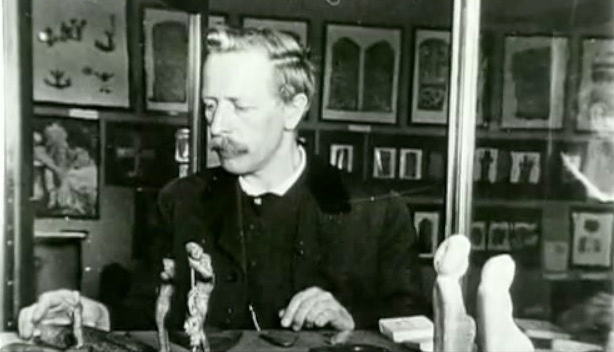
And then, suddenly everything changed. I encountered the works of a man who is practically unknown – Herman Wirth. No one knows him in our country, nor do the Traditionalists of the West know him. He is the “great unknown”, le grand inconnu. His works were taken from Berlin by the Soviet Army and for years lay in a storage room where they ended up wet and covered with mold. Nobody had touched them since 1945. I tried unsuccessfully to find Wirth’s works in the libraries of several European capitals. Only once, in the Alain de Benoist’s underground library bunker did I see one of Herman Wirth’s books on a shelf. The owner, however, had paid no special attention to it, which is no surprise, as there was such a volume of books that their owner simply had not yet made his way to Wirth.

I spent two years studying Wirth. For two years I was glued to his works, trying to understand at least something. His works are huge volumes including maps. The text is not structured, everything begins in the middle and stops mid-sentence. I think no one really read it. To do so, one would have to be a fanatic. Interestingly enough, Julius Evola, who is extremely popular among European Traditionalists, called Wirth one of his three main teachers (alongside Guénon and Guido de Giorgio) in his autobiographical work, The Path of Cinnabar. But even after the publication of this book, still no one paid attention to Wirth. Such a strange author. As Guénon wrote, “certain things protect themselves.” There are some items that are laying in the middle of the room in plain sight, but we are incapable of finding them. Modern occultists have even evoked the notion of “black holes” existing everywhere. In fact, everything is more complex and subtle. 

As was Herman Wirth. Guénon devoted a very important review to him. Nevertheless, Wirth is unknown, and this despite the fact that even the most insignificant authors mentioned by Guénon or Evola have been devoted in the very least separate studies by Western Traditionalists. But no one in these circles has heard of Wirth. 

“We are in search of the stone with runic or prerunic inscriptions”

What comprises Wirth’s ideas, his message? Wirth deciphered the very proto-language which we have been talking about. He did this in a reliable manner without occultist exaggerations and positivist skepticism. No more nor less. His work is maximally close to this language. No one has done more reliable metaphysical, historical, linguistic, or conceptual (if you will) studies of the language of the Primordial Tradition. In my opinion, Wirth did not know Guénon, and I found no citations of him in his works. He read Bal Gangadhar Tilak, the famous Hindu Traditionalist, and cited him. However, Wirth himself was not a Traditionalist. Rather, he was an idealist, a scrupulous scholar and a German patriot. The fact that he did not share the numerous prejudices of occultists who hurry to discredit serious research, only enhances the significance of his works. Looking at Wirth through the eyes of Guénon, we see all that Guénon did not say, but which undoubtedly follows from what he did. Wirth adds an essential part to Guénon’s Traditionalism [5]. Even Evola did not add anything in particular to Guénon. Evola was original, daring, and active, but this rather aesthetic and existential component brought to Traditionalism in fact contains little substance.

What Wirth brought is a startling revelation – sudden, extremely complex, and demanding tremendous attention. This figure so much changed the picture of modern Traditionalism that ignoring him is simply impossible. It is intriguing that although we live on the outskirts of the Traditionalist world, in the bear corner, we are one of the first to approach such important things. In his time, the mysterious author Otto Rahn wrote a book entitled The Crusade against the Grail [6] and advanced the following hypothesis: perhaps the Grail was not a chalic, but a stone with certain prerunic inscriptions that are a universal key to all religious models, and all knowledge in general. Guénon himself wrote (if I’m not mistaken, in The King of the World [7]) that there indeed exists a view that the Grail is simultaneously a chalice, a book, and a stone. When Guénon studied the Canterbury megaliths, he said that it is possible that the Grail ought to be understood as a concrete object covered in signs, and that these signs probably represent primordial hieroglyphs. In some sense, Herman Wirth’s reconstruction reveals something very similar. In the volumes of research of this German scholar, there is something of a Holy Grail, a Holy Grail of meanings. 

Arctida – the cradle of humanity

As a kind of prelude to studying the primordial language, Herman Wirth presents an historical-geographical reconstruction of the first ages of mankind. As a positivist scholar, he draws out a long table of monkeys with different species of animals and geological shifts, but we can disregard this. The most interesting begins at 20,000 B.C. Here Wirth switches over to serious, correct language. He adheres to the ideas of the geologist Wegener.

The modern contours of continents emerged only recently. Continents are not dormant and are not constant masses. They slide along the shelf, and thus the look of the earth was once completely different. There once existed two continents: a Northern one, Arctogaia (Arctida) and a Southern one, Gondwana.  Wegener’s chronology, which Wirth partially appropriates, is based on the positivist methods of calculating time and transposing modern physical processes onto ancient times, a method which is rather incorrect. Guénon himself has written much [9] about shifts in the cosmic environment in correlation to the unfolding of the cyclical process. But this is not the point.

Wirth argues that Arctida was the cradle of mankind. This is the starting point in Wirth’s model. He claims that man originated at the North Pole, i.e., humanity is essentially a polar phenomenon. Hence Nordism as a method, as a vision of the particularities of the primordial language, primordial knowledge, and primordial religion. This is not the North Pole as an abstract concept (such as the mountain Meru), but a real pole where the continent of Arcotgaia lay and on which lived amazing people – the Hyperboreans. Contemplating the surrounding world, they developed the proto-language which lies at the heart of the complex of ideas which we have now, many thousands of years later.

This model of Wirth’s perfectly corresponds with Guénon’s holistic views on humanity’s polar origins and the primordial Golden Age. Thus, Wirth’s formally positivist research led him to the Nordic theory of man’s origin which is classic for Traditionalism. But if Guénon limits himself to merely asserting this as fact, then Wirth draws conclusions therein of enormous importance. He reasons that we cannot decipher ancient languages and ancient culture, cannot piece together an adequate view of ancient peoples, nor can we find some, so to say, “antediluvian” remnants simply because we do not accept the notion of the northern origin of humanity, do not take into account the fact that the climate in this northern, polar continent was no harsher than the south of modern France. The North Pole was the point from which the rays of civilization spread South.

Affirming this concept, Wirth with ease explains the hang-ups of paleo-anthropology and ancient history. He explains why there are no remains of Nordic man: firstly, because burial forms for Nordic people were different (as was the very quality of their lives), and the lands which they inhabited either shifted or sank. Wirth conducted very interesting research on the shallows of Dogger between Holland and England, where he sought the remains of Arctida which, from his point of view, existed as centers of civilization up to historical times. These explorations yielded colossal results, most of which are, alas, beyond our scope.

The first hieroglyph – the Nordic Year

Now about the primordial language. In Wirth’s view, the main key to understanding this language, and all existing languages and traditions, is the year. The year and man, the year and God, the year and nature, the year and time, the year and space are, in Wirth’s view, synonymous concepts. Man is the embodiment of condensed time. Time in and of itself is a divine manifestation.

The northern, polar cycle is the highest knowledge and, as follows, everything else is to be explained through the calendar. Special attention should be paid to the natural features of the North Pole. We know that a day there lasts not 24 hours, but six months, as does a night. For example, such a notion as the “midnight sun”, which is addressed in many of the Dionysian mysteries and is a generally important element in multiple sacred theories, acquires an entirely natural sense in Arctida – natural-magical meaning. This is the sun that shines at midnight at the North Pole during the summer solstice. Indeed, there is sun, and there is midnight. The memory of this midnight sun, like the memory of the primordial homeland of our ancestors, has been preserved in traditional models and been passed down from generation to generation in the form of legends and stories.

There is a fundamental difference between the daily and yearly cycles. We, living south of the polar latitude (22 degrees North), imagine the year as divided into days. But the man of polar origin saw the year differently. The day of the gods was equal to a year of people, which means that the difference between the divine and human was erased. There was no difference to be distinguished between the created and uncreated; there was no difference between subject and object or divine and natural revelation. Nature was a fact of the Divine, and the Divine was an inner dimension of nature. There existed a kind of “polar-paradisal worldview” in which the spirit was to be found at both the center and the periphery.

Wirth employed the structure of the polar year, or the year as a set of natural phenomenon characteristic of the northern, polar regions, as a universal instrument for interpreting all other elements. The first people were not comical, semi-finished products from classical evolutionary textbooks, and they did not see the world as primitive and flat. This was something completely different. The most diverse concepts, objects, creatures, situations, scenarios, and rituals boil down to a single paradigm. For Wirth, such a method of explaining everything through the paradigm of the year – the polar year – was the starting point of his ambitious studies.

The first calendar model

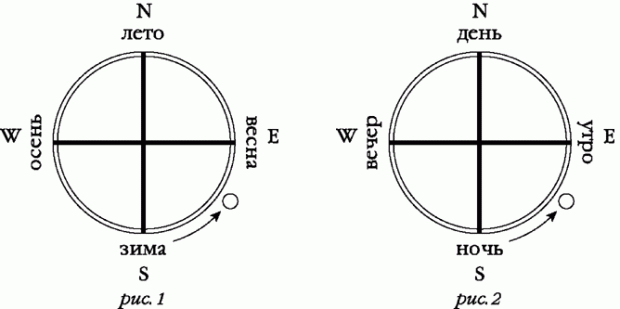
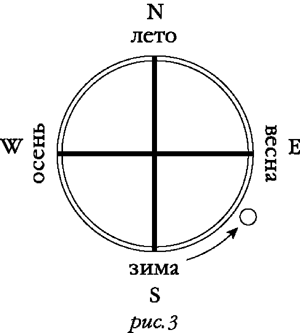
This is the basic model of the annual polar cycle. It might seem that there is nothing special here. The only particularity is that the South is identified strictly with winter, the East with spring, the North with summer, and fall with the West. In the annual circle, the sun goes in a different direction than in the daily one.

p04
Figure 1: “N – summer, E – spring, S – Winter, W – autumn”;  Figure 2: “N – day, E – morning, S – night, W – evening”

In this, in Wirth’s view, is contained great historical and historic-gnoseological drama.

Ancient humanity, according to Wirth and Tilak, moved south for a number of reasons. For example, in the Bundahishn (the sacred Zoroastrian book), it is said that “the red serpent of Ahriman sent cold to the blessed country of the Aryans and the city of Vara where the primordial white people lived, and they were forced to leave their homes.” So what happened then?

The polar cycles’ yearly phenomenon stop below the 22 degrees northern latitude. Man no longer plainly sees evidence of the primordial calendar-topographical model and does not understand the direct meaning of what was so obvious before. He loses the key to interpreting certain signs and schemes in which movement towards summer and movement upwards mean movement northwards.

Everything is inverted in the ordinary daily cycle, and all the phenomena that lie at the heart of the primordial language and the primordial proto-religion are obscured. Accordingly, mythological elements, and language itself, are now interpreted differently. There is an overlap between at least two cycles. In one – the annual, global, Nordic cycle – movement is counter-clockwise, whereas in the other – the daily one – movement is clockwise. It is by virtue of this that these two sacred paradigms (the daily and yearly) change places and (pay attention to how serious this is!) there is a transition from God to man and from the day of gods to the day of people.

As follows, the symbolic details of the primordial code, the primordial language and paradigm of religious knowledge change places. We lose the key to understanding them. This, according to Herman Wirth, is the Babylonian dispersal of languages. We lost the ciphers of the Nordic worldview, and the miasma of the southern seas begin to penetrate our consciousness. We increasingly become mere people to the point that we reach today’s dismal, critical state. There is probably no lower.

Also important is the hieroglyph of the Celtic cross, the circle with four orientations, which is the first calendar.

p05
Figure 3: “N – summer, E – spring, S – Winter, W – autumn”


The very notion of a calendar is a very sacred thing. A calendar is a visual model which condenses and clearly displays two concepts: time and space. In a calendar, time is displayed synchronously and simultaneously. What man is given in progressive development is given in a calendar, and only in a calendar, as a possibility of simultaneous setting. Thus, contemplating over the Nordic calendar, meditating on it is one of the most direct ways of making contact with Eternity. When man looks at the calendar, he grasps all time together as his internal quality, and the nature of perceiving the most simple objects changes. He sees a circle, how time turns into space, and how space, thanks to time, acquires orientation. This is very important, because space itself has no orientation without such a calendar; it is insufficient. The cross which establishes these orientations can thus be depicted anywhere.

Thanks to this calendric perception of the world, what happens in this space undergoes some kind of relativization. In the first lecture, we spoke of the transition from qualitative (sacred) space to quantitative (non-sacred, profane) space. Sacred space, furnished with qualitatively meaningful orientations, arises out of the most complex Nordic operation of bringing time into space (“spatializing time”, so to speak).

The main compass of these sacred, qualitative orientations is the calendar.

The point of the North is one, the South point is another, the point of East the third, and the point of the West the fourth. Each of these points of space corresponds to a certain, strictly fixed sign. If we impose the circle of time onto this space, then it shows all possible mutations of space as if grasping the eternal movement of the four directions in one fixed picture.

Interestingly enough, the problem of squaring the circle and perpetuum mobile (“perpetual motor”) which recently completely puzzled the best men of science, is in fact a distant echo of this Nordic knowledge expressed in this simple figure.

Today football fans wear the Celtic cross on their scarves without knowing what colossal meaning this symbol has. It is also depicted on targets for shooting. In the 1960’s, the Belgian Jean Thiriart made the Celtic cross the emblem of his Young Europe (his pan-European national movement) which was later adopted by football fans and skinheads, since which he has been constantly present in their symbols.

Take another look at the Celtic cross.

The sequence is built into the cycle. The line becomes the circle. Eternal movement is provided by the representation of all time at once. It cannot end and cannot be stopped. It cannot disappear. It is some kind of absolute paradigm, the essence of being, expressed graphically.

Such was Herman Wirth’s first step towards revealing the structure of the proto-language.

Already at this stage we can arrive at numerous conclusions of incredible value. Can every situation, every event, and every mythological tale or everyday scenario be dissected using this model?

How do we act, how do we live? Under the sign of the North? Or under the sign of the West? Under the sign of the East? Or under the sign of the South? Along the downward arc or the rising one? Towards what are things gravitating? Towards the sky and summer or towards winter and earth?

Upon applying this paradigm to the most complex cults and theological constructions, we will always find whole layers of meanings, the existence of which we knew nothing of before. Even if Wirth had stopped here, this alone would have already been very serious and very much, as we would be given a clue. But he went further…

Part two coming soon…

Footnotes:

[1] R.Guénon, “Le Roi du Monde”, Paris, 1993, “Le Regne de la Quantite et les Signes des Temps”, Paris, 1995, “Formes traditionnelles et cycles cosmiques”, Paris, 1995.

[2] H.C.Agrippa, “La philosophie occulte”, Paris, 1981.

[3] J.Evola, “Il camino del cinabro”, Milano, 1972


© Jafe Arnold – All Rights Reserved. No reproduction without expressed permission. 

Post-Anthropology

Author: Alexander Dugin

Translator: Jafe Arnold 


Human Society after the Crisis: Hell on Earth Through the Lens of Depth Sociology


Depth sociology 

A concrete (phenomenal) society always consists of two parts – the aboveground and underground. The aboveground part is what we normally term “society”, meaning a sphere of rational activity where logos (λόγος) prevails. This is the domain of the “diurnal”. The underground part is the dark, underwater island of the collective unconscious, the region of the social night (the “nocturne”), where myth (μύθος) rules.

For some time, progressivist science believed that these two parts were situated in diachronic order. In ancient times (and among “primitive” peoples, the unfortunate “residue” of ancient times), myth was predominant. But the progress of civilization gradually supplanted the mythological order and replaced it with an order based on logos. The community, or Gemeinschaft, is superseded by society, or Gesellschaft (F. Tönnies). But this optimistic exaltation did not last long. Whereas blind faith in purported progress reigned almost unquestionably in 18th-19th century Western Europe, the subconscious, where the eternal and unchanging laws of myth predominate, was discovered by the beginning of the 20th century. 

Jung’s works developed Freud’s theory and established a new topology of human psychology. Freud had already shown that in addition to the “I” (the “ego”), an invisible and repressed “It” (German “es”, Latin “id”) actively operates within man. Jung demonstrated that the foundation of this “It” is rooted in a special reality common to all people. The collective unconscious is one for all.

Jung’s follower, the French sociologist G. Durand, relying on the Jungean theory of the collective unconscious and its archetypes, complemented the psychoanalytic topology with a sociological one, thus laying the foundations for a “depth sociology” or “sociology of the imagination.” Thus, the second, underground part of society, at the heart of which lies myth, was discovered, studied, and imparted with description.

Ordinary sociologists such as Weber, Sombart, Durkheim, Moss, Sorokin and so on, more often described aboveground, diurnal society and its properties, i.e., the social logos. Depth sociologists, on the other hand, such as G. Durand or M. Maffessoli, engaged in the exploration of social myths, elaborating a kind of sociology of myth.

The study of the interconnectedness between the two main levels of this topology, i.e., between logos and myth, buried the concept of rationality and the notion of “progress” at the very first stage. According to G. Durand, it turns out that the latter are nothing other than a rationalization of the myth of Prometheus. The next step was the discovery that Logos itself, as the axial destiny of Western European culture (from Plato through Descartes to positivism) was but a special edition of myth (an “ascendental myth” in G. Bachelard’s theory or the “diurnal regime”, “le diurne” in Durand’s theory). This is the discovery of deep sociology (the sociology of the imagination) based on the structuralism of C. Levi-Strauss, the history of religion (H. Corbin, M. Eliade), psychoanalysis (C.G. Jung), reflexology (M.Bekhterev), modern physics and mathematics (R.Tohm, V.Pauli etc.). This opened a completely different view of the essence, content, meaning, nature and quality of social processes. Classical sociology, which had detected numerous failures of logos in society (for example, the principle of “heterotelie” – a sociological law that states that social processes almost always attain goals other than those they set to begin with, thus overturning the cause-and-effect logic in which the founding fathers of sociology – the positivists Kant and Durkheim – so firmly believed) came through deep sociology to form a consistent and semantically complete system. The enormous methodological and documentary material accumulated by the classical sociologists thus started to be interpreted in an entirely new way.

Thus, by the end of the 20th century, a “two-dimensional sociology” was established in which research on the social logos was paralleled by studies of the “social underground”  (“social dungeon”) and “social myth.” In other words, the “social unconscious” was discovered.

Social logos

By his profession, a sociologist is called to look beyond “public opinion”, “common ideas”, and “common sense”, i.e., those beliefs and ideas that circulate among the masses in their “majority” and constitute the framework of “conventional wisdom”. “Public opinion” never reflects the whole picture. Its natural place is situated in the space between scientific truth and that which is a pure chimera, or nothing. Even Plato, in his The Republic, defined “opinion” (δόξα) as showing us something while at the same time hiding something else from us, in all cases revealing to us not that which lies on the surface of conveying, but somewhere else, thus always deceiving us. More straightforward American experts on financial speculation and stock markets have formulated the same law in rougher terms: “the majority is always wrong”.

In analyzing “opinion”, sociologists derive from such the half-manifested and half-hidden truth, and thus explain the mechanism and, in turn, semantic structure of lies (silence, euphemisms, projections, transposition, and other rhetorical tropes). It is thus the sum of extracted scientific truths, clarifications, and etiologies of misconceptions and lies – the content of the social logos – that constitutes the object of classical sociology.

The pessimism of the classical sociologists: Logos on the brink of catastrophe

The majority of the classical sociologists’ major reconstructions (“grand theories”) were marked by the disturbing nature of social processes in the 20th century. The very idea of “progress”, which has become something taken for granted in “public opinion”, was at a certain moment recognized to be a euphemism designed to brighten up premonitions of impending disaster.

Most sociologists, and Pitirim Sorokin in particular, unanimously emphasized the hedonistic, material, sensual, and sensate nature of modern Western civilization, and this quality affected the “social logos” all the more profoundly over the course of the 20th century. Material values, entailing an “obsession with economics”, the search for egoistic, material freedom and pleasure, came to the forefront and undermined, eroded the structure of society’s rational organization. Almost all sociologists predicted in one way or another that the social logos of the West and all of world civilization having come under decisive Western influence, threatens disaster.

This feeling especially intensified in the postmodern era, when many began to speak of the “society of the spectacle” (G. Debord), the “order of simulacra” (J. Baudrillard), or the “end of history” (F. Fukuyama). Indeed, Fukuyama spoke of a “society of gaps”, increasing “fragmentation of social ties”, etc. The social logos had disintegrated in front of our very own eyes, transforming into something else ascertained only with great difficulty and demanding new sociological methods for understanding and explaining it.

Some, such as Castells, have timidly suggested that logos does not die, but moves on to a new form of existence as a network. But this did not and does not sound very convincing. In any case, starting at the end of the 20th century, classical society stood at the threshold of, as the optimists say, a fundamental, qualitative metamorphosis or, as the pessimists (such as Spengler) suspected, collapse.

The social moment through the eyes of depth sociologists: Slipping into the night 

Even more alerted by the exhaustion of modernity are depth sociologists, who have in principle believed that reassessing logos in view of myth amounts to a disaster, which by definition and from the very onset is fraught with collapse and colossal inflation of the logos. Being no opponents of logos, they merely point out that the gigantic endeavor of reassessing one half of society (the diurnal half) is fraught with the possibility of rapid regression and falling into the opposite extreme, the regions of the unconscious, with no easing up or intermediate stages. They rightly considered the European totalitarianisms of the 20th century to be such a rapid drop towards myth, i..e, the Nazi regime (with its “Myth of the 20th Century” which, admittedly, is rather a pale and pitiful parody of myth itself) and the USSR with its chiliastic attempt at building a “paradise on earth” (the diachronic-trinitarian myth of Joachim de Flora skipped over by Hegel, and specifically Russian, cultic messianism).

But the inflation of logos did not cease with the victory over fascism or following the end of communism. In the 1990’s arose the temporary illusion that the social logos had at last found its final incarnation in the liberal-democratic American paradigm (hence globalism and the “end of history”) which would last forever (as the American neocons tried to inaugurate with the “Project for a New American Century” and theories of “benevolent hegemony” and “benevolent empire”). In the 2000’s, all of this became increasingly doubtful. When the financial crisis of 2008 hit and the black Democrat Barack Obama came to power in the US, it became clear that the preceding round was not the establishment of a “new world order”, but the final agony of the Western-centric logos.

From the standpoint of depth sociologists, the point at hand was the collision of two myths that had acted for three centuries in the “dungeon” of Western European societies (and those that came under their influence).

The modern era and the Enlightenment reflected the rise of the myth of Prometheus, who inspired both the rationalists and romantics, the people of day and the poets of night. The titan, trickster, deceiver of the gods (night), Prometheus, acting as Faust and Lucifer, brings people fire and knowledge (day). Schelling, Hugo, Hegel, Marx, and both liberals and socialists were inspired by the myth of Prometheus. Even in fascism, through the Nietzschean lens of the “Superman” and Wagnerianism, Prometheus found peculiar expression.

But with the end of the 19th century, Prometheus began to give way to the myth of Dionysus. Emanating from decadent salons, he penetrated culture and subsequently became the main myth of people engaged in media (and, as a rule, dropouts, drunks, perverts and drug addicts, as Durand aptly noted), cinema, and later television, intellectuals, and artists – typical people of  the night in practically all societies. Gradually imbued with the individualist-hedonistic style of “journalists”, inveterate skeptics, and the opponents of all rational organization (enemies of the social logos), society became a society of entertainment and enjoyment, the “society of the spectacle.”

Dionysus displaced Prometheus, the end of the whose myth is described in Andre Gide’s splendid, ironic book, Prometheus Ill-Bound. But Dionysus himself gradually lost his appeal, momentum, and energy as the decadent perversions of the elite, bearing something stylistically attractive, turned into the disgusting rot of the decaying masses sliding into the night. Plebeian gay parades turned the refined atmosphere of Oscar Wilde’s salons, the solar insanity of Arthur Rambo, and the poetic gesture of Kuzmin’s Apollon into plebeian kitsch (yet another instance of the significance of the expression “don’t throw pearls before swine”). The myth of Dionysus in turn reached the point of saturation and became one of the sources of freshness of the stagnant, stymphalian swamp.

The cycle of Western culture has come to an end. Postmodernity with its epiphenomena is a convincing illustration of this.

At any rate, depth sociologists are awaiting a new myth (perhaps they hope that this will be the balanced and integrative myth of Hermes – such as the Eranos group which included Jung, Eliade, Bachelard, Corbin, Dumezil, Scholem, and Durand), but they clearly understand that the European logos is about to finally slip off into the night. Frankly speaking, it seems to me rather doubtful that these wonderful people, these neo-Hermeticists, will manage to stop that which is falling, much less shift this fall…

Jung’s topology

The preceding observations were necessary in order to arrive at the main topic, i.e., our attempt at conceiving what awaits humanity once postmodernity finally comes into its own and the social logos finally perishes into the night of the myth. In other words, we are interested in reconstructing the picture of the impending sociological dimension taking into account those structural, semantic meanings which we (or not) must survive (or not). On the basis of a sociological reconstruction of classical and non-classical theories, we can construct different models of the future, basing ourselves on the psychoanalytical topology of Jung, who preoccupied himself with the fate of man and attempted to as impartially as possible describe the fullness of the human factor in its various dimensions at different stages. Before “painting” the “sociology of the Apocalypse” with “Jung’s paint”, let us recall the main parameters of his topology.

According to Jung, a human being is a complex system consisting of several poles, the main of which are “ego”, “persona”, “anima/animus”, “shadow”, and Selbst (“self”). Let us add Freud’s “superego” for the sake of completeness.

My “I” and my mask

Man is considered to be a rational individual who calls himself “I”. In psychoanalysis, this function is denoted by the Latin term “ego”, whose properties are intellect, capacity for mental operations, the possession of logical structures (or “proto-logical” ones like among so-called primitive tribes” and “savages”), capacity for self-reflection and clear separation of oneself (“ego”) from the outside world, “others”, and “the other.”

The generalized social logos is the collective projection of the “ego”, what Freud called the “superego” or “super-I.” The “ego” always correlates to the “superego”, which thus gives rise to a system of social norms and determines a large part of the being of “I.”

In regards to other social “I” and the aggregate social logos (superego), the ego acts as the persona, personality, or mask. A gap exists between the ego and personality which consists of the “ego” having another dimension, reversed into itself, which distinguishes it from the personality or “persona” through a fully exhaustive socio-logical function. The ego has a psyche, while a persona does not (such is carefully hidden and ignored). The psyche of the ego makes itself known only when a persona begins to behave or feel inappropriately within society or in the face of the superego given as a standard in morality and the rules of thinking (a mental disorder).

“I” usually appears to be alone as a result of the reflection of the logos on the physical separateness of the human body. But this is not necessary, Jung emphasizes. The deformation of logical structures, a lowering of mental level (abaissement du niveau mental) or simply dreaming can easily blur the singularity of “I”, its identity, and scatter into various fractions the “alter-ego.” In some instances of psychosis, this manifests itself through voices, through sight, or even through visions of one’s self. In some cases, several “egos” can form a fairly stable form of identity (such as in Stevenson’s Dr. Jekyll and Mr. Hyde).

Jung’s “I” is not a constant once and for all, but is plural. Sometimes Jung speaks of the ego as one part of a complex psyche alongside other “complexes.”

The realm of the collective unconscious and Selbst

Within the “ego” begins the space of the psyche containing different layers, some close to the “ego” (such as memory, subjective assessment of actions, and “invasion” from below) and those further away from it, such as the unconscious.

Freud called the unconscious “es” or “id.” He himself restricted the unconscious to individual feelings and instincts formed as a rule during infancy and even in the prenatal period. In Jung’s famous dream of 1909 in which he travelled across the Atlantic by ship with his teacher, he saw that in the unconscious there is an even deeper level which ceases to be individual, and becomes collective. The realm of the collective unconscious is the center of Jung’s conceptualized topology.

The collective unconscious, according to Jung, is all the same for everyone and is inhabited by eternal myths and archetypes. This collective unconscious is explained by stable plots of certain dreams (great dreams), myths, stories, fairy tales, religious visions, and artistic works. The properly perceived, integrated, embraced, accepted, and sacredly exalted collective unconscious directed above to the light at the surface is what Jung terms Selbst or “self.”

Animus/anima and the dark double

Furthermore, between the ego and collective unconscious exist two of the main intermediate instances: the animus/anima (the soul that Jung divides by gender) and the “shadow” (umbra, die Schatten).

Animus/anima (like Balzac’s Seraphitus and Seraphita) is an image of the collective unconscious as it appears in pure form in the male or female ego.  Over the course of his research (including clinical studies), Jung noted that men steadily imagine the “unconscious” (“es” and “id”) as feminine (hence “anima”, the feminine soul), while women imagine such to be the male (hence “animus”, the masculine soul). In Russian, it would be tempting to use the cognate words dusha (“soul”) and dukh (“spirit”), but they have a steadily different meaning (although one could ask: do either of them have any meaning at all today?).

There is also the “shadow” representing the dark twin of the ego which consists of negative products of the dialogue between the ego and the collective unconscious. All that the diurnal mind represses, rules out, represses, pushes out, censors, and does not cognize in the impulses rising from the unconscious depths, makes up the “shadow”, shaping its structure and a kind of “anti-persona” (symmetrically opposite to a persona). The devil is the generalized form of the shadow.

Individuation as the realization of Selbst

Of great importance in Jung’s works is the subject of “individuation.” Individuation is the harmonious, balanced, incremental and measured transfer of the collective unconscious’ structures to the level of the logos. A correctly oriented human life is the realization of Selbst, i.e., individuation. Only in this case, the ego serves the purpose of letting what lies on the level of the myth out into the realm of logos.

Jung clarified the relationship between given instances in his topology, supplied nuances, explained details, and solved the puzzles of their dialectical relations. He delineated the dialectic of this structure in his patients and in works of art, religious doctrines, philosophical theories, famous biographies, and in the prejudices of average citizens. Practically all of his creative work was devoted to this end.

Sociology of the imagination

Applying Jung’s topology to society (with certain adjustments) yields depth sociology or the sociology of the imagination as developed mainly by R. Bastide and G. Durand. The social logos (Durkheim’s “public consciousness”) is the generalized ego (superego). At the other extreme is the collective unconscious (or social unconscious). Between them is the human ego facing society through its personality (persona) and facing the collective unconscious (the nighttime realm of myths) through its psyche and its figures (the anima, animus, and shadow).

Between the collective consciousness and collective unconscious exists a dynamic insofar as they resonate in certain issues and are homologous, while in some cases enter into discord and conflict. This is due to social kinetics (including mobility) and the deep content of social processes. The individual or human is a point in this complex two-stage dialectic of night and day, or diurne and nocturne.

Pitirim Sorokin’s tripartite model of social topology, which distinguishes between three types of societies and social structures (the ideational, idealistic, and sensual) on the grounds of a purely heuristic approach, is given firm ground in Durand’s three archetypal structures – the “heroic”, “cyclical”, and “mystical”, which are a direct mythological homologue to Sorokin’s sociological constructs. Durand’s school, the Center for Research on the Imaginary, has in the 50 years of its existence produced an enormous amount of hermeneutic work on “mytho-analyzing” sociological systems and the “mytho-criticism” of literary works or historical records.

Dreaming the world

Now on to the economic crisis. Above we said that it is highly probable that the current financial crisis is an expression of a much deeper process, i.e., the decline of the social logos blurred or saturated with sensual moments (a la Sorokin) or the Dionysian myth which has been overtaken by the osculating masses (a la Durand). In Jung’s system, this process can be seen as the “lowering of the mental level” (abaissement du niveau mental). Let us assume that the logical structures of the ego and superego were to crumble at a critical threshold – and this is highly likely if we take into account observations on Russian society, which has rapidly degraded in the intellectual and moral sense, as well as processes taking place in Western culture and politics. In this case, we should expect humanity to plunge head first into the night regime.

In Jungian topology, this means that we have descended into the collective unconscious. This is not simply nihilism. The very concept of nothing, or nihil, belongs to the order of logical structures capable of abstractly representing pure negativity in contrast to pure presence. But insofar as logic is eroded, the crystal-clear nothingness of logical nihilism appears to us not as empty, but filled with elusive meanings, inconsistent pictures, and cacophonesque sounds arranged disharmoniously. The nihilism of night is full of sounds, colors, and shapes, but only from the standpoint of the day. This is nothingness.

We will begin to see the critical points enumerated below in darkness. After all, there are always objects that are darker than others. It is at this point that we have arrived at the Jungian version of post-crisis futurology.

The social logos has fallen. Despite having successfully defeated all of its logical and ideological competitors (theocracy, monarchy, fascism, and communism), liberalism has not coped with the burden of the social logos, i.e., it is incapable of defending the order of the day all on its own against the night closing in on it from all sides and from within. The last such attempt was the American neocons’ imperial adventure. Meanwhile, the previous logoi are left hopelessly repudiated and distraught.

The diurnal character of liberalism is relative. Perhaps it won precisely because it offered the softest of all orders, the most unobtrusive logos, the most compromising and tolerant instrument of daytime repression of the nocturnal unconscious. But now it has perforce been left one-on-one in the face of chaos – the very same chaos which it relied upon earlier.

If the current economic crisis (for liberal civilization, economics is a substitute for order and logos) turns out to be the last, then a fundamental “lowering of the mental level of humanity” will take place. The world will be plunged into a dream.

Just what kind of dream will this be?

Post-anthropology’s new actors

The scrapping of the “ego” and “superego”, their overturning into the dark haze of psychosis, leads to the emergence of new actors in the forefront. These actors will be neither classes (as in communism) nor races (as in National-Socialism) nor even the individual (as in liberalism) – all of these social ideologies were founded on specific logical systems and, parallel to such, on rather distinguishable nocturnally structured myths. These actors will be the shapes of the unconscious left over from the epoch of the luminous domination of logos. This will be a post-logos order that will lead to the introduction of post-anthropology.

The main figures in the relationship between the ego and the unconscious will acquire autonomy and become the ego’s substitute. Humanity will hear “voices.”

The fact that modern man’s ego will become dynamic, plural, game-like, and random can already be seen everywhere – in the constant changing of professions, moving (the new nomadism), changing genders, nick-names, the appearance of doubles and clones (first in literature, films, and computer games, but tomorrow in practice). Such will become commonplace as life acquires more of an ironic, game-like nature. The cycle will shrink as families, partners, friends, countries, and occupations are changed with kaleidoscopic speed. People will change their gender all the more often, and sex-change operations will come to be more than a one time affair – one is a woman, has enough, becomes a man, then a woman again, and so on. But after a certain point – we will hardly notice it – the notion of individual identity itself will dissolve and the principle of freedom will corrode the “totalitarian shackles” of individuality. In the human atom separate components will be “discovered” – electrons, protons, quarks which will demand for themselves “new freedoms” (as the Belgian writer Jean Ray anticipated in his The Hand of Götz von Berlichingen.

And it is at this moment that we will face a series of very interesting phenomena and advents which will define the panorama of the post-anthropological landscape.

The coming of the shadow

The “shadow” will be one of the main actors of the “Jungian Apocalypse.” Fantasies of living shadows (in Anderson’s works and popular folklore) are a famous tale repeatedly surfacing in literature, theater, and opera. “Shadow” is a synonym for the devil, and we can say that this image coincides with the wide and varying descriptions of the Antichrist or the “coming of Satan.” Jung’s perspective differs from religious, theological views on this subject in that he examines the figure of the devil – in the spirit of Origen Adamantius’ “Apocatastasis” – as relatively negative. According to Jung, in the “shadow-devil” accumulates all that has been discarded by the ego over the course of unsuccessful individuation, i.e., over the course of the translation of the collective unconscious and its archetypes in the sphere of the logos. Thus, the devil is not independent or primordial, but merely symbolizes the totality of human failures and the results of friction with the “sueprego” which is in turn associated not so much with individual errors as with dissonance and the conflict of the social logos (including religious and moral aspects) with the mythological complex lying beneath the foundations of society. The shadow is failed Selbst. After all, the devil was once an angel of light who fell…

The shadow which will reveal itself in the near future should not necessarily be regarded as only the “devil” of the Christian religion. In social and psychoanalytic terms, this will simply be a ”residue”, some kind of surrogate of a disappearing “I”, and in the face of the undifferentiated collective unconscious, this figure will seem like “salvational straw” which, as it pertains to its identification, will be higher than the mythological chaos swimming down below. Therefore, for post-humanity the “shadow”, as an image preserved from the lost “ego”, will present itself as a kind of temptation. The shadow will not act as an enemy of humanity (especially since man will by this time give way to post-man). Rather, it will act as an enemy of the undifferentiated abyss of indistinguishable dreams.

What will this “shadow” be in its coming? This is difficult to imagine since the social landscape will change significantly. The collapse of the logos will not cancel science, or more precisely technology, hence the dissolution of the individual might very well be combined with the continuation of technological progress by inertia. Therefore, the shadow will come in the entourage of machines and devices. But it will not be a singular human being or group of beings. It will be something resembling a cloud, fog, a thinking nebula which can assume various identities, names, and types. These images will be somewhat vague, as if covered in fog. The shadow will hardly appear in the form of monsters, but rather in the form of memories and languid and dense dreams.

This is one pole.

Operation Alraune

Another figure of the Jungian Apocalypse will be the disincarnate female anima. This will not be a human female, but femininity in its collective, apparitional aspect.

Here it is worth dwelling on the idea of the anima in Jung’s works in more detail. Jung’s anima is not an image of a woman based on animal instinct or lustful observation of the female sex, and not even on genetic memory as Freudism and materialist psychology present such. It is the creation of a purely male ego which, through the anima, structures both itself and relations with the internal other (which is the same), proceeding to project this relation outwards on the other and itself now within the framework of form – this is woman in a social-gender sense.

The male ego does not know anything about the female ego, and does not want nor can it know nothing about it. It merely projects a living image, in which it is appealed to by the collective unconscious (“es”), onto the surrounding socio-biological matter. The internal anima and external woman are for the male ego (logos) strictly one and the same. The anima is primary and that which does not coincide with anime in a woman is either not noticed, rejected, censored, or hated by the male ego. All of this has been tracked by psychoanalysts in millions of examples.

If the male anima is drawn to the figure of the Melusine (the water-inhabiting fairy-fish-woman with a tail and no genitals), then a mismatch in external women in relation to this standard will be presented as their fault, and not as the fault of the image (in which, in fact, there is nothing pathological – after all, such is harmoniously and tightly woven into the sacred lexicon of great dreams).

Parallel research has been conducted by Levi-Strauss in studying the structure of kinship. In the myths of many American tribes as well as other peoples of Africa and Melanesia or, more broadly, the whole world, the theme of a “proper scale of marriage” is recurrent. In order to show what is correct, a myth shows what is incorrect. There are countless, stable motifs concerning marriage with animals (Masha and the bear  etc.), spirits, demons and angels (the Book of Enoch), objects, monsters, and so on. These are too distant of relationships, which means that the ego swung too far across the horizons of the unconscious and, as a rule, legends warn that nothing good comes out of this.

Too close of a kinship is represented by incest, a taboo which rests at the heart of all known social structures with only the rarest exceptions (such as Zoroastrianism which legalized and even proscribed incest; and in the practice of Jewish Sabbatist sects in Turkey – see M. Maffesoli). In relation to the anima, this means that the ego has come too close to the collective unconscious, which is fraught with dissolution or could in place of such introduce its own “egotistical” projections leading to sterility or the generation of monsters, i.e., to flowing into the realm of the shadow. The shadow is the totality of those taboos which man has been tempted to violate.

Herein arises a question: From where does the male ego come? Different sociologists, philosophers, and psychologists have offered different answers. The Marxist sociologist Bourdieu, for example, believes that gender is a purely social phenomenon, i.e., the ego is endowed with a male quality exclusively by society – the dictatorship of the “superego” – and in practice through education and the structuring of family relations. According to Bourdieu, if a boy is raised and treated as a girl, he will be a girl, and his ego and persona will be fully-fledged feminine in personality. On this is based contemporary “gender tolerance” and the Western interpretation of human rights, in which man (as the classic of liberalism, Locke, affirmed) is a tabula rasa upon which society writes all that it pleases. Marx also thought so.

In any case, it can be assumed that it is not the gender of a soul (anima-animus) that depends on whether the ego is male or female, but on the contrary – a soul’s gender via a converse logic determines the gender identity of the ego. Anima leads to the ego being masculine in order to make the process of individuation harmonious, i.e., its coming out into the light of the logos. Conversely, the animus extrapolates itself in the region of the logical through the feminine ego in order to exercise the whole, same individuation. Let us note that all of these considerations apply only to Jung’s theory, according to which a soul has a gender.

At any rate, comprehending the particular autonomy of the soul imbued with gender allows us to visualize the figure of Anima who will probably meet us over the course of the global financial crisis. This femininity “without women” or “apart from women” might very well appear through a series of archetypes which will either diachronically or synchronously manifest themselves in the form of giant female figures, dark, ugly and old women, fairies, Undine, nymphs, and salamanders, or in the form of female elements directly such as water and earth. The plastic fantasy of the decaying social logos yields technical or virtual forms. However, it is unimportant whether these figures of Anima will appear by means of malfunction in the process of cloning or as a result of the development of the visual illusions of the totalitarian screen. Most important in this is not the technology of the phenomenon of Anima, but its philosophical meaning. The social logos has in the last millennium been predominantly masculine. In decomposing, it will spill out the final female fantasy just as, according to legend, the seed dropped by the hanged man yields the mandragora or Alraune (see the wonderful novel by Hanns Heinz Ewers, Alraune).

When we think of femininity without women, we want to emphasize just how the anima is associated with the male ego, and this means that the post-anthropological pole of anima will likely be tied to disappearing men and their sinking “I” rather than women who, from the logical point of view, will be relegated to a specific existential niche. We shall now consider just what kind of niche this will be.

Animus

If anima is the product of the pure male ego, then animus is the product of the purely female. The man who constitutes the woman’s dream, i.e., the male form of “es”, has never existed and does not exist. This is not the male ego, but something quite different altogether. Prince charming, the noble knight, the hero – the woman gives birth to and populates culture with them. Woman created man. In the literal sense, she gave birth to him. Figuratively, she invented him. Man was thought up by woman in three forms – as the baby, the hero, and the wise old teacher. These are the three instances of the unconscious. Puer ludens, homunculus, Lilliputian, the playing and laughing child – these are intimations of the unconscious which the female ego is capable of embracing, understanding, and encompassing. The heroic husband is the unconscious in the form with which existential battle can be waged to stake their existence (since real men who would deserve this simply do not exist). Finally, the elderly teacher is the unconscious in the form of death which captures the dynamic of the female ego and freezes it into the ice of eternity. Such men live only in the psyche of the woman and from there appear in works of art. Talented feminized artists read the thin folds of women’s dreams and bring them into culture. And only from there, as patterns, do they assume their male ego, entirely different in structure and style, conforming to social norms, the dictatorship of the “superego” and maintain the status of persona. 

The weakening of the pressure of culture leads to men turning into what we see around us today from which the female ego recoils in disgust. These are today’s snotty, screaming babies, swine, filthy (in the best case), cowardly, and greedy men, and the old and rude who have accumulated over their whole lifetime only strife and bad habits. The social projections of the female spirit earlier weaved together images of heroic men and imposed such as the standard. When this work was weakened in a segment of the social logos for which female personalities were responsible in the era of patriarchy, then everything collapsed. Only strange and untidy beings of non-traditional orientations remain – freaks and geeks. Patriarchy was a product of the extrapolation of the female fantasy.

So who will Animus be without men?

This will be the figure of the final release of female energy, the solar hero, the “superman” – innocent like a child, cruel as a man, and wise as an elder. Feminine dialogue with the unconscious will yield the final volley of erotic energy in a flying, golden figure. It will be ephemeral and quickly dissolve since, given the absence of social order (on the surface of which the leftover residue will swim in the likes of traffic police, who will easily survive the disappearance of sense and logic in things), Animus will have nothing through which to secure its will to power. This will be the flash of the absolute dawn of metaphysical “fascism” which will show itself on the horizon only to melt away into the impending night in a flash.

However, who knows, perhaps even the momentary contemplation of the birth and disappearance of Animus will be a spectacle which, in an illusory manner, will satisfy great female expectations.

The Radical Subject

Yet another figure will have its place in the post-crisis (anti)utopia. This time, this personage is not from the arsenal of Jungian topology, but from the post-philosophical intuitions of “new metaphysics.” This is the Radical Subject described schematically in my books The Philosophy of TraditionalismPost-Philosophy, and The Radical Subject and its Double. While not being a Jungian figure, it can nevertheless be described in the terms of the “Jungian Apocalypse.”

The Radical Subject is the realization of the outburst of the collective unconscious’ archetypes into the light of day along a model differing from that of the social and cultural logos which dominated in the cycle of known human civilization. The Radical Subject is the alternative logos (or more precisely, the logos in potentiality bearing a number of logoi) which shares with the hitherto known logos its diurnal nature, but which belongs to the collective unconscious and mythological foundation of society (culture, civilization) in a different fashion. Compared to this, the genesis of the former (old) logos out of mythos was questionable in the very beginning, if not fatally wrong.

From the philosophical point of view, the theory closest to this model is Heidegger’s “Ereignis” which he developed from 1936 to 1944.

The Radical Subject is capable of individuation under any circumstances insofar as it operates with logos not as an actuality, but with logos as a potentiality, i.e., in the sphere which lies between the collective unconscious (mythos) and its concentration in the actuality of the logos – before this concentration becomes irreversible.

This is the dissolved logos, the proto-logos. The Radical Subject is the realization of Selbst in its unconditional form free of all circumstances, and the psyche does not participate in such realization since we are dealing (according to Jung and Otto) with the numinous horizons of the spirit in pure form beyond psychic waters, a kind of “dry path.”

The final composition

The writer Mamleev once wrote in the title of one of his stories: “We are ready for the Second Coming.” That is right.

What will be the combination of the poles of post-anthropology?

Theoretically, and following formal symmetries, there will be four dynamic post-identities that are relatively autonomous – the shadow, anima, animus, and the Radical Subject. It can be assumed that the “shadow-devil” will try to expand its field to the maximally available extent, i.e., against the anima, animus, and Radical Subject.

Just how the re-doubling of the Radical Subject will happen, i.e., the establishment of its diabolical simulacrum – I’ve tried to describe this in my book The Radical Subject and its Double in which with “double” we have in mind strictly that which Jung refers to as the “shadow”, only in the apocalyptic and sociological perspective which we are now examining – the shadow of the macrocosm, not micro-psychology. To summarize this book in a single phrase: distinguishing the Radical Subject from its double will be difficult, and in this lies the metaphysical nerve of the whole drama of the world (the world was created in the light of the telos of this final discernment).

The valence of the relationship between the shadow and Radical Subject will, among other things, lend the shadow a metaphysical value, and out of this inertial residue of the scattering logos will turn it into a “socially” significant figure. Here, incidentally, is quite pertinent the theological model of understanding the devil who, unlike Jung’s psychological pragmatism (and his reliance on the Gnostics) forms in relation to this character the proper proportions of reaction, fight, and flight (if at such a point anyone is still “making up their mind”, then by now their mind is not simply “not theirs”, but disappears altogether like smoke).

The golden Animus, taking off from the periphery of the female horizon in the glow of absolute (never former) fascism, will probably have no relation whatsoever to Anima or the shadow. To the shadow it is inaccessible for in it the female ego is liberated from itself, its own sin, its own shadow. The female ego is the shadow. But what, then, is the male ego? Perhaps just a misunderstanding? How the Radical Subject relates to the disincarnate Animus is not clear yet. And will it ever have any meaning for it?…

Now the shadow is definitely trying to seize the liquid Anima, include it in its structure, perhaps by the inertia of memory. As modern physics knows, even material substances have memory. The shadow will see the post-anthropological symmetry with its female ego disappearing into nowhere.

Yet another, fifth, element will be the background, which can only be described as the “return of the ancient gods” (Heidegger’s formula), the rise of the collective unconscious or hell in its etymological form, as the invisible (Hades) becomes visible (idea, form). In the absence of a repressing logos, all myths will rise up together without any diachronical control or any order (Ordnung). Christian consciousness can also safely relate to this as religion demands. In a moral, strictly religious sense, temptation should have no power or force over saved man if evil does not in one moment assume ambiguous features that form a spiritual and moral choice – for the discernment of spirits is a truly heroic challenge and great feat – and not taking itself for granted as socio-cultural banality. When evil comes in the guise of evil, it is not so difficult to reject. When it comes forth as something incomprehensible and overwhelming all at once, then taking a strict position is much more difficult. Everything spins and falls out of place, and it is impossible to distinguish one thing from the other. This is vigorous and effective evil.

Will this happen?

It necessarily will, since, on the one hand, such a scenario has in general terms been written down in the sacred texts of humanity, while on the other hand, modern sociology, cultural studies, philosophy, and analytical psychology have in their own languages and terminologies come to a more or less similar view. It certainly will, and precisely as it has been described. The question is when exactly?

Every failure in the history of civilization, every great war, natural disaster, bloody revolution, and mad cycle of cultural, political, social, economic, and technological development can potentially mean the collapse of the social logos, which has clearly and sufficiently long since achieved its saturation and passed through the main stages of its journey. The social logos has already “born, married, and died.” This had become obvious by the time of Nietzsche. Heidegger, Spengler, and in a wider sense most of Germany’s conservative revolutionaries in the 1920’s and ’30’s were living exclusively with the feeling of this end.

The Russian Revolution rode this very same wave, at least as poets, philosophers, and the artists of the Silver Age understood it (and they were the only ones to understand it correctly). The proposal that the proletariat recognize itself as a class identity (especially in the 1920’s), A. Planatov’s literature, and Klyuev, Blok, and Mayakovsky’s poetry had already anticipated the post-anthropological movement of disembodied, de-humanized energies. Blok’s Rus-Sofia is Anima. Klyuev described in detail the geography of the collective unconscious with the thoroughness of a German zoologist or surveyor. Mayakovsky created a poetic ontology of class beings. Platonov explained how being lives and works through the luminous communes, as his heroes eat the earth (like the character Chevengur who calls himself “God”), transform into Dostoevsky, and ravishly and voluptuously harm the reality of Rosa Luxemburg and the world revolution.

If we peer deeper into history, then what Rus lived through in the age of the schism and Europe during the Reformation can very well be attributed to the same category. The world ended, the social logos cracked and toppled, and out from underneath the rubble crawled the giant figures of the untamed subconscious.

There have been no few repetitions of the current crisis, and humanity is culturally ready for such. The swindling which we call “modernity” with its chimeras and emptiness will sooner or later end. Thus, everything will happen, happen soon, and happen precisely so. Sure, we have not described how, because we see everything as open and are preparing to participate.

And still there is the likelihood that this bursting bubble is not the last (or the next to last). Heidegger metaphysically pondered: “We live close to the point of midnight – no, it seems not yet – always the eternal ‘not yet’”…

But no matter how frustrated expectations for a quick outcome might be, this does not mean that there will never be an end. It might be delayed, but look around. Everything bears its signs. Perhaps it will be postponed once again, will blow over, and the scum will once again rejoice and stir, feeling that this time it is “still not yet…” We could allow for this, but then again, maybe it won’t be postponed. Even if it were, one must live – already today – as if it will not be postponed. And when we will truly live, fixed on the post-anthropological outcome, living within it itself and perhaps anticipating its events, then everything will happen .

It will, it necessarily will. 


© Jafe Arnold – All Rights Reserved. No reproduction without expressed permission. 

Herman Wirth: Runes, Great Yule, and the Arctic Homeland

Author: Alexander Dugin

Translator: Jafe Arnold

[The foreword to Signs of the Great North: The Hyperborean Theory (Moscow, Veche: 2008); originally an episode of Dugin’s “Historico-Magical Meditative Radio Show” FINIS MUNDI]

***

There exists no greater mystery in human existence than the mystery of life and death, dying and becoming. For man, the Year is the supreme Revelation of divine action in the Universe. The Year is the expression of God’s providential cosmic law, in accordance with which occurs the becoming of the world in the infinite and everlasting return. The most magical and profound phenomenon before us in nature is the Year of God. A number of days makes up the Year, and in each of these days is opened the image of the Year: the birth of the Light from which comes all life, its climb to the highest peak, and its descent, death, and sinking, only to rise again. The morning, noon, evening, and night in a day correspond to spring, summer, autumn, and winter in the Year.

In spring, the “Light of the World” once again awakens all life, rectifies, and develops until it reaches its full deployment and limit of growth at the noon-summer time, then to once again begin the path to night and winter, preparing for death, after which inevitably follows new birth. The Nordic man beheld the image of his existence daily and yearly: early in the morning was his childhood, later his youth, then at noon and in the summer was his maturing, full maturity, and then the decay of life and old age leading to the winter of death, and through this to new life, to the rebirth and new becoming embodied in offspring. The cycle of the day reflects in its permanent and uninterrupted repetition the yearly cycle, as the Year is the circle of human life. The cycle, circular motion, and rotation itself is the supreme cosmic law of God, the ethical Foundation of the Universe of all beings. On this principle rests every consideration of God and every sense of justice. The law of eternal rotation, whose expressions are space and time, especially realized in the Year, were recognized by the Atlanto-Nordic race in the symbol of the Year and World Tree, the Tree of Life.

These words are from the book of the great Dutch scholar, Herman Wirth. His name can be mentioned to few modern men, even highly educated people, and his works cannot be found in modern university libraries, but the reason for this will be understood later. Nevertheless, Herman Wirth was one of those people who in our century, in this dark period of the Iron Age, the Kali Yuga, did an astonishing amount for the restoration of the Great Tradition from the time of the Golden Age and the mysterious region of Hyperborea – the magical, Apollonian land lying in the Far North. René Guénon and Julius Evola spoke of the Primordial Tradition and the polar paradise, and their names are known to all Traditionalists. But very few know of Herman Wirth even though this tall, thin professor, modest and passionate like any genuine scholar, discovered the secret of secrets of this Primordial Tradition, reconstructed its language, revealed the secrets of the ancient runes, and deciphered the message of the Golden Age.

This may seem incredible, but it is a fact. Herman Wirth did no more and no less than recreate the “Sacred Proto-Language of Humanity”, Die Heilige Urschrift der Menschheit, the very name of one of his thick, astounding, fundamental books.

Herman Wirth was born in 1885 in Utrecht, the Netherlands. His family descended from a line of ancient Frisians, the inhabitants of the northern regions of Holland differing to this day in their unusual height and classical Indo-European facial features. From his childhood, Wirth was interested in the history of his country and his people. He collected tales and legends, and attentively studied the signs and symbols which decorated the homes of ordinary Dutch peasants.

Wirth explored his entire country far and wide. In 1910, he defended his thesis entitled The Degradation of Dutch Folk Song and already in this first work surprised others with his incredible erudition, which subjected to analysis practically all available material relating to Dutch folklore. Moreover, he attempted to construct a general model, a kind of proto-mythology that stood behind all folk art and which could help one better understand the holistic worldview of the ancient ancestors. Proceeding from the symbols and elements of Dutch antiquity, Wirth expanded the range of his ethnographic, cultural, symbolical searches first to all the Germanic lands, and then broader to Europe, Eurasia, and, finally, to the regions most distant from Europe itself: America, Oceania, Africa, and so on. In search of a formula that could generalize the worldview of the ancient Aryan ancestors, Wirth moved in a spiral, clarifying, correcting, extending, or re-considering all the information hitherto gathered by linguists, archaeologists, historians of religion and art, anthropologists, etc. His endeavor was one of incredible intensity.

Herman Wirth mastered a few hundred – just imagine, a few hundred! – ancient languages, seeking to find in them some kind of common patterns dating back to forgotten times. The models that Wirth developed anticipated the “Nostratic theory” of Illich-Svitych which appeared only much later, according to which the populations of Europe, Asia, and Africa spoke the same language at the dawn of humanity.

But Herman Wirth was unique by virtue of more than just his dazzling intellect. Unlike the positivist scientific community, he categorically disagreed with confining oneself to small spaces and spending one’s entire life clarifying and and double-checking minor details, as was accepted practice among scholarly circles in the “critical,” pessimistic century. Wirth, like the scholars of the Middle Ages, strove to cover an enormous field of knowledge at one time. His approach was not analytical, but synthetic. Therefore, for a fundamental historical hypothesis he appeals not to chaotic and isolated fragments of modern anthropologists’ studies which idolize fact, but to ancient myths, Tradition, and sacred sources. Like René Guénon, Wirth understood that the modern world is an anomaly, regression, and degeneration, and that truth is to be sought in myths, symbols, legends, religions, cults, rites, and folklore.

Yima – the First Man – acted on the advice of Ahura Mazda and built the city of Vara in the Far North surrounded by a wall and brought there the seeds of all the best from people, animals, and plants to preserve them from the fatal winter, the punishment of the spirit of evil, Angra Mainyu, descending upon the sacred land of happiness. Yima built the city of the golden arrow and made the gates luminescent and others into lights. And Spitama Zarathustra asked Ahura Mazda: ‘O creator of the material world, worthy decreer of the Aryans and builder of Asha! What are these lights in the city built by Yima?’ And Ahura Mazda replied: ‘These lights are both eternal and transient. Only once a year do they rise and descend in the city of Vara, the Stars, Moon, and the Sun. The city’s inhabitants believe the whole year to be one Day.

This fragment from the Bundahishn, the sacred book of the Zoroastrians, can be interpreted in different ways, as can many of Tradition’s other indications that in the Far North in forgotten times there existed an amazing country of paradise, Hyperborea (Thule, Varahi) where the joyful ancestors of the golden-haired, blue-eyed Aryans lived, the divine race of kings and heroes. Herman Wirth treated Tradition’s message literally, and this allowed him to create a unique theory of the origin of mankind, “Der Aufgang der Menschheit,” decipher ancient signs, explain the secret, unfathomable sides of archaic symbols, cults, and rituals, grasp the meaning of sacred rites, and restore the long-lost alphabet of the humanity of paradise. This may seem impossible. Why has such a fantastic discovery remained unnoticed by the general public? How can such stunning, breathtaking revelations be passed over? Why are both ordinary people and the scientific community not told of such a scholar’s name? Alas, once again, political incorrectness. Herman Wirth had the temerity to join at a young age the patriotic national movement of Holland, and later Germany. Wirth was the inspiration behind the Dutch youth movement, Dietske Trekvogels, an analogue of the German Wandervogel. This was a broad youth organization whose members visited rural areas, collected national folklore, and invested the typical revolutionary enthusiasm of youth into a paradoxical interest in the archaic. They hated the modern world, the commercial spirit of cities and stock exchanges, and the cynical attitude of the corrupt cosmopolitan hell into which Europe had inexorably slipped by the beginning of the 20th century. The anarchism of the Wandervogel was coupled with love for their people, the customs of their ancestors, and Tradition. By the 1930’s, this tendency could not but become a component part of another political movement whose name alone draws feelings of terror among today’s well-intentioned citizens. The ideas and works of Herman Wirth, the great restorer and discoverer of the most ancient proto-language of humanity, became unfortunately associated with a political regime that became extremely unpopular after the mid 1940’s. In the end, the North and its light, its people, its Tradition, and its symbols henceforth became politically incorrect.

Herman Wirth formulated the foundations of his theory in 1928 in his work Der Aufgang der Menschheit (“The Ascent of Mankind”). He believed that all the mentions of the ancient continent lying at the North Pole are not myths or fantasies, but historical fact. To confirm this hypothesis, he referred to the writings of modern geologists, in particular Wegener, according to whom continents are not in constant rest, but are constantly sliding along the shelf and can therefore move around the globe over fairly large intervals of time. Once upon a time, in the North Pole there existed a continent where different atmospheric conditions reigned. Memory of this continent was preserved in ancient legends, myths, and tales, etc. It is from this continent that the spiritual culture of humanity united in a common formula began to spread.

The basis of this culture, this Hyperborean cult, was not simply the Year, but the Year beheld in polar conditions in which a month lasts six months and six months a night. According to Herman Wirth, descriptions of the Polar Year lay at the heart of all sacred texts and cults, symbols, and signs from the cave paintings and first markings on mammoth bones to the most refined and sophisticated theological and mystical constructs. This fact, which other modern historians of religion and anthropologists had not considered, can be explained very simply. If we merely apply calendric cult circles to the primordial conditions of the lands on which we encounter the remains of ancient cultures, such as Sumer, India, Eurasia, the Pyrenees, the Mediterranean, the Middle East, etc., then it is impossible to trace genuine correspondences since only part of the hieroglyphs remain unchanged since Hyperborean, polar times, while a portion were constructed under new, non-polar and non-arctic circumstances. The real key to interpreting ancient symbols is given only by accepting the hypothesis of a polar, nordic origin of civilization. But this hypothesis had never been seriously considered by anyone.

“A Day of the Gods equals one human year” – this assertion can be found in the Rig Veda, the Avesta, Ancient Greek myths, the Germanic sagas, Sumerian epics, and in archaic fragments of the Bible. The German Professor Herman Wirth took this literally and thus proceeded to make an incredible, unheard of discovery.

The first people were not Neanderthaloid idiots huddling in caves and poking each other with sticks as Darwinists, Marxists, and other profane thinkers assert. They were fully-fledged human beings with a refined, simple, yet ultimately spiritual worldview. They were the bearers of the Supreme Religion of Light, Purity, and the Spirit. They did not know of a detached Creator God acting on humanity and nature as if on something external. The whole world was permeated  with divine energies, and people themselves were seen as children of the Sun, descendants of Gods, as angelic, supreme beings professing a particular world view, a God-worldview, or Gottesweltanschauung. They did not need morality or laws insofar as moral and religious law was in them. These were tall, blond-haired and blue-eyed beings for whom ill thoughts, the spirit of greed, lust for power, and other subhuman defects were alien. Interestingly enough, Wirth was for some time close to the Dutch Communists, in whose plans he saw a return to the primordial, supreme, Nordic system. Of course, the Nordic-Aryan communism of Professor Wirth somewhat differed from the Marxian utopia. Wirth put forth the theory of a polar “proto-monotheism,” a “proto-God.” All elements of this most ancient ritual were in strict accordance with the harmony of cosmic Nature. There were no strict barriers between the human, natural, social, religious, and temporal.

Dualism was unknown. Thought and matter, spirit and substance, the particular and the whole, the natural and the social, and the divine and non-divine all existed in total harmony and determined a single formula, knowledge of which can be deciphered by not only linguistic and symbolic figures – products of artificial human origin – but the language of nature, the voices of animals, plants, rocks, and mountains. Here Wirth ultimately transcends the materialism generally accepted at the time in scholarly circles. He believed that the great sacred formula lying at the heart of polar civilization was not simply a description of the external world, but magical thought itself given flesh. “God creates thinking”, Wirth quotes the famous phrase of an Icelandic runic song. Knowledge is Being, both coinciding and each having no right to eminency. Therefore, to understand and to create are one and the same. Tradition is not an aggregate simply describing historical facts, but an absolutely living thing that is outside time and space. He who is able to reveal its secrets, changes not simply in the sense of broadening his knowledge, but is transformed within. Such an approach might be understood by believers, but not highbrowed and snobby professors with crooked mouths and short brains accustomed to believing poisonous doubt and selfish skepticism to be the scientific norm.

Germany’s scientific community ganged up on Herman Wirth. His ideas were regarded as extravagant and too radical. Essentially no objections were brought forth to seriously converse with this great erudite scholar, as all that was necessary was possessing qualities that opponents simply do not have. The main criticisms leveled concerned the “idealistic” approach and excessive trust which Wirth supposedly put in sacred sources. But today, after the research of Dumézil, Eliade, Lévi-Strauss, Kerényi, Jung, etc., scholars’ doubts back then seem to be completely unfounded. But the positivist approach still dominated then. Nevertheless, Wirth paid little attention to the attacks by his colleagues and continued to explore the Nordic Tradition and ascertain the secret formula, knowledge of which, in his opinion is, like Archimedes’ lever, capable of changing the world.

In studying the proto-language of humanity, Herman Wirth reached the astonishing conclusion that runic writing and especially the runic calendric circles discovered in Northern Europe are the remnants of Hyperborean proto-writing. They are not distorted Latin or a degenerate variant of the Mediterranean Phoenician alphabet. On the contrary, they are traces of the great symbolic circle out of which other historical alphabets developed much later, including the Phoenician one, which boasts no supremacy over other types of writing. But runes and their meaning can be understood only by accepting the hypothesis of the existence of the Polar Continent, Hyperborea, as their meaning, name, and distribution on calendric circles reveal their sense only in relation to the natural phenomenon that take place in the Arctic. Scholars have therefore been incapable of putting the pieces of this historical puzzle together and weave together the different details of archaeological and anthropological glimpses. Of course, primordial runes greatly differed from those known today. But they can be restored. In the thousands of pages he authored, Herman Wirth examined thousands of illustrations, ancient symbols, rock carvings, patterns on ancient household items, pottery, various tools, etc. All of this brings us closer to the much sought secret, the original runic circle.

The center of this circle is the winter solstice. The Great Yule is the main celebration of the Hyperborean Year. In it is the secret of the runes and the Primordial Tradition. In Hyperborea, Yule was celebrated on December 22nd. On December 22nd every year, the true New Year arrived, the moment of the birth of the runes, the moment of the Eternal Return, the second in which Hyperborea stood outside of time and space, pulled away from the cycles of the dark age, the confusion in the South, false theories, and miserable neglect of Supreme Magical Purity…Vara, Varahi, Ultima Thule…

Herman Wirth argued that the secrets of the runes were originally kept not by male priests, but priestesses. White Ladies. Weise Frau – Weisse Frau. The words “wisdom”, “woman,” and “white” are indeed closely related in many languages. Pallas is the Goddess of Wisdom, and the Sophia of the Gnostics is also an embodiment of knowledge and the feminine element in the Divine. The Russian word mudrost’ (wisdom) is similar to the German Made, Madchen or Maiden, Girl. Hence the ancient cult of the vestal virgins, the keepers of the sacred fire in Rome. Here we should also include the practice of the female priesthood in the early Christian church, and the Old Believers’ theory of “salvation through one’s wife.” Following Bachofen, Herman Wirth claimed that the Primordial Tradition was none other than matriarchal. It was the realm of the White Lady, the Pure Virgin. The primordial Nordic Pantheon was headed by a Goddess – not female in our patriarchal understanding of a capricious, stupid, cruel, and demanding being – but as the special, Most Pure Creation, a kind of Androgyne standing beyond dualism, its spiritual intuition penetrating the essence of things. The Polar Paradise, the Aryan race, the Primordial Tradition, the domination of the White Lady, the guardians of the runic cults and priestess of the dolmens and menhirs – for Wirth these are synonyms. Wirth thus insists on the primordial matriarchy of the polar Tradition.

In practice, this manifested itself in him professing a particular form of “Germanic Aryan Feminism.” The following picture of sacred archetypes in history is developed in Wirth’s work: Primordial matriarchy is deemed intrinsic to the northern peoples, the first bearers of culture. The other tribes of the earth received from them the foundations of cults, language, ritual, and myth. But as a result of mixing with the peoples of the South, the messengers of the North gradually lost Tradition’s proportions, forgot the meaning of the runes, and tweaked their religious-calendric rituals under new natural conditions. With this arose the new institute of priesthood in which the main role is henceforth played by men. The Germanic peoples, and especially the ancestors of the Dutch and the Frisians, were the last upholders of Aryan matriarchy, although other Indo-European peoples who adopted the practice of determining their identity through the mother’s line did belong to this category. These are the legendary Tuatha Dé Danann, the “tribes  of the goddess Danu” from the Irish sagas, the Frisians as the “children of Freya”, etc. Gradually mixed cultural forms thus yielded patriarchy, which came to be perfected among Middle Eastern ethnoi, especially the Semitic peoples.

Indo-European civilizations themselves came to be subjected to the influence of these new cults. The Ancient Hyperborean priestess institutions were abolished, demonized, or reduced to vestigial forms.

These ideas cost Herman Wirth very much. In the 1920’s, when he began presenting and widely promoting his Aryan-feminist views, he found himself an implacable enemy in the face of an immigrant from Russia’s Baltic lands, a certain Alfred Rosenberg who, on the contrary, believed patriarchy to be an indigenous Aryan institution. Unlike Wirth, Rosenberg was a pedant, a mediocrity, and aggressive plagiarist. But it was not even about his ideas…Herman Wirth was the archetype of a passionate scholar, a visionary, and seer. Rosenberg was a pathetic doctrinaire who regurgitated undigested fragments of knowledge and pretentiously arranged these scraps in his rash and meaningless book The Myth of the Twentieth Century. Unfortunately, it was this Baltic official embroiled in ressentiment who happened to determine the cultural police of the National Socialists who won in 1933. It is no wonder that afterwards the best intellectual and spiritual forces of the German Conservative Revolution – such people as Junger, Heidegger, Hielscher, and Wirth himself – were finally pushed into the opposition camp.

In 1932, German Wirth founded a society for the study of ancient cultures under the name Ancestors’ Heritage, or Ahnenerbe. In 1933, this organization came under the control of Heinrich Himmler, who was Rosenberg’s main opponent and rival among the Nazi leadership. For all this time, Herman Wirth continued his intense research into elucidating the secrets of the origin of mankind, language, ancient cultures, and primordial cults. The Ahnenerbe organized unique expeditions to the North Sea where, Wirth presumed, the traces of the ancient civilizations of the Hyperboreans were supposed to remain – such as in Dogger Bank or Dogger Shallows, the lands flooded relatively recently, altogether some 12,000 years ago. According to Wirth’s reconstruction, these are the lands of Ponseti or Forseti, Forsetiland, a remnant of the even more ancient continent of Mo-Uru. The expeditions acquired unique findings. In parallel, Wirth directed Schaeffer’s expedition to Tibet to check his hypothesis on the preservation of remains of Hyperborean culture in the Gobi desert and Western Tibet, in the mountainous land of Shan, the homeland of the Bon religion.

The Ahnenerbe juxtaposed enormous amounts of archaeological, paleo-epigraphical, as well as ethnological and linguistic materials at the organization’s disposal. Unique research unprecedented in scale and depth was carried out. Moreover, the majority of the Ahnenerbe’s leaders did not at all share the official regime’s totalitarianism and chauvinism. In the opinion of Wirth and his pupils, the descendants of the Hyperboreans, or pure Aryans, are currently among all of the earth’s peoples regardless of skin color, and Europeans, including Germans, were not vested with any kind of superiority in this regard. All of this inevitably led Wirth into the opposition. Wirth’s pupil and disciple, Wolfram Sievers and Friedrich Hielscher became the heads of an anti-Hitler conspiracy. They helped numerous persecuted people, including Jews, escape and relocate to safe places. Unsurprisingly, while head of the Ahnenerbe in 1938, Herman Wirth, not being a member of the National Socialist German Workers Party, was removed from his office and put under scrupulous surveillance by the Gestapo. His home was searched and many valuable artifacts were taken from his personal collection. His whole endeavor was thus ruined by conformists and idiots. Alas, this repeats itself constantly in history. One only has to demonstrate some kind of unique, lively, creative, fantastic, avant-garde initiative for thick, sullenly stupid, envious, and incompetent scum to grossly ruin the whole thing. Just as in science, thus it is in politics and art. The only true racism would be that directed against aggressive mediocrities and vain but swift empty heads, members of the ubiquitous “conspiracy of mediocrities”, the secret order of those with average capabilities united to constantly and invariably destroy the glorious plans of heroes and geniuses.

And so, Herman Wirth fell into disgrace and came under supervision by the secret police. If not for the intervention of his friend and colleague, a sophisticated mystic and lover of antiquity, Walter Darré, Wirth would not have avoided a concentration camp. But what do you do? Alas, this is the dark age, the triumph of lies and dishonesty. Injustice is the law of the epoch when the wheel of Dharma flies off of its axis…

Herman Wirth explained everything, such as why there exists the custom of putting up a Christmas tree. It turns out that this is a very ancient ritual, in which the tree symbolizes the World Tree, whose origins date back to the point of the winter solstice, the shortest day, and the crown at the top is the summer solstice, June 22nd. The months in a year are the branches and the ornaments are days. The spruce is the eternally green tree, in this respect similar to the Year or the biblical Burning Bush. The year moves, but remains the same just as pine needles do not change their color over the course of the year. The burning bush on Mount Sinai burns, but does not burn out. Wirth traces the Russian name for spruce, yel, back the ancient root ii or ei, referring to Light and the Divine as well as sacred artifacts symbolizing Light. The gifts placed under the Christmas tree are the New Year, the new world, fresh and full of new energy. There also exists the custom of stuffing boots or stockings with gifts. These are meant to not be matching. This symbolizes the fact that Time crosses the magical line of Yule with one foot, the winter solstice, while the other leg is left in the old year. The lights on the tree represent the sun at different stages of its yearly movement. For this very same reason, Ded Moroz’s (or Santa Claus’) red coat depicts a large, solar circle. Ded Moroz himself once represented a Light Deity, the Ancient-in-Days. Later his functions were taken over by Saint Nicholas the Wonderworker whose holiday is celebrated by the Church shortly before the winter solstice. Even the downward-slanted branches of the tree, according to Wirth, have symbolic meaning. This repeats the runic sign Tiu, the man with down-stretched hands. This symbolizes the half of the year over the course of which the polar sun descends downwards spirally to the dark regions of night. According to Wirth, Tiu, Tyr, and Tuisto are not simply the names of ancient deities in German paganism. After all, paganism was a perversion of the ancient proto-monotheism which came along with patriarchal usurpation. The Aryan ancestors never recognized the existence of separate, individualized deities. They worshipped the One World imbued with the presence of the One God whose signs of manifestation changed, unfolding in time and space, but while remaining essentially the same, the Self. Paganism arose out of the crisis of the primordial Nordic matriarchy. The White Lady, the Snow Queen, and our Snegurochka paradoxically turn out to be figures more ancient and more authentic than Ded Moroz. The True Mistress of the Great Yule, the winter solstice, is die Weisse Frau, die Weise Frau. She immaculately gives birth in this fantastic moment to the New Divine Eon, the New Year, the new God. It all fits together. It is no coincidence that Herman Wirth called the primordial Hyperborean tradition the somewhat strange combination of “polar Christianity”.

The New Year. The Great Yule. The rune tiu, i.e., the man with down-stretched hands, descends to the roots of the World Tree. This is the point of death. This is the center of hell. And in the Christian tradition, Satan himself is distinguished by all the features of the symbolic complex describing the signs of the winter solstice. Satan and devils have tails and tridents. Have you ever wondered why? Because the trident pointed downwards is the rune ig, the clear sign of the roots of the World Tree. And this rune is found at the point of the winter solstice. Such is also the meaning of the Greek Neptune’s trident.

The underworld in mythology is associated with being underwater, as in Lithuanian, in which jura means sea. The devils’ tails complement their bipedalism up to the fullness of the sacred sign. In fact, Satan limps for the same reason that a stocking with gifts is put by the Christmas tree for children. And the devils’ tridents, with which they actively stir their sinners in their cauldrons (which in themselves are also symbols of Yule) finally complete the picture. They are black and live underground. The fire of hell is an infernal version of the Christmas Lights, etc. Thanks to Herman Wirth’s formula, one can interpret all ancient and modern folklore and theology, the meaning of rites, and even the message of Nature. And this is embodied in the primordial Hyperborean language whose beginning was God. Gott ist Angang jeglicher Sprache. Martin Heidegger argued something similar when he said that Poetry lies at the basis of language. According to Wirth, language is not an instrument for formulating messages and expressions, but is in itself the higher Message and most important Expression. But modern people are deaf to this reality. They crudely and in a utilitarian manner use what furnishes first decoding, consciousness, understanding and only then – in fact, then you don’t want to tolerate and listen to all of this nonsense to which you’ve become so accustomed and which seems to us to be something familiar and obvious. But this is a propos; let us return again to the devils.

After all, it is known that on New Years night, the forces of hell rise up out of the ground to harass and frighten the two-legged. Everything that Gogol wrote is pure truth, and he even left out a lot that we would regret. And so, devils have horns. But why? Herman Wirth says that this is another rune, the rune ka, the man with raised hands and two upward-angled lines. These luminous horns are depicted on Moses’ brow. Two raised hands are also an Egyptian hieroglyph denoting a resurrecting soul. And in Egyptian it sounds – don’t be surprised – the same as the typical Icelandic rune ka. Thus, Death is tiu, and Resurrection is ka. The sacrificial descent into hell precedes the Great Yule, after which follows the victorious ascent. Before this magical point, God – the Light of the World – the Christmas Tree – Man – Priest – Priestess – the White Lady lower their hands. Tiu. Afterwards, their hands are lifted up. Ka or Kai. The birth of the new.

This is the meaning of initiation – transitioning from the old to the new, from the profane to the enlightened, from the mortal to the immortal, from the material to the spiritual. The Great Yule is the moment of initiation, dedication. Inside the heart, inside the small ventricle of the heart, in the cave, in a manger, in the place of the Brahma is born a new being, homo novus, Sonnenmensch.

Herman Wirth’s work is the metaphysics of the New Year, the reconstruction of the New Language – the unified Language which was spoken before the dispersion of Babel. This is the Nordic glossolalia, systematized and explained. All Kabbalistic designs, not to mention the pathetic attempts of modern occultism, fade before such a picture. Wirth operates with realities much more ancient than the emergence of the Ancient Hebrew or Phoenician writing systems which are in official Mediterranean scholarship considered to be the most culturally ancient. Herman Wirth easily interprets the Bible, every one of its tales, all of its linguistic difficulties, every symbol, and every passage. All the theology of Leviticus collapses before our very eyes. The Old Testament is a detailed narrative of the primordial Tradition and the Hyperborean formula, but not the only and unique one. Rather, it is one equal among other mythological constructs such as Hinduism, Buddhism, Greek, Iranian, Slavic, and Germanic mythologies, and the myths of the Indians, Malays, Africans, and peoples of Oceania. The ritual tattoos of the Maori peoples, the special initiatic language of their wisemen, and the West African alphabet of the Bamun script all suggest a divine reality that is just as clear (and perhaps even clearer) as the amazing and poetic passages of the Torah. In fact, Herman Wirth dedicated his enormous book of more than 1000 pages, Palestinabuch, to this subject. But, alas, no one, no matter how much they desire, can read it. In 1969, it was stolen from the old professor’s home by unknown assailants. Someone really did not want this veritable interpretation of the Old Testament to exist, even in manuscript form.

In 1945, Herman Wirth, after seven years of Gestapo surveillance, was interned in a concentration camp. What was left of his collection by the Gestapo beasts was destroyed by the “civilized” Americans. For two years, Herman Wirth – a sworn enemy of narrow German chauvinism and a member of the anti-Hitler underground – went through tortuous and humiliating de-Nazification. But the victors were not interested in nuances. They were even less concerned about the spiritual proto-language of humanity, the Northern ancestral home, the pre-Babel language, and the secrets of the runes. One side of the winners was not interested in anything more than money and comfort, while the other half was completely absorbed in its own totalitarianism and Engels’ illusory and rather simpleminded constructs. The very fact that Herman Wirth was a “Nordicist” and held to the theory of “cultural circles” (Kulturkreise), which was considered an indicator of “misanthropy”, proved to be sufficient grounds to expunge his name from official scholarship along with Klages, Baeumler, Kossina, Teudt, Horbiger, and others. Wirth was still lucky, however, as his disciple and successor Wolfram Sievers – who was also a leading member of the underground involved in an assassination attempt on Hitler and preparing an assassination attempt on Himmler – was altogether executed as a result of the Nuremberg Trials. But in the era of the Winter Solstice, in the midst of the Polar Night, such an outcome is natural.

Heidegger said: “Modern people are so far removed from the light of Being that they are unaware that they live in darkness. In complete absence of Light, the darkness itself ceases to be darkness for sake of nothing for comparison.” Wirth argued the same point, only he identified Light and Being with understanding the Divine Year, the source of language, thought, symbols, and spiritual teachings. Herman Wirth wrote:

The sacred meaning of the Year is completely unknown to modern, city-dwelling man. For him the year is only an abstract, temporal understanding in no way different from all other intervals of time along which modern “socio-economic” life operates. The year is known to him only on the calendar, in business records, and wardrobe changes. Modern urban man is no longer in step with the rhythm of creation. His encounter with the God Year in nature occurs only sporadically, during vacation or natural disasters. In order to return to the experience of the Year, modern man must “recover” from his civilized existence that is separated from the experience of being. As the pace of work and life is becoming faster, even the gap with the more human Year, with the cycle of man’s Destiny-Life, is increasing. In need of “recovering” are none other than those “social” people who, freed from all the natural laws of the God Year, turn night into day, and day into night, and make “optimal use of time” while they are in fact killing time. The God Year in nature refreshed men, but they can no longer find an inner path to it. If they understood its very meaning, they would have never set off in mad pursuit of Mammon, making money into a goal of life; they would have not started believing that senseless industrialization and the enlargement of cities is inevitable; and they would not be mired in such deep materialism that seals the poverty, weakness, and nothingness of their soul, the soul of ‘modern humanity.” The main reason for all ills is modern men’s fall from the eternal rhythm of the God Year. They themselves do not live, but are lived by something extraneous, something alien. They rot in their bodies and souls and grow old even in youth.

Herman Wirth lived to a very old age and died in 1981. His whole life was struggle, selfless activism, and preparing Spiritual Revolution. Not long before his death, he said in an interview to a small regional German journal, Humus: “Mein Leben ist immer geistige Revolutions-Arbeit gewesen” (“My life has always been working towards Spiritual Revolution”). Like all heroes in dark times, on the external level he was met with defeat, but on the spiritual level with Triumph and Victory. The blacker the night, the closer are the rays of the Golden Dawn, Aurora Consurgens. Among us lived a man who revealed great secrets, the secret cyphers of the Past, a man who reconstructed in its entirety the language of the great Primordial Tradition, but who remains virtually unknown, unnoticed, misunderstood, and unread. Despite the fact that Julius Evola called Herman Wirth one of his three teachers (along with Guénon and Guido de Giorgio), and despite the fact that Guénon himself dedicated a most important review of the cycles and symbolism of human races to Wirth, Traditionalists to this day altogether ignore this great author. This is so strange that it even arouses suspicion. Are even the chosen ones in the shadows and shroud of cosmic midnight? Does their carelessness and desire to at any price hold on to imaginary orthodoxy not expose their own parody and fraud? 

But Herman Wirth’s work has not been lost. The Light of the North beats in our hearts. The Snow Queen has taken our souls and enchanted them with the spells of polar dreams. There, in the Arctic night, in Arctogaia, we, under the initiatic name of Kai – the resurrected, risen, and belonging to the spring half of the Divine Year – piece together out of icicles the magic word, EWIGKEIT, the favorite word of the German professor, Herman Wirth.

© Jafe Arnold – All Rights Reserved. No reproduction without expressed permission. 
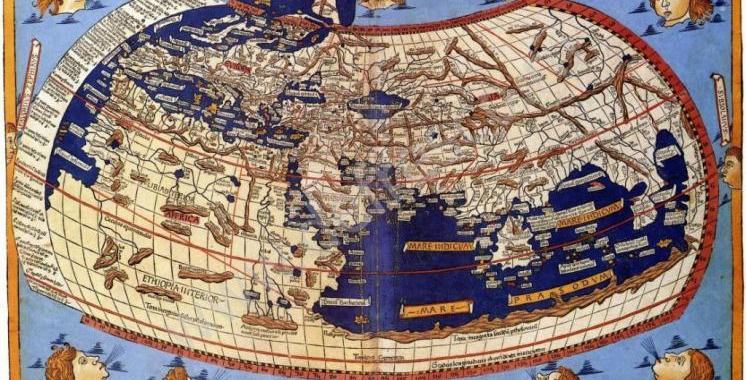
Counter-Hegemony in the Theory of the Multipolar World

Author: Alexander Dugin

Translator: Jafe Arnold

From Leviathan No. 5 [Moscow, Eurasian Movement: 2013] 

The most important aspect of the Theory of the Multipolar World (TMW) is the concept of counter-hegemony as first formulated in the context of the Critical Theory of International Relations (IR). In transitioning from Critical Theory to the Theory of the Multipolar World[i], this concept also undergoes a special sense of transformation which should be examined in more detail. In order to render such an analysis possible, we should first recall the main positions of the theory of hegemony with the framework of Critical Theory.   

The Concept of Hegemony in Realism

Although the concept of hegemony in Critical Theory is based on Antonio Gramsci’s theory, it is necessary to distinguish this concept’s position on Gramscianism and neo-Gramscianism from how it is understood in the realist and neo-realist schools of IR.

The classical realists use the term “hegemony” in a relative sense and understand it as the “actual and substantial superiority of the potential power of any state over the potential of another one, often neighboring countries.” Hegemony might be understood as a regional phenomenon, as the determination of whether one or another political entity is considered a “hegemon” depends on scale. Thucydides introduced the term itself when he spoke of Athens and Sparta as the hegemons of the Peloponnesian War, and classical realism employs this term in the same way to this day. Such an understanding of hegemony can be described as “strategic” or “relative.”

In neo-realism, “hegemony” is understood in a global (structural) context. The main difference from classical realism lies in that “hegemony” cannot be regarded as a regional phenomenon. It is always a global one. The neorealism of K. Waltz, for example, insists that the balance of two hegemons (in a bipolar world) is the optimal structure of power balance on a world scale[ii]. R. Gilpin believes that hegemony can be combined only with unipolarity, i.e., it is possible for only a single hegemon to exist, this function today being played by the USA.

In both cases, the realists comprehend hegemony as a means of potential correlation between the potentials of different state powers. 

Gramsci’s understanding of hegemony is completely different and finds itself in a completely opposite theoretical field. To avoid the misuse of this term in IR, and especially in the TMW, it is necessary to pay attention to Gramsci’s political theory, the context of which is regarded as a major priority in Critical Theory and TMW. Moreover, such an analysis will allows us to more clearly see the conceptual gap between Critical Theory and TMW.

Antonio Gramsci’s Hegemony Concept

Antonio Gramsci based his theory, later known as Gramscianism, on his understanding of Marxism and its practical embodiment in history. As a Marxist, Gramsci was convinced that socio-political history is completely predetermined by the economic factor and, like all Marxists, he explains the superstructure (Aufbau) through the base (infrastructure). Bourgeois society is in essence a class society in which the processes of exploitation reach their most concentrated expression in the form of the ownership of the means of production and the appropriation of the surplus value arising in the production process by the bourgeoisie. Inequality in the economic sphere (the base) and the domination of Capital over Labor composes the essence of capitalism and accordingly determines all social, political, and cultural semantics (the superstructure).

This thesis is shared by all Marxists, and there is nothing new or original here. But then Antonio Gramsci asked: how was a proletarian socialist revolution possible in Russia where, from Marx’s point of view (analyzing the situation in the Russian Empire in the 19th century from a prognostic perspective) and from the point of view of classical European Marxism from the beginning of the 20th century, the objective base (the underdevelopment of capitalist relations, a small proletariat, the predominance of the agricultural sector in the country’s total GDP, the absence of bourgeois political system, etc) excluded the possibility of a Communist party coming to power? After all, Lenin made this possible and began to build socialism.

Gramsci understands this phenomenon as fundamentally important, calling it “Leninism”. In Gramsci’s understanding, Leninism was the vanguard, advanced action of a consolidated and strong political superstructure (in the form of the Communist Party of Bolsheviks) in seizing political power. Once such a vanguard becomes a relevant factor, and revolution is successful, then it should rapidly develop the base through the accelerated creation of the superstructures whose according economic realities have not yet been implemented under capitalism, i.e., industrialization, modernization, “electrification”, “public education,” etc. Thus, Gramsci drew the conclusion that under certain circumstances politics (the superstructure) can stay ahead of the economy (the base). The Communist Party can “get in front” of the “natural” development of historical processes. Consequently, Leninism proves the existence of the significant autonomy of the superstructure in regards to the base.

But Leninism, as Gramsci understood it, was limited to the political segment of the superstructure, in which the functioning of law and government and the issue of domination are already solved. Gramsci insisted that the superstructure has yet another important segment which is not political in the fullest sense, i.e., not merely associated with political parties or bound to the issue of political power. Gramsci called this sphere “civil society.” Such a notion, however, should always be accompanied with the qualification of “civil society as understood by Gramsci”, for its meaning does not always coincide with the one that it is assigned in liberal theories. Gramsci’s civil society is the “zone of expansion” for the intellectual parts of society including science, culture, philosophy, art, analytics, journalism, etc. The Marxist, for Gramsci, relies on the regularity of the base in this domain, as for the whole superstructure. But…Leninism demonstrated that the regularity of the base, in some cases, is overcome by the relative autonomy of the superstructure, which advances ahead of the base’s processes. The experience of the Russian Revolution, as an historical example, demonstrated how politics is realized at the level of the superstructure. But here Gramsci emphasizes that, if this is so in the case of the political sphere of the superstructure, then why could something similar not happen at the level of “civil society?” It is at this point that Gramsci’s notion of “hegemony” appears.[iii] He successively outlines something analogous to the economic division of Capital vs. Labor in the base, or the contradiction between the bourgeois party and government vs. the proletarian party and government (as in the Soviet Union), can take place in the intellectual sphere (Gramsci’s “civil society”). This third realm of contradiction is termed “hegemony” by Gramsci, where bourgeois consciousness and proletarian consciousness vie for domination relatively autonomous from both politics and the economy.

Studying bourgeois sociology[iv], the German sociologist Werner Sombart showed that leisure is valuable for this third category, or third “class,” which partially possesses such comfort while other social groups either do not know or do not have such. Hegel’s The Phenomenology of Spirit[v] similarly says that the Slave operates not by his own consciousness, but the Master’s consciousness. As is known, this and other elements of Hegel formed the foundation for Marx’s communist ideology. Continuing this chain of thought, Gramsci concluded that the adoption or rejection of hegemony (bourgeois consciousness structures) does not and cannot directly depend on the fact of belonging to the bourgeois class (in the sense of the base) or from political involvement in a bourgeois party or administrative system. Being on the side of hegemony, or against it, according to Gramsci, is a free choice. As an intellectual chooses it consciously, he is transformed from a “traditional” intellectual into an “organic” intellectual, i.e., one who consciously takes his/her stance on hegemony.

This leads to an important conclusion. The intellectual may oppose bourgeois hegemony even while living comfortably in a society in which capitalist relations are the basis and bourgeois political domination prevails. The intellectual can reject or accept hegemony freely, i.e., he has a gap of freedom similar to the autonomy of the political in regards to the economic base (as seen in the Bolshevik experience in Russia). In other words, one can be the carrier of proletarian consciousness and stand on the side of the laboring class for a just society even while being at the heart of bourgeois society. Everything depends on the intellectuals’ choice. Hegemony is thus a matter of conscience.

Gramsci himself came to such conclusions based on his analysis of political processes in Italy in the 1920’s-30’s[vi]. During this period, according to his analysis, the conditions prevailing in Italy were quite ripe for socialist revolution in terms of both the base (developed industrial capitalism and the sharpening of class contradictions and struggle) and the superstructure (the political successes of consolidated leftist parties). But, despite these seemingly favorable conditions, according to Gramsci’s further analysis, leftist forces failed in the intellectual field. It was here that Italy was most oppressed by bourgeois hegemony, who constantly introduced bourgeois stereotypes and clichés into popular consciousness even though these contradicted economic and political realities and the popularity of active, anti-bourgeois circles. In Gramsci’s view, Mussolini applied hegemony in his favor (fascism was disgusting for communists, who saw it as a form of domination by the bourgeois classes) and prevented an “artificial” socialist revolution from appearing in accordance with the natural historical course of events. In other words, despite waging (relatively) successful political battles, the Italian Communists overlooked “civil society”, the intellectual sphere, and the “metapolitical” fight. Gramsci saw this as the cause of their defeat.

Gramscianism has since been adopted by the European Left (especially the New Left) and left-wing movements in Europe have applied Gramscianism in practice since the 1960’s. The Leftist (Marxist) intellectuals (Sartre, Camus, Aragon, Foucault, etc.) were able to implant anti-bourgeois concepts and theories in the center of social and cultural life, thus taking advantage of publications, newspapers, clubs, and university departments which were integral parts of the capitalist economy, and they acted in the political context of the domination of the bourgeois system. They went on to prepare the events of 1968 which swept across Europe and the left turn of European politics in the 1970’s. Just as Leninism proved in practice that the political segment of the superstructure has a certain degree of autonomy, in the sphere of which activism can accelerate the processes unfolding at the base, so did the Gramscianism of the New Left demonstrate the efficacy and practical value of an active intellectual strategy in practice.

Gramscianism in Critical Theory: the Left Pivot

The Gramscianism which we have described has been integrated into IR Critical Theory by its modern representatives such as Robert Cox[vii], Stephen Gill[viii], etc. In Postmodernism, the autonomy of “civil society” was furthered and, consequently, the phenomenon of the intellectuals’ choice of hegemony and the placement of epistemological straggles above political processes and economic structures in general preserved the continuity of Marxist, leftist discourse. In this view, capitalism is regarded as generally better (more “progressive”) than pre-capitalist socio-economic systems even if it is obviously worse in comparison to any post-capitalist (socialist and communist) model by which it is to be replaced. This explains the structure of the project of counter-hegemony[ix]. IR Critical Theory remains leftist in its understanding of the historical process. One can describe this perspective in the following way: according to the representatives of Critical Theory, hegemony (bourgeois society culminating in the hologram of bourgeois consciousness) replaces that which “hegemonized” it (types of pre-bourgeois formations with inherent forms of pre-modern collective consciousness) only then to be subverted by counter-hegemony which, upon victory, is to establish post-hegemony. In the Communist Manifesto[x], Marx and Engels themselves insisted on the different ways in which communists’ opposition to the bourgeoisie has nothing to do with the claims against the bourgeoisie advanced by anti-bourgeois feudalists, nationalists, Christian socialists, etc. Capitalism is pure evil which concentrates in itself (albeit not so clearly and explicitly) previous forms of social exploitation. In order to defeat this evil, it must first be allowed to fully manifest itself, and only then can it be eradicated, instead of retouching its most odious features which only delays the horizon of revolution and communism. This must be taken into account when considering the structure of the neo-Gramscian analysis of international relations.

This analysis divides all countries into those in which hegemony is obviously strengthened (developed capitalist countries featuring industrial economies, the domination of bourgeois parties in parliamentary democracies organized in accordance with the example of the nation-state, a developed market economy, and a liberal legal system) and those in which, by virtue of various historical circumstances, such factors have not appeared. The first group of countries are called the “developed democratic powers” and the second are “borderline cases,” “problematic areas,” or even categorized as “rogue states.” The leftist (Marxist, neo-Maxist, and Gramscian) analysis is totally applicable in the countries in which hegemony is strengthened. However, in the case of countries displaying “incomplete hegemony”, things should be regarded in a different way.

Gramsci himself places these countries under the “Caesarist” category (seeing the experience of fascist Italy as a clear reference). “Caesarism” can be regarded in a broad sense as any political system in which bourgeois relations exist in fragmented form while their full political arrangement (in the form of classic bourgeois-democratic states) has been delayed. In “Caesarism,” the main point is not authoritarian rule, but the delay of the full realization of a fully-fledged, Western-style capitalist system (both base and superstructure). The reasons for this “delay” can vary from dictatorial styles of government, clan elites, and the presence of religious or ethnic groups in power to the cultural characteristic of a given society or the historical circumstances of a particular economic or geographical location, etc. What is first and foremost important is that in such a society hegemony acts both as an external force (from bourgeois states and societies) and as an internal opposition, which in one way or another is connected with external factors.

In IR, the neo- Gramscians insist that “Caesarism” is “incomplete hegemony.” Thus, its strategy is to ensure a balance between external and internal hegemonic pressures by granting certain concessions, all the while doing so only selectively in order to maintain power and prevent seizure by bourgeois political forces of the political superstructure presiding over the economic base of society. Caesarism is thus doomed to “transformism” (from the Italian transformismo), i.e., the permanent adjustment of hegemony, that very force which Caesarism constantly desires to delay or deflect down a false trajectory, the end of which is steadily approaching.

In this regard, IR Critical Theory considers “Caesarism” to be something that will sooner or later be eliminated by hegemony, as this phenomenon is nothing more than a “historical delay” rather than an alternative, i. e., a counter-hegemony in itself.

According to the representatives of modern IR Critical Theory, such“Caesarism” is obviously represented by most of the countries of the Third World and the major powers included in BRICS (Brazil, Russia, India, China and South Africa).

Taking into account such characteristics, the limitations in such a conceptualization of counter-hegemony presented by the IR Critical Theory become clear as does the pure utopianism of alternative projects, such as Cox’s “counter-society”, which represents something expressionless and undefined. They proceed from the vague project of socio-political world order, which is supposed to appear “after liberalism”[xi]  (Immanuel Wallerstein) and conform to the usual left-wing communist utopia. A similar version of counter-hegemony is also limited by the fact that it hastily pushes numerous other political phenomena, which are obviously unrelated to hegemony and lean towards alternative versions of world order, into the category of “Caesarism”, and thus “incomplete hegemony.” This deprives these alternatives of any consideration as to their development towards an effective counter-hegemonic strategy. Nonetheless, it is this general analysis of the structure of international relations in the light of neo-Gramscian methodology which constitutes an extremely important trajectory for developing the TMW.

However, in order to overcome the limitations inherent to Critical Theory and fully exploit the potential in neo-Gramscianism, we should qualitatively expand this approach, going beyond left (and even “leftist”) discourse, which places the entire structure in the zone of ideological sectarianism and marginal exoticism (where such is currently found). In this regard, invaluable assistance can be found in the ideas of the French philosopher Alain de Benoist.

“Right Wing Gramscianism” – Alain de Benoist’s Revision

Back in the 1980s, the French representative of the “New Right” (“Nouvelle Droite”), Alain de Benoist, directed attention towards Gramsci’s ideas from the point of view of their methodological capacity[xii]. Just like Gramsci, de Benoist revealed the centrality of meta-politics as a special area of intellectual activity that prepares (in the form of a “passive revolution”) further political and economic changes. The success of the “New Left” in France, and in Europe in general, only confirms the effectiveness of this approach.

Unlike the majority of French intellectuals of the second half of the 20th century, Alain de Benoist was not a supporter of Marxism, a fact which isolated his position. However, de Benoist nonetheless built his political philosophy upon a radical rejection of liberal and bourgeois values, a negation capitalism, individualism, modernism, as well as a rejection of geopolitical Atlanticism and Western Eurocentrism. Moreover, he contrasted “Europe” to the “West” as  two antagonistic concepts. For de Benoist, Europe is the field of deployment of a special cultural Logos handed down from the Greeks which intensely combined the richness of the Celtic, Germanic, Latin, Slavic, and other European traditions. The “West”, on the other hand, is equivalent to the mechanistic, materialist, rationalist civilization based on the predominance of technology over other spheres. Alain de Benoist, like Oswald Spengler, understood the “West” as the “decline of Europe” and, along with F. Nietzsche and M. Heidegger, he is convinced of the need to overcome modernity as nihilism and “the abandonment of Being in the world” (Seinsverlassenheit). In this regard, the “West” is identical to the very liberalism, capitalism, and bourgeois society against which the New Right strove to fight. At the same time, although not being materialists, the New Right agreed with the key significance assigned by Gramsci and his followers to “civil society.” For example, Alain de Benoist came to the conclusion that the phenomenon which Gramsci called “hegemony” is a set of strategies, attitudes, and values which he considered to be “pure evil.” This led to the proclamation of the principle of “Gramscianism from the Right.”

This Gramscianism “of the right” means recognizing the autonomy of “civil society” as understood by Gramsci as well as identifying the phenomenon of hegemony in this sphere and the personal choice of one’s ideological position on the opposite side from hegemony. Alain de Benoist has published a programmatic work entitled Europe and the Third World – One and the Same Battle[xiii] which entirely bases itself on the parallels between the struggle of the peoples of the Third World against bourgeois neocolonialism and the will of European nations to free themselves from the dictatorship of the bourgeois market society and the morality and praxis of traders, and replace such a system with heroic ethics[xiv] (Werner Sombart).

The crucial importance of this “right-wing Gramscianism” for TMW is that such an understanding of “hegemony” that allows one to transcend leftist and Marxist discourse and reject the bourgeois order at the base (economy) and the superstructure (politics and civil society) not after hegemony has become a total planetary and global factor, but in spite of it. Hence the extremely importance nuance imbued with meaning in the title of de Benoist’s second programmatic work, Against Liberalism[xv], which contrasts to the neo-Marxist Immanuel Wallerstein’s After Liberalism[xvi]. For de Benoist, the “after” cannot be counted on. In any case, one must not let liberalism be allowed to become an accomplish fact. Liberalism must be opposed here and now and must be fought from any position at any point in the world. Hegemony attacks on a planetary scale and finds its bearers in the developed bourgeois societies as well as in those societies in which capitalisms has not yet been definitively established. Therefore, counter-hegemony should be perceived as something beyond sectarian ideological restrictions; if we want to create a counter-hegemonic bloc, then it must include all anti-bourgeois, anti-capitalist forces whether of the left, right, or those without any kind of definitive classification (Alain de Benoist himself has constantly emphasized that the division between “left” and “right” is not only outdated, but also does not correspond to the real choice of position – today what is significantly more important is whether one acts for or against hegemony).

Alain de Benoist’s right Gramscianism takes us back to the Communist Manifesto by Marx and Engels despite their rather exclusive and dogmatic appeal for the formation of a Global Revolutionary Alliance without “fellow travelers”. In contrast, we are dealing with one which unites all opponents of capitalism and hegemony and everyone who is essentially against this force. It is thus unimportant what is taken to be the positive alternative, since in this situation the presence of a common enemy is more pressing. Otherwise, according to the New Right (who in fact refused to call themselves “right”, the label which was given to their movement by their opponents), hegemony will be able to divide its opponents on artificial grounds and pose them against each other for the purpose of successfully dealing with everyone separately.

Denouncing Eurocentrism in Historical Sociology

The modern scholar of International Relations and one of the main representatives of historical sociology in International Relations, John Hobson, presents a completely different approach to this problem. In his key work, The Eurocentric Conception of World Politics[xvii], Hobson analyzes nearly all of the approaches and paradigms of IR in terms of their hierarchies which are founded in principle on the comparisons of states, their roles, structures and interests to Western society as the universal referential standard. John Hobson concludes that all IR schools, without any exception, are based on an implicit Eurocentrism which recognizes the universality of Western societies and believes European history to be a phase compulsory for all other cultures. Hobson rightly considers this approach to be a form of European racism which gradually and imperceptibly passes from biological theories of the “superiority of the white race” to notions of the universality of Western cultural values, strategies, technologies, and interests. The “White Man’s Burden” becomes “the imperative of modernization and development.” At the same time, an indigenous society and culture are subjected to “modernization” by default – no-one asked whether they agree that Western values, technologies, and practices are universal of if they are an object of rejection. Only being faced with violent forms of desperate resistances in the forms of terrorism or fundamentalism does the West sometimes bring itself to ask the question: “Why do they hate us so much?” But the answer is a preconceived one: “The savagery and ingratitude of non-European peoples for all the blessings which Western “civilization” brings with it.”

Hobson importantly and convincingly shows that racism and Eurocentrism exist not only in the bourgeois theories of IR, but also in Marxism, including IR Critical Theory (neo- Gramscianism). The Marxists, despite their criticism of bourgeois civilization, remain convinced that its triumph is inevitable and thus share a common Eurocentrism in regards to Western culture. Hobson shows how Marx himself partly justified colonial practices insofar as they led to the modernization of the colonies and, thus, hastened the onset of proletarian revolutions. Thus, from historical perspective, Marxism is an accomplice of capitalist globalization and an ally of racist civilizational practices. Decolonization is regarded only as a prelude to the construction of the bourgeois state, which has yet to embark on full industrialization and move towards the future proletarian revolution. Very little separates this from the theories of the neo-liberals and trans-nationalists.

John Hobson thus proposes to begin to construct a radical alternative, a development of IR theory that is not based on Eurocentrism or racist approaches. He stands for the project of a “counter-hegemonic bloc” which, while being indeed nominated by neo-Gramscianism, would liberate itself from all forms of Eurocentrism and thus be qualitatively expanded.

The project of a non-Eurocentric theory of IR leads us directly to the Theory of the Multipolar World.

The Transition to Multipolarity

We can now bring together all of the above said on counter-hegemony and situate such in the context of the Theory of the Multipolar World (TMW) which is a theory of IR that is essentially, consistently no-nEurocentric, and which rejects hegemony on its own grounds and calls for the creation of a broad counter-hegemonic alliance or counter-hegemonic pact.

In TMW, counter-hegemony is understood in a similar way as neo-Gramscian theories and the Critical School of International Relations. Hegemony is the domination of capital and the bourgeois political system of society expressed in the intellectual sphere. In other words, hegemony is first and foremost a discourse. At the same time, the three segments of society designated by Gramsci, the base and the two components of the superstructure (politics and “civil society”) are considered by TMW to be predominant on the level of discourse, i.e., the intellectual sphere, in accordance with post-modern and post-positivist epistemology. Thus, questions of hegemony and counter-hegemony are central and fundamental to the construction of the TMW and its effective realization in practice. The sphere of metapolitics is just as important as politics and economics and does not eliminate them, but rather logically and conceptually precedes them. Man ultimately deals with his mind and and its projections. Therefore, the arrangement or reorganization of consciousness automatically entails a change in the (internal and external) world.

The TMW is a fixation of the concept of counter-hegemony in the concrete theoretical field. Until a certain point, TMW strictly follows Gramscianism. But when it arrives at the expression of the content of a counter-hegemonic pact, there arise certain divergences. The most important of such involves the rejection of left dogmatism; the TMW refuses to consider the bourgeois transformation of modern societies to be a universal law, which thus brings the Gramscianism and metapolitics of the TMW closer to the “New Right” (Alain de Benoist’s) version than that of the “New Left” (of R. Cox), but without excluding Marxism to the extent that it is an ally in the common struggle against capital and hegemony. Strictly, speaking, the term “right Gramscianism” is not entirely correct – it would be more correct to speak of an inclusive Gramscianism, i.e., in which counter-hegemony is widely understood as including all types of hegemonic confrontation and etymologically generalizing the otherwise rigid “counter”). This stands in contrast to exclusive Gramscianism (in which counter-hegemony is narrowly understood as “post-hegemony”). The TMW advocates inclusive Gramscianism. This position overcomes right and left and transcends the conceptual borders of the political ideologies of modernity, thus unfolding in the form of the Fourth Political Theory which is inextricably linked to the TMW.

J. Hobson’s contribution to the development of inclusive counter-hegemony is extremely important in this regard. His call to build a non-Eurocentric IR theory precisely coincides with the purpose of the TMW. International relations should be interpreted from a plurality of positions just as the construction of any universal theory must take into account different cultures, civilizations, religions, ethnic groups, societies, and communities. Every society has its own values, anthropology, ethics, regulations, identity, and understanding of space and time, and the general and the particular. Every society has its own “universalism” or at the very least its own understanding of “the universal.” What the West thinks about “universality” is well known, even too much so. It is time to give the rest of humanity the right to their own voices.

In its fundamental dimension, multipolarity means the free polylogue of societies, peoples, and cultures. But before this polylogue can actually appear, it is necessary to define general rules. Hence the a theory of International Relations, one which will involve an openness of terms, concepts, theories, notions, a plurality of actors, and the complexity and polysemy of expressions. In this case, TMW is not an end, but a beginning, the basic spatial preparation for the future world order.

However, the call for multipolarity is not sounded in empty space. Discourse on international relations and global political, social, and economic practice is dominated by hegemony. We live in a strictly Eurocentric world in which only one superpower (the USA) together with its allies and vassals (the NATO countries) are the imperialist dominants and in which market relations dictate all the rules of business practices, where bourgeois political norms are considered to be compulsory, where the technique and level of material development are considered to be the highest criteria, and in which the values of individualism, personal comfort, material well-being, and “freedom from” are extolled above all other factors. In other words, we live in a world of triumphant hegemony which has spread its network on a planetary scale and has subordinated all of mankind. Therefore, we need a radical opposition, struggle, and confrontation in order for multipolarity to be made real. In other words, we need a counter-hegemonic bloc (in the inclusive sense). We should now consider what resources this potential bloc has. 

The Syntax of Hegemony and the Syntax of Counter-hegemony

In its conceptual hologram, hegemony is based on the belief that modernity excels over antiquity (the past), that modernity triumphs over pre-modernity, and that the West dominates the non-West (the East and the Third World).

Thus we have the structure of the syntax of hegemony in its most general form:

The West=Modernity=the goal=welfare= progress=universal values=the USA (+ NATO)=capitalism=human rights=market=liberal democracy=law

VS

The Rest= backwardness (pre-modernity)=the need for modernization (colonization/aid/lessons/external control)= the need for Westernization= barbarism (savagery)=native values=pseudo-capitalism (non-capitalism)=violation (less respect) of human rights=unfair market (State role, clans, group preferences)=pseudo-democracy=corruption

These formulas of hegemony are axiomatic and self-referencing, a kind of “self-fulfilling prophecy”. One term is justified by another one of the equivalent chain and is opposed to any term (symmetric or not) of the second chain. This unpretentious rule creates the discourse of hegemony. While it may have the appearance of causality, illustration, descriptiveness, analysis forecasting, historical research, opinion polling, debate, opposition, etc., in its structure, hegemony is in fact built on this backbone supported by millions of variations and disclosed experiences. If we accept these two parallel, equivalent chains, we find ourselves within hegemony and fully codified in its syntax. Any objection will be extinguished by new suggestive passes galloping through one or another term in order to arrive at hegemonic tautology. Even the most critical formulas of discourse sooner of later slip into these constantly repetitive semantic synonyms and dissolve. It is necessary to recognize at least one of these identifications, and then everything else is preordained. Hence why the creation of counter-hegemony begins with the retraction of both of these chains. Let us create the symmetrical syntax of counter-hegemony:

The West≠Modernity≠the goal≠welfare≠ progress≠universal values≠the USA (+ NATO) ≠capitalism≠human rights≠market≠liberal democracy≠law

VS

The Rest≠ backwardness (pre-modernity) ≠the need for modernization (colonization/aid/lessons/external control) ≠the need for Westernization≠ barbarism (savagery) ≠native values≠pseudo-capitalism (non-capitalism) ≠violation (less respect) of human rights≠unfair market (State role, clans, group preferences) ≠pseudo-democracy≠corruption

If the equal signs hypnotically enter the collective consciousness as something matter of fact, then the detailed justification of each equal sign requires a separate text or group of texts. To one degree or another, the TMW and its parallels in the forms of the Fourth Political Theory,[xviii], Eurasianism, the “New Right” (A. de Benoist), non-Eurocentric IR theory (J. Hobson), traditionalism, postmodernism, and so on fulfill this task in their own way, but what is important is presenting this schema as the most generalized form of counter-hegemonic syntax. The denying of a meaningful expression is in itself meaningful due to its negation of the fact, which means that each inequality is in fact imbued with meaning and connections. In questioning the chain of the identification of hegemony, we obtain a semantic field free of hegemony and its suggestive “axiomatism.” This completely unties our hands and allows us to deploy counter-hegemonic discourse.

In this case, we have retrieved such basic guidelines for a specific purpose: the preliminary and most generalized estimation of the resources that can be theoretically expected in the construction of a counter-hegemonic pact.

A Global Revolutionary Elite

The counter-hegemonic bloc is built by intellectuals. Therefore, at its core should be a global revolutionary elite which rejects the “status quo” at its deepest level. In trying to understand one’s position at any point of the modern world – in any country, culture, society, social class, professional function, etc. – man sooner or later arrives at an understanding of the basic theses of hegemonic discourse in searching for deep answers to the deep questions of the social arrangement in which he lives. Of course, this is not possible for everyone even though according to Gramsci every man is an intellectual in one way or another. However, the only real intellectual is he who represents man in a holistic sense, a kind of delegate to the parliament of thinking humanity (homo sapiens) on behalf of the more modest representatives (those who cannot or do not want to realize the fullness of man in the form of the possibility culminating in the opportunity to think, i.e., being an intellectual). We have such an intellectual in mind when we speak of identifying hegemony. At the point when he is faced with a choice, i.e., realizing his opportunity to become an intellectual, he can say “yes” to hegemony and accept its syntax, thus continuing to act within its structure, or he can say “no.” If he says “no”, he is sent on the quest for counter-hegemony; he searches for accession to the global revolutionary elite.

This search can stop at the intermediate stage. There are always local structures (traditionalists, fundamentalists, communists, anarchists, ethnocentrists, revolutionaries of different types, etc.) who, realizing the challenge of hegemony and rejecting it, operate at the local level. At this point we are already dealing with the level of organic intellectuals who do not yet realize the need for culminating the rejection of hegemony in the form of a universal, planetary strategy. However, joining the real (not imaginary) fight against hegemony means that a revolutionary will sooner or later discover hegemony’s transnational, extraterritorial nature. To realize its goals, hegemony always resorts to the combination of internal and external factors, attacking whatever it considers to be its enemy or an obstacle to its imperial domination (the elements of the second chain, “the rest”). Thus, the localized resistance to the global challenge at one point reaches its natural limits. Hegemony may retreat at one time only to come back. No one can ever merely dodge its attacks.

When such a realization is acquired, the most intellectually developed representatives of local counter-hegemony will feel the need to pass to the level of a fundamental alternative, i.e., mastering counter-hegemonic syntax. This is the direct path to the Global Revolutionary Alliance which will be objectively and quite naturally formed by the global counter-hegemonic elite, which is destined to become the core of counter-hegemony. Herein lies the necessity of the Theory of the Multipolar World.


[i] Dugin, A. The Theory of the Multipolar World, Moscow, 2012.

[ii] Before the end of the Cold War, Waltz took  the example of the fight between the USA and the USSR as a fight between two hegemons. Now, his adherents promote the idea that a there will be a new bipolarity in which American hegemony will face China as the new candidate for the second pole.

[iii] “What we can do, for the moment, is to fix two major superstructural “levels”: the one that can be called “civil society”, that is the ensemble of organisms commonly called “private”, and that of “political society” or “the State”, said Gramcsi. “These two levels correspond on the one hand to the function of ”hegemony” which the dominant group exercises throughout society and on the other hand to that of “direct domination” or command exercised through the State and “juridical” government.” Gramsci A. The Prison Notebooks vol. 1. Columbia University Press, 1992

[iv] Werner Sombart. Der Bourgeois. München und Leipzig: Duncker & Humblot, 1913

[v] Hegel G. W. F., The Phenomenology of Spirit, Oxford: Clarendon Press, 1977

[vi] Gramsci A. The Prison Notebooks. Columbia University Press, 1992

[vii] Сох Л. Gramsci, Hegemony and International Relations: An Essay in Method// Millennium. 12.1983.

[viii] GUIS. Gramsci, Historical Materialism and International Relations. Cambridge: Cambridge University Press, 1993.

[ix] The Neo- Gramscian, Nicola Pratt defines counter-hegemony as the “a creation of an alternative hegemony on the terrain of civil society in preparation for political change”. Pratt N. Bringing politics back in: examining the link between globalization and democratization// Review of International Political Economy. Vol. 11. No. 2. 2004.

[x] Marx K., Engels F. Manifesto of the Communist Party. 1955.Маркс К., Энгельс Ф. Манифест Коммунистической партии // Маркс К., Энгельс Ф. Сочинения. 2-е изд. Т. 4. М.: Государственное издательство политической литературы, 1955. С. 419-459.

[xi] Wallerstein I. After Liberalism. New York: New Press. 1995

[xii] BenoistdeA. Vude droite. Anthologie critique des idees contemporaines. P., Copernic, 1977.

[xiii] Benoist deA. Europe, Tiers monde, тёте combat. P.: Robert Laffont, 1986.

[xiv] Sombart, Werner (1915): Händler und Helden. München: Duncker & Humblot. 1915.

[xv] de Benoist A. Against Liberalism. To the Fourth Political Theory. S.-Petersburg, 2009

[xvi] Wallerstein I. After Liberalism. New York: New Press. 1995

[xvii] Hobson J. The Eurocentric Conception of World Politics: Western International Theory, 1760-2010. Cambridge: Cambridge Umoniversity Press, 2012.

[xviii] Dugin A. The Fourth Political Theory. S.-Petersburg. 2009


© Jafe Arnold – All Rights Reserved. No reproduction without expressed permission. 
The Rus of Rurik

Author: Vladimir Karpets

Translators: Jafe Arnold, Nina Kouprianova

Chapter 1 of Tsarsky Rod (2016)  

“He who correctly explains the name of Rus will find the key to explaining her primordial history,” wrote the Polish historian A.R. Brueckner. What’s more, not only its primordial history, but the very “seed of its logos,” its meaning, and he will find the key to the Russian future. As the monk Andronik (A.F. Losev) wrote, “the Greek expression EIS ONOMA or EN ONOMAK, ‘in the name’, itself proves that a name is a certain situating of divine energies, and the immersion and residence in it of all created beings leads to enlightenment and the salvation of the latter.”

Today we are beginning to grasp, to understand our name. Our own name. Our name – “Russians” – transcends the division into Great Russians, Belarusians, Little Russians, and Rusyns. It is derived from Rus.

And now the first and oldest question: Where are you from, Rus? In her book, Prizvanie varyagov [The Calling of the Varangians], Lydia Grot says:

Scholars have long paid attention to the abundance of hydronyms in Eastern Europe, the formation of whose names involved the root component ras/ros/rus’ or rus. The most ancient of known names for the main river of Eastern Europe, the Volga, was Ra. This was maintained by Ptolemy (the middle of the second century A.D.) and has been discovered in Herodotus (the fifth century B.C.) with the same vocalization of the root ra-. The historian A.V. Podosinov believes that there are even more ancient names for the Volga. One of them was preserved on the ancient Iranian Avesta, the commonly accepted dating of which is believed to be the end of the second and first half of the first millennium B.C. The text on this artifact mentions a river called Ravjha (Rangha or Rankha) in which many Iranian scholars see the Volga. In the hymns of the ancient Indian Rig Veda (from the end of the second to the beginning of the first millennium B.C.), there is reference to the northern river of Rasa which scholars equate to the Avestian Rangha and the Volga. In one Greek treatise from the third or fourth century A.D., the authorship of which is attributed to Agapimeno, there is mention of the Volga in the form of Ros. In the space stretching from the Volga/Rasa/Ros to Neman/Ros’ (Rus) can be found Ros’ or Rusa, a river in the Novgorod province; Rus’, a tributary of the Narew; Ros’, the famous tributary of the Dnieper river in Ukraine; Rusa, a tributary of the Seym; the Ros’ of the the Emajõgi river; the Ros’ of the Oskol river; and Poruse, a tributary of the Polist, etc.

The presence of the land of Rus and the Rusians themselves on the territory between rivers with the names Ras/Rus/Ros’/Rus’ speaks to the fact that Rus was supposed to be the ancestral territory of a people bearing the same name.

But it is completely clear that this is not only and not so much of a matter of ethnonyms. The Rig Veda also contains the word rasa which stands for “liquid,” “juice,” or “main substance,” and in the Mahabharata means “water,” “drink,” “nectar,” or “milk” i.e.,  it possesses related semantics.

Another example: in studying the etymology of the river in the Novgorod region named Poruse, which in antiquity was called Rusa, some scholars have come to the opinion that the river’s name is ancient Baltic and descends from the root rud-s/roud-s meaning red. However, this is a root word with the same meaning as in Sanskrit, hence it could have been borrowed to Lithuanian (given their proximity). This word is also in the Russian language. In Sanskrit, the word rudhir means red, blood-red, or blood. The Indologist N.R. Guseva explains: “the meaning of red in Sanskrit traces back to the ancient route rudh which meant ‘to be red or brown.’ This ancient meaning can be juxtaposed to the ancient Russian words rodry, rudy, or rdyany which denoted the color red, as well as the ancient Russian word ruda – blood.”

But what is this “blood”? What kind of blood?

Lydia Grot concludes that the name Rus, from which many rivers in Eastern Europe received their names, was the sacred name of the ancestor of the Rusian people.

The entire Hungarian and Romanian region is covered with names reminiscent of Rus: Poiana Rusca, Ruskberg, Russ, Rusor, Rusanesti, Ruscova, Rusova, Ruspoliana, Rustina, Rutka, Rostock, Rossia, Rosaci, Roschina. Many villages’ names are conjuncted with oros or orosh, which in Hungarian is rus.  They can also include olah or vlah, i.e., Roman, Magyar, horvat, roman, and nemet. This serves as undeniable proof that the population, at least in the old days, distinguished between themselves Rus, Walachians, Croatians, and Germans.

But this is by no means limited to “Eastern Europe.”

Besides the conventional singling out of an “Eastern European” Rus (Kuyaba, Slaviya, Ar(s)taniya), the scholar of “paganism” (we employ this concept with a certain degree of reservation), M.L. Seryakov, also distinguished “another Rus” far in the West. Later, over the course of our narrative, we will see the proto-geopolitical meaning of this.

M.L. Seryakov points to the Primary Chronicle’s testimony of the existence of Rus on both sides of the Varangian sea, i.e., also in the “English land.” Of course, Seryakov stipulates that he is not speaking of Jutland which, in his opinion, was inhabited by the Angles before their relocation to Britain. He also refers to the Jewish Book of Yosippon (from the 10th century), whose author “places one Rus in the neighborhood of the Saxons and Angels, and the second on the Dnieper.”

This testimony is important because the “Russian-British drama” has dragged on throughout all memorable centuries. But more on this later.

***

The phrase “Ancient Rus” was artificial in its common usage (before the 17th century). It arose from the desire of the official historiography of the 19th and especially the 20th century to identify Russian history with the histories of other peoples and states. The very desire for such an identification, however, betrays the poorly concealed doubt in its subject. In one way or another, it must be recognized that the Russian state of the 8th-10th centuries which is discerned as the epoch of “Ancient Rus” (no more nor less up until Peter the Great) has no relation whatsoever to the ancient, i.e., classical world. Before us is a typical medieval state. As for the actual period of Russian antiquity, then, guided by the methods of positivist science, i.e., documents whose dating is always doubtful, it is difficult here and now to speak of anything at length. It is necessary to draw only the most general outline.

Certain revelations which, not coincidentally, appeared at the very beginning of the Second World War in the journal Bulletin of Ancient History, appear to us to be extraordinarily valuable. The author of the article “On the Question of the Origin of the word ROS, ROSIA”, Russia, M. Syuzyumov, merely summarized the Old Testament and in particular Byzantine evidence of this ancient sacred name which later became a generally accepted ethnonym. M. Syuzyumov writes:

“It can be asserted with full certainty that the ancient Russians never called themselves ‘rossians’. There is no such word in Russian language in ancient artifacts. Moreover, it can be assumed that even the Byzantine Greeks themselves hardly called the Russians ‘rossians’ in spoken language…Liutprand, the bishop of Cremona who visited Constantinople the mid-10th century, mentions the Russians in his work Antapodosis. He reports that the Russians received their name from the Greek word ROYSIOS (which means ‘red’) and that this name was given to the Russians for the particular color shade of their bodies…In the Greek translation of Ezekiel, one encounters more than once the name ‘ros’ in the form of ‘rosh’: ‘Son of man, set your face toward Gog of the land of Magog, the prince of Rosh, Meshech and Tubal, and prophesy against him’ (Ezek. 38:2)…However, if one carefully follows the epithets of Patriarch Photios addressed to the Russians, then it turns out that Photios falls into an obvious contradiction. On the one hand, he calls the Russians  a world-famous people. On the other hand, about the same Russians in his second speech, Photios speaks of a people entirely unknown, ETNOS AFANES AL NASION, a mysterious, unknown ETNOS ASEOMOS, unclear people who are MEZE MEKHRI TES KAT EMON EPEL YSEOS GIGNOSOMENON, incomprehensible and unrecognizable upon approach. How can we combine his words TO TRYLLOYMENON, i.e., that they are those ‘about whom everyone speaks,’ ‘commonly-known’, and ‘infamous’ with his words that they are, AGNOSION, ‘unknown’ and AFANES, ‘shady’? If in mind is a concrete nationality, the Russians, who attacked Constantinople, then we are left with a contradiction, a genuinely irreconcilable one.

We will return to this “irreconcilable contradiction” again, and more than once. As for an “introduction to the problem,” let us recall the Varna caste system of Aryan society that was preserved (of course, in a diminished, rudimentary form) up until the French Revolution of the 18th century with its uprising of the “third estate” against the first (the aristocracy) and the second (the clergy). In the ancient Aryan (Japhetic) languages, sur, ms, kyr, syr, and sar meant not only the color red, but sun, gold, blood, (metal) ore, race, and generation (all of these concepts are essentially synonymous) and, of course, imperial power, the imperial-warrior, Kshatriya caste – in other words, the Golden Type or Royal Blood (Sang Royal). In addition, as noted in the 19th century by A.A. Kunik and V.R. Rozen: “Rus is from the Gothic hrodh, or glory (hence the definition of the Black Sea Goths as the Hrudgoths. This word was part of the name Rurik (Hrodhrekr) and originally meant the dynasty, only to then transition to mean the country where this dynasty ruled.”

Is it not interesting that in “Biblical Hebrew”, there is also this letter? Resh means head (including beheading) and prince, i.e., the ruler. The “mystery” of the “Rus race” (which is mentioned as the future race of the liberators of Tsargrad in The Tale of the Capture of Constantinople from the 15th century attributed to Nestor Iskander) is entirely explainable given that Byzantium did not develop dynastic elements. Anyone could become the emperor. At the moment of the fall of Constantinople, the Russians had an obvious, solid ruling princely dynasty. In this sense, the adjective “Russian” which has caused confusion among some modern authors becomes a quite natural designation for the royally anointed, the sovereign. Moreover, it turns out that for Russia the ethnonym and state name coincide with the name of its first ruling line. The meaning of this for Russian historiosophy, as for the Russian consciousness, cannot be overestimated.

There are just as many meanings and designations in the ethnonyms of the Slavs, or Novgorod Slavs called Slovene in Russian. In fact, we know from so-called “academic history” the names of the “Slavic tribes” – the Drevliane, the Vyatichi, the Poliane, Radimichi, etc. – who did not directly bear the name Slavs or Slovene and, despite the closeness of their languages, frequently did not understand one another.

“In the beginning was the Word, and the Word was with God, and the Word was God” – everyone knows this beginning of the Fourth Gospel (John 1:1). The Word of God, or the Eternal Sacrifice slain before the beginning of time (here we cannot speak of time, but of aeonic dimension) is an image both ‘about’ and ‘before’ created from the red (ros) land of man (if we combine the Russian word for “word,” slovo and for “man”, chelovek, we have slovek). This is the “voiced image” (MEROIS or MERORIS) – the “first born from God” and the “first sacrifice” in one and the same name. The eternal sacrifice of the Son of God and God, the Second Face of the Holy Trinity, the “uncreated”, precedes the creation of created man in the sense known to him as materia prima. Jesus Christ from the heavens is the eternal Adam (the Red Clay) and is in one and the same name the new Adam and His Resurrected Flesh. Fallen Adam himself is in one and the same name the ruler, bestowing the names to creations, and the priest is the sacrifice of the mystery of Paradise (“fruit and prayer”). However, with the fall of the first man, the heavenly mystery was been deprived of its fruit and turned into bloody pagan sacrifice (all pagan cults, including the Dionysian), since for the restoration of the heavenly dimension and the new bloodless, Eucharistic sacrifice, the phenomenon of the sacrifice of the God-man himself in history was necessary. The pagan priests, however, and their Varna caste and tradition, preserved a corrupted memory of serving the God Word, of course in “shadow, not truth” in the words of Metropolitan Hilarion. The “shadow”, however, was so profound, down to the depths of the underworld, that it “demanded” human sacrifices as inevitable in a world outside of Christ. These dedicated priests originally, as far as is apparent, were originally Slavs or Slovene. It is from them, as some authors believe, that the ancient city of Slovensk probably received its name, which is precisely in the place of modern Novgorod (some trace it a bit further north and closer to a modern city on the Neva). “The Ilmen Slav sovereigns that founded Slovensk and Rus were the masters of all of Pomerania and even up to the Arctic Sea and along the great Pechora river and Vyma through the high, impassable mountains in the country of Siberia to the great river Ob and to the mouth of the whitewater river.”

One of the “gods” of the pre-Christian Slavic pantheon was Veles or Volos. Volosy, meaning “hair” in Russian, are an attribute of solar light, the king-priest (let us remember that the Word of God is the King and the High Priest). The first to draw attention to the anagram of the Volos-Word was the outstanding translator and writer Vladimir Mikushevich. In addition to a direct reference to the Adamic, heavenly rites even in “paganism,” before us is a direct indication that “Slav” or “Sloven”, i.e., the “voiced image” (MEROIS), is first and foremost a sacrifice and priest, albeit, of course, before the sacrifice, the God-Word, abolishes the “bloody, human sacrifice.”

Applying this to the “social structure” of the ancient society of the Slovene, there is the priest who is identical to a druid or sorcerer. Thus, the Slavo-Russian language is the royal, priestly language just as how in Europe, for example, the Franco-Celtic combination is a combination of free (francs) soldiers, i.e., the same people bearing light-brown hair and Celtic druids (kit-kchld – Chaldean – koldun) and the magi-“Slovene.” With the adoption of Christianity, the Varna caste division of Aryan society was, of course, cleansed of its “pagan abomination” and “mystery of iniquity,” i.e., specifically of blood sacrifices. Thus, it was miraculously transformed into the symphony of the Orthodox Empire and yielded the Bloodless Sacrifice of the Orthodox Priesthood. The concepts of “Russian”, “Slav,” “Frank,” or “Gaul” (hl-kl-klt), “Goth,” or “Celt” were gradually transformed into ethnonyms. This can only be realized upon setting aside the famous dispute between the “Normanists” and “anti-Normanists.”

The point is that both the Slavs and the Rus (like the Franks and Celts) ethnologically belonged to one Northern Aryan ethnos today known as the Veneti. In the days of old, one could stumble upon the name mentioned by Strabo – Vindelicum or Vendelicum (and the Baltic Sea was the Sinus Venedicus). Moreover, one of their names was Franks (the “free ones”) and the other was Slavs. As Eckhard wrote, “The Franks once dwelled near the Baltic Sea, where there is now the Vagria” (Franci olim ad mare Balthicum, ubu nune est Vagria). It should thus be clearly borne in mind that all of these ethnonyms are from later times. “The Franconian Slavs,” writes the 19th century Russian scholar Y.I. Venelin (Gutsa), “did not call themselves Vindelicum, just as they did not call themselves Slovene as the name existing only in ethnographic books. The very word Franks is a modern ethnonym derived from one of the names of the kings who ruled the ancient Vagria called Reges Francorum and who, according to Fredegar and the later chroniclers, were the descendants of the Trojan kings (the line of Priam). These are the Trojan Veneti settlers who formed the ruling, princely caste of whom Polybius wrote. According to him, they “differ little from the Celts, but speak their own language. The writers of tragedies often mention this people and speak of its many miracles.”

Everything thus turns out to be very simple: in the West they were called Franks, and in the East, Rus. This also renders clear the process of the transformation of the Varnas (the castes) into ethnoi (and not vice versa, contrary to Marxist and Liberal science) and renders it easier to trace the evolution of the remnants of the old law of the land.

The modern scholar of the history of law, M.A. Isaev, writes:

Rus could finally merge with the Slavs no early than the 12th century. The Russian Truth knew very well the Rusin opposed to both the Varangian Kyfling (the foreigner) and the Slav. This is a very characteristic feature of the Russian tradition. The sources of barbarian law usually secured legal position not only among different layers of the population, but also in different forms between ethnoi. The barbarian laws knew a similar differentiation between the conqueror peoples and, for example, the Romans, who continue to live according to jus Quiritium. But what distinguishes the Russian legal as well as cultural and state civilization among the whole lot of barbarian and ancient samples of Western European culture is the rejection of ethnic particularism as a principle of state life…

The latter is quite natural based on the Divine and Theophonic, not ethnic origin of royal (i.e., Russian) authority. Wherever authors more based in tradition do not literally, i.e., like “foreigners,” understand, for example, the Varangians (we will see below what this word meant among the ancient Aryans), the picture manifests itself more clearly, acquiring intelligible outlines.

The Primary Chronicle of the 15th century and the praise of the Russian language contained therein, the sources of which date back to the Kiev dome, says:

This will be known by all languages and all peoples that the Russian language is from nowhere and this holy faith and Russian alphabet was not introduced by anyone but God the Almighty, the Father, Son, and the Holy Spirit. The Holy Spirit imbued/breathed faith and the acceptance of baptism and other Church customs from the Greeks to [St.] Vladimir [the Great], whereas the Russian alphabet was given by God in Korsun [Chersonesos Taurica in Crimea] to the Russians, and from this philosopher Constantine learned it, from this he wrote books in the Russian language. […] That same Russian man was virtuous in thought and action, in pure faith he isolated himself, and from the Russian language came early Christians, and it is not known by anyone where it came from. [1]

A.G. Dugin writes: “The Russian monarchical tradition began, as is known, with the calling of Rurik from the Varangians to kingship over a group of Slavic and Finno-Ugric tribes. In the later period, descending from the first prince – Rurik – was the spiritual and genealogical justification of royal authority, its legitimacy and sacred legality. This tradition was so persistent and deep, so self-evident and absolute in Russians’ understanding, that it simply could not have been inconsistent with the indigenous archetypes of ancient forms of consciousness which, although they moved into the sphere of the unconscious, nevertheless did not lose their efficiency and validity. In our opinion, the calling of Rurik from among the Varangians was seen as a great, nationwide mystery embodying in itself the script of the supernatural origin of royal power which is characteristic for all ancient, traditional dynasties.”

Thus, Slavo-Russian means simply Divine-ruling. ROS and MEROIS. MEROIS is the “voiced image,” i.e., the voiced, or slovesny in Russian, and thus Slovensky – one of the names of the First Adam.

***

The modern world has an exceptionally short memory. While extolling “European civilization” as the kingdom of democracy, i.e., Laodicea (which sounds like the Greek synonym of the word laocracy, or rule of the people), it is forgotten that the history of the latter is the history of a mere three centuries. Moreover, the Russian liberals of the last century, dreaming of the “Novgorod Republic,” did not remember, did not know, and did not want to know of the sacred center of our ancient homeland which had nothing in common with their understanding of the “principles” of the French and American bourgeois revolutions as they envisioned and reflected upon in their minds.

It must be said that the most significant refutation of liberal forgetfulness is the historical and archaeological science of recent years that has paradoxically confirmed the Church Tradition (the chronicle tale Of the Slovene and Rus, the Christian Cosmography of Saint Cosmas Indikoplov and others), just as has practically all of the archaic Byliny, ancient Japhetic, and semi-fantastic corpus. A scholar of the Romans from the ’80’s and ’90’s of the last century who compared the results of historical-archaeological science with legend speaks of a place approximately covering the space between present-day Novgorod and St. Petersburg:

Great Slovensk. The ancient northern capital of the Japhites founded in 2409 B.C. and defunct after the rejection of the Apostle Andrew and the outbreak of hostilities by Princes Lalokh (Khalokh) and Lakhern against the ‘scepter of the Greek kingdom.’ In the 9th century, under the reign of Rurik, the northern capital was transferred down the river Volkhov and called New City, or Novy Grad. The works of the eastern geographers containing data related to the 50’s-’80’s of the 9th century speak of three groups of the Rus, the main of which was As-Slaviyu with its center in the city of Slava…usually identified with the Ilmen Slovenes and their center with the precursor of Novgorod, whose name has been preserved by eastern authors (see the works of A.P. Novoseltsev and V.Y. Petrukhin). The oldest part of Novgorod bears the name ‘Slavno’ which is consistent with the names in Arab sources. Based on this, it is clear that the expanses of Slovensk should, if not surpass, then at least match the square of the ancient part of Novgorod. However, contrary to common sense, the majority of Soviet archaeologists have identified such an enormous metropolis as Slovensk presented in sources as a small, princely ‘Rurik settlement.’ The real Great Slovensk, whose kilometer-long ramparts are covered by forest, remains unexplored and is not marked on archeological maps to this day.

Speaking of the history of Novgorod (from the 8th-9th centuries), much allows the assumption to be made that it was conceived of long before the official Baptism of Kiev as an Orthodox Christian city, as early Novgorodian Orthodoxy, with its special veneration of the Sophia, the Holy Wisdom, which also houses the genealogical mystery of (and indeed answer to) the House of Rurik itself.

Conventional historiography depicts the baptism of the land of Novgorod as the deed of the famous Dobrynya Malkhovich, the “uya” (uncle) of Saint Vladimir, done “by fire and sword”, and Novgorod itself and the Russian North in general as “pagan Wandea.” However, an attentive reading of local Novgorodian literary sources reveals a significantly more complex picture. Let us recall that in ancient times, Northern Rus was an integral part of Northern Europe as a whole in which the confrontation between Christianity and “paganism” – before the mass genocide orchestrated in the 9th-10th centuries on the order of the Carolingian papacy – did not acquire such tragic severity as in the Roman Empire. Let us also recall that behind the “round table” of King Arthur, the Druid Merlin sits adjacent to the Archbishop of Canterbury, and in the Edda both pre-Christian cosmogony and Christian historiosophy coexist. Only under the Carolingians did the destruction of entire ethnic groups, such as the Saxons and Bretons, begin on religious grounds…

And yet was the Russian North “pagan” or Christian on the eve of the official Baptism of Rus?

In the Tale of Bygone Years that Passed in Great Novgorod, it is said:

In the age of our pious Russian great princes living in Novgorod and voluntarily at peace with all the lands, the Germans [foreigners] sent their envoys from all 70 cities. They bowed to the earth in front of the archbishop of Novgorod, and the local government, and military, and the entire city of Novgorod and said, “Dear neighbors! Give us a piece of your land in the middle of Great Novgorod where we can place a shrine according to our own faith and customs. [2] 

The Novgorodians responded, saying:

By the grace of God and that of the Most Pure Mother of God and our father, the archbishop, through blessing and prayer, in the birthplace of our lords, great Russian princes in Great Novgorod, there are only Orthodox churches of our Christian faith here. After all, how can light and darkness join forces? How can your shrine be built in our city? […] Mayor Dobrynia, blinded by a bribe and taught by the Devil, ordered to move the Church of St. John the Baptist to a different location and gave its place to the Germans [foreigners]. […] And when the Germans [foreigners] built their own church [of a different faith], they hired Novgorod icon painters and ordered them to paint the image of the Savior on the southern wall at the top in order to appeal to and seduce [Orthodox] Christians. And when these icon painters painted the image of the Savior in the [foreign] church without informing the archbishop about this, and took off the covers, then immediately at that moment came rain and hail, and the place where the image of the Savior was painted was knocked out by hail and washed away by rain without a trace. [3] 

At first glance, the Tale of Bygone Years was compiled and written by the zealots of piety. However, a reading of the commentary to it written by L.A. Dmitriev leaves one to think somewhat differently about its origins and – especially! – the reasons for its emergence and distribution. Dmitriev writes:

This tale dates figures among those landmarks of Novgorodian literature at the heart of which lie oral traditions of local origin…V.L. Yanin believes that the ‘there exist visible signs of the reliability of this legend.’ The legend itself apparently appeared very early, no later than the 12th century, but the tale was written down considerably later. E.A. Rybina noted that the Khutyn abbot Zacchaeus is named in literature dated to the years 1477-1478. Accordingly, the Tale of Bygone Years could not have been written earlier than the second half of the ’70’s of the 15th century. The pronounced anti-Boyar orientation of the Tale of Bygone Years, the words in its beginning on the independence of Novgorod, and the clearly evident condemnation of Novgorodian customs – all of this speaks to the fact that it was written after Novgorod’s loss of independence, i.e., once again no earlier than the late ’70’s of the 15th century. We cannot say what the thrust of the original legend of Dobrynya was, but the character of the Tale of Bygone Years is evidence that this work was forged in a democratic environment, and religious motives are no longer at the fore in the Tale…

But if not religious motives, then what kind? Let us pay attention to the words of this historian, namely, that this work was created in a democratic environment.

The book of the Novgorodian historian and archaeologist of the last century, Vasiliy Peredolsky, which we shall have to repeatedly cite (the book was published only in Novgorod in 1898 and has never been reprinted, neither before nor after 1917) indeed speaks of several mysterious temple (and not only temple) buildings somehow subsequently destroyed over the course of approximately the 8th-16th centuries. First and foremost, this most inquisitive historian, who was also the author of studies on the prehistoric tombs of the Novgorodian Slavs, points to the existence in Novgorod at least until the 13th century of an Orthodox church named after the Apostle Peter whose services were held in Latin. This church is also mentioned in the famous The Questions of Kirik. During the war with the sword-bearers, i.e., the Catholics, this temple was not disturbed but, moreover, all Novgorodians came to it for sacrifices. “Was it not Fryazian, i.e., did it not at all belong to the Christians of Roman Orthodoxy, the Fryazians, and did its original appearance have no relationship to the centuries before the division of the Church into East and West?” According to V.S. Peredolsky, this church standing on the corner of Malo-Mikhailovksaya and Nutnaya streets was destroyed. Overseas merchants established the Orthodox Pytatnitskaya church in 1156. The first Novgorodian church in general was thus, according to Peredolsky, the Orthodox church of St. Lazarus established in the pre-chronicle times (i.e., in the 9th-10th centuries at latest), and was completely destroyed. After the destruction of the temple, in its place remained Lazarev Hill on the Volkhov, upon which the temple was rebuilt in the 18th century in honor of the same saint. This Novgorodian historian also tells us that then, i.e., before the construction of the churches of Saint Elijah and Saint Sophia and before the famous Dobrynin campaign unleashed upon the “pagans” with “fire and sword,” an Orthodox church of Saint Mary Magdalene (who according to the Gospel of John and more detailed interpretations of the ancient Western exegetes was Saint Lazarus’ sister) stood in Novgorod. Peredolsky does not say where this church stood and what subsequently happened to it. However, his analysis of the history of the other churches points to certain peculiar points.

In the official chronicle, it is said: “In 1194 was established in Great Novgorod a wooden church of the Holy Trinity on the Sofia side, on Redyatin street of Shchetishcha Yugorsha which is now called Novinka.” In the same parchment book under the year “6673 since the Creation of the World”, it is written: “there was built the Church of the Holy Queen of Shchetitsinita.”  Soon after the name of this church was changed to the Church of the Holy Trinity of Shchetinitsa. But in honor of what queen was the church built and why was its name changed? It was officially claimed that it was erected by German merchants from the city of Stettin. However, in 1194 they could not have built an Orthodox church. In such a case, what was meant was clearly not the city of Stettin (Szczeczin), but a holy queen covered in shchetina, or “bristles.” The merging of pre-Christian with Christian symbolism is obvious in the name of the church. Here one can, of course, recall the ancient Hyperborean totem of the White Boar traceable back to the “primordial tradition.”

If we recall the purely northern location of the lands of Novgorod, the “Land of Saint Sophia” as the Novgorodians themselves called them, then we have an unexpected confirmation of the guesses of some contemporary authors. A.G. Dugin, whom we have already cited, wrote in particular: “But this country, as we have already said, was also called Varakhi, the ‘land of the Wild Boar,’ which corresponds exactly with the Greek root bor, i.e., north, or the country of Hyperborea (‘lying in the far north’)…And it is no accident that, according to Ancient Greek sources, the Hyperboreans sent symbolic gifts of wheat to Delphi via the Scythian and more northern Russian lands. It is curious that the word varakhi reminds us also of varyagi, i.e., the legendary people who gave the Russians a sacred monarch.”

In antiquity, both a woman’s comb for long hair and long hair itself were called bristles. The ancient Christian legend of Saint Mary Magdalene describing her voyage to Rome and Gaul (together with the righteous Lazarus, St. Martha, St. Joseph of Arimathea, and St. Maxamin) took particular note of her ascetic life in Sainte Marie de la Mer in southern France, where the saint appeared with long, ankle-length, reddish-brown hair. But is such a reference to the Land of the Wild Boar and the equally-apostle woman who bore the world not incompatible? Let us recall the ancient art of “making the incompatible compatible” which penetrated the entire medieval worldview and all of science from the apophatic theology of the Eastern Fathers to Western alchemical investigations. Let us also recall that the image of the “long-haired woman” or even “queen” in folk legends often bears an obviously chthonic-infernal shade. This should not surprise us. Traditional, sacred symbols are always twofold, just as the ‘smart light’ for the holy turns out to be the flames of hell for the sinner. The Nativity of St. John the Baptist is the day for flowering the fern and “rusalli merrymaking” (which was repeatedly pointed out in the lectures of V. Mikushevich), and so on.

What can be said of the mysterious “Shchetsinitsa”? This is the Slavic Marena, Marina, Mara, mora, kikimora, the French Cauchear (female kind). For the Carpathian Rusyns, this is lisova panna, nyauka, perelestnitsa, vtreshcha, mayka  a young woman with long hair but backless and with exposed entrails. This is the divje devojka, the mistress of the reindeer who nurtures them with milk. To her come the young, but they leave as the very old…According to the “Golden Legend”, Mary Magdalene was of the Japhetic royal family (her parents were Sir, i.e., Kir, and Eucharia) who ran from Herod, and in the canonical Gospels the Savior casts seven demons out from her (Luke 8:2), i.e., precisely those Japhetic “deities” who she, as princess, could serve.  Such a figure so teeming with canonically unconfirmed (but nowhere denied) dualistic characteristics could, among other things, have affected the fate of the most ancient temple built in her honor still during the time of the united church before it was later destroyed and, as part of the gradual “moralization” and institutionalization of a consciousness, she acquired new names – the “Holy Queen of Shchetitsinita” and the “Holy Trinity.”

No fewer mysteries are to be found in V.S. Peredolsky’s reference to two ruined monasteries. The first of them was destroyed in approximately the 10th century which bore the name of Zverinsky Monastery. The second suffered such a fate in the 16th-17th centuries – the monastery of Saint Arcadia or the Arkadsky Monastery in the place of which also existed the similarly destroyed village of Arkazha. What’s more, the location around the former Zverinsky Monastery also bore the name Zverinets up until the 18th century. Herein are revealed the mysteries of these names (and the causes of the monasteries’ ruin), and here it is sufficient to offer a few most general observations. Homer referred to the Arcadians’ role in the siege of Troy and how later the Priam line of Trojan kins moved to the North through Arcadia. The Arcadians themselves claimed that they descended from the fabulous deity of the land of Arkas which translates to mean “bear.” According to mythology, Arkas was the son of the nymph Calypso, the main star of Ursa Major (the star of Arkas “heads” the Ursa Minor). Artaios (the “bear-like”) is an epithet of the Celtic Mercury (the Gaelic arto – bear; Greek ARKTOS – the name of the Centaur). The name of Hesiod’s centaur is ARKTOYROS, a designation of Arcturus, the guard of of Ursa Major in the Boötes constellation. The bear is the ancestor and the pervotsar (“first-king”), hence the Celtic King Arthur as well as the “secret,” “unpronounced” names of the beast – urs, rus, syr = tsar. At the same time, in Christian symbolism, the bear, like the lion, is a symbol of royal authority. Artos is the blessed Paschal bread distributed in the Orthodox Church on the Saturday of Bright Week in memory of the Risen King of Kings and Lord of Lords. The North, the Arctic, is the polar paradise, the land of the bear (ber, bjorn) and the white boar, the unity of the King and High Priest, the military element and the spiritual, the red and white castes. Understood in a meta-historical and eschatological perspective, the symbolism of such unity is genuinely Orthodox. It was revealed and then found expression in the famous images of the Reverend Sergey on Makovtsa and the Reverend Seraphim of Sarov who nurtured the bear in the forests of Russian Paradise – Diveeva.

As regards the Zverinsky Monastery, in the local Novogorodian dialect only the bear was called a beast (zver) and the name Rus (Urs) was taboo, never to be pronounced even in Christian times. In Latin, urs remained. The very name of the beast, “bear”, or in Russian medved is clearly a euphemism. In remote areas in the North and Siberia, hunters to this day still cautiously call a bear “that” or “the main one” or even “forest Archimandrite.”….Saint Urs from Ravenna can still be found among the Latin saints.

A certain semantic tie between the two “bear” monasteries and the church of the semi-folkloric “Holy Queen of Shchetitsinita” cannot escape our attention. After all, the bristle, schcetina, is an attribute of the boar. In the Golden Bristled Pig tale, for example, it brings prosperity and belongs to Baba Yaga. In any case, we believe that there apparently exists a link between the destruction of the churches of Saint Lazar and Saint Mary Magdalene (perhaps the “Queen of Shchetitsinita”) and the Arkad and Zverinsky monasteries. It is so obvious that it can be considered proof of the existence of Christian temples in the epoch of the still united – Orthodox! – church during the period that preceded the baptismal campaign of Dobrynya Malkhovich hitherto famously described as accomplished “by fire and sword” and as having met widespread resistance from the Novgorodians. Thereafter, this resistance was often represented as the resistance of the “Russian people” to allegedly “foreign” Orthodoxy. Moreover, the question begs itself: what kind of “paganism” did the “son of Malekh Lyubechanin” fight? We stand before the fact that at the time of Rurik’s calling to rule, the Russian North-West (the land of Rus and Sloven) was fully, if not to a considerable extent Christian, Orthodox. The worship of ever since unknown saints was observed there.

As an example which could serve as a further guide and key to the Introitus Apertus ad Occulusum Regis Palatium, we can refer to the testimony of the so-called Old Russian treasure found in 1892 in the Seltsa district of the Old-Russian district. Among the images on the coins of this treasure dating back to the 12th-13th centuries, V.S. Peredolsky discovered an unknown martyr in a hat like in the case of Boris and Gleb, with a cross and two lilies on both sides of the image. Who is this clearly royal martyr with lilies who was unknown to later Russian history?

We will come back to this. In the meantime, let us recall how in 679, in the Ardennes not so far from Novgorod, per dolum ducum et consensuum episcoparum (“with the participation of the leaders and consent of the bishops”), Dagobert II, the last truly reigning representative of the Merovingian dynasty, was killed under an old oak tree near a stream while hunting. He was killed on the orders of Pepin of Heristal, his own attendant, the grandfather of the future usurper of Pepin the Short, the founder of the “second” Carolingian “race” of the Frankish kings. Soon, however, the remains of the king turned out to be miracle-working and even defended the city of Stene from a Viking attack. One hundred years later, the martyr king was canonized by a meeting of Frankish bishops without the Pope’s approval. The spring of Saint Dagobert can be found in the Verdun forest in the Ardennes to this day and is revered as a shrine. However, Dagobert was put on the official list of French kings only in the 17th century and is absent in some French textbooks to this day.

We meet the cult of “unknown saints” as it once was directly preceding the history of ancient Novgorod in Europe (part of which in those ages was Northern Rus, named in some chronicles “Bretania”. G.P. Fedotov, who wrote a series of outstanding works on medieval studies alongside his passion for “Christian socialism”, summarized his observations on these phenomena in the following way:

Question can be raised as to such a peculiar phenomenon as the veneration of nameless saints confined to ancient tombs. This is the moment of transition from popular cult to canonization by the church, the transitional moment in the established biography of a saint. When did the church close its altars to these unknown, chosen representatives of the people’s faith?…In the least, the Carolingian Renaissance finds this cult to be still alive in order to inflict a fatal blow upon it…The age of Carolingian “enlightenment” apparently put an end if not to popular worship, then to the church’s reception of nameless cults…In the 17th century, Mabillon tells of a place in his contemporary France where a cult of unknown saints emerged. But this cult repressed by the Carolingian church could never rise again.

Indeed, the Carolingians themselves and the Roman “Catholic” Church that they produced, and the clergy of the Roman diocese, might have thought so.

But centuries pass and

The worm and mob will learn of the Lord

By the flower growing out of his hand

And “worm” and the “mob” – this is a democratic environment.

***

[1] Translated from Old Church Slavonic by Nina Kouprianova

[2] Translated from Old Church Slavonic by Nina Kouprianova

[3] Translated from Old Church Slavonic by Nina Kouprianova


© Jafe Arnold – All Rights Reserved. No reproduction without expressed permission.