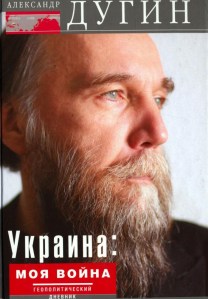
Ukraine: My War – A Geopolitical Diary

Author: Alexander Dugin

Translator: Jafe Arnold

The foreword to Ukraina: Moia Voina – Geopoliticheskii Dnevnik [Ukraine: My War – A Geopolitical Diary] (Moscow: Tsentrpoligraf, 2015). 

ukraina-_moia-voina-geopoliticheskii-dnevnik-9785227056900

This book consists of texts written in the spring and summer of 2014 on the subject of the Ukrainian drama, i.e., the Maidan, the overthrow of Yanukovich, the nationalist junta’s seizure of power in Ukraine, the start of the Russian Spring, reunification with Crimea, and the battles for Donbass and Novorossiya. These texts have three levels:

  1. The geopolitical and political analysis of ongoing events, i.e., an attempt at understanding and systematically outlining the meaning of the dramatic events in Ukraine. This is the level of detached, objective analysis).
  2. Personal reactions to what transpired, i.e., a systematic outline of a citizen’s patriotic position. This is the level of emotional involvement and empathy in which geopolitics and its processes take place not in an abstract field, but in the context of one’s full existential involvement in the process itself.
  3. The formulation of patriotic responses, projects, and programs as an imperative that is meaningful and alive on the basis of the first two levels.

The first layer of texts can serve as the basis for an impartial analysis and, as such, does not lose any value. The second layer is of interest only for those who, alongside the author, relate to the events in Ukraine as if to a personal drama, thereby empathizing, participating in, and having compassion for them. The third layer presents itself as a kind of virtual field of desires or instructions which can either coincide with reality and confirm Realpolitik or “big politics” (an appraisal of the Maidan, the reunification with Crimea, the mobilization of the militia of Novorossiya), or contradict reality (as of the current moment in autumn, 2014, no peacekeeping contingent has been deployed, the DPR and LPR’s political independence has not been recognized, and there is hesitation  in Moscow over the fate of Donbass).

The geopolitical analysis is objective, and the emotional engagement is subjective, while the spectrum of practical imperatives is a zone of intersection between what is wished for and reality.

All together, this text represents a kind of geopolitical diary, with its own characteristic features, thoughts, remarks, sharp emotions, biased definitions, convergences and divergences with the factual state of affairs, etc. This book is of precisely that genre which imposes on itself certain clear, understood limitations. Due to the fact that some of the “imperatives” have been realized, it follows that the understanding of what has happened is correct. That the others have not been realized underlines the gap between the position of the author and the resultant trajectory of Russian politics as of spring 2014, when these two different stances began to diverge considerably. The risk of this book is that it describes a process which has not been concluded. How much the author was right and how much he was mistaken, where he was ahead of events and correctly recognized their meaning, and where he hurried or factors were incorrectly correlated – all of this will become clear and depend on what the conclusion to this process will be. Therefore, this book might subsequently have a varying fate: it could turn out to have been “prophetic” or to have been merely “a set of delusions,” “subjective appraisals” and “emotional breakdowns.”

If the situation on the map was only magnificent, then the risk of this book would be ridiculous. But what the conclusion to the Ukrainian drama will be depends on much more than the scholarly authority of this book’s author alone. The Russian Spring, victory or defeat for Russia in the battle against its existential enemy (Atlanticism, the global financial oligarchy, the West), the fate of the Russian World, Greater Russia, and the fact that Russia can be either great or will not exist at all – all of this has been thrown onto the table. And, of course, in all eras people have always paid a heavy price for greatness, sometimes spilling a whole sea of blood. Our people has paid an enormous price for Novorossiya. Dozens of thousands of people have been killed defending the Russian World in Donbass. I knew many of them personally. Two of them were my friends, Boris Sysenko and Alexander Proselkov, who went to Novorossiya and died there in the name of the ideals of Eurasianism in the struggle for a Russian future. I knew many of the fallen, not all of them so closely. Some had written to me; I met some one time or another, and some went to Donbass having listened to my opinions and accepted my analysis. I recognize that I bear personal responsibility for the drama and blood of Novorossiya, for its fate, its dead, and its living. Therefore I cannot be unbiased. This is my war, and I am a participant and a soldier in it like all the rest. And this risk cannot be boiled down to reputation, but amounts to proving and upholding a life position, principles, and symbols of faith – my Russian faith and my faith in Great Russia.

This book was interrupted in mid-sentence. I continued to write texts after I had submitted those already written to the publisher. In the meanwhile, the situation changed and a number of my prognoses came true and became facts while a number were refuted. I preferred to leave everything as is, and introduced only a few corrections. Frankly speaking, I would rather change recent history rather than my own texts. Therefore, instead of appearing to be a more insightful analyst, I would prefer to remain who I am – a Russian patriot who insists on his own opinion and who goes in his own direction even when it contradicts the decisions of the authorities. Truth and principles are for me the most important successes. My mistakes in prognoses testify not so much as to incompetence as to the divergence of the Russian version of the arrangement of events with something else, the successful actions of those forces who did everything possible in order to prevent the Russian Spring, stop the Russian Awakening, and dispel the rising strength of the people or draw it away from the true enemy towards a false one. From the very beginning, I knew that the Russian Spring would encounter fierce resistance not only from without (the Kiev junta, Ukrainian Nazism and, most importantly, the West in the form of the USA with its desire to prolong global domination), but also from within, as segments of this global Western-centric network exist in Russia, are represented within the Russian elite, and make up the Sixth Column which is more camouflaged and hidden than the Fifth Column, but which is, even though more delicate, more efficient at this time. But I did not expect that it would successfully seize the initiative in Novorossiya and bring the situation to such a sad state as it is in now.

The point of the Maidan in Kiev and the overthrow of Yankovich was striking at Russia and Vladimir Putin personally. This strike was dealt and the war with Russia has reached an acute form. In some ways, we were able to deflect this strike, while in some ways we were forced to retreat. From the very onset, I oriented myself towards only one scenario, one in which war has been declared by the West (first and foremost, the USA and NATO) on us, the Russian World, Putin, and Russia, and in this situation there is only one way out: to win this war. Naturally, I assume victory to be over both the external as well as the internal enemy. I analyzed everything from the position of victory. I cannot say whether this was correct or not. The lines of victory coincide, but I did not think about defeat. Wherever we see existing differences between analysis and reality, we are dealing with defeats of the Russian World, which I did not allow for. “Well, in vain!”, some aloof analysts will say. They are probably right for their part. But what is more important for me is what Russian patriots, the people awakened by the Russian Spring, and the people of Novorossiya, both living and dead, will say. To this day, I believe in only one victory: our victory in Novorossiya and in Russia itself. It is impossible to deny the successes of our enemies, including the Sixth Column. But this is not the end. It is barely only the beginning.

This book is being released at a difficult time in the Ukrainian drama. Our offensive, in all senses, has been suspended. Perhaps the situation will change at any moment and, accordingly, so will analyses, prognoses, wishes, and guidelines. But that would be an altogether different book.

October 5, 2014 – Alexander Dugin

Pivot to the East

Author: Petr Nikolaevich Savitsky 

Translators: Jafe Arnold and Yulian Orlov

Source: Exodus to the East: Forebodings and Events: an Affirmation of the Eurasians (Sofia 1921), accessible in Russian here

There is a certain constantly noticeable analogousness in the situation of the world of France in the time of the Great Revolution and of Russia in the present time. However, apart from details and particulars, there is a fundamental difference that might be pregnant with the future… Then (as is the case now), Europe existed, and one of the countries of Europe brought Her a ‘new Gospel’: this country, having left its old political borders in a revolutionary burst outward, conquered nearly the entire continent; however, when it faltered in its conquests, the rest of Europe (by then united into a coalition) managed to bridle and occupy it. Before both the war and the revolution, Russia “was a modern civilisation of the Western type, [although] the least disciplined and most ramshackle of all the Great Powers…” (H. G. Wells) [1]. During the war and the revolution, however, the “Europeanness” of Russia fell away, much like a mask falls off a face, and when we saw that image of Russia that was not covered by a fabric of historical decorations, we saw a Russia with two faces… One of her faces was turned to Europe, that of Russia as a European country; as France did in 1793, she brings Europe a ‘new Gospel’, this time that of the ‘revolution of the proletariat’, of communism made manifest… Her other face, however, is turned away from Europe… Wells tells how “Gorky… is obsessed by a nightmare of Russia going East…”

“Russia going East”. But is Russia herself not “the East”? 

Can one find many in Russia through whose veins there does not flow Khazar or Polovtsy, Tatar or Bashkir, Mordvin or Chuvash blood [2]? Is the mark of the Eastern spirit (its mysticism, its love for contemplation, and, finally, its contemplative laziness) alien to many Russians? One notices a certain sympathetic attraction to the popular masses of the East among the Russian masses of the common people, and through the organic fraternisation of the Orthodox with the Asian nomad or pariah, Russia truly is an Orthodox-Muslim, an Orthodox-Buddhist country.

The Bolsheviks launched a campaign of persecution against Orthodoxy and mockery of all religion. This is true. At the same time, however, the religious attitude and direction of those Russian and non-Russian masses by whose movements and breath Bolshevism lives comes to the forefront with even greater clarity and emphasised by the full force of contrast… 

The Bolshevik mockery of, or the Bolshevik indifference towards religion are of as much use for understanding Russia as the Bolsheviks’ attempts to implement the eloquent prophecies of Marx in practice.

It is for this reason that Russia is not just “the West”, but also “the East”, not just “Europe”, but also “Asia”, and not even Europe at all, but “Eurasia”… For this very reason, the historical essence that was embodied in the Great French Revolution is joined by another, far from unveiled essence in the Russian Revolution…

The French Revolution was a revolution that took place in a European country with a population of 25 million and an area of 540 thousand square kilometres. The Russian Revolution is taking place in a country that is not entirely European, or even European at all, and in a country with 150 million inhabitants and an area of 20 million square kilometres. France is a part of Europe. Russia on the other hand is a “continent in itself” that is (in a certain sense) “equal” to Europe… The allies of 1814-1815 managed to pacify and occupy France. How great must the new coalition be for it to gain the opportunity to pacify and occupy Russia?.. The Great French Revolution is one of the episodes of European history. The Russian Revolution is not merely an episode of European history.

Two problems fuse together in the modern period. One touches upon deep questions of being and cultural creation; the other translates the terms of ideological denominations into the concrete language of cultural-geographic, cultural-historic reality.

Through immense suffering and deprivation, hungry and covered in blood and sweat, Russia has taken upon itself the burden of finding the truth from all and for all. Russia is mired in sin and godlessness, covered in filth and dirt; however, Russia is searching and struggling in a quest for an otherworldly city… The pathos of history will not stay its hand against those who are calm in their knowledge of the truth, on those who are self-content and full. Fiery tongues of inspiration will not descend on the beati possedentes [3], but on those who are restless of spirit: the wings of the angel of the Lord disturbed the water of the fount.   

It seems as if the world has not changed, except for the fact that Russia is now absent from the comfortable civilised world. In this absence lies change, for in her special kind of “non-existence”, Russia is becoming in a certain sense the ideological center of the world.

Translating what has been said above into the language of reality, this means that a new cultural-geographical world that has not yet played a guiding role has appeared in the arena of world history. An intense gaze looks onto the future with disdain: might the goddess of Culture whose little tent had been put up among the valleys and hills of the European West leave for the East? Might she leave for the hungry, the cold and the suffering?..

We are under the spell of a premonition… And in this premonition we can obtain a source of contentment of a special kind: the contentment of those who are suffering… To surrender to contentment means to die. It is not permissible to hide that which is considered to be the truth. However, it is also not permissible to relax in premonition. It is not by quietism, but by the achievement of self-perfection that the matter of history is formed. Those who become prideful will be abandoned by the grace of seeking, and the curse of infertility will strike the self-confident… There is no inevitability. There is possibility. Only by way of intense creativity without any fear of confessing one’s mistakes and acknowledge one’s weaknesses, only at the price of constant efforts that are realised within the limits of this ‘plastic’ world that is open to will does possibility become actuality.

Translator’s notes:

[1]: A citation from Wells’ Russia in the Shadows, which is available online here.

[2]: All groups mentioned here (with two exceptions) are ethnic groups that inhabit Russia. The Khazars were a Turkic people that ruled a large khaganate that encompassed the South-Russian steps until 969 A.D. The Polovtsy (also known as the Cumans) were a nomadic Turkic people that roamed the Russian steps until their settlement in Hungary, where they were assimilated by the local population. The Tatars and Bashkirs are two Turkic peoples who live in two republics in the southern region of the Ural Mountains. The Mordvins are a Uralic people that inhabit a republic on the Volga river. Finally, the Chuvash are a Turkic people who inhabit a region stretching from the Volga to Siberia.

[3]: ‘Beati possedentes’ is a Latin expression meaning ‘blessed are they who possess’ that is usually used to illustrate the stronger position of the possessor over someone who does not possess a certain object (as the possessor does not need to prove that he owns something, whereas anyone else must do so).

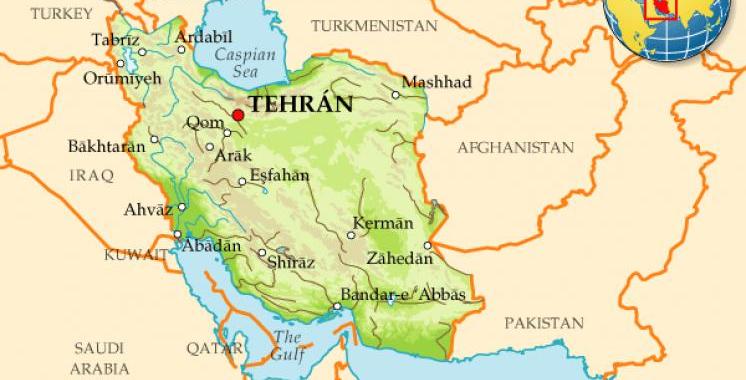
Iran and Multipolarity

Author: Leonid Savin

Translator: Jafe Arnold 

The following is an excerpt from a forthcoming book…

At the turn of the millennium, Iran’s President from 1997-2005, Mohammad Khatami, proposed the concept of a dialogue of civilizations. Initially being a counter-thesis to Samuel Huntington’s work, The Clash of Civilizations, Khatami insisted on and argued for the need for discussion between different religions and cultures, especially during his address to the 53rd session of the UN General Assembly (1998-1999) when he officially declared 2001 to be the Year of Dialogue Among Civilizations. The peculiarity of Mohammad Khatami’s theory of “dialogue of civilizations” rests in that it offers a systematic, scholarly, and practically feasible and purposeful use of exchange between civilizations to overcome barriers of alienation between different players on the global political scene to prevent crisis situations in the world taking into account the modern level of technological and communication development and with an eye towards global problems which threaten the very existence of mankind.[1]  Khatami said:

We should not forget that cultures and civilizations always have interaction and mutual influence. New abilities were formed due to their interaction. Non-dialogue paradigm leads to a deadlock, to overcome which we inevitably appeal to the dialogue approaches. Constructive indicators of dialogue certainly must not be limited only to the spheres of politics and culture. Not all constructive indicators of culture are only cultural ones; since economic, social, cultural and educational aspects participate in this formation. Therefore, promotion of dialogue of civilizations should be recognized as a multi-sided necessity.[2]

In 2001, however, a terrorist attack struck New York and the American neoconservatives subsequently triumphed in their insisting on the necessity of military intervention in Iraq and Afghanistan under the pretext of fighting terrorism and finding (non-existent) weapons of mass destruction. The harsh dualism put forth as an ultimatum by the George W. Bush Administration to the tune of “those who aren’t with us, are with the terrorists” buried any efforts at establishing such a dialogue of civilizations.

During the presidency of Khatami’s successor, Mahmoud Ahmadinejad, Iran became yet another pretext for the West’s contrived “concerns.” Meanwhile, on the other hand, Iran became an object of interest for all those forces resisting Washington-led unipolar globalization. High prices and demand for oil contributed to Iran’s economic development, although sanctions imposed by Western countries and later the UN hampered the Iranian economy. Despite this, Iran demonstrated political resilience to outside influence, remained loyal to its ideological principles, and affirmed its right to be an influential player in the region. In addition, Iran under Ahmadinejad began actively cooperating with those Latin American countries which adopted an anti-imperialist foreign policy course.

The fact that these countries’ leaderships, and first and foremost Venezuela, Ecuador, Nicaragua, and Bolivia adhered to socialist views did not hinder the establishment of an alliance which set for itself the goal of political multipolarity based on respect for the sovereignty of states and their peoples’ cultural traditions. Cooperation with Russia, China, and African countries was also amplified.

Moreover, similar views came to be shared by other senior politicians of the Islamic Republic of Iran. In May 2006, the Commander-in-Chief of the Islamic Revolutionary Guard Corps, General Yahya Rahim Safavi, stressed that “Today, taking into account countries such as Russia, China, India, an Iran, the world is moving in the direction of multipolarity contrary to the desire of the USA.”[3] Ahmadinejad continued Iran’s course towards multipolarity during his second presidential term as well. At the 65th session of the UN General Assembly in October 2010, Ahmadinejad said:

The inefficiency of capitalism and existing global governance and its structures has manifested itself for many years, and the majority of countries and peoples are in search of fundamental changes for the sake of justice in international relations…The world is in need of the logic of compassion, justice, and universal cooperation, not the logic of force, domination, unipolarity, war, and intimidation…The Iranian people and the majority of peoples and governments of the world are against the current, discriminatory global governance. The inhumane nature of this governance has brought it to a standstill and requires radical revision. Universal cooperation, pure thoughts, and divine and humane governance are needed to remedy the situation in the world and to transition to peace and prosperity.[4]

The Supreme Leader of Iran, Ayatollah Khamenei, also stressed the pursuit of multipolarity. During his speech at the 16th summit of the Non-Aligned Movement in Tehran in August 2012, Khamenei pointed out the need to reform the UN, drew attention to the West’s unilateral imposition of its programs undermining the principles of democracy, the destructive work of monopolized mass media, and problems of weapons of mass destruction. Khamenei proposed the doctrine of a “Middle East without nuclear weapons” by which, of course, he meant Israel as an outcast in this issue, and highlighted the need to improve “political productivity in global governance.”[5]  Without a doubt, such a venue as the Non-Aligned Movement’s summit is not only for political reports advising the need for high morality and justice, but is a platform for criticizing neo-imperialism. It is a powerful pooling of leaders and senior officials of states from all continents to meet and take advantage of a decent opportunity to reach agreements, discuss the prospects of joint projects, and reduce possible friction in diplomatic relations.[6] Iran’s role in this regard is very indicative.

If Iran de facto is and has been before a geopolitical center, then the changing international situation has opened the possibility for it to transform its status and rise to the level of a geopolitical pole. If Iran is approached not only as a sovereign nation-state, but as a center of Shiite Islam, then we undoubtedly see that Iran’s influence in a number of countries with Shiite populations makes it a geopolitical subject of a different level and significance. Lebanon, Syria, Iraq, Yemen, and Palestine are states which depend on support from Iran through various mechanisms.

The Iranian international relations expert Behzad Khoshandam posits that 2016 was a turning point for Iran in regards to choosing its international course, which was finally confirmed to be that of multipolarity. This is due to several interconnected factors: (1) the signing of the nuclear deal with six countries (a manifestation of the logic of Iran’s strategic patience in political, trade, economic, and other interests); (2) rapprochement with Russia; (3) Trump’s victory in the US presidential elections; (4) understanding the hostile intentions of the numerous countries conducting proxy wars against Iran (Qatar, Saudi Arabia, Israel); (5) and the overall serious turn towards Eurasia.[7] To this we can add the strategic agreement with China announced in January 2016 which includes Beijing actively supporting Iran in acquiring full membership in the SCO.[8]

Indeed, in the opinion of Iranian scholars, the country’s national interests are best protected in none other than the multipolar paradigm of global politics. Mohammad Mehdi Mazaheri from Tehran University believes that only in a multipolar international system can regional cooperation and balanced relations with all powerful states help countries achieve their national interests.[9]

The Iranian political scientist Massoud Mousavi Shafaei from Tarbiat Modares University has proposed that Iran take advantage of the fluidity of the international system and the emergence of new conditions for active operations in different regional environments. Insofar as Iran is located between the Middle East and Central Asia, it indeed does have a choice. The Middle East is submerged in chaos, ethnic conflicts, wars, and terror, and this crisis will likely continue for an indefinite period of time. In these circumstances, the restoration of order in the region under the leadership of a single hegemonic power or even under the pressure of large powers is seen as practically impossible.[10] Given that the US instrumentalizes most Arab countries to contain Iran’s geopolitical ambitions, this thesis is justified. Washington simply will not allow Iran to be more actively engaged in the region even if Iranian intentions are altogether benevolent and noble. Therefore, in Massoud Mousavi Shafaei’s opinion, Iran must reorient itself and its geo-economic logic towards Central Asia and Southeast Asia. However, this does not mean an end to Iranian presence in the Middle East necessary to defend its vital national security interests.

The opinion has also been expressed that Russia, Iran, and China “all feel that [a] multipolar world is the only condition for future development of our planet and its inhabitants. They have experienced again and again that unilateral dictates emanating from US, instead of solving problems, generates more and more of them. So it is obviously in their interests, to get united on the issue of multi-polarity, and insist – through various institutions like US, or press, or even new military alliances – that the business as usual – is not going to be accepted.[11]          

Iran understands that joining the multipolar club inevitably means pressure from the West. Thus, Tehran can expect new challenges, as can the other architects of the multipolar world order. In this vein Tehran University Professor Jahangir Karami has noted that although Russia can effectively restrict the US’ unilateral approach through the UN, NATO expansion challenges Russia’s efforts, as was the case with the crises provoked in Ukraine and Syria aimed directly against Moscow.[12]

Nevertheless, Iran has a long history of withstanding Western hegemony and other forces from the first contacts with the Portuguese in the early 16th century to the seizure of the US Embassy during the Islamic Revolution of 1979. Indeed, opposing US sanctions and working to develop their own economic approaches and conduct in international affairs are characteristic of Iran’s course towards multipolarity.

Footnotes: 

[1] Мелихов И.А. М. Хатами: межцивилизационный диалог и мусульманское сообщество/ «Дипломатический вестник», серия «Дипломатия, наука и общественность». № 9. 2001.

[2] Seyyed Mohammad Khatami. Dialogue among Civilizations. High-Level Conference. Eurasia in the XXIst Century: Dialogue of Cultures, or Conflict of Civilizations? Issyk-Kul, Kyrgyzstan, 10 and 11 June 2004. Paris, 2005. http://unesdoc.unesco.org/images/0014/001465/146593E.pdf

 [3] Иран и Российская Федерация: Россия, Китай, Индия и Иран – линия мощной силы, 10 мая 2006. http://www.iran.ru/news/politics/39484/Iran_i_Rossiyskaya_Federaciya_Rossiya_Kitay_Indiya_i_Iran_liniya_moshchnoy_sily

[4] Выступление президента Ирана на 65-й сессии Генеральной Ассамблеи ООН, 04 октября 2010 http://www.iran.ru/news/interview/68545/Vystuplenie_prezidenta_Irana_na_65_y_sessii_Generalnoy_Assamblei_OON

[5] Выступление аятоллы Хаменеи на саммите Движения неприсоединения.// Геополитика. 31.08.12 http://www.geopolitica.ru/Articles/1483/

[6] Савин Л.В. Иран, Движение неприсоединения и многополярность. Геополитика.ру, 17.09.2012 https://www.geopolitica.ru/article/dvizhenie-neprisoedineniya-iran-i-mnogopolyarnost

[7] Behzad Khoshandam, Iran’s Foreign Policy in 2016, Iran Review, DECEMBER 28, 2016      http://www.iranreview.org/content/Documents/Iran-s-Foreign-Policy-in-2016.htm

[8] Iran, China Announce Roadmap for Strategic Partnership, Farsnews, Jan 23, 2016.       http://en.farsnews.com/newstext.aspx?nn=13941103001266

[9] Mohammad Mehdi Mazaheri, Russia Bracing for Multipolar International System, Iran Review, September 21, 2015  http://www.iranreview.org/content/Documents/Russia-Bracing-for-Multipolar-International-System.htm

[10]   Massoud Mousavi Shafaei, Iran’s Foreign Policy Needs Paradigm Change: Transition from Middle Eastern Terror to Geo-economics of Asian Hope, Iran Review, JANUARY 31, 2017 http://www.iranreview.org/content/Documents/Iran-s-Foreign-Policy-Needs-Paradigm-Change-Transition-from-Middle-Eastern-Terror-to-Geo-economics-of-Asian-Hope.htm

[11] Prof. Golstein: ‘Russia, Iran, China Feel Multi-Polar World is Only Condition for Future Development’, Jul 17, 2016    http://en.farsnews.com/newstext.aspx?nn=13950421000941

[12]          Jahangir Karami, Russia, Crises in Syria and Ukraine, and the Future of the International System, Iran Review, APRIL 15, 2014    http://www.iranreview.org/content/Documents/Russia-Crises-in-Syria-and-Ukraine-and-the-Future-of-the-International-System.htm

Thinking Chaos and the “Other Beginning” of Philosophy

Author: Alexander Dugin

Translator: Yulian Orlov

From Platonizm.ru 

Chaos was not part of the context of Greek philosophy. Greek philosophy was built exclusively as a philosophy of the Logos, and to us such a state of affairs is so normal, that we (probably correctly from a historical point of view) identify philosophy with the Logos. We do not know any other philosophy, and, in principle, if we are to believe Friedrich Nietzsche and Martin Heidegger along with contemporary postmodernist philosophy, we will have to acknowledge that the very philosophy which was discovered by the Greeks and built up around the Logos has today fully exhausted its contents. It incarnated itself in techne, in the subject-object topography that turned out to be evidentiary for only two or three centuries until the final, sunset note of West-European philosophy. As a matter of fact, today we are standing on the line or endpoint of this philosophy of the Logos.

Today, we can glimpse the entire process of the evolution of logocentric philosophy that began with Heraclitus and the Pre-Socratics, reached its apogee in Platonism and Socrates, was developed fairly violently in Greco-Latin patristics and later in Scholasticism and the Neoplatonic Renaissance and, in the New Era, turned together with Descartes through the subject-object topography onto its last- self-reflective stage that, in turn, ended with Nietzsche.  According to Heidegger, it was precisely Nietzsche who ended West-European philosophy. Thus, we have before us a finished story with a beginning, climax, and end, all about logocentric culture. The Logos, from cradle to grave. But then we have to ask ourselves: who was Heidegger?

On the one hand, Heidegger definitely ends this process of Western philosophy and puts down the final seal, but on the other hand he (potentially) lays the foundations of something new. The end of philosophy is absolutely clear, but the question about the “other Beginning” (der andere Anfang) remains open.

It is totally clear that West-European philosophy, being logocentric, has exhausted its potential. However, we have to ask ourselves the question: what role did chaos play in this logocentric philosophy? It was rejected from the very beginning, left out of account, crossed out, because the Logos is based on the exclusion of chaos, on the affirmation of there being a hard alternative to it. What is the fundamental difference between logos and chaos? The Logos is exclusivity, the Logos is separation, the Logos is a clear idea about the one and the other; it is not by random chance that the Logos received its formalised form in the logic of Aristotle, in its fundamental laws: the law of identity, the law of negation and the law of the excluded third. It is necessary to emphasise that modern and post-modern studies entirely correctly show, that the logocentric understanding of the world is masculinoid, i.e. exclusively male, exclusivist [1]. It is this way, in an explosive manner, that men think of the world and order. The Logos is a male, hierarchised beginning that was simplified in West-European philosophy, reached its high point, and… collapsed, was cast down, dissipated. Today, the “great man”, the “cosmic man” has been shattered into fragments. He collapsed, and together with him his philosophy crumbled, as the Logos and the male beginning are, as a matter of fact, the very same thing. This is where the rightness of the postmodernist, critical term “phallo-logocentrism” comes from. The entire West-European philosophy was built on the male principle from beginning to end. This end is here. We are living through it. This means that the Logos is exhausted. Therefore, we must either meekly slip into the night, or search for new paths.

If we review this process of the appearance, establishment, and downfall of Western European philosophy and the appearance of the Logos in a pure form, consequently, as demasculinisation continues (according to Plato, only the philosopher is a true man; in other words, a man is he who philosophises; therefore, today we can speak of a sweeping degeneration and spiritual castration of men, as they are no longer capable of engaging in philosophy) and the Logos falls, we see before us an image of mixing: dissipated fragments of male logical thought are turbulently mixing amongst each other, thereby forming a post-masculinist amalgamate. It is precisely to this mixing, this phenomenon of the turbulence of parts that are no longer part of something whole that is indicated by those who use the concept of “chaos” in modern science.

Here, we must immediately say that the chaos with which modern science, modern physics, and chaos theory operate is actually a set of structures of order that is more complex. This is nothing else than complex systems that are not at all alternatives to order as such, but are just an extravagant, baroque (here, too, the ideas of postmodernist G. Deleuze from his essay “The Fold: Leibnitz and the Baroque” are valuable) version of a complexified, twisted and significantly perverted order. That was is today called “chaos” by representatives of the scientific and, in part, the cultural establishment is the condition of the post-logical world, a world that is still located, however, within the Logos, inside its orbit, albeit at the most distant periphery, at its last border. A very precise name for such a state of affairs has been given by René Guénon, who called this situation “la confusion” (Fr. “mixing”, “tangle”, “everything getting caught in everything else”.

The concept of “chaos” that is dominant in modern science does not correspond at all to the Greek chaos as something primordial, organic, and spontaneous, but as the product of the collapse of logocentric philosophy and the logocentric culture that was based on it. The fact that we are today dealing with an alleged “chaos” actually refers to the product of the Logos’s collapse and separation into different fragments. It is precisely for this reason that scholars of “chaos” find within it residual or extravagant, eccentric structures of the Logos. These can be studied and quantified only in more complex procedures and with the help of a special device that has been adapted for the quantifying and description of bifurcational processes, non-integrated equations (I. Prigozhin), and fractals (B. Mandelbrot). The theory of “chaos” studies process that are exceptionally dependent on initial conditions. The definition of “chaos” in modern science is today taken to be the following: a dynamic system with the following traits: sensitivity to initial conditions, topological mixing, and the density of periodical orbits. Mathematicians further specify, that a “chaotic system should have non-linear characteristics and be globally stable, but also have at least one unstable point of equilibrium of oscillating type; in addition, the dimensions of the system should be no less than 1,5 (i.e. the order of a differential equation should be no less than 3)” [3].

Actually, it is not the Greek chaos at all that is hinted at in this concept of “chaos”, but a product of the dispersion and disintegration of the Logos. This is so because we have not yet left the bounds of the Logos: the chaos that modern science deals with is integrated into the Logos, it splashes around within its inner space (albeit at the most extreme orbit), as far away as possible from the logocentric axis, in the furthest borderland of the conceptual Platonic cosmos, in the world of the Titans [4]. Therefore, we must, strictly speaking, call this reality a “very remote copy” that has nearly lost its link to the original; we must not in any case, however, call it “chaos”. Here, either the term “mixing” (Guénon’s “la confusion”) is most appropriate or the postmodern concept of the “simulacrum”, which J. Baudrillard interprets as a “copy without an original”. This is an intralogical zone (albeit at a maximum distance from the centre) that has nothing in common with the initial image of Greek chaos, which, according to myth, precedes the Logos, precedes order, i.e. the cosmos. True chaos is pre-cosmic, pre-ontological. The “mixing” or “chaos” of modern science is post-cosmic, and although almost nothing of being remains within it, it still is, which means that it is in some sense ontological. Here, Zeno’s aporia on the quick Achilles and the turtle is entirely relevant. No matter how much the “mixing” might try to run from ontology, it is analytically incapable of doing so; as René Guénon shows, a line x moving towards 0 will never be equal to 0, but will only continually approach 0 while always remaining at an ever diminishing but still infinitely great (although it is infinitely small) distance from it. 

While researching “chaos” (the philosophical Gilles Deleuze describes this as a way of coexistence for incompatible monads [6]; Deleuze himself calls such “monads” “nomads”), modern science is researching the intra-logos, post-logos, dissipative order, instead of an alternative to order, as the nihilistically minded postmodernists had hoped. 

Here, it is important to pay attention to the concept of “nothing”. The Logos draws everything into itself and accords to everything the quality of self-identification with itself, i.e. with the Logos. The Logos is everything and draws everything into itself, with the exception of that which it is not; but that which it is not is nothing, the Logos excludes everything that it does not include, and, as it includes everything, only nothing remains outside of it. However, it interacts harshly with this nothing: according to Parmenides, there is no non-being. Nothing surrounds order and serves as a boundary. As we are looking at nothing through the eyes of the Logos, however, it becomes clear that we cannot reach that boundary. However hard we might strive to words nothing, whatever nihilism we might cultivate, we keep remaining in the limits of something and not nothing, inside of order, under the hegemony of the Logos. And even though this hegemony weakens at its extreme limit, it never entirely disappears. Therefore, on the road towards liberation from the power and domination, the modernists (and the postmodernists after them) find the figure of the “despot” in God and traditional society, in society as such, later in reason, even later in man himself, structures, language, context (poststructuralism) etc. The condition that there is no non-being makes being unbearable for those who consider its weight to be a hindrance. All evocations of “chaos” or calls to “nomadic”, incompatible monads that are incapable of providing the desired result, i.e. the final and irreversible uprooting of the “will to power”, which is the main aim of the liberating program of the Enlightenment cannot and will not succeed by its very definition.

Those who understand the situation of the deep crisis of Modernity (in particular Martin Heidegger) turn to the roots of the West, to the Greek matrix that birthed philosophy. Heidegger meticulously studies the birth of the Logos and tracks its faith, all the way up to the rule of technics, Machenschaft. In order to describe it, he introduces the concept of “Gestell”, in which the referential theory of truth itself is summed up, from Plato (and even from Heraclitus) up to the mechanical mercantile-materialistic civilisation of modern, utmost planetary (but continuously Western-centric) decadence. Having examined the history of philosophy (which also is history as such) from beginning to end, Heidegger finds that it ended so wrongly precisely because it begun so incorrectly. As an alternative, he proposes the project of the “other Beginning” [7].

Having described the first Beginning of philosophy, which led to the logos and, finally, to that dissipative postlogos (and post-masculine) ontological regime that we find ourselves in, Heidegger identifies it as the consequence of a fundamental error that was made in the first, even preparatory stages of the development of West-European philosophy. According to his views, the history of Western European philosophy, culture, and religion is the result of a small, primordial fault in our metaphysical contemplation. According to Heidegger, two-and-a-half thousand years of human history were in vain, seeing as at the very beginning, somewhere in the area of the first formulations of the Logos’ status, a certain error was accidentally allowed to sneak in, an error that, as Heidegger puts it, must first be acknowledged and then be overcome. Thus develops his idea of the two Beginnings of philosophy: the first Beginning, which began, formed, developed, flourished, and eventually degraded and has now become nothing (let us at least remember the modern nihilism that was discovered by F. Nietzsche and magnificently examined by Heidegger), and the other Beginning, which could be found as far back as the roots of philosophy (but this did not happen, and we can see the result: the Logos and its defeat), but, in any case, it should be delineated and initiated now, while everything is clear. But this beginning will begin only when everything truly becomes clear. Everything became clear to Heidegger. The rest is experiencing a “delay”, everything is “still not clear”, noch nicht[8], the eternal “still not”. The other Beginning — der andere Anfang.

If we examine in detail what Heidegger means by the “other Beginning” (the alternative, potential Beginning that has not yet formed or come to pass), and if we trace the line of the grandiose deconstruction of the Logos that he has undertaken, we will be able to view the entirety of West-European philosophy, culture, and history, including religious history; after all, religion is nothing other than the development of constructions of the Logos (which is why Heidegger speaks of “theologica”: the Christian faith, as well as the Muslim kalam and theological Judaism are founded upon the Logos, and, in principle, we know of no other monotheistic religions but for those religions of the Logos). The logocentrism of religions is a very important thing to understand: it shows, that it is futile to turn to religion when searching for an alternative or protection from the downfall of the Logos. The crisis of modern religions is the crisis of the Logos; when the Logos collapses, its entire vertical structure and all its variations (including theological ones) fall with it. This is interrelated: monotheism loses its fascinativeness as the attraction of the Logos weakens, and vice versa. Religions without the Logos cease to be themselves. But even in the case where the Logos is present within them, it will be as a phantom pain, a “confusion”, as the vanity of desemantisised structures (which is what we are seeing today in the form of the dubious phenomenon of a “religious renaissance”, which unambiguously smacks of a simulacrum and a parody).

For this reason, Heidegger proposed to look for an exit in a completely different way: in the sources of Greek philosophy, in the very Beginning (even in the vestibule of this Beginning) on the one hand, and beyond the boundaries of our world on the other, thereby uniting the problem of the moment of philosophy’s birth, its existence in an embryonic, intrauterine state with the problem of the moment of final agony and death. Before Heraclitus, philosophy was located in the uterus, the Logos “swam” in amniotic fluid, in a matrix: today, the Logos is buried in its grave. The grave and the womb have, on the one hand, the meaning of an antithesis: the first signifies death, the second birth; however, at the same time we know, that in the collective unconscious they are synonyms, mutual systems. One can figuratively say, that in both cases it is a night, darkness, existence without distinction, erasure of borders, nocturne [9], all the more so because many intiatic rituals are linked to a descent into the grave as well as the beginning of resurrection, i.e. another, second birth. This is also the rite of Orthodox baptism: water symbolises the earth, the grave, death. The total, three-time immersion of the baptised into the baptistery is a symbol of the three days Christ spent in the grave. It is a descent into the earth, into the grave: the “burial of Christ” is a prerequisite for a new birth.

Thus, if the Logos was born in the first Beginning of Greek philosophy through the rejection of Chaos as an exclusive, central principle of division, hierarchy, exception, and order; that is to say, the male beginning was essentially raised to the level of the absolute; and if all of this began the way it did, and if everything ended with what we have in the modern world, then, accordingly, we must follow Heidegger in finding what was lost, what the mistake of that first impetus, which started the development of a logocentric civilisation, was. Heidegger develops his vision in recapitulative and exceptionally complex book “Beitrage zur Philosophie” [10], which I recommend all readers to familiarise themselves with (the work has not been translated, and I would say that this is excellent; it cannot be translated, and there are things that are not just difficult to translate, but which are criminal to translate, things that require the original language to be learned to be understood). The book directly deals with the “other Beginning”; contrariwise, we find a short and relatively “light” treatment of these ideas in the “Geschichte des Seyns” [11].

Heidegger proposes us to think in a radically different way from the one that is usual in philosophical or philosophical-religious thought. But how is it possible to philosophise differently, how can there be a “different Beginning” of philosophy? If we take a close, detailed look at the moment of the birth of Greek philosophy, we will find a single, essential element: philosophy is born alongside exclusion; what is more, it is Chaos that is the first victim of exclusion. Chaos is not a philosophical concept and never was one, but it enters philosophy exclusively through its intermediary, through its substitute in the person of the choir (cora), Platonic “space” in the “Timaeus”, or later in the person of Aristotle’s “matter” (ulh). However, the view of the choir in the “Timaeus” and the view of Aristotle’s matter is the view of the Logos [12], and all the Logos says it that it has already excluded Chaos during the process of its ascension in a similar fashion to “political propaganda” or a “press release”. What the Logos tells us about matter is an exclusively constructivist Wille zur Macht, the “will to power”, a development of an impassioned and aggressive strategy of male domination, the establishment of hierarchic hegemony, the projection of wishful thinking and self-fulfilling prophecy. From the very beginning of philosophy, the “dog was wagged”. Philosophy tries to force unto us that, which is favourable to itself. This is the hiding place of male cunning, the male drive to the absolutisation of the self, and, accordingly, the exclusion of the female beginning, the “other” beginning. And, if we examine this, we can recognise the total incomprehension of the woman. This is the source of woman being accorded qualities that, in reality, she does not have at all. Thus, the male forms between itself that which is excluded by the male from the intellective process. The Logos rejects the choir because of its (un)intelligibility. However, it does not understand it purely because it does not want to understand and prefers to deal with a representation instead of the female itself. The man thinks, that the only way of knowing the woman is to hide her in inner rooms, separate her from the public, social dimension. Later, he thinks a suitable solution is to chase the female away entirely, etching way her traces through the suffering of lonely male asceticism. Therefore, the opinion of the Logos about chaos is a notorious lie, violence, hegemony, the exclusion of chaos as the other. As the Logos is everything, chaos becomes nothing [13].

If we want to comprehend the very possibility of an “other Beginning” of philosophy, on the one hand, we must come to the moment of the birth of the Logos and fix this transition of the boundary, discern the details and semantics of this rite du passage. How could it have come to pass that the Logos managed to break loose, unbind itself, and who allowed it to issue its own, exclusive decrees concerning chaos? Now we come to the most interesting: if we feel discontent with the dissipative logical and postlogical structures, we must acknowledge, that we must turn to the Logos again, seeing as it was the Logos that created all the prerequisites of its dissipation through its exclusivity. We cannot simply up and return to Platonism: there is no way back. The Logos moves only in one direction: it divides and divides (and divides and divides… and so on into the distance [14]). Gilbert Durand [15] call this logic the regime of the “diurn”: until everything is reduced to a chit and stops. This schizomorphosis [16] directly leads to G. Deleuze and F. Guattari’s concept of “schizomass” [17]. This has been beautifully illustrated in the films of Takeshi Miike, for example, in “Killer Ichi” or “Izo”. In the latter film, an insane samurai, having begun his battle with the world, does not stop until he has cut everyone he encounters into pieces. Izo is the Logos.

The Logos will not help us. If we do not like how the modern, postlogical world is organised, we are forced (if we like it or not) to turn to chaos. We have no other alternative: we must fundamentally step backward towards the first Beginning of Greek culture, in order to make even the smallest step forward, truly forward, and not following the endless arc of the eternally ending world, that is still not capable of finally ending (“still not”). If we do not do this, we will reach the eternal deadlock of the infinite return of dissipative structures and confusions. This is the choice we must make: either we choose the modern, postlogical chaos of confusions, or we break through its boundaries; but the way to break through its boundaries can be found only in chaos, which itself precedes the Logos and is located radically beyond its borders, behind the line of its peripheral agony. 

Chaos can and should be seen as an inclusive order, as an order founded upon a principle that is opposite to the Logos; that is to say, the principle of inclusivity, inclusiveness. Therefore, it is very important to understand what inclusiveness means. Once we have comprehended this term, we will know if it is at all possible to build a philosophy of chaos, that is, a philosophy of the “other Beginning”.

If we see chaos the way it is seen by logocentric models, we will get nowhere. There is nothing logical (exclusive, masculine, no Wille zur Macht) in chaos, and this means, that it becomes ouk on (Greek: “pure non-being”), French “rien”, Spanish “nada” to the Logos and Onto-Logos. – ouk on and not mhon, as the Greeks called the non-being that is capable of producing something from itself, “pregnant non-being”). As the Logos will not see anything except itself, according to the principle of Aristotelian logic, we cannot juxtapose anything to it: either A is equal to A (and, in this case, we find ourselves within logical boundaries) or A is not equal to A; now we are outside of those borders, in nothing. According to Aristotle, the latter situation means that A simply does not exist; the A that was not equal to A does not exist. This is in contrast to, for example, the view of the Japanese philosopher Kitaro Nishida, who has, in contrast to Aristotle, developed a separate logic of spaces, “basho”, founded upon Zen Buddhist models of thought.

However, outside of the Logos and its hypnotic suggestion, it is entirely possible to conceptualise chaos as a principle of absolute inclusion or an inclusive philosophy. Why is this possible? Because, if we extract ourselves from the political propaganda of the Logos (under the conditions of which we have been living for two and a half thousand years), we will be able to see chaos as it presents itself, and not the way the Logos presents it. Chaos reveals itself as the inclusive, it carries within itself all possibilities, including the possibility of exclusion, right up to the exclusion of the self. Naturally, chaos contains the Logos as it thinks itself, like a seed in a woman’s uterus: it is and it is being born, it will most definitely be born, tear away, mature, and leave: however, something more important is left out of the picture: that which allows it to live, that which produces, nurtures, and feeds it.

The Logos can be seen as a fish swimming in the waters of chaos. Without this water, thrown onto the surface, the fish chokes, and this is, actually, how the structures of the Logos “croaked”. We are dealing with nothing but its dissipative remains. These are the bones of the fish that has hurled itself onto the shore. It is not by chance, that many speak of the symbolism of Aquarius as the new water, without which the old fish could not live.

The philosophy of chaos is possible because chaos, being all-inclusive, all-encompassing, and the antecedent of any exclusion, contains this very exclusion within itself, but carries a different relation to it and itself, as well as differing from the way exclusion itself (i.e. the Logos) relates to chaos and itself. We know only one view of chaos: the philosophical view from the position of the Logos, and if we want to look at the Logos from the point of view of chaos, we are told that this is impossible, seeing as we are used to examining chaos only from the point of view of the Logos. It is thought, that only the Logos is capable of seeing, and that chaos is blind. No, this is not true, chaos has a thousand eyes, it is “panoptic”. Chaos sees itself as that which contains the Logos, which means that the Logos is located within chaos and can always be within it. However, while containing the Logos within itself, chaos contains it in a totally different way the Logos contains itself, which it does by rejecting the fact that it is contained by anything (whatever that container may be) except itself, and, accordingly, placing chaos out of its view, equating it to nothing, rejecting it. Thus, the fish, recognising itself as something different from the water surrounding it, can come to the conclusion that it no longer needs the water and jumps onto the shore. However one might try to throw the stupid fish back, it will try to jump time and time again. They called this insane fish “Aristotle”.

But water is the beginning of everything. It contains the root of other elements and other creatures. It contains that which it is and that which it is not. It includes that which acknowledges the abovementioned fact, but also that which does not.

We can draw the following conclusion: first, a philosophy of Chaos is possible, and second, salvation through the Logos is impossible: the salvation of the Logos is only possible through a correct turn towards chaos.

Chaos is not just “old”, it is always “new”, because eternity is always new: the eternity (l’éternité) that Rimbaud found again (a retrouvé) – c’est la mer allée avec le soleil. Pay attention: la mer. Chaos is the newest, the freshest, the most fashionable, the latest from the current season’s collection (Il faut être absolument moderne. Point de cantiques : tenir le pas gagné) (1). Precisely for the reason that it is absolutely eternal: time ages extremely quickly, yesterday appears archaic (there is nothing more ancient than the “news” of a month old newspaper), only eternity is always absolutely new. Therefore, the discovery of chaos does not equate to an excavation of history or of the structures that are presented to us as conquered by historical time; no, it is an encounter with the eternally young. Chaos was not sometime earlier or before. Chaos is here and now. Chaos is not that what was, as the Logos propagandises. Chaos is that what is, and that what will be.

In conclusion, we return once more to Heidegger. To reach the truth of being (Wahrheit des Seyns) is possible only in two moments of history: in the Beginning, when philosophy is about to be born, and in the End, when the disappearance, the liquidation of philosophy takes place. Of course, individual personalities could reach the truth in different stages as well; however, they could do this, but they could also be satisfied with something else: they lived in the magic of the Logos, warming themselves in the rays of the solar seed.

Today, this is the only thing we have left, all the rest has been bled dry, and to satisfy ourselves with dissolution in an endlessly ending but incapable of truly ending world, in the “not yet” is the fate of nonentities. Apart from this, doing this in our time is easier than it ever was before. You and I, dear reader, are living in extraordinary times, in which we are presented with an entirely unexpected opportunity to directly encounter chaos. This is not an experience for the weak minded. After all, our task is the construction of a philosophy of chaos.

Footnotes: 

[1] See the problem of the “diurn” in the topography of G. Durand’s imaginative structures. Dugin A. G. Sociology of the Imagination. Moscow:Akademichesky Proekt, 2010.

[2] Deleuze, G. The Fold: Leibniz and the Baroque. Moscow: Izdatelstvo Logos, 1997.

[3] Gutzwiller Martin. Chaos in Classical and Quantum Mechanics. New York: Springer-Verlag, 1990.

[4] See Proclus. Commentaire sur le Timee. Par A.J.Festugiere. t. I. P.:Vrin, 1966.

[5] Guenon René. Les principes du calcul infinitésimal. Paris, Gallimard, 1946.

[6] Deleuze, G. The Fold: Leibniz and the Baroque.

[7] Dugin A. Martin Heidegger. The Philosophy of Another Beginning. Moscow: Akademichesky Proekt, 2010.

[8] Heidegger M. Sein und Zeit. Erstes Kapitel §§ 46–53. Tübingen: Niemeyer, 1952.

[9] Dugin A. G. Sociology of the Imagination.

[10] Heidegger M. Beiträge zur Philosophie. Frankfurt am Main: Vittorio Klostermann, 2003.

[11] Heidegger M. Geschichte des Seyns. Frankfurt am Main: Vittorio Klostermann, 1998

[12] Dugin A. Martin Heidegger. The Possibility of Russian Philosophy. Moscow: Akademichesky Proekt, 2011.

[13] Ibidem.

[14] On “diarhysis” and the structure of the “diurn”, which are distinct features of the Logos’ work, see Dugin A. Sociology of the Imagination..

[15] Durand G. Les Structures anthropologiques de l’imaginaire, Paris: P.U.F., 1960.

[16]  Ibidem.

[17] Deleuze, G., Guattari F. Anti-Oedipus. Capitalism and Schizophrenia. Yekaterinburg: U-Faktoriya, 2007.

Translator’s note:

(1): One must be absolutely modern. Never mind hymns of thanksgiving: hold on to a step once taken.

The Solar Hounds of Russia

Author: Alexander Dugin

Translator: Yulian Orlov

From part 5 of Tamplery Proletariata [The Knights Templar of the Proletariat] (Moscow: Arktogeya, 1997). 


1. Terminus

The border circumscribes the State. It describes the State. In being its boundary, it determines the State.

Every thing is what it is thanks to its borders. After all, it is they that separate it from another thing. This distinction carries the most important meaning of the concept of the border not just for international law, defense doctrine, or the structuring of a country’s armed forces, but also for philosophy as such. The border is not just an instrument of philosophy, but its essence, seeing as the highest philosophical concept – transcendence -in Latin literally means “that what lies on the far side of the border”.

The border externally reflects that which lies inside it, while simultaneously confining the essence of the thing in its confrontation with other things. The border is something sacred. The ancient Greeks knew a special god, Terminus, whose name meant ‘limit’, ‘border’. This was not just the guardian-deity of borders, but a “border-deity”, a kind of special, sacred concept that played a central role in the worldviews of the ancient Indo-European peoples.

In magic, there also exists the important concept of the “Guardian of the Threshold”, a special being that is located at the intersection of two worlds: the beyond and the present, the vulgar and subtle, that of life and that of death, the waking world and the dreaming world. This is the very same ancient Terminus, with only slight modifications.

The hierarchy of the “guardians of the threshold” is described in particular detail in Tibetan tantric Buddhism. They are depicted as dakini, terrifying female creatures from the retinue of the goddess Kali or Tari. They throw themselves at a man the very moment he reaches a new level of existence: at the moment of completion of special rituals (especially the ritual of Chöd), during travels through abandoned places, immediately after death etc. It is as if the “guardians of the threshold” try to make sure that people and things remain themselves, to ensure that their inner “I” is preserved unmolested and steady. As soon as someone crosses a line, they are right there. The same could be said about the philosophical side of things. A thing exists through its concept, through a kind of awe-inspiring aureole of meaning and language that does not allow it to dissolve in the chaos of an unstructured, irrational reality. The border is adjoined to reason and reason’s secret nature. As an exclusively human and divine quality of the highest order, reason happens to manifest precisely through the erection of borders, definitions, confirmations of the essence of things and phenomena.

Thus, the border is the foundation of thought, the manifestation of the divine principle. God as such is limitless, ‘transcendental’; however, he reveals his divinity through the absence of those borders that He already affirms in being, in order to differentiate Himself from the not-Him and to ‘become known’ by the not-Him, even if partially.

If all of this is true, then the borders of the state and their defenders should be allocated an entirely distinct symbolism and execute a highly important, sacred mission that far and away transcends a purely utilitarian, administrative, military-strategic function.

Border guards are not just a type of soldier, but a kind of special, sacred quality. They are the modern adepts of the extremely ancient cult of the god Terminus.

2. Expansion: from tribe to Empire

The border as an index is not quantitative, but qualitative. The greater its volume and extension, the more universal and full-fledged the concept it expresses through itself. Therefore, as the concept (the definition, enclosure of space by the boundary) widens, it encompasses in itself a constantly growing number of individual aspects. In other words, everything that is included in the concept is comprehended by the mind as a part, while it could earlier have been erroneously taken as a whole. The widening of the border of things and concepts is a dynamic process of the development of a single essence that clearly demonstrates the common part of something that earlier was present in two (or several) different things before a certain moment. Thus, the concept “animal” includes tigers, rabbits, mice, turkeys, elephants etc. “Animalness”, “animality” lays bare its universality through the inclusion of all species and variants of living creatures, which themselves make the transition from the individual to the common.

The same happens in the state. A tribe or lineage has its territorial, cultural, linguistic etc. borders. These borders widen, stretching themselves out to the concepts ‘people’, ‘nation’, ‘state’. Finally, the highest form of a state is the Empire. Its borders are enormous, they include the maximum possible number of natural human organisations: it has a place for tribes, lineages, cultures, religions, nations, ethnoi, and, in some cases, it can even accommodate likenesses of independent states (provinces, dominions etc.). As a form of state, the Empire is the highest category, comparable to the most sacred and all-encompassing gnoseological concepts such as “God”, “Truth”, “Good” etc. This is why the concept of the “Sacred Empire” is so durable. The sanctity of the Empire flows forth from the quality of its borders, which should incorporate some kind of absolute, universal knowledge, some kind of global mission that constitutes the essence of the imperial state as a historical and national community. For this reason, the borders of the Empire are directly linked to its fundamental theological orientation. The Roman Empire and its borders carried within them one spirit; the Empire of Alexander the Great another; the Arab Caliphate a third; Byzantium yet another; Rus a fifth and so on and so forth. The axial mission of the Empire also dictated the quality of Its borders, be they maritime, riverine, overland, and located in mountain, steppe or desert… The highest idea of the Empire spilled out into the landscape and structure of the borders. Researching the transition from maritime to terrestrial borders allows us to trace the dynamics of the spiritual and social development of a society, and even to from time to time explain the most important religious, cultural, and economic transformations. Thus, only after the unification of all lands in a unitary state did England recognise itself as an Island, did it change its religion, transition to a maritime existence, and lay the foundation for capitalism and industrialisation (1). The movement from clan to Empire is not a political, but a spiritual process that is merely reflected in earthly reality. As borders expand and different landscapes, civilisations, religions, and ethnoses are included into a unified geopolitical space, the discovery of a new, more universal Idea, that had earlier hidden Itself under the kaleidoscopic manifold of the multitude, takes place.   

3. Templars of the Great Wall

Based on the direct link between the sacred spirit of Empire and its borders, military units of border guards (warriors who were charged with the protection of the far reaches of the state) were formed in traditional civilisations. This link can be seen most clearly in the Knightly Order of the Temple, the Templars, warrior monks and bearers of a special, universal knowledge. This esoteric knowledge was concentrated in the secret of common ratios that were capable of unifying different regions of the feudal medieval West, including Near-Eastern lands. The symbolism of the Templars does not only contain very ancient pre-Christian elements related to the sacred geography of Europe, but also doctrines drawn from esoteric Islam, especially from Sufism and heterodox Shiism. It is not by chance that the overwhelming majority of Templar commanderies were located next to megalithic structures which had once belonged to civilisations of more ancient eras. The Templars united the North and the South, the past and the future. The warriors of the Order executed a most important function: the safekeeping of the secrets of Western unity. Simultaneously, their conception of Islam opened up an opportunity for a truly imperial expansion beyond the boundaries of Europe, towards the south and south-east. Growing their esoteric competencies, the members of the Order potentially laid the foundation for an expansion of the State, of the Western Roman Empire. Once more, it is not by chance that with the destruction of the Order by Philip the Fair, United Europe collapsed for all eternity. The line of the Ghibellines and the Hohenstaufens [1] was defeated by the Guelphs, the Vatican, and divided nation states modelled after the centralist and absolutist France.

The Templars, as well as their analogues in other cultures, were a shield against the intrusion of the forces of hell, Gogs and Magogs of the Bible, into the Empire [2]. They defended sacred civilisation from streams of decomposition and sickness. It was this that was the goal of Alexander the Great’s “iron wall”. The very same symbolism forms the foundation of the Great Wall of China, as well as the ancient fortifications on the northern borders of the Roman Empire. When the Orden of the border guards disintegrates, the foundations of imperial unity are undermined, the forces of chaos infiltrate civilisation, and, finally, a new collapse and Babylonian mixing of the tongues begin. The fall of the Empire is the catastrophe of the order of the border guards (in the physical as well as magical sense).

A brilliant illustration of the magical nature of border guard duty is given in the film “The Desert of the Tartars” [3]. In it, a mysterious, exclusively male collective (Mannerbund) of border guards awaits the advance of an enemy, an imaginary enemy, faith in the existence of which is seen by the border guards themselves as an obsessive, collective mania. One after the other, they fall to internal tension. Only the last of them, haggard from premonitions and visions, receives his reward: he becomes worthy of participating in a true miracle, during which the imagined enemy becomes a reality and its wild hordes attack the almost defenceless and abandoned fortress. The last templar against the hordes of Gogs and Magogs.

4. Cynocephalus

The Soviet Empire was an empire in the fullest sense. It was united by a common, universal idea: the idea of Socialism, in which the primordial Russian will to Truth and Justice manifested itself. The Soviet was a legitimate continuation of the Russian and the Orthodox, if only more universal, more common, more global. The archetype of border mysticism was entirely analogous to the traditional idea of the role of the Templars, the guardians of the threshold. The Soviet period was initially pregnant with a deep esotericism, which, however, was rarely expressed in a rational, open, and finished way.

To trace the trails of the Templar element in the concept of the Soviet Border Troops, we will turn to the most banal association possible: “the border guard and his trusty hound” [4]. The hound is not just an instrument of state security. It is something more: a symbol. The symbolism of the dog in the Tradition is tightly linked with the idea of the border in a wide sense, including in the metaphysical dimension. The dog guards the house, all the while located at the edge of the internal and the external. This animal is the incarnation of the “guardian of the threshold”, of an occult character, whose mission is the safekeeping of the selfsameness of the thing. Simultaneously, however, the dog also symbolised a crossing of borders, which is why it accompanied the soul of the deceased in shamanic rituals meant to help the dead travel to the other world. In other words, the dog is the animal manifestation of the god Terminus, the border deity. This is the origin of the very ancient myth about the origins of men and hounds. The Mongols and Turkic peoples state, that their ancestors were “yellow hounds”. The same belief remained among many North American Indians. The main hero of the Celtic national epos is Cú Chulainn, whose name means “the hound of Chulainn”. Even Christianity knows an image of the dog as a sacred symbol. For example, Dante uses the word veltro, “beagle”, to indicate a mysterious harbinger of the Second Coming, as well as the “Ghibelline emperor” (once again, a link with the Empire!). Monks of the Catholic Orden of Saint Dominicus deciphered their name as “Domin canes”, “hounds of the Lord”. The same symbolism is found among the Egyptian cynocephali, divinities with canine heads, especially Anubis, the “guide of the dead”. The Greek Cerberus stems from the same origin. This symbolism allows us to form the following image: the border guard (the modern analogue of the Templar) is not just the master of the hound that he uses, but, in the spiritual perspective, becomes a projection of the Sacred Hound, a manifestation of Anubis, cynocephalitic, a “yellow hound”. The animal and man “change places” as it were. Human individuality retreats in the face of a higher, magical function. Personality disintegrates in the mystery of the border.

Not the eagle, but the Hound’s Head should be the emblem of the border guards, the seal of a neo-Templar order, and, in turn, we involuntarily remember the attributes of Ivan the Terrible’s oprichniki   

5. Requiem

The fall of Empire is not just a socio-political catastrophe. It is a spiritual disaster. Along with the contraction of the borders, a collapse of the life-giving organic idea takes place. The highest philosophical spheres are struck. The parts lose their understanding of belonging to the whole, fall away from the life-giving centre, die off, and degenerate. The fall of the borders is the fall of concepts, ideas, a mental muddling. The fall signifies blood and the mixing of tongues. It is a deep catastrophe of the holy figure of the border guard. The forces of hell infiltrate the nation; the thief makes his way into the house; strife and numbness assault peoples. The cynocephalic god Terminus loses consciousness and distances himself. The chaos of spiritual night descends unto the Empire’s people.

Empire is the good made manifest into endless borders. The end of Empire is evil, manifesting itself in the destruction of borders. This is national, state treason, but it is also more. The warriors who fell at the border, the templars of the Soviet Idea are betrayed by their successors and descendants; however, their magical acts are primordially mated to the mystery of thought. The fall of the borders is directly provoking a crisis of philosophy. The chaos of the Gogs and Magogs penetrates the mind. Idiots head the country’s government.

The bastion of the spirit has fallen.

The gates of hell are open.

Hordes of enemies pour in through the crack in the great wall… 

All is lost.

But the abandoned, betrayed, lonely and forgotten border guards of the Empire carry on their duty at far-flung posts. Islands of Orders lost in chaos, now meaningless guardians of the remains of a once truly Great Wall.

Forgotten on their half-smashed barriers, like Baudelaire’s sailors. However, for the time being, like the hound of saint Dominicus, they release fiery bursts of rage from their lungs. Tracer bullets into a light that has become darkness.

“Fiery air”. Ernst Jünger described it thus:

“Fiery air is necessary for the soul for it not to choke. This air makes a man die day and night in total solitude. The moment when youth feels that the soul is beginning to spread its wings, it is necessary that its view should be turned away from those mansards, away from those stores and bakeries, so that it can feel that there, deep below, on the edge of the unknown, in the no man’s land someone does not sleep, someone is guarding a banner, and that there is a watchman even at the farthest post.”   

Dead or alive, with the head of a dog or a man, in a dream or in reality, “our men” are standing at the stumps of the border. They are the last who think for all of us. Guardians of a sold Idea. Watchmen of a no man’s land. Sentries of the farthest posts.

Within them is the beat of the pulse of the world, and of our Russia, which will rise again at the moment of the so very sweet, so very near Day of Judgement.


Footnotes:

*(1) See Carl Schmitt. “The Planetary Tension between Orient and Occident and the Opposition Between Land and Sea”, accessible here.

Translator’s notes:

[1]: The Ghibellines and Guelphs were two warring factions in the Italian city-states during the 12th and 13th centuries; the former supported the Holy Roman Empire, while the latter defended the interests of the Papacy. The Hohenstaufens were a German noble lineage that produced several Holy Roman Emperors, the most famous of which was Frederick I Barbarossa. They were supporters of a strong Empire and involved themselves in the violence in Italy, until the destruction of the lineage in the 13th century. Further details on all parties listed above can be found in the excellent work by Julius Evola, The Mystery of the Grail: Initiation and Magic in the Quest for the Spirit (Inner Traditions: 1996).

[2]: Gog and Magog are two entities (which are sometimes collectives, and sometimes individual beings) that appear in several books of the Bible, as well as the Muslim tradition. They are always forces of violence, destruction, and chaos.

[3]: The film (based on the eponymous book by Dino Buzatti) can be found here (in Italian). 

Multipolarity and India

Author: Leonid Savin

Translator: Jafe Arnold 

The following is an excerpt from a forthcoming book…

Indian theories of multipolarity also deserve attentive study. The Indian political scientist Suryanarayana believes that multipolarity is conceivable as a stable principle of international relations only between states that have developed organically as “power houses.” Implicit in this notion is a criticism of colonialism, neocolonialism as well as the chimerical political culture vividly exemplified in the US which, with its strategic notion of the “Frontier” and historical statehood, cannot represent such an organic power house.

By engaging in economic reform,” it is assumed, “India will have the opportunity to develop and exploit its large population and economic opportunity to become a global power in an increasingly multi-polar system, thereby allowing for an ambitious foreign policy permitting India to protect its interests in South Asia and act as the preeminent power in the region.” It has also been noted that India has earned “high political credibility in most parts of the world on top of its growing economic stature, it seems reluctant to capitalize on this. Unwilling to break with the creeds that have guided its foreign policy since independence but, rather, trying to conserve them by adapting them to the emerging new multipolar order.” Upon attaining a new economic level, moreover, India will inevitably strengthen its military and political presence in the Indian Ocean.

University of Colorado Professor Peter Harris believes that multipolarity will be directly linked to a shift in the balance of forces in the Indian Ocean. Harris writes:

Today, centuries of relative unipolarity are giving way to noticeable multipolarity. India’s announcement of a base in the Seychelles is another important step in this direction—a sign that New Delhi is doubling down on its blue water navy and attendant power-projection capabilities.  From the Seychellois island of Assumption, which is already equipped with an airstrip, the Indian military—even if it is limited by geography to maintaining only a tiny military presence—will boast a central position in the Western Indian Ocean, close to the East African coastline and astride the important maritime trade route that runs from the Mozambique Channel to the Arabian Sea.

It is not just India that is beefing up its presence in the region, of course. Late last year, China announced the creation of its first permanent overseas base in Djibouti at the mouth of the Red Sea, and Beijing continues to expand its naval capabilities (most recently by announcing the construction of its first Chinese-made aircraft carrier). With the United States also present in Djibouti—as well as Bahrain, Diego Garcia and elsewhere—this means that at least three of the great powers are demonstrably seeking to expand their military reach in the Indian Ocean.  And middle powers such as Britain and France also boast considerable military assets in the wider region…

International Relations theory helps to delineate three scenarios that might play out. First, the great powers could cooperate to combat piracy, maintain geopolitical stability, and keep sea lanes open. This is the hope of liberal academicians, who see few conflicts of interest between the various powers in terms of their vision for the ocean’s future; on the contrary, a common stake in policing the commons should provide great impetus to maintaining regional stability. Second, however, the Indian Ocean could become the focus of great power competition and even outright conflict, as distrust and divergent interests push states to shun collaboration. This is the pessimistic prediction of most realist scholars.

But third, the Indian Ocean could become the scene of a new sort of world order—or, to put it more accurately, world orders—as rival great powers go about organizing their own spheres of influence that exist discretely and distinctly with one another’s. Such a world was outlined by Charles Kupchan in his book, No One’s World, in which the author argued that the coming international system will be characterized by decentralization, pluralism, and co-existence…

Whatever the form of international governance that emerges in the Indian Ocean, then, it will have to accommodate the reality that several great powers have vital interests in the region. Come conflict or cooperation, political order in the Indian Ocean will have to be multipolar in character — if, indeed, it is not already. The prospects for peace and harmonious cooperation under such circumstances are not altogether bleak, but they are not endlessly auspicious either.  In many ways, twenty-first century geopolitics begins here.

In their joint article, “The multipolar Asian century: Contestation or competition?”, Samir Saran, a senior research fellow and vice president of the Observer Research Foundation (India) and Ashok Malik, a senior research fellow at the Australian Lowy Institute for International Policy, also assign India an important place in the future world order and focus on the Asia-Pacific region as a possible source for the formation of a multipolar world. Saran and Malik suggest three possible scenarios:

Should the US choose to bequeath the liberal, international order to Asian forces, India will be the heir-apparent. India would not, under this circumstance, play the role of a great power — because Asia is too fractious and politically vibrant to be managed by one entity — but simply that of a ‘bridge power’. India is in a unique and catalytic position, with its ability to singularly span the geographic and ideological length of the continent. But two variables will need to be determined. Can the US find it within itself to incubate an order that may not afford it the pride of place like the trans-Atlantic system? And, can India get its act together and be alive to the opportunity it has to become the inheritor of a liberal Asia?

The second possibility for an Asian order is that it resembles the 19th century Concert of Europe, an unstable but necessary political coalition of major powers on the continent. The ‘big eight’ in Asia (China, India Japan, Saudi Arabia, Iran, Australia, Russia and America) would all be locked in a marriage of convenience, bringing their disparate interests to heel for the greater cause of shared governance. Difficult as it would be to predict the contours of this system, it would likely be focused on preventing shocks to ‘core’ governance functions in Asia, such as the preservation of the financial system, territorial and political sovereignties and inter-dependent security arrangements. Given that each major player in this system would see this as an ad hoc mechanism, its chances of devolving into a debilitating bilateral or multi-front conflict for superiority would be high — very much like the Concert that gave way to the First World War.

A third possibility could see the emergence of an Asian political architecture that does not involve the US. This system — or more precisely, a universe of subsystems — would see the regional economic and security alliances take a prominent role in managing their areas of interest. As a consequence, institutions like ASEAN, the Shanghai Cooperation Organisation, the AIIB, the Gulf Cooperation Council and the South Asian Association of Regional Cooperation will become the ‘hubs’ of governance. The US would remain distantly engaged with these sub-systems, but would be neither invested in their continuity, or affiliated to its membership.

There also exists the point of view that India will represent the third pole of a multipolar world (besides the US and China) by 2050. Given that the author of this model is Hindu, such a theory is of a clearly prejudiced character. On the other hand, a tripolar system a priori cannot be multipolar. What’s more, India’s leadership considers Russia to be one pole of the multipolar world, as was stated by Indian Prime Minister Narendra Modi during his visit to Moscow in December 2015, who said that he sees in Russia a “significant partner in the economic transformation of India and the creation of a balanced, stable, inclusive, multipolar world.”

However, the Indian view of multipolarity implicitly harbors negative perceptions of China due to territorial disputes and, in a broader context, due to the civilizational competition between these two countries. Russia is also an often subject of criticism. For example, the retired Indian diplomat M. Bhadrakumar has remarked: “Russia and China give lip-service to their shared interests with developing countries and they profess ardor for a polycentric world order, ultimately they remain self-centered, comfortable in the knowledge of their assured veto power in the UN and their sequestered place within the discriminatory nuclear Non-Proliferation Treaty (NPT) regime. Unsurprisingly, they are paramountly focused on perpetuating their privileged position as arbiters of regional problems.”

Nevertheless, the understanding that the window of opportunities could expand considerably under none other than multipolarity continues to push India in this direction. As Amee Patel has pointed out in the context of India-China dialogue: “While improved relations could alleviate each nation’s challenges, a further motivation is given by India’s shared resentment toward the international system.”